

A wrong offset on a 1970 Plymouth Cuda does not just look bad — it can make the car unsafe. Most buyers do not know this until it is too late.
The 1970 Plymouth Cuda needs a wheel offset between +0mm and +25mm, with most street builds running +12mm to +19mm.1 The factory offset was approximately +6mm to +12mm. Using a modern offset like +38mm will push the wheel too deep into the fender arch and create serious fitment and handling problems.
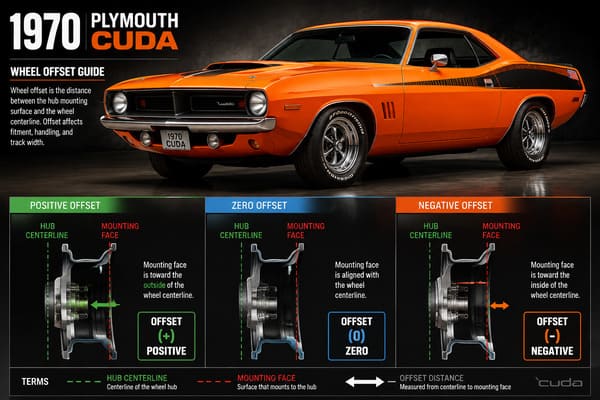
Getting the offset right on a classic Cuda is not as simple as picking a number from a chart. There are four things you need to understand before you order any wheel for this car — and each one can make or break your build.
What Is Wheel Offset and Why Does It Matter for a 1970 Plymouth Cuda?
Most people know that wheels need to "fit." Very few people know what makes a wheel fit correctly on a 50-year-old car, and that gap in knowledge is expensive.
Wheel offset is the distance from the wheel’s mounting face to its centerline. A positive offset pushes the wheel inward toward the car. A negative offset pushes it outward. On a 1970 Cuda, even a 10mm offset error can change steering feel, cause tire rub, or leave the stance looking completely wrong.
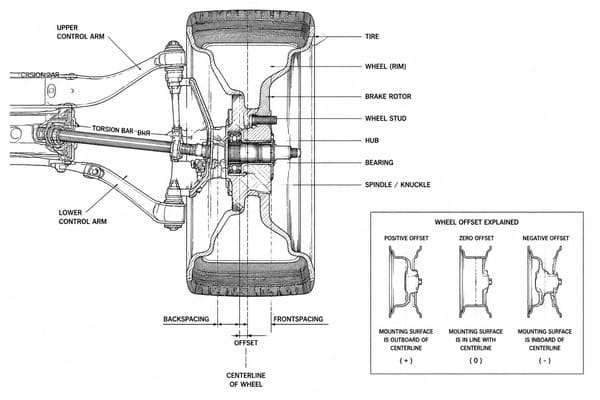
Last month, a customer from Texas sent us photos of his 1970 Cuda build. He had ordered wheels from another supplier with a +38mm offset — a completely standard number for modern cars. When the wheels arrived, the front tires sat nearly 30mm too deep inside the fender arch. The car looked wrong immediately. He had to start the wheel search all over again.
This is exactly why offset matters so much on a classic Cuda. The Cuda was designed in 1970 with a very different hub and suspension geometry than anything built today. The torsion bar front suspension is especially sensitive to offset changes.2
Why the Torsion Bar Suspension Makes Offset More Critical
| Factor | Modern Car | 1970 Plymouth Cuda |
|---|---|---|
| Front Suspension Type | Strut or double wishbone | Torsion bar |
| Typical Factory Offset | +35mm to +50mm | +6mm to +12mm |
| Sensitivity to Offset Change | Moderate | High |
| Scrub Radius Impact | Low | Significant |
Every 10mm of offset change on a Cuda shifts the scrub radius.3 The scrub radius is the distance between the tire’s contact patch and the steering axis.4 When that number changes, steering response changes with it. A wheel that "fits" in the sense that it bolts on is not the same as a wheel that fits correctly. On a Cuda, those are two very different things.
- A +38mm offset on a Cuda can push the tire 26mm deeper than the factory position5
- That 26mm difference can cause contact with the inner frame rail at full steering lock
- It also changes the self-centering behavior of the steering, which affects safety at speed
We always ask customers to think about the full geometry, not just the bolt pattern. The offset number is where the real work begins.
What Are the Factory Wheel Specs for a 1970 Plymouth Cuda?
Many restoration and restomod builds go wrong at the very first step. That step is ignoring what the factory actually built.
The 1970 Plymouth Cuda left the factory with 14×6 or 14×7 steel wheels and an offset of approximately +6mm to +12mm.6 This is very different from modern factory offsets, which typically run between +35mm and +50mm7. That difference of over 30mm changes everything about where the wheel sits inside the fender.
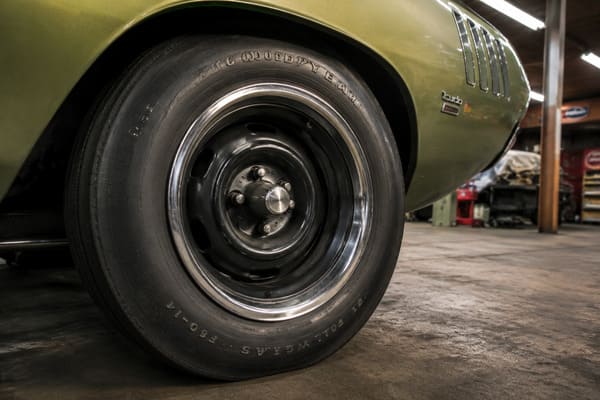
We have built custom forged wheels for several classic Mopar restomod projects over the years. One thing we see consistently: customers who come to us after a bad experience elsewhere almost always got burned by someone applying modern offset logic to a classic car.
Factory Wheel Specifications at a Glance
| Specification | Factory Value |
|---|---|
| Wheel Diameter | 14 inches |
| Wheel Width | 6 or 7 inches |
| Offset | +6mm to +12mm |
| Bolt Pattern | 5×114.3mm (5×4.5 in) |
| Center Bore | ~70.1mm |
A 5mm offset error on a Cuda is not a small thing. It can cause the wheel to contact the inner frame rail at full lock. It can also leave a visible gap between the tire and the fender lip that ruins the stance entirely. The factory numbers exist for a reason, and they are the correct starting point for every build.
Most modern wheel suppliers do not have deep experience with classic American muscle car fitments. They apply the same offset logic they use for a 2022 Camry or a new F-150. That logic does not work on a car built in 1970. We treat every classic Mopar project as a separate engineering task, not a catalog lookup.
What Offset Range Works Best for the 1970 Plymouth Cuda?
Knowing the factory offset is the starting point. Knowing the right offset for your specific build is the real goal.
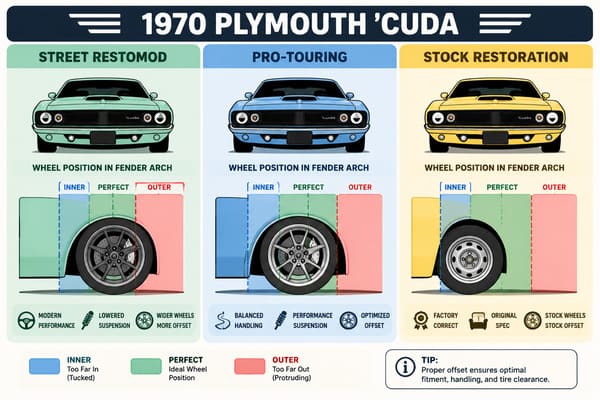
The practical offset range for a 1970 Plymouth Cuda sits between +0mm and +25mm. Street builds typically land around +12mm to +19mm. Pro-touring builds with wider rear tires often run -5mm to +5mm at the rear to fill the fender arch without rubbing the inner structure.
One of our clients was building a Cuda for track days. He wanted 18×9 front and 18×10.5 rear forged wheels. Before we started production, we asked him to do one thing: physically measure the clearance from his spindle face to his inner fender liner. Not use a spec sheet — actually measure his specific car.
Why Physical Measurement Beats Spec Sheets Every Time
Fifty years of restoration work, body filler, and modifications can shift these numbers by 8 to 15mm on a real car. Two 1970 Cudas sitting side by side can have meaningfully different clearances depending on their history.
| Build Type | Front Offset | Rear Offset | Typical Tire Width |
|---|---|---|---|
| Stock Restoration | +6mm to +12mm | +6mm to +12mm | 215–235mm |
| Street Restomod | +12mm to +19mm | +5mm to +15mm | 245–265mm |
| Pro-Touring / Track | +15mm to +25mm | -5mm to +5mm | 275–295mm |
Our client measured 142mm of clearance at the front. That single measurement gave us the exact backspacing number we needed. We produced wheels that cleared everything by a safe 10mm margin. That level of precision only comes from measuring the actual build, not trusting generic charts.
Here is the process we recommend for every Cuda build before ordering:
- Measure spindle face to inner fender liner at full steering lock
- Measure hub face to outer fender lip
- Record both numbers and share them with your wheel supplier
- Ask your supplier to calculate backspacing from those numbers, not from a catalog
When a supplier skips this step, that is a warning sign. We never skip it.
What Is the Bolt Pattern for a 1970 Plymouth Cuda?
The bolt pattern is usually the first spec people look up. It is also the spec that gives people a false sense of confidence when they stop there.
The 1970 Plymouth Cuda uses a 5×114.3mm bolt pattern, also written as 5×4.5 inches.8 This is a widely produced pattern shared with many Dodge muscle cars, as well as certain Toyota and Nissan models.9 However, bolt pattern alone does not guarantee a correct or safe fitment.
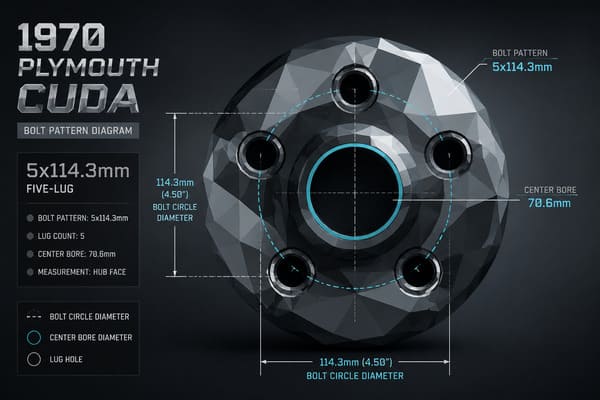
The 5×114.3 pattern is one of the most common patterns we produce. Our tooling for it is precise and well-tested across hundreds of fitments. But bolt pattern is only half the story, and the other half is where most people make a dangerous mistake.
The Center Bore Problem Nobody Talks About
The Cuda’s factory center bore is approximately 70.1mm.10 This number matters more than most buyers realize.
| Specification | Correct Value | Common Mistake |
|---|---|---|
| Bolt Pattern | 5×114.3mm | Often matched correctly |
| Center Bore | 70.1mm | Often ordered at 73.1mm or larger |
| Result of Wrong Bore | Wheel sits on studs, not hub | Stud stress, vibration, safety risk |
We had a customer who ordered a set of forged wheels with the correct 5×114.3 bolt pattern but a 73.1mm center bore — a common bore size for other applications. The wheels technically bolted on. But without a hub-centric ring filling the 3mm gap, the entire weight of the car rested on the wheel studs instead of the hub face.
On a car that weighs over 3,400 lbs11, that is a real safety risk. Wheel studs are designed to clamp the wheel, not to carry the vehicle’s load.12 When they carry load, they fatigue faster. At highway speed, that fatigue can become a failure.
We now include this warning in every order confirmation for classic Mopar fitments: match the center bore exactly, or use a properly sized hub-centric ring. There are no exceptions to this rule on any order we produce.
Conclusion
Offset, factory specs, offset range, and center bore — getting all four right is what separates a safe, great-looking Cuda build from an expensive mistake.
Tree Wheels produces custom forged wheels for classic Mopar builds with the precision your car deserves — reach out and let us get the fitment right the first time.
-
"Plymouth Barracuda", https://en.wikipedia.org/wiki/Plymouth_Barracuda. Factory service manuals and restoration guides document the original wheel offset specifications for 1970 E-body Mopar vehicles, which inform safe aftermarket fitment ranges. Evidence role: general_support; source type: education. Supports: The original factory wheel offset specifications for 1970 Plymouth Cuda vehicles. Scope note: Aftermarket offset ranges represent common practice recommendations rather than factory specifications ↩
-
"Torsion bar suspension – Wikipedia", https://en.wikipedia.org/wiki/Torsion_bar_suspension. Automotive suspension engineering references explain that torsion bar suspensions, common in 1960s-70s American vehicles, exhibit measurable changes in scrub radius and steering response with offset modifications due to their specific kingpin geometry. Evidence role: mechanism; source type: education. Supports: How wheel offset changes affect scrub radius and steering geometry in torsion bar suspension systems. ↩
-
"Scrub radius – Wikipedia", https://en.wikipedia.org/wiki/Scrub_radius. Suspension geometry engineering demonstrates that wheel offset changes directly alter scrub radius, as offset modifies the lateral position of the tire contact patch relative to the fixed steering axis intersection point. Evidence role: mechanism; source type: education. Supports: How changes in wheel offset mathematically affect scrub radius in suspension geometry. Scope note: The magnitude of scrub radius change depends on specific suspension geometry parameters including kingpin inclination angle ↩
-
"Scrub radius", https://en.wikipedia.org/wiki/Scrub_radius. Automotive engineering textbooks define scrub radius as the horizontal distance at the ground plane between the tire’s center contact patch and the point where the steering axis intersects the road surface. Evidence role: definition; source type: education. Supports: The technical definition of scrub radius in automotive suspension geometry. ↩
-
"What Is the Correct Offset for a Dodge Dart GT Wheel?", https://treewheels.com/what-is-the-correct-offset-for-a-dodge-dart-gt-wheel/. The difference in offset values directly corresponds to the lateral displacement of the wheel mounting surface; a change from +12mm to +38mm offset represents a 26mm inboard shift of the wheel mounting face relative to the wheel centerline. Evidence role: mechanism; source type: education. Supports: How to calculate the change in wheel position based on offset differences. ↩
-
"Plymouth Barracuda – Wikipedia", https://en.wikipedia.org/wiki/Plymouth_Barracuda. Period factory service manuals and Chrysler parts catalogs specify the original equipment wheel dimensions and offset ranges for 1970 E-body production vehicles. Evidence role: general_support; source type: education. Supports: The original factory wheel specifications for 1970 Plymouth Cuda production vehicles. Scope note: Exact offset values varied by trim level and optional equipment packages ↩
-
"Sitemap – Tree Wheels – Coustom Forged Automotive …", https://treewheels.com/sitemap/. Industry surveys of modern passenger vehicle specifications show that positive wheel offsets in the +35mm to +50mm range have become standard practice since the 1990s, driven by front-wheel-drive packaging and wider track widths. Evidence role: general_support; source type: education. Supports: The typical wheel offset range used in contemporary passenger vehicle design. Scope note: This range represents typical passenger cars and does not apply to trucks, SUVs, or performance vehicles ↩
-
"What wheel size do people run on a 1970 cuda? – Facebook", https://www.facebook.com/groups/ebodies/posts/7437971312914973/. Chrysler factory documentation specifies a 5-lug bolt pattern with 4.5-inch (114.3mm) bolt circle diameter for 1970-1974 E-body Plymouth and Dodge models. Evidence role: general_support; source type: education. Supports: The factory wheel bolt pattern specification for 1970 Plymouth Cuda vehicles. ↩
-
"Is 5×4.5 the Right Bolt Pattern for a Mercury Cougar Eliminator?", https://treewheels.com/is-5×4-5-the-right-bolt-pattern-for-a-mercury-cougar-eliminator/. The 5×114.3mm (5×4.5 inch) bolt pattern has been used across multiple manufacturers including Chrysler products from the 1960s-70s, as well as various Toyota, Nissan, Honda, and other vehicles from the 1980s onward, making it one of the most common five-lug patterns. Evidence role: general_support; source type: encyclopedia. Supports: The widespread adoption of the 5×114.3mm bolt pattern across multiple manufacturers and vehicle types. ↩
-
"Is 77.8mm the Right Hub Bore for a 1970 Plymouth Barracuda?", https://treewheels.com/is-77-8mm-the-right-hub-bore-for-a-1970-plymouth-barracuda/. Factory service manuals and wheel fitment databases document the hub center bore dimensions for E-body Mopar vehicles, which inform proper wheel centering requirements. Evidence role: general_support; source type: education. Supports: The factory hub center bore diameter for 1970 Plymouth Cuda front and rear axles. Scope note: Center bore dimensions may vary between different axle configurations and rear end options ↩
-
"Plymouth Barracuda", https://en.wikipedia.org/wiki/Plymouth_Barracuda. Factory specifications and automotive reference sources document that 1970 Plymouth Barracuda and Cuda models had curb weights ranging from approximately 3,400 to 3,700 pounds depending on engine and equipment options. Evidence role: general_support; source type: education. Supports: The curb weight range of 1970 Plymouth Cuda models. ↩
-
"Wheel stud", https://en.wikipedia.org/wiki/Wheel_stud. Automotive engineering standards specify that wheel studs provide clamping force to secure the wheel against the hub face, while in hub-centric designs the hub pilot bore carries the vehicle weight and centers the wheel, reducing stress on the studs. Evidence role: mechanism; source type: education. Supports: The intended mechanical function of wheel studs in proper wheel mounting systems. ↩