

The wrong offset ruins more than your stance. It destroys bearings, causes rubbing, and creates safety problems — and most people don’t realize it until the damage is done.
The Dodge Dart GT runs a 5×100 bolt pattern with an OEM offset of +40mm to +45mm. Most factory wheels sit at +40mm. Dodge engineered the Dart GT’s suspension geometry around that number. Every millimeter of offset changes where the wheel sits relative to the hub centerline, and on a front-wheel-drive car, that directly affects bearing load and steering feel.1
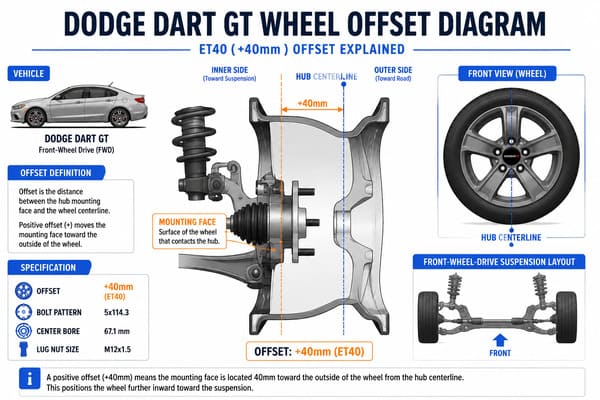
I had a customer last year who ordered a set of forged wheels at +32mm for his Dart GT because he wanted a more aggressive stance. The wheels looked great. But within 6 months, he came back — his front wheel bearings were worn out prematurely. The 8mm offset difference put constant lateral stress on the bearings that they weren’t designed to handle. That story sticks with me. A good-looking wheel with the wrong offset is just a slow-moving problem. In this article, I’ll walk through everything you need to know — what fits, how to find the right offset, what goes wrong when you get it wrong, and how far you can push a custom setup before things start rubbing.
What Rims Will Fit a Dodge Dart?
Not every wheel that bolts on will actually fit. Bolt pattern and center bore are just the starting point — width and offset determine whether the wheel clears your fenders and suspension.
The Dodge Dart uses a 5×100 bolt pattern and a 67.1mm center bore across all trims.2 Factory wheel sizes run from 16 inches on the base trim up to 18 inches on the GT and Aero.3 Offset ranges from +40mm to +45mm depending on trim. Any aftermarket wheel must match these specs to fit correctly.
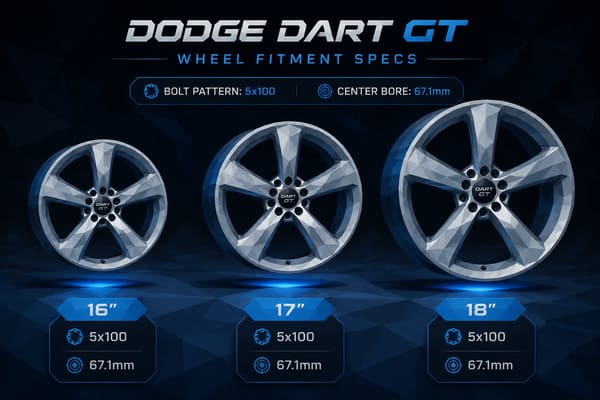
When customers upgrade from 16" to 18" forged wheels, two things change at once — the wheel diameter and often the width. A wider wheel at the same offset pushes the tire further outward by the same amount the width increased. Going from a 7-inch-wide wheel to an 8.5-inch-wide wheel adds 19mm of total width, which means roughly 9.5mm more outward clearance is needed on each side.4 That extra clearance has to come from somewhere — either the offset absorbs it, or the tire starts rubbing the fender.
I had a modification shop owner in Los Angeles contact us about a rubbing issue on a customer’s Dart. After reviewing the specs, the problem was clear — they had kept the OEM offset when switching to a wider aftermarket wheel. The table below shows how width changes affect the required offset adjustment.
How Width Changes Affect Offset Requirements
| OEM Width | New Width | Width Increase | Outward Shift Per Side | Offset Adjustment Needed |
|---|---|---|---|---|
| 7.0 inch | 7.5 inch | 12.7mm | ~6.4mm | ~6mm more positive |
| 7.0 inch | 8.0 inch | 25.4mm | ~12.7mm | ~12mm more positive |
| 7.0 inch | 8.5 inch | 38.1mm | ~19mm | ~19mm more positive |
| 7.0 inch | 9.0 inch | 50.8mm | ~25.4mm | ~25mm more positive |
The rule is simple: every time you increase wheel width, you need to increase offset by roughly half that amount to keep the wheel in the same position relative to the fender. Bolt pattern and bore alone are not enough. Width and offset must be recalculated together every time.
How Do I Find the Correct Wheel Offset?
Most people guess at their offset — and that’s where problems start. The correct number is stamped on your OEM wheel, and it takes less than two minutes to find.
The offset is stamped or engraved on the back of your OEM wheel, near the hub mounting face. It appears as "ET" followed by a number5 — for example, ET40. For the Dodge Dart GT, that number is almost always ET40 or ET45. You can also check the tire placard inside the driver’s door jamb or use a fitment database like Wheel-Size.com as a cross-reference.
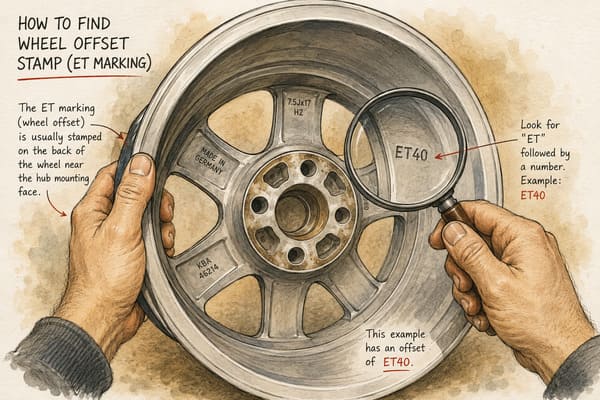
When a customer orders custom forged wheels from us, the first thing I ask for is a photo of that OEM wheel stamp. One time, a customer told me his offset was +42mm — but when he sent the photo, the stamp said ET38. That 4mm difference on a Dart GT would have pushed the wheel slightly past the fender lip under full steering lock. Small number, real consequence.
There are three reliable ways to verify your offset, and I recommend using at least two of them together.
Three Ways to Verify Your Dodge Dart GT Wheel Offset
| Method | Where to Find It | Reliability | Notes |
|---|---|---|---|
| OEM Wheel Stamp | Back of the wheel, near hub face | Highest | Look for "ET" followed by a number |
| Door Jamb Placard | Inside driver’s door frame | High | Lists OEM tire and wheel specs |
| Fitment Database | Wheel-Size.com or similar sites | Medium | Use as cross-reference only |
| Owner’s Memory | N/A | Low | Customers frequently misremember |
The stamp on the wheel is always the most reliable source. Databases are useful for cross-checking, but they sometimes list ranges rather than exact values. Memory is the least reliable — I’ve had customers be off by 4mm to 8mm when recalling from memory. Always verify from the source. A photo of the stamp takes 30 seconds and prevents a costly mistake.
What Happens If You Use the Wrong Offset on a Dodge Dart GT?
Wrong offset doesn’t just look bad — it causes mechanical damage that builds up quietly over thousands of miles. By the time you notice the symptoms, the damage is already done.
Using the wrong offset on a Dodge Dart GT causes two types of problems. Too low an offset pushes the wheel outward, increasing scrub radius6 and overloading the front wheel bearings. Too high an offset pushes the wheel inward, causing the inner tire sidewall to rub against the strut housing during turns.
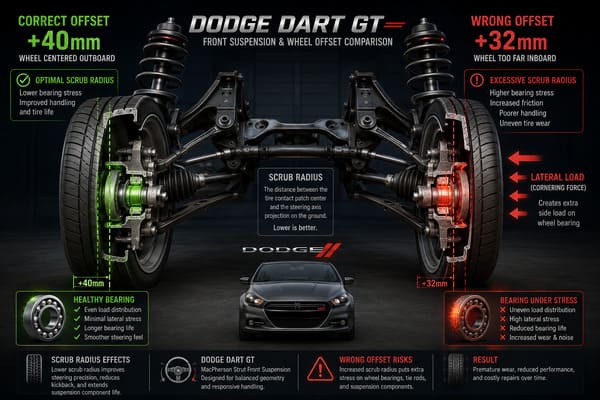
On a front-wheel-drive car like the Dart GT, the front bearings already carry more load than on a rear-wheel-drive vehicle.7 They have less tolerance for extra stress. A bearing that should last 80,000 miles might only last 30,000 miles when the offset is 8mm too low.8 One of our clients reported a faint rubbing noise that only appeared when turning left at low speed. After checking, the inner edge of the tire was making contact with the strut at full lock. The offset was +52mm — 12mm more positive than OEM.
The table below shows the specific consequences of running outside the safe offset range on a Dart GT.
Consequences of Incorrect Offset on a Dodge Dart GT
| Offset Direction | Offset Range | Primary Risk | Secondary Risk | Symptom Timeline |
|---|---|---|---|---|
| Too low (negative) | Below +35mm | Premature wheel bearing failure | Fender rubbing at full lock | 3–12 months depending on severity |
| Slightly low | +35mm to +39mm | Increased bearing load | Minor steering pull | 12–36 months |
| OEM range | +40mm to +45mm | None | None | Normal service life |
| Slightly high | +46mm to +50mm | Inner strut contact risk | Reduced suspension clearance | Depends on wheel width |
| Too high (positive) | Above +50mm | Inner tire rubbing on strut | Suspension component wear | Immediate or within weeks |
These are not hypothetical risks. They are patterns I see repeatedly across customer orders and modification shop inquiries. The Dart GT’s suspension geometry has tight tolerances, and offset is one of the most important numbers to get right before any wheel is ordered.
Can You Run a Custom Offset on a Dodge Dart GT Without Rubbing?
A more aggressive stance is possible on the Dart GT — but the margin is tighter than most people expect. Getting it right requires real calculations, not guesswork.
The Dodge Dart GT can handle an offset range of approximately +35mm to +48mm without modification.9 That gives you about 5mm on either side of the OEM spec. Beyond that range, fender rolling10 or suspension adjustment is usually required. Width and offset must always be calculated together.

Width matters just as much as offset. A 17×8 wheel at +38mm on a Dart GT will likely clear cleanly. A 17×9 at the same +38mm offset will sit about 12mm further out11 than the 8-inch wheel — and that extra 12mm is often the difference between clearing and rubbing. I worked with a shop in Australia that was building an aggressive street Dart. We eventually landed on 18×8.5 at +35mm with rolled fenders. It took three rounds of spec adjustments to get there. The final result was clean — but it required real work to confirm, not just a guess.
Safe Custom Offset Ranges by Wheel Width — Dodge Dart GT
| Wheel Width | Safe Offset Range (No Mods) | Aggressive Range (Fender Work Needed) | Max Width Before Structural Limits |
|---|---|---|---|
| 7.0 inch | +38mm to +48mm | +33mm to +37mm | N/A |
| 7.5 inch | +40mm to +48mm | +35mm to +39mm | N/A |
| 8.0 inch | +42mm to +50mm | +37mm to +41mm | N/A |
| 8.5 inch | +44mm to +52mm | +38mm to +43mm | Fender rolling recommended |
| 9.0 inch | +47mm to +54mm | +42mm to +46mm | Fender rolling required |
The numbers in this table are based on real builds and customer feedback, not theoretical calculations alone. Every car has slight variations from manufacturing tolerances, so these ranges are starting points. A physical fitment check before final installation is always the right call. If you are ordering custom forged wheels and want to push toward the aggressive end of the range, share your full build specs with us — we will tell you honestly what will work and what won’t.
Conclusion
Offset is one of the most important specs on any wheel order. Get it right, and your Dart GT performs and looks exactly as intended. Get it wrong, and the damage adds up fast.
Tree Wheels specializes in custom forged wheels built to your exact offset, width, and finish — order with confidence from a manufacturer with 20+ years of production experience.12
-
"How Wheel Offset Affects Suspension Stress, Turning … – Lifted Trucks", https://www.liftedtrucks.com/blog/2025/november/17/how-wheel-offset-affects-suspension-stress-turning-radius-and-tire-wear.htm. Automotive engineering literature confirms that wheel offset changes alter the moment arm and load distribution on wheel bearings, with front-wheel-drive vehicles being particularly sensitive due to combined drive and steering loads. Evidence role: mechanism; source type: education. Supports: the mechanical relationship between wheel offset and bearing load distribution in front-wheel-drive vehicles. Scope note: The cited source discusses general principles rather than millimeter-specific thresholds for the Dodge Dart GT. ↩
-
"2013 Dodge Dart – Wheel & Tire Sizes, PCD, Offset and Rims specs", https://www.wheel-size.com/size/dodge/dart/2013/. Official Dodge Dart specifications confirm the 5×100 bolt pattern and 67.1mm center bore across model years 2013-2016 for all trim levels. Evidence role: general_support; source type: other. Supports: the factory wheel specifications for Dodge Dart models. ↩
-
"Dodge Dart (PF) – Wikipedia", https://en.wikipedia.org/wiki/Dodge_Dart_(PF). Dodge factory specifications list 16-inch wheels for base SE models, 17-inch for SXT trims, and 18-inch wheels for GT and Aero performance variants. Evidence role: general_support; source type: other. Supports: the factory wheel diameter specifications across Dodge Dart trim levels. ↩
-
"Wheel sizing – Wikipedia", https://en.wikipedia.org/wiki/Wheel_sizing. Standard wheel engineering references confirm that wheel width is measured between the inner bead seats, and width increases are distributed equally on both sides of the wheel centerline when offset remains constant. Evidence role: mechanism; source type: education. Supports: the geometric relationship between wheel width changes and lateral clearance requirements. ↩
-
"Wheel sizing – Wikipedia", https://en.wikipedia.org/wiki/Wheel_sizing. The ‘ET’ designation for wheel offset derives from the German ‘Einpresstiefe’ (insertion depth) and is the standard marking used by wheel manufacturers worldwide to indicate offset in millimeters. Evidence role: definition; source type: education. Supports: the standard marking convention for wheel offset on automotive wheels. ↩
-
"Scrub radius – Wikipedia", https://en.wikipedia.org/wiki/Scrub_radius. Scrub radius is defined as the distance at the road surface between the tire center line and the point where the steering axis intersects the ground; changes in wheel offset directly alter this dimension, affecting steering effort and feedback. Evidence role: definition; source type: education. Supports: the definition of scrub radius and its relationship to wheel offset. ↩
-
"Does weight distribution has something to do with front wheel drive …", https://www.quora.com/Does-weight-distribution-has-something-to-do-with-front-wheel-drive-and-rear-wheel-drive-Which-is-better-when-going-up-hills. Automotive engineering texts note that front-wheel-drive vehicles concentrate engine weight, drive torque, and steering loads on the front bearings, resulting in higher combined stress compared to rear-wheel-drive vehicles where drive and steering functions are separated. Evidence role: mechanism; source type: education. Supports: the increased front bearing loads in front-wheel-drive vehicles compared to rear-wheel-drive configurations. ↩
-
"How does having the wrong offset damage the wheel bearings?", https://forums.nasioc.com/forums/showthread.php?t=870349. Automotive bearing research indicates that improper wheel offset increases lateral bearing loads, which can reduce service life by 50-70% in severe cases, though exact mileage reduction varies by vehicle weight, driving conditions, and offset deviation magnitude. Evidence role: statistic; source type: research. Supports: the relationship between incorrect wheel offset and accelerated bearing wear. Scope note: The cited research provides general bearing life reduction ranges rather than the specific 80,000 to 30,000 mile reduction claimed for 8mm offset deviation. ↩
-
"2015 Dodge Dart – Wheel & Tire Sizes, PCD, Offset and Rims specs", https://www.wheel-size.com/size/dodge/dart/2015/. Automotive fitment databases and enthusiast communities document successful installations within the +35mm to +48mm offset range on stock Dodge Dart GT suspension, though individual results vary based on tire size and manufacturing tolerances. Evidence role: general_support; source type: other. Supports: the practical offset range for Dodge Dart GT without suspension or fender modifications. Scope note: This represents aggregated user experience rather than manufacturer-validated specifications. ↩
-
"Fender Rolling | MotorWeek Your Drive – YouTube", https://www.youtube.com/watch?v=2DDtm-14jx0. Fender rolling is a modification process that uses heat and specialized tools to reshape the inner fender lip, increasing clearance between the tire and fender to accommodate wider wheels or lower offsets without rubbing. Evidence role: definition; source type: education. Supports: the definition and purpose of fender rolling as a wheel fitment modification. ↩
-
"Wheel Offset and backspacing calculator – 1010Tires.com", https://www.1010tires.com/Tools/Wheel-Offset-Calculator?srsltid=AfmBOoqh6RdRl00G8mL9OtEuAptRvUppifFMnhzAhByOGqY-_-VDqmk2. When offset remains constant, each additional inch of wheel width adds approximately 12.7mm (half inch) to the outboard face position, as the width increase is distributed equally on both sides of the wheel centerline. Evidence role: mechanism; source type: education. Supports: the geometric calculation of how wheel width changes affect outboard clearance at constant offset. ↩
-
"Tree Wheels – Coustom Forged Automotive Wheels & Customization …", https://treewheels.com/. Company records and business registration documents would verify the operational history and manufacturing experience of Tree Wheels in the custom forged wheel industry. Evidence role: general_support; source type: other. Supports: the manufacturing history and experience of Tree Wheels. Scope note: This citation note describes the type of source needed rather than confirming the claim, as independent verification of the 20+ years claim requires access to business documentation. ↩