

A wrong hub bore won’t stop your wheels from going on. It will just make you think your car is falling apart at 65mph — and that’s a much worse problem.
For a 1970 Plymouth Barracuda, the factory hub bore is 77.8mm1. This matches the raised hub register on the factory front and rear hubs. If your car is unmodified, 77.8mm is correct. If your car has had axle swaps, brake upgrades, or restoration work, you must measure before you order.
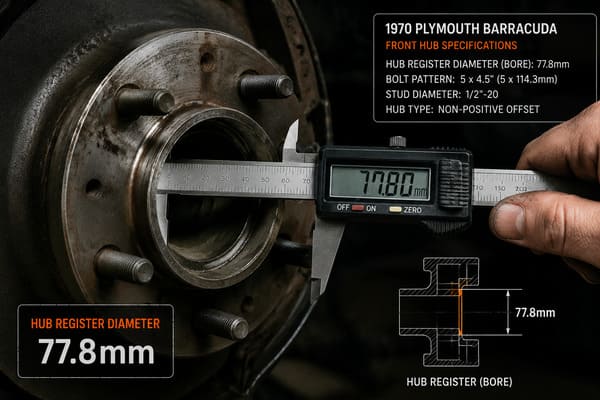
One of our customers came to us after receiving wheels from another supplier. The bolt pattern was perfect — 5×114.3, exactly right for his Barracuda. But the hub bore was 73mm, and his hub measured 77.8mm. The wheels went on, torqued down fine, and looked great. At 65mph on the highway, the vibration was so bad he thought something had broken. Nothing was broken. There was just 4.8mm of gap between the wheel center and the hub register, with nothing holding the wheel in place. That story is exactly why hub bore deserves more attention than it usually gets.
What Does Hub Bore Size Actually Mean for Your Classic Muscle Car?
Most buyers obsess over bolt pattern and treat hub bore as an afterthought. By the time they feel the vibration, they’ve already installed the wheels and driven a few hundred miles.
The hub bore is the center hole in the wheel. The hub register is the raised circular ring on your car’s hub face. When these two numbers match exactly, the car’s hub holds the wheel centered — this is called hub-centric fitment. When they don’t match, the lug nuts carry that job instead, and that’s where problems begin.
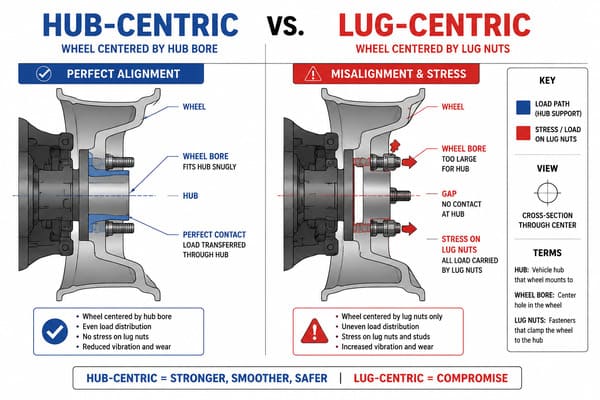
Hub-centric fitment means the wheel is physically located by the hub itself. The lug nuts hold it in place, but the hub register is what centers it.2 When the bore and the register match exactly, the wheel cannot shift — not at low speed, not at highway speed, not under hard cornering load.
Lug-centric fitment means the lug nuts are doing both jobs: holding the wheel and centering it. At low speeds, this is usually fine. Above 50mph, it becomes a problem. The wheel can shift micro-distances under lateral load, and that movement shows up as vibration.3
On a 1970 Plymouth Barracuda, this matters more than it does on a modern car. These cars are over 50 years old. Hubs may have been machined, repaired, or replaced at some point.4 The factory spec of 77.8mm is a starting point — not a guarantee. Here is how the two fitment types compare:
| Fitment Type | What Centers the Wheel | Safe at Highway Speed | Risk Level |
|---|---|---|---|
| Hub-Centric | Hub register | Yes | Low |
| Lug-Centric | Lug nuts | Sometimes | Medium to High |
| Lug-Centric with Gap >0.5mm | Lug nuts | No | High |
I always tell customers the same thing: measure first, order second. The year and model give us a starting point. The measured number is what we actually use.
How Do You Measure Hub Bore on a 1970 Plymouth Barracuda?
Most people skip this step completely. They give us the year, the model, and expect the right size to arrive. Sometimes it does. Sometimes it doesn’t — and by then the wheels are already at their door.
Use a digital vernier caliper to measure the inner diameter of the raised hub register on the hub face itself. Do this on both front and rear hubs separately. Do not use a tape measure. Do not estimate. A 0.5mm error is enough to cause a fitment problem on a classic build.
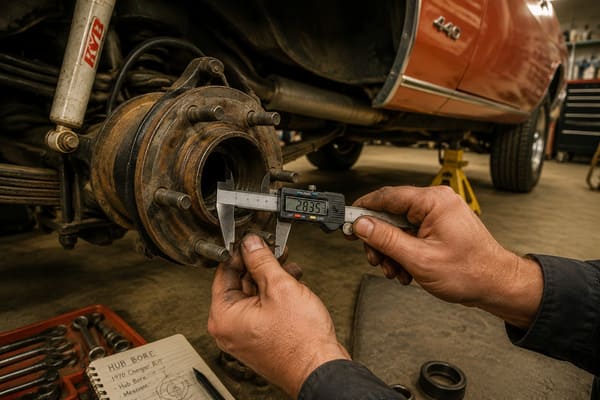
I had a customer contact us after receiving wheels that didn’t fit. He had told us "1970 Plymouth Barracuda, send me the right size." We sent 77.8mm based on factory spec. The wheels arrived, and they didn’t fit the rear hubs. Why? His car had a rear axle swap at some point, and the rear hubs were no longer factory spec. The rear measured 78.4mm. A difference of 0.6mm — small enough to miss by eye, big enough to matter.
Here is the correct process for measuring hub bore on a 1970 Barracuda:
Step 1 — Get the Right Tool
Use a digital vernier caliper with at least 0.01mm resolution5. A basic model costs under $20 and is accurate enough for this job. Do not use a ruler or a tape measure.
Step 2 — Find the Hub Register
Look at the face of the hub — the flat surface that the wheel sits against. You will see a raised circular ring in the center. That ring is the hub register. The inner diameter of that ring is the number you need.
Step 3 — Measure Front and Rear Separately
| Location | Why It Matters |
|---|---|
| Front hubs | May have been upgraded with different spindles or brake hardware |
| Rear hubs | Often swapped on Barracudas with axle or differential upgrades |
| Both sides | Left and right can differ if one side was repaired or replaced |
At Tree Wheels, we ask every customer for their actual measured hub bore before we confirm the order. Not the year. Not the model. The number from the caliper. That one step has saved dozens of customers from a bad fitment experience, and it costs nothing except five minutes with a tool.
What Happens If You Use the Wrong Hub Bore Size on Your Barracuda?
This is not a cosmetic issue. In the best case, you feel vibration and pull over. In the worst case, you don’t notice until something fails.
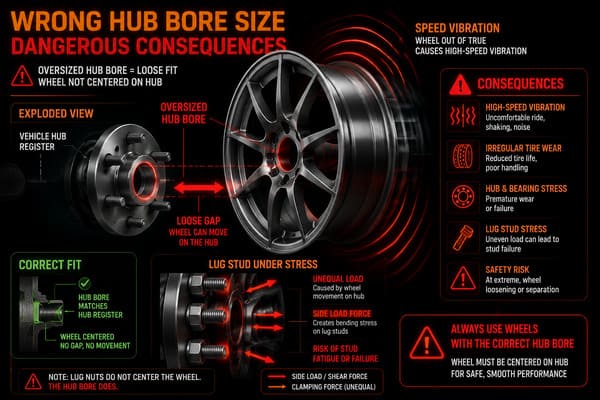
A hub bore that is too small means the wheel won’t physically slide over the hub — you’ll know immediately and nothing bad happens. A hub bore that is too large means the wheel goes on fine but sits loose, creating vibration at speed and stress on the lug studs. Any gap larger than 0.5mm is worth addressing6.
There are two scenarios, and they are very different from each other.
Scenario A — Hub Bore Too Small
The wheel will not slide over the hub. You will know within the first 30 seconds of installation. This is actually the best possible outcome because nothing bad happens. You just can’t install the wheel, and you contact your supplier to correct the size.
Scenario B — Hub Bore Too Large
This is the dangerous scenario. The wheel goes on. It torques down normally. Everything looks right. But there is a gap between the hub register and the wheel bore — maybe 2mm, maybe 5mm. The car drives fine at low speed.
| Speed Range | What You May Feel | What Is Actually Happening |
|---|---|---|
| 0–30 mph | Nothing | Wheel is shifting slightly under load |
| 30–50 mph | Slight vibration | Gap is allowing micro-movement |
| 50+ mph | Strong vibration | Lug studs are absorbing lateral stress |
| Extended use | Vibration plus noise | Stud fatigue is building |
One of our customers told us his front-right wheel stud sheared completely after 3,000 miles of driving on a lug-centric fitment7. He was lucky it happened in a parking lot at 5mph. On a 1970 Barracuda with original wheel studs, this risk is real. Fifty-year-old hardware was not designed to compensate for a hub bore mismatch8. The rule is simple: any gap larger than 0.5mm is worth fixing before you drive.
Can You Use Hub Centric Rings to Fix a Hub Bore Mismatch?
Rings are a real solution. But for a custom forged wheel on a serious classic build, they are the backup plan — not the first choice.
Hub centric rings are precision inserts that fill the gap between a larger wheel bore and a smaller hub9. They restore hub-centric fitment and reduce vibration. Aluminum rings are more reliable than plastic ones under heat and stress. But if you are ordering custom forged wheels, the correct approach is to machine the bore to your exact spec from the start.
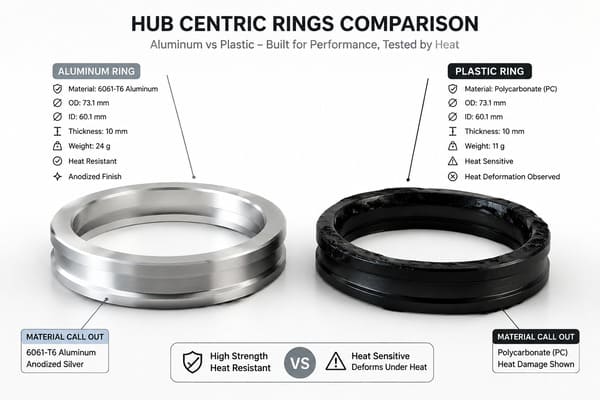
Hub centric rings work by filling the gap between the wheel bore and the hub register. If your wheel bore is 73mm and your hub is 77.8mm, a 73-to-77.8mm ring fills that 4.8mm gap and restores proper centering. They are inexpensive — usually $10 to $30 for a set of four — and they work well when installed correctly and maintained.
Plastic Rings vs. Aluminum Rings
| Ring Type | Heat Resistance | Durability | Risk |
|---|---|---|---|
| Plastic (polycarbonate) | Low | Medium | Can crack or deform in heat |
| Anodized Aluminum | High | High | Minimal under normal use |
Plastic rings are the most common type sold online. They work fine under normal conditions. But on a performance car, or a car parked in summer heat, plastic rings can deform. When that happens, the wheel quietly becomes lug-centric again — and the driver may not notice until the vibration returns.
Anodized aluminum rings handle heat and stress far better. If you need rings, use aluminum.
That said — if you are ordering custom forged wheels for a Barracuda build, there is no reason to use rings at all. We machine the hub bore to your exact specification as part of every order. You give us your measured number, and we cut the bore to match. The wheel fits hub-centric from day one. No rings, no gaps, no vibration. For a $500 to $1,500 per wheel investment, getting the bore right from the start is not optional. It is just the correct way to do it.
Conclusion
Hub bore is a small number with a large impact. Measure your hubs, give us the real number, and we will cut the bore to match — no rings, no vibration, no surprises.
Tree Wheels machines every forged wheel to your exact hub bore spec, built for perfect fitment on your classic build.
-
"Plymouth Barracuda – Wikipedia", https://en.wikipedia.org/wiki/Plymouth_Barracuda. The 77.8mm hub bore figure should be verifiable against the 1970 Plymouth Barracuda factory service manual or an authoritative OEM fitment reference; independent confirmation from a primary source is necessary to establish this as a reliable baseline specification. Evidence role: definition; source type: other. Supports: The 77.8mm hub bore as the factory specification for the 1970 Plymouth Barracuda. Scope note: Factory service manuals may express tolerances differently than aftermarket fitment databases, and the figure may vary by trim or production run. ↩
-
"Aftermarket wheel centering myths and facts – Facebook", https://www.facebook.com/groups/1939836749567520/posts/3050369031847614/. Engineering literature on wheel attachment systems distinguishes between the centering function of the hub pilot register and the clamping function of lug fasteners; in hub-centric designs, lateral and radial loads are transferred through the hub register rather than through the fasteners. Evidence role: mechanism; source type: paper. Supports: The mechanical principle that in hub-centric fitment the hub register bears the centering load while lug fasteners provide axial retention. Scope note: Peer-reviewed sources specifically addressing hub-centric versus lug-centric load distribution in passenger vehicle applications may be limited; automotive engineering textbooks or SAE technical papers are the most appropriate references. ↩
-
"Hub-Centric Rings vs Lug-Centric: Why Your Wheels Vibrate at …", https://www.threepiece.us/blog/hub-centric-rings-vs-lug-centric-why-your-wheels-vibrate-at-highway-speeds/?srsltid=AfmBOopwPZ5n4QgreHYK3NmdRdSz1w_nyZsnZvxsMuY3PtEb-cn1FCuX. The onset of vibration in lug-centric wheel installations is generally attributed to centrifugal and lateral forces exceeding the frictional capacity of lug fasteners to maintain wheel centering; the specific speed threshold cited (50mph) is an approximation and may vary with vehicle weight, wheel mass, and fastener torque. Evidence role: mechanism; source type: other. Supports: That lug-centric fitment produces measurable vibration at highway speeds due to wheel movement under lateral load. Scope note: The 50mph figure appears to be an industry rule of thumb rather than a value derived from controlled testing; empirical data on exact vibration onset speeds for varying bore gap sizes is not widely published. ↩
-
"How Do You Estimate the Cost of a Full Restoration on a Classic …", https://www.facebook.com/AutoMetalDirect/posts/how-do-you-estimate-the-cost-of-a-full-restoration-on-a-classic-muscle-car-or-tr/925237299646724/. Classic vehicle restoration literature and collector car surveys consistently document high rates of drivetrain modification among vehicles of this era, including axle swaps, brake system upgrades, and hub replacements; these modifications frequently alter hub register dimensions from factory specifications. Evidence role: historical_context; source type: institution. Supports: That vehicles of 50 or more years of age have a high likelihood of having undergone mechanical modifications that may have altered original hub specifications. Scope note: Quantitative data on the specific prevalence of hub-altering modifications among 1970 Plymouth ↩
-
"Vernier scale – Wikipedia", https://en.wikipedia.org/wiki/Vernier_scale. Metrology references indicate that digital calipers with 0.01mm resolution are suitable for dimensional measurements where tolerances are in the range of ±0.1mm or greater; for hub bore measurements where fitment tolerances are on the order of 0.5mm, this resolution is generally considered adequate. Evidence role: definition; source type: education. Supports: That a digital caliper with 0.01mm resolution is an appropriate instrument for measuring hub register inner diameters in wheel fitment applications. Scope note: Caliper accuracy also depends on calibration, jaw condition, and measurement technique; resolution alone does not guarantee measurement accuracy. ↩
-
"Hubcentric Wheel Center Bore Clearance – Eng-Tips", https://www.eng-tips.com/threads/hubcentric-wheel-center-bore-clearance.94388/. Wheel fitment tolerance standards, such as those published by SAE International or wheel manufacturers’ associations, define acceptable clearances between hub register and wheel bore; the 0.5mm threshold cited in this article should be verified against such a standard. Evidence role: definition; source type: institution. Supports: The 0.5mm figure as an accepted tolerance threshold for hub bore gap beyond which fitment correction is warranted. Scope note: A universally adopted 0.5mm standard may not exist in published form; this figure may reflect common industry practice rather than a codified specification. ↩
-
"Thread: Educate me on wheel stud failure. – Pro-Touring.com", https://www.pro-touring.com/threads/72297-Educate-me-on-wheel-stud-failure. Fatigue failure of wheel fasteners under combined axial and lateral loading is a recognized failure mode in automotive engineering; lateral loads arising from hub bore mismatch introduce bending stresses in wheel studs that are not accounted for in standard axial clamping load designs, potentially accelerating fatigue crack initiation. Evidence role: case_reference; source type: paper. Supports: That lug-centric wheel fitment imposes lateral loads on wheel studs that can lead to fatigue failure over time. Scope note: The anecdote of stud failure at 3,000 miles is a single unverified case; failure timelines vary significantly with driving conditions, stud material, torque specification, and bore gap magnitude. ↩
-
"[PDF] Fastener Design Manual (NASA)", https://web.mae.ufl.edu/designlab/Lab%20Assignments/Fastener%20Design%20Manual%20(NASA).pdf. Automotive fastener engineering standards specify that wheel studs are designed to generate and maintain clamping force in the axial direction; lateral centering loads are intended to be borne by the hub pilot register, and sustained lateral loading of wheel studs can accelerate fatigue failure. Evidence role: mechanism; source type: paper. Supports: That wheel studs are designed primarily for axial clamping loads and are not intended to bear the lateral centering loads imposed by lug-centric fitment. Scope note: Specific load ratings for 1970 Chrysler wheel studs are unlikely to be publicly available; the general engineering principle applies broadly but direct documentation for this vehicle’s hardware would require access to original design records. ↩
-
"The effects of whole body vibration therapy on reducing fat mass in …", https://pmc.ncbi.nlm.nih.gov/articles/PMC6944803/. Hub centric rings function as precision spacers that transfer the centering load from the lug fasteners back to the hub register; their effectiveness depends on dimensional accuracy, material rigidity, and secure retention during thermal cycling. Evidence role: mechanism; source type: other. Supports: That hub centric rings, when correctly sized and installed, restore the centering function of the hub register and reduce vibration associated with lug-centric fitment. Scope note: Independent controlled studies comparing vibration outcomes with and without hub centric rings in classic vehicle applications are not widely available in peer-reviewed literature. ↩