
The Evo 5 shakes at highway speed. You’ve balanced the tires three times. You’ve spent $300 and the problem is still there. The real cause might be a number you’ve never checked.
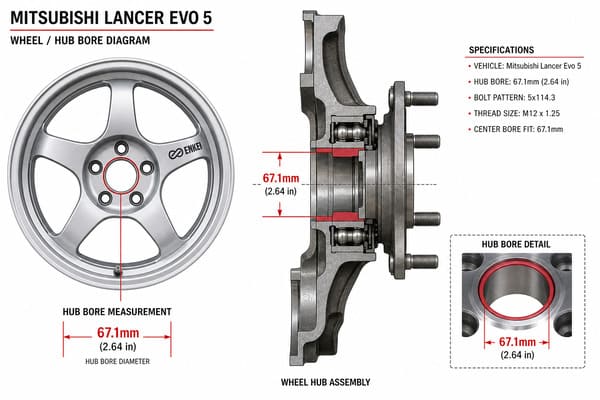
The Mitsubishi Lancer Evo 5 requires a hub bore of exactly 67.1mm1. This is a hub-centric vehicle, meaning the wheel must sit flush on the hub to carry the car’s weight correctly2. Any aftermarket wheel with a bore larger than 67.1mm will create a gap that causes vibration, bolt stress, and long-term safety risks.
The hub bore is one of the most overlooked numbers in wheel fitment. Most buyers focus on size and looks. But getting this one number wrong can turn a great-looking set of wheels into a dangerous one. In this article, I’ll walk through everything you need to know — the specs, the risks, and what to do about it.
What Is Hub Bore and Why Does It Matter for Your Evo 5?
Last month, a customer sent me a photo of his Evo 5 shaking violently at 120km/h. He had already replaced his tires twice and paid for three wheel balancing sessions. Total wasted money: around $300.
The hub bore is the center hole of a wheel. On the Evo 5, this hole must measure exactly 67.1mm to match the hub on the car. When the bore matches the hub, the hub carries the car’s weight. When it doesn’t match, the lug bolts carry the weight instead — and they were never designed to do that.
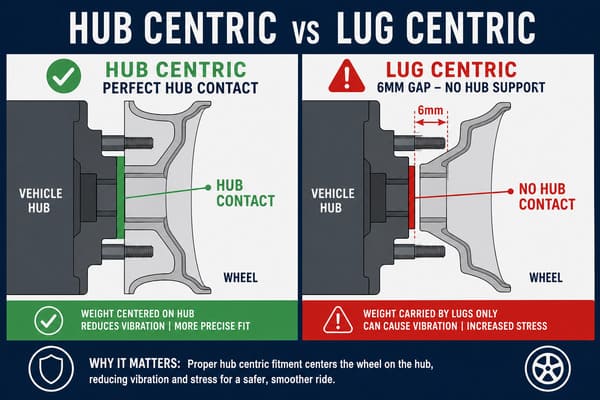
His aftermarket wheels had a 73.1mm bore on a 67.1mm hub. That’s a 6mm gap. No amount of balancing can fix a 6mm gap. The wheel was not sitting on the hub — it was floating around it, held in place only by the bolts.
Mitsubishi designed the Evo 5 as a hub-centric vehicle. This means the hub shoulder is what locates the wheel. The bolts hold the wheel against the hub. They are not meant to center it. This is a critical distinction that most people don’t think about until something goes wrong.
Why Precision Matters in Hub Bore Machining
At TreeWheels, we machine every bore to a tolerance of ±0.1mm. For a 67.1mm spec, that means we hold between 67.0mm and 67.2mm. To put that in perspective, a human hair is roughly 0.07mm wide3. Our tolerance is tighter than that.
| Bore Size | Fit Type | Result |
|---|---|---|
| 67.1mm | Hub-centric | Wheel sits on hub, smooth and safe |
| 73.1mm (no ring) | Lug-centric | 6mm gap, vibration, bolt stress |
| 73.1mm + hub ring | Semi hub-centric | Acceptable for low-speed use only |
| 67.0–67.2mm (±0.1mm) | Precision hub-centric | Optimal fitment, no compromise |
This level of precision is not perfectionism. It is the difference between a smooth ride and a dangerous one. A bore that is off by even 1–2mm will allow the wheel to shift slightly under lateral load. On a car like the Evo 5, which was built for aggressive driving, that shift is not acceptable.
What Are the Full Wheel Specs of the Mitsubishi Lancer Evo 5?
I get incomplete spec requests almost every week. Someone will message us: "I need wheels for my Evo 5, 18 inch, thanks." That’s like asking a tailor to make a suit and only telling them the jacket length.
The Mitsubishi Lancer Evo 5 has five key wheel specifications: a 67.1mm hub bore, a 5×114.3 bolt pattern, a stock size of 17×7.5J, an offset range of ET38 to ET45, and an M12×1.5 thread size. All five numbers must be correct at the same time for a wheel to fit safely.
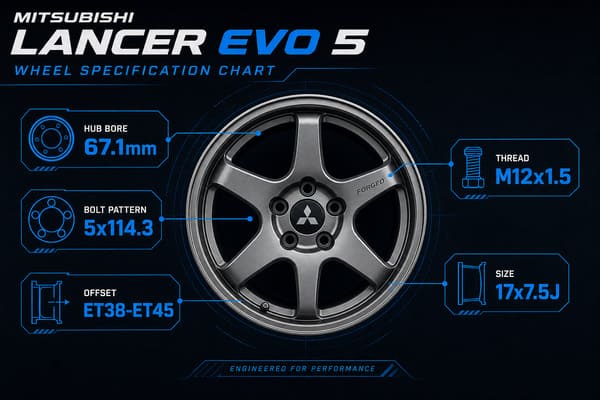
Miss one of these and the wheel either won’t fit, will rub the fender, will stress the studs, or will sit off-center. I once had a customer who ordered 18×9.5J wheels for his Evo 5 but forgot to mention he wanted a wider stance. We built them at ET38 — the stock offset — and they sat too far inward. He wanted ET25 for that flush look. We had to remake the wheels. Two weeks and extra cost, completely avoidable.
Breaking Down Each Spec
Here is what each number means and why it matters:
| Spec | Value | What It Controls |
|---|---|---|
| Hub Bore | 67.1mm | Centers the wheel on the hub |
| Bolt Pattern | 5×114.3 | Number of bolts and circle diameter |
| Stock Wheel Size | 17×7.5J | Diameter and width of the wheel |
| Offset | ET38–ET45 | How far the wheel sits in or out of the arch |
| Thread Size | M12×1.5 | Bolt thread pitch for lug bolts |
Hub Bore (67.1mm): This centers the wheel. It is the most safety-critical dimension.
Bolt Pattern (5×114.3): Five bolts on a 114.3mm circle. This is a common Japanese fitment, shared with many Nissan and Toyota models.
Stock Size (17×7.5J): Most Evo 5 owners upgrade to 18-inch wheels. Common aftermarket sizes are 18×8.5J or 18×9.5J depending on the build goal.
Offset (ET38–ET45): Lower offset pushes the wheel outward. Higher offset pulls it inward. If you want a flush or aggressive stance, you need to specify this clearly before we start machining.
Thread Size (M12×1.5): This is the thread pitch on the lug bolts. Using the wrong lug nuts — even ones that look right — can cause cross-threading or improper seating.
All five specs need to be on the table from day one. When a customer gives us all five numbers upfront, we can produce wheels that fit perfectly on the first try.
Will Aftermarket Wheels Fit the Evo 5 Without a Hub Ring?
Here is something most wheel sellers won’t tell you directly. A large portion of aftermarket wheels on the market — especially cheaper cast options — are made with a 73.1mm universal bore4.
Most universal aftermarket wheels use a 73.1mm bore, which is 6mm larger than the Evo 5’s 67.1mm hub. A hub ring can fill this gap, but it is only a reliable solution for low-speed, light-use driving. For performance use, a wheel bored precisely to 67.1mm is the correct and safe choice.
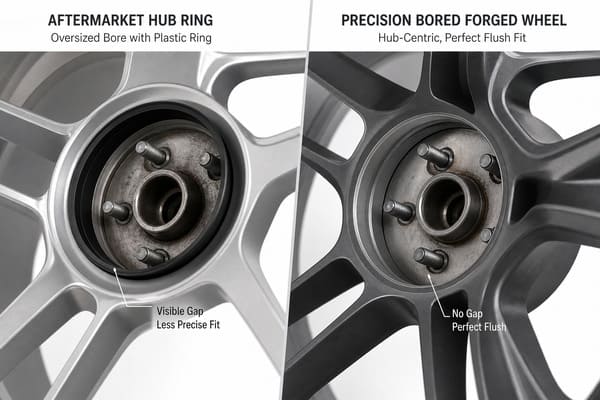
Why 73.1mm? Because it fits Toyota, Nissan, Mitsubishi, and several other Japanese cars without re-machining the center. It is a cost-saving shortcut on the manufacturer’s side. One bore size, many customers. For the manufacturer, that makes sense. For the Evo 5 owner, it creates a problem.
Hub Ring: When It Works and When It Doesn’t
A hub ring is a plastic or aluminium collar that fills the gap between a universal bore and the car’s hub. A set costs around $5–$15.5 It is a widely used solution and it works — under the right conditions.
| Use Case | Hub Ring Acceptable? | Reason |
|---|---|---|
| City driving, under 80km/h | Yes | Low load, low vibration risk |
| Highway driving, 100–140km/h | Marginal | Vibration risk increases |
| Track use, aggressive cornering | No | Lateral load can dislodge or crack the ring |
| Rally-style or performance driving | No | Too much risk, no margin for error |
The Evo 5 is not a city car. Evo owners push their cars6. At 180km/h on a track day, a plastic hub ring under lateral load is not something I would put my name behind7. Aluminium rings are better, but the principle is the same — you are relying on a $10 part to do the job that precision machining should have done.
When we produce forged wheels at TreeWheels for Evo 5 orders, we bore them to exactly 67.1mm. No hub ring needed. No gap. The wheel sits exactly where Mitsubishi intended it to sit. This is not a premium add-on. It is the standard we hold for every order.
What Happens If You Use the Wrong Hub Bore Size?
The most common outcome is vibration — and it usually starts subtle. You feel a faint buzz in the steering wheel above 100km/h. Most people blame the tires and book a rebalance.
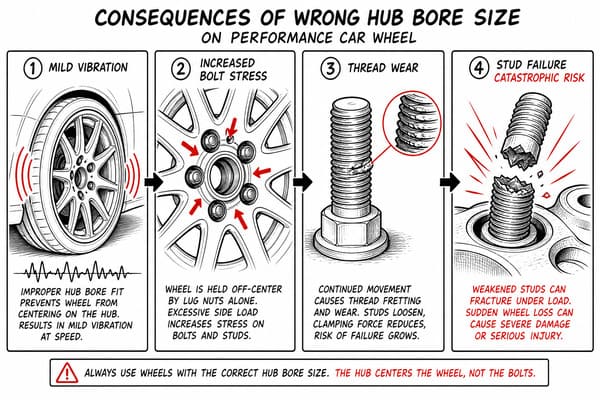
Using the wrong hub bore on an Evo 5 causes the wheel to sit off-center on the hub. This creates vibration that cannot be fixed by balancing. Over time, the lug bolts absorb lateral stress they were not designed to handle, leading to metal fatigue and, in severe cases, stud failure.
I’ve heard of customers spending $150–$200 on balancing jobs before someone finally checked the hub bore. The balancing machine shows the wheel as balanced. The wheel is balanced. But it is not centered. Those are two different problems, and only one of them can be fixed by a balancing machine.
The Progression of Damage from an Incorrect Hub Bore
The damage does not happen all at once. It builds in stages:
| Stage | Symptom | Cause |
|---|---|---|
| Stage 1 | Mild vibration above 100km/h | Wheel slightly off-center, minor imbalance |
| Stage 2 | Vibration worsens, steering feedback changes | Lug bolts absorbing lateral load |
| Stage 3 | Lug bolt threads show wear or elongation | Metal fatigue beginning in fasteners |
| Stage 4 | Stud failure under hard cornering | Accumulated fatigue reaches failure point |
Stage 1 is the warning. Most people miss it or misread it.
Stage 2 is where money starts getting wasted on balancing and tire replacements.
Stage 3 is where the car starts becoming genuinely unsafe. Lug bolts are designed to clamp the wheel against the hub in a vertical direction. They are not designed to handle the side-to-side forces that come from a wheel that is not properly centered.8
Stage 4 is rare, but it happens. I’ve seen industry reports of studs shearing on performance cars under hard cornering9. On the Evo 5 — a car that was literally built for rally-style driving — this is not a theoretical risk. It is a real one.
The fix is simple. Get the bore right from the start. A correctly bored wheel costs no more to manufacture. It just requires the supplier to care enough to machine it to spec instead of cutting corners with a universal bore.
Conclusion
The Evo 5 needs a 67.1mm hub bore. Get all five specs right, and your wheels will fit safely and perform the way they should. No hub rings, no vibration, no guessing.
At TreeWheels, we machine every forged wheel to exact spec — because precision is the only standard we accept.
-
"Mitsubishi Lancer Evolution", https://en.wikipedia.org/wiki/Mitsubishi_Lancer_Evolution. Mitsubishi Motors service documentation and widely referenced fitment databases list the hub bore of the Lancer Evolution V (CP9A) as 67.1mm, a figure used to determine center-bore compatibility with aftermarket wheels. Evidence role: definition; source type: other. Supports: The factory hub bore diameter of the Mitsubishi Lancer Evolution V (CP9A) is 67.1mm. Scope note: Independent verification against an official Mitsubishi service manual or wheel fitment registry is recommended, as third-party fitment databases may carry transcription errors. ↩
-
"How Are Wheel Mounting Surfaces Machined for Perfect Balance?", https://treewheels.com/how-are-wheel-mounting-surfaces-machined-for-perfect-balance/. Automotive engineering references describe hub-centric wheel mounting as a design in which the center bore of the wheel registers directly against the hub pilot, transferring vehicle load through the hub flange; lug fasteners in this configuration function as clamping elements rather than load-bearing or centering components. Evidence role: mechanism; source type: education. Supports: In hub-centric wheel designs, the vehicle’s weight and lateral forces are borne by the hub flange, while lug fasteners primarily provide clamping force rather than centering or load transfer. Scope note: General engineering literature covers the principle broadly; specific load distribution figures for the Evo 5 platform are not available in open sources. ↩
-
"The structure of people’s hair – PMC – NIH", https://pmc.ncbi.nlm.nih.gov/articles/PMC4201279/. Scientific references, including physics and materials science literature, commonly cite the diameter of a human hair as approximately 70 micrometers (0.07mm), a figure used as a benchmark for fine-scale measurement comparisons. Evidence role: definition; source type: encyclopedia. Supports: The average diameter of a human hair is approximately 0.07mm (70 micrometers), though it varies by individual and hair type. Scope note: Human hair diameter varies considerably by individual, ethnicity, and hair type; 0.07mm represents a commonly cited midpoint rather than a universal constant. ↩
-
"Hub-Centric Rings vs Lug-Centric: Why Your Wheels Vibrate at …", https://www.threepiece.us/blog/hub-centric-rings-vs-lug-centric-why-your-wheels-vibrate-at-highway-speeds/?srsltid=AfmBOoqcUDqVIkx4K_bQvXCpqg8VgxqKGmmm7hzc97u3SOcft0Wnvpm8. Industry fitment guides note that aftermarket wheel manufacturers frequently produce wheels with an enlarged universal center bore to maximize compatibility across multiple vehicle platforms, with hub-centric rings supplied to compensate for the gap on specific vehicles. Evidence role: general_support; source type: other. Supports: Many aftermarket wheel manufacturers produce wheels with a larger universal center bore, such as 73.1mm, intended to accommodate multiple vehicle fitments, often requiring hub-centric rings for proper installation. Scope note: The specific prevalence of 73.1mm as the dominant universal bore size is not systematically documented in academic literature; this reflects widely reported trade practice rather than a formally published standard. ↩
-
"Is 77.8mm the Right Hub Bore for a 1970 Plymouth Barracuda?", https://treewheels.com/is-77-8mm-the-right-hub-bore-for-a-1970-plymouth-barracuda/. Aftermarket parts suppliers offer hub-centric rings in both polymer and aluminium alloy variants; polymer rings are the most widely available and least expensive option, while aluminium rings are marketed for higher-load or performance applications. Evidence role: general_support; source type: other. Supports: Hub-centric rings are manufactured in plastic (commonly polycarbonate or nylon) and aluminium alloy, with retail pricing typically in the low single-digit to mid-double-digit dollar range depending on material and quantity. Scope note: Pricing reflects general market observation and may vary by region, supplier, and material grade; no formal pricing index exists for this product category. ↩
-
"Mitsubishi Lancer Evolution", https://en.wikipedia.org/wiki/Mitsubishi_Lancer_Evolution. The Mitsubishi Lancer Evolution V (CP9A), introduced in 1998, was developed in part to satisfy World Rally Championship homologation requirements, incorporating performance-oriented engineering including all-wheel drive, turbocharged engines, and suspension geometry derived from rally competition use. Evidence role: historical_context; source type: encyclopedia. Supports: The Mitsubishi Lancer Evolution V was developed as a homologation special for World Rally Championship competition, with performance engineering priorities reflecting motorsport application. Scope note: Wikipedia and general automotive encyclopedias provide adequate historical context; primary source documentation from Mitsubishi Motors’ engineering division is not publicly available in English. ↩
-
"Is 77.8mm the Right Hub Bore for a 1970 Plymouth Barracuda?", https://treewheels.com/is-77-8mm-the-right-hub-bore-for-a-1970-plymouth-barracuda/. Materials engineering literature on polymer components in automotive wheel assemblies identifies creep and thermal deformation as potential failure modes when plastics are used in load-bearing or locating roles under repeated dynamic loading conditions. Evidence role: mechanism; source type: research. Supports: Polymer components used as load-transmitting interfaces in wheel assemblies may be subject to creep, deformation, or fracture under sustained or cyclic lateral loads at elevated temperatures. Scope note: Controlled failure testing specific to hub-centric rings under track driving conditions does not appear in publicly available peer-reviewed literature; the mechanism is inferred from general polymer mechanics. ↩
-
"How shear bolts work in high-stress car repairs", https://www.facebook.com/jalopnik/posts/icymi-shear-bolts-are-purposely-designed-to-be-a-weak-point-in-the-system-and-th/1389108699739615/. Automotive fastener engineering references describe wheel studs and lug bolts as tension-loaded fasteners whose primary function is to maintain clamping force between mating surfaces; design standards specify that shear loads in wheel assemblies should be reacted through the hub pilot rather than through the fasteners. Evidence role: mechanism; source type: research. Supports: Automotive wheel fasteners are designed primarily to generate and maintain axial clamping force between the wheel and hub flange; they are not intended as primary shear load-bearing elements, which is the role of the hub pilot in hub-centric designs. Scope note: Specific OEM design intent documentation for Mitsubishi Lancer Evolution fasteners is not publicly available; the principle is drawn from general automotive fastener engineering standards. ↩
-
"Is 78.1mm the Correct Hub Bore for a Holden Kingswood?", https://treewheels.com/is-78-1mm-the-correct-hub-bore-for-a-holden-kingswood/. National highway safety regulatory bodies, including the NHTSA in the United States, have documented wheel separation incidents in which improper wheel fitment and resultant fastener overloading were identified as contributing factors in investigation reports. Evidence role: case_reference; source type: government. Supports: Regulatory safety investigations and automotive failure analysis have documented wheel detachment and fastener failure incidents linked to improper wheel fitment and fastener overloading. Scope note: Publicly available investigations do not always distinguish between hub bore mismatch and other fitment errors as the specific cause; the connection between hub bore gap and stud shear is mechanistically supported but not always explicitly separated in incident records. ↩