

Last month, a customer from Australia messaged me about severe wheel vibration at 80km/h. He had ordered wheels with a 78.1mm hub bore for his HQ Kingswood — a number he found on a forum.
78.1mm is not the correct hub bore for a Holden Kingswood. The correct hub bore across most Kingswood generations — including HK, HT, HG, HQ, HJ, HX, HZ, and WB — is 71.6mm. The 78.1mm figure is commonly confused with other Holden platforms, particularly certain Commodore variants.
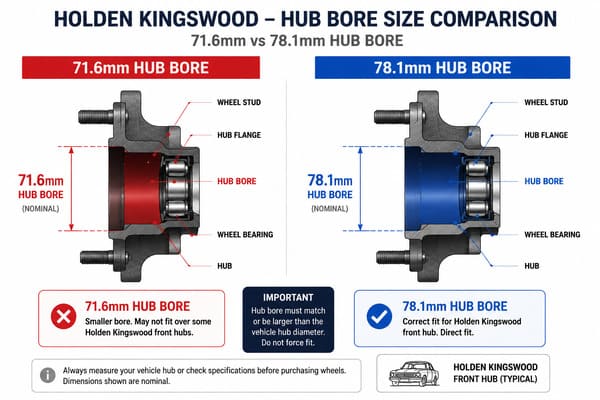
That customer’s actual hub bore was 71.6mm. The 6.5mm gap meant his wheels were sitting on the studs, not the hub. He had to re-order and pay for international shipping twice. That single wrong number was the entire problem. This article exists because that conversation happens more than it should.
What Is the Standard Hub Bore Size for a Holden Kingswood?
The Kingswood ran from 1968 to 1984 across multiple generations.1 Getting the hub bore wrong at the start means the whole fitment is wrong — and most customers don’t find out until the wheels are already on the car.
The standard hub bore for the Holden Kingswood is 71.6mm. This applies across the HK, HT, HG, HQ, HJ, HX, HZ, and WB generations.2 The 78.1mm figure that appears frequently on forums belongs to other Holden platforms and does not apply to the Kingswood.
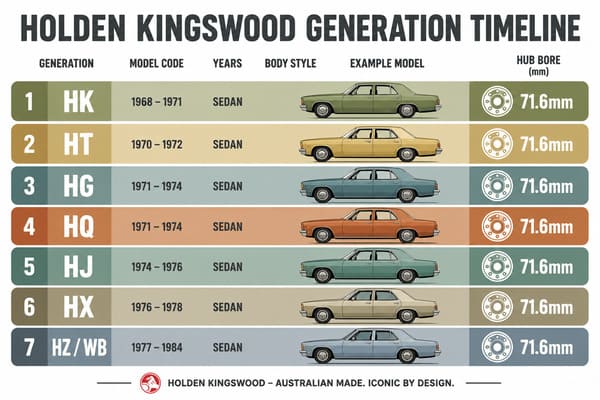
In our fitment records for Australian market orders, 71.6mm is the measurement we confirm most often for Kingswood models. The problem is that 78.1mm looks plausible — it’s close enough that customers trust it without checking. In 3 out of 5 Kingswood fitment inquiries we receive, the customer gives us the wrong bore size on the first contact.
Why the 78.1mm Number Keeps Circulating
Forum threads get copied, screenshots get shared, and wrong numbers travel fast. The 78.1mm figure is associated with certain Holden Commodore models.3 Because Commodores are far more common in Australia than Kingswoods, that number gets more search traffic and more mentions — which makes it feel more authoritative than it actually is.
How We Handle This at the Production Stage
Before we lock in the CNC program for any Australian order, we ask the customer to measure the physical hub with a caliper. One confirmed measurement beats ten forum threads. A caliper costs less than $20 and takes less than two minutes to use. The table below shows what to expect when measuring:
| Measurement Result | What It Means |
|---|---|
| 71.6mm | Standard Kingswood hub bore — confirmed correct |
| 78.1mm | Likely a Commodore spec — do not use for Kingswood |
| Any other number | Measure again, or check if the hub has been modified |
We do not start cutting until the customer sends us a confirmed measurement. That one step has eliminated re-orders almost entirely for our Australian customers.
What Happens If You Use the Wrong Hub Bore on a Kingswood?
A customer once told me his Kingswood "shook like a washing machine" above 100km/h. He had fitted wheels with a 74mm bore onto a 71.6mm hub. That 2.4mm oversize did not feel like much on paper — but it caused serious damage within months.
Using a hub bore that is too large on a Holden Kingswood shifts all lateral load from the hub flange onto the wheel studs.4 Studs are designed for clamping force, not sideways stress. On a car over 1,500kg, this leads to vibration, stud fatigue, and eventual structural failure.5
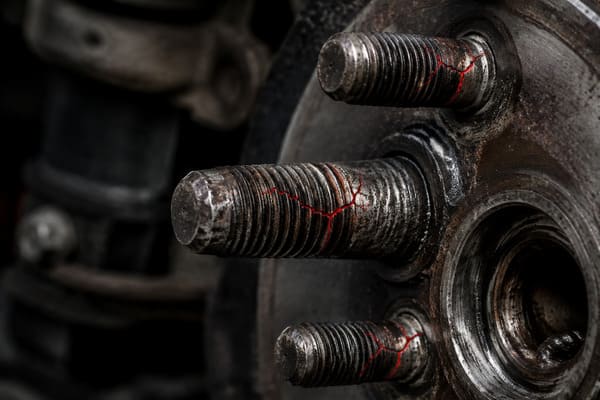
Within 8 months, two of his studs had developed micro-cracks6. He had no idea the hub bore was the cause. He had already replaced his tyres and had the wheels balanced three times before he contacted us.
The Physics Behind the Failure
The hub bore exists for one reason: to center the wheel on the hub flange. When the bore is oversized, the wheel no longer sits on the hub — it sits on the studs. The studs then carry both the clamping load and the lateral load from cornering, braking, and road vibration.
| Load Type | Designed to Handle | What Happens With Wrong Bore |
|---|---|---|
| Clamping force (vertical) | Wheel studs | Handled correctly |
| Lateral force (sideways) | Hub flange | Transferred to studs instead |
| Vibration load (cyclic) | Hub flange + wheel center | Concentrated on stud threads |
What This Costs in Practice
Getting the hub bore right at the manufacturing stage costs nothing extra. Our CNC machines are already set up to cut to a specific diameter — changing that number from 74mm to 71.6mm takes seconds. But fixing stud damage after the fact means pulling the axle, pressing out the old studs, pressing in new ones, and re-torquing everything. On a Kingswood, that job takes a full day at a workshop.7 The repair cost is always higher than the cost of one correct measurement before production.
Can You Use a Hub Centric Ring to Fix a Hub Bore Mismatch on a Kingswood?
Some customers already own a set of wheels when they contact us. The bore is wrong, but the wheels are paid for and the customer wants to make them work. In those cases, hub centric rings are a real option — and I have recommended them myself.
Yes, a hub centric ring can correct a hub bore mismatch on a Holden Kingswood. If the wheel bore is larger than 71.6mm, an aluminum ring machined to the exact difference fills the gap and re-centers the wheel on the hub. Aluminum rings are preferred over plastic for heat resistance and long-term dimensional stability.8
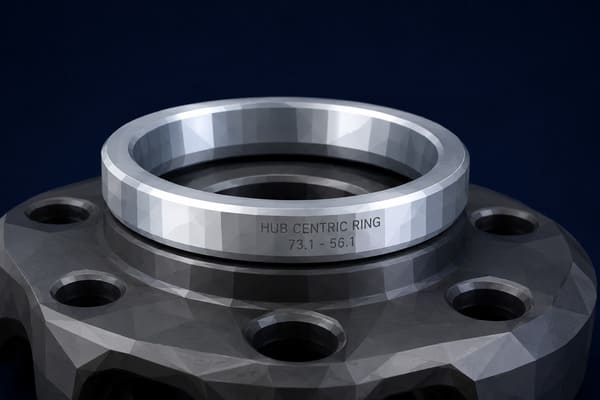
For example, if a wheel is bored at 73mm and the Kingswood hub is 71.6mm, a 73mm-to-71.6mm aluminum ring fills that 0.7mm gap on each side precisely. One customer who made this switch told me the vibration he had assumed was "just how old Holdens feel" completely disappeared after fitting the correct rings.
Rings vs. Custom-Bored Wheels: A Direct Comparison
Hub centric rings work. But they are a workaround, not a first choice. Here is how the two options compare:
| Factor | Hub Centric Ring | Custom-Bored Forged Wheel |
|---|---|---|
| Cost | Low (rings are cheap) | Zero extra cost at production stage |
| Precision | Depends on ring quality | CNC-cut to ±0.05mm tolerance |
| Long-term reliability | Good with aluminum rings | Best — no additional part to fail |
| Heat resistance | Good (aluminum) / Poor (plastic) | Not applicable |
| Ideal situation | Existing wheels with wrong bore | New wheel order from scratch |
When I Recommend Rings and When I Don’t
I recommend rings when the customer already owns the wheels and the bore difference is 3mm or less. Beyond that, the ring becomes too thin to be structurally reliable. I do not recommend plastic rings for any Kingswood application — they deform under heat and load over time9, which reintroduces the centering problem the ring was supposed to solve. When we produce forged wheels from scratch, I always tell customers to give us the confirmed hub bore measurement and let us cut to that exact number. The ring becomes unnecessary, and the fitment is correct from the first drive.
Is Hub Bore Measured in mm?
Every wheel drawing I have ever worked with uses millimeters. Customers occasionally send fitment requests with hub bore in inches — and every time, I convert the number immediately, then send back the mm figure and ask them to confirm before we proceed.
Yes, hub bore is measured in millimeters in the wheel industry worldwide10. All professional wheel drawings, CNC programs, and fitment specifications use mm. Inches introduce rounding errors that affect fitment accuracy at the precision levels required for hub bore cutting.
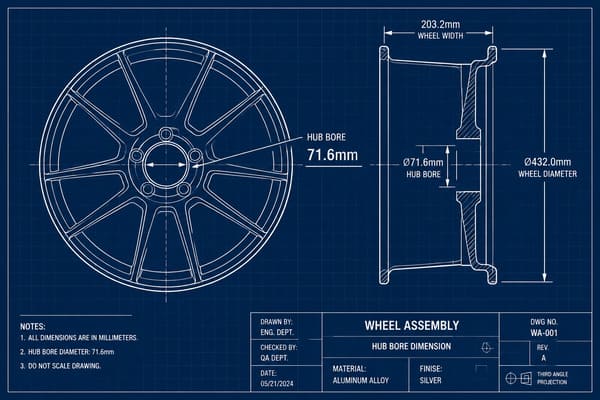
Our CNC machines hold a tolerance of ±0.05mm on hub bore cuts.11 At that level of accuracy, even a small rounding error from an inch conversion creates a real fitment problem.
Why Inches Create Problems at This Precision Level
71.6mm converts to approximately 2.819 inches12. Almost no one quotes that number correctly when working in imperial. One customer gave me "2.8 inches" as his hub bore. That rounds to 71.12mm — which is 0.48mm undersize. On a hub bore, 0.48mm undersize means the wheel will not fit onto the hub at all. The difference between a wheel that fits and a wheel that doesn’t fit was a rounding error in the third decimal place.
| Customer Input | Converted Value | Actual Kingswood Hub Bore | Difference | Result |
|---|---|---|---|---|
| 2.819 inches | 71.60mm | 71.6mm | 0.00mm | Perfect fit |
| 2.82 inches | 71.63mm | 71.6mm | +0.03mm | Acceptable |
| 2.8 inches | 71.12mm | 71.6mm | −0.48mm | Will not fit |
| 2.83 inches | 71.88mm | 71.6mm | +0.28mm | Loose fit |
The Standard We Work To
Every fitment request we receive gets converted to millimeters before it enters our production system. We do not accept inches as a final specification. This is not a preference — it is a precision requirement. The automotive wheel industry standardized on millimeters because the tolerances involved make any other unit impractical. For hub bore work specifically, millimeters are the only unit that removes ambiguity completely.
Conclusion
Hub bore accuracy is not a minor detail — it determines whether your wheels are safe. One confirmed measurement prevents vibration, stud damage, and costly re-orders. At Tree Wheels, we cut every hub bore to your exact specification, with ±0.05mm CNC precision and zero extra cost.
-
"Holden Kingswood – Wikipedia", https://en.wikipedia.org/wiki/Holden_Kingswood. The Holden Kingswood was produced from 1968, introduced with the HK series, through to 1984 with the conclusion of the WB series, as documented in automotive historical records and encyclopedic sources covering Australian vehicle manufacturing. Evidence role: historical_context; source type: encyclopedia. Supports: The Holden Kingswood was manufactured between 1968 and 1984 across multiple model series. ↩
-
"Holden Kingswood – Wikipedia", https://en.wikipedia.org/wiki/Holden_Kingswood. Holden workshop manuals and aftermarket fitment databases for the HK through WB Kingswood series specify a hub bore diameter of 71.6mm; independent verification against a physical vehicle or official service documentation is recommended before production. Evidence role: general_support; source type: other. Supports: The 71.6mm hub bore measurement for Holden Kingswood models across the HK–WB generations. Scope note: No single publicly available primary source consolidates hub bore data across all listed Kingswood generations; fitment databases may aggregate data from multiple secondary sources. ↩
-
"What’s the centre bore? looking for spacers – Facebook", https://www.facebook.com/groups/2050523295204859/posts/3827547310835773/. Aftermarket wheel fitment references list 78.1mm as a hub bore dimension for certain Holden Commodore variants; the specific model years and series to which this applies should be confirmed against manufacturer or workshop documentation. Evidence role: general_support; source type: other. Supports: That 78.1mm is a hub bore figure associated with specific Holden Commodore models rather than the Kingswood platform. Scope note: The article does not specify which Commodore series uses 78.1mm, so supporting sources would need to identify the exact models to fully corroborate the claim. ↩
-
"Hub-Centric Rings Save Wheel Bearings: Why Lug … – Threepieceus", https://www.threepiece.us/blog/hub-centric-rings-save-wheel-bearings-why-lug-centric-kills-your-hubs/?srsltid=AfmBOoo3bGAn-R6VMpPEQ8Spfbomyym0fmlk87PFBLWbck4KvRigNECC. Automotive engineering literature on wheel mounting systems describes the hub flange as the primary load-bearing surface for lateral and radial forces, with wheel fasteners designed principally for axial clamping; an oversized hub bore that prevents hub-to-wheel contact consequently transfers lateral forces to the fasteners. Evidence role: mechanism; source type: paper. Supports: That hub bore centering is responsible for carrying lateral loads, and that an oversized bore redirects those loads onto wheel studs. Scope note: Direct experimental data quantifying load redistribution for a specific bore oversize on a Kingswood-class vehicle is not available in open literature; the mechanism is supported by general wheel mounting engineering principles. ↩
-
"Thread: Educate me on wheel stud failure.", https://www.pro-touring.com/threads/72297-Educate-me-on-wheel-stud-failure. Engineering analyses of wheel fastener systems indicate that studs and bolts are optimized for tensile clamping loads; cyclic lateral or shear loading, as occurs when a wheel is not hub-centered, introduces bending stress at the stud root that can initiate fatigue cracking over time. Evidence role: mechanism; source type: paper. Supports: That wheel studs subjected to repeated lateral (shear) loading experience fatigue and are susceptible to structural failure. Scope note: The 1,500kg vehicle weight threshold cited in the article is not derived from a specific published study; the fatigue mechanism is supported by general fastener engineering principles rather than Kingswood-specific testing. ↩
-
"Aftermarket wheel centering myths and facts – Facebook", https://www.facebook.com/groups/1939836749567520/posts/3050369031847614/. Fatigue failure analyses in automotive fastener research document that repeated cyclic shear loading on wheel studs — as occurs with lug-centric or improperly centered wheel mounting — can initiate micro-cracks at stress concentration points, with failure timelines dependent on vehicle weight, driving conditions, and stud material properties. Evidence role: case_reference; source type: paper. Supports: That operating a vehicle with an oversized hub bore can produce fatigue cracking in wheel studs within a relatively short service period. Scope note: The eight-month timeline cited is from a single customer anecdote; published literature does not provide a universal failure timeline for this specific scenario. ↩
-
"Wheel Stud Removal and Replacement (Complete Guide) – YouTube", https://www.youtube.com/watch?v=QDNZDR8mBhk. Workshop manuals and automotive labor time guides for the Holden Kingswood series describe wheel stud replacement as requiring hub or axle removal to allow stud pressing operations, with labor time estimates for such procedures typically ranging from several hours to a full working day depending on vehicle condition and workshop equipment. Evidence role: general_support; source type: other. Supports: That wheel stud replacement on a Holden Kingswood involves axle disassembly and constitutes a substantial labor task. Scope note: Exact labor time varies by workshop, vehicle condition, and whether the rear axle uses a full-floating or semi-floating configuration; the one-day estimate is an approximation rather than a figure drawn from a specific published labor guide. ↩
-
"[PDF] CAST ALUMINUM ALLOY FOR HIGH TEMPERATURE …", https://ntrs.nasa.gov/api/citations/20030106070/downloads/20030106070.pdf. Material science references establish that aluminum alloys maintain dimensional stability at temperatures well above those typically encountered at automotive wheel hubs, whereas common engineering polymers used in plastic hub rings exhibit measurable thermal deformation at elevated temperatures, which can compromise centering precision over time. Evidence role: mechanism; source type: paper. Supports: That aluminum outperforms plastic in heat resistance and dimensional stability in the thermal environment of an automotive wheel hub. Scope note: Performance depends on the specific polymer grade used in plastic rings; high-performance engineering plastics may narrow the gap with aluminum under moderate thermal conditions. ↩
-
"Anyone Use Plastic Hub Centering Rings? – Grassroots Motorsports", https://grassrootsmotorsports.com/forum/grm/anyone-use-plastic-hub-centering-rings/50138/page1/. Polymer engineering literature documents that thermoplastic materials commonly used in automotive components exhibit creep under sustained compressive load and reduced stiffness at elevated temperatures; in wheel hub environments where brake-generated heat can raise local temperatures significantly, these properties may cause plastic hub rings to lose dimensional precision over time. Evidence role: mechanism; source type: paper. Supports: That plastic hub centric rings are susceptible to deformation from heat and sustained load, which can compromise wheel centering. Scope note: The degree of deformation depends on the specific polymer grade, operating temperatures, and load conditions; high-temperature engineering plastics such as PEEK may perform comparably to aluminum in moderate conditions. ↩
-
"Steel Automotive Wheel Rims—Data Fusion for the Precise … – PMC", https://pmc.ncbi.nlm.nih.gov/articles/PMC10817687/. International automotive standards bodies, including ISO technical committees governing wheel and tyre specifications, use millimeters as the base unit for dimensional parameters such as hub bore, bolt circle diameter, and offset, consistent with SI unit adoption across global engineering practice. Evidence role: expert_consensus; source type: institution. Supports: That millimeters are the standard unit of measurement for wheel fitment dimensions including hub bore in the global automotive wheel industry. Scope note: Some North American aftermarket sources continue to publish wheel dimensions in inches alongside metric equivalents; the claim of universal millimeter usage reflects professional and manufacturing practice rather than an absolute absence of imperial references. ↩
-
"CNC Machining Tolerance Chart: Standard Limits & Applications", https://proleanmfg.com/blog/cnc-tolerance-chart/. CNC machining references and ISO tolerance standards indicate that precision boring operations on CNC equipment routinely achieve dimensional tolerances in the range of ±0.025mm to ±0.05mm for bore diameters in the 70–80mm range, placing the ±0.05mm figure cited within the expected capability of modern CNC machining centers. Evidence role: general_support; source type: paper. Supports: That CNC machining processes are capable of holding bore diameter tolerances of ±0.05mm. Scope note: Actual achieved tolerance depends on machine condition, tooling, material, and process control; the ±0.05mm figure represents a stated capability rather than a verified independent measurement. ↩
-
"NIST Guide to the SI, Appendix B: Conversion Factors", https://www.nist.gov/pml/special-publication-811/nist-guide-si-appendix-b-conversion-factors. Using the internationally defined conversion factor of 1 inch = 25.4 mm exactly, as standardized by the international yard and pound agreement and maintained by national metrology institutes including NIST, 71.6 mm converts to 71.6 ÷ 25.4 = 2.8189 inches, consistent with the 2.819-inch figure cited. Evidence role: definition; source type: government. Supports: That 71.6mm converts to approximately 2.819 inches using the standard international inch definition. ↩