

Most people think wheel balance is about the tire. Customers swap tires three times, spend $400, and still feel the shake at 100km/h. The problem was never the tire.
A 0.1mm deviation on the flange face1 is invisible to the eye, but at highway speed, it translates directly into vibration. Balance starts at the mounting surface — before the tire is even on the wheel. Getting this surface right is the only way to eliminate the problem at its source.
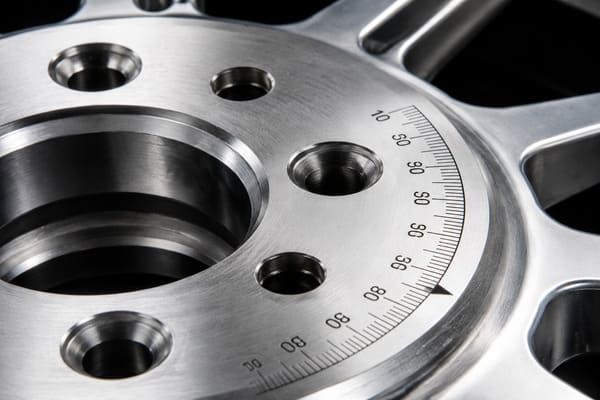
We have been producing forged wheels for over 20 years. In that time, I have seen the same mistake repeated across shops, factories, and markets — people treat balance as a final step, not a manufacturing standard. This article breaks down exactly how mounting surfaces are machined, what machines are involved, and why the process matters more than the equipment.
What Is a Wheel Mounting Surface and Why Does It Matter?
A customer once called me after his client complained about vibration on a freshly installed set of wheels. He had balanced the tires twice. The wheels looked perfect. The real problem was hiding in the data.
The mounting surface — also called the flange face — is the flat area on the back of the wheel that contacts the hub.2 Any runout on this surface means the wheel does not sit flat against the hub. The industry standard for high-performance forged wheels is within 0.05mm of runout3. Anything beyond that introduces a repeatable vibration at speed.
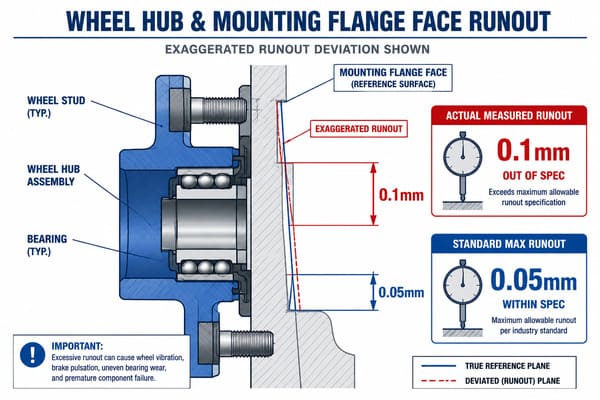
When we checked the mounting surface runout on that customer’s wheels, it was sitting at 0.15mm. That 0.1mm difference above the standard was enough to cause a repeatable vibration above 80km/h. The tires were never the issue.
For forged wheels, this problem is less obvious than it sounds. Forged aluminum has a density roughly 10–15% higher than cast aluminum.4 The internal residual stress is also more concentrated. In our early production years, we had a batch where we went straight from rough machining to finish machining the mounting surface5. The wheels passed all outgoing inspection checks. But after about three months of use — around 10,000 kilometers — customers started reporting a light vibration.
We recalled the wheels and measured them. The mounting surface had shifted by 0.08mm. The cause was residual stress releasing slowly during use. The stress was locked in during the forging process and had not been given time to relax before we cut the final surface.
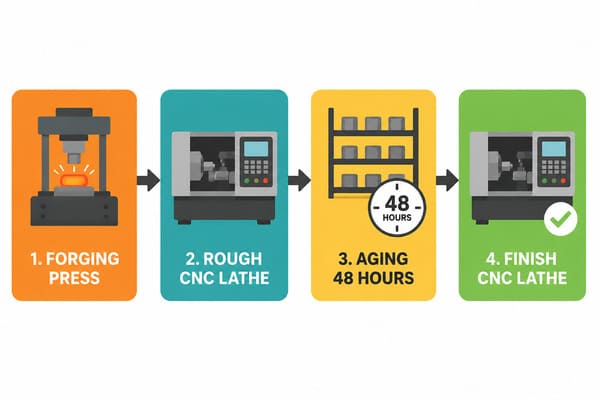
After that, we added a mandatory natural aging step between rough machining and finish machining6. Every wheel now rests for at least 48 hours before the final cut is made. That problem has not appeared since.
Why Residual Stress Affects Mounting Surface Accuracy
| Stage | What Happens | Risk if Skipped |
|---|---|---|
| Forging | High pressure shapes the aluminum blank | Residual stress locked into the material |
| Rough Machining | Material is cut to near-final shape | Stress begins to redistribute |
| Aging (48 hours) | Stress releases naturally at room temperature | If skipped, surface shifts after finish cut |
| Finish Machining | Final surface is cut to tolerance | Runout target: ≤0.05mm (our standard: ≤0.03mm) |
The aging step costs almost nothing in materials. The two days it adds to production time add less than $5 to the unit cost. But skipping it can produce a wheel that passes inspection and fails on the road three months later. We do not skip it.
What Machines Are Used to Cut Wheel Mounting Surfaces?
I have visited facilities with brand-new CNC lathes — machines that cost $200,000 or more — that were producing mounting surfaces with 0.12mm runout. The equipment was not the problem. The process was wrong.
The mounting surface is cut on a CNC lathe during the finish machining stage.7 The machine must hold positional accuracy within 0.01mm and use a rigid clamping setup to prevent vibration during the cut8. But the machine alone does not determine the result — the process sequence before and after the cut is equally important.
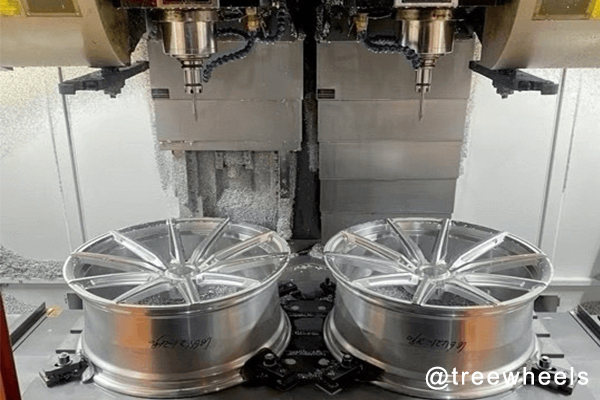
Those facilities were skipping the intermediate step between rough and finish machining. They were trying to cut production time by 20%. What they did not account for is that forged aluminum holds residual stress from the forging process. If you finish-machine the surface before that stress is released, the surface will shift — slightly, slowly, but enough to matter.
Our current process works like this. We rough-machine the wheel and leave 0.3mm of material on the mounting surface. The wheel then sits for 48 hours. After that, we finish-machine the surface on a CNC lathe and bring the runout down to within 0.03mm. This is tighter than the industry standard of 0.05mm.
Key Equipment and Process Steps for Mounting Surface Machining
| Step | Equipment Used | Specification |
|---|---|---|
| Rough Machining | CNC Lathe | Leave 0.3mm stock on mounting face |
| Stress Relief | Aging rack (room temperature) | Minimum 48 hours |
| Finish Machining | High-precision CNC Lathe | Runout ≤ 0.03mm |
| Inspection | CMM / Runout gauge | 100% check on mounting face |
The CNC lathe used for finish machining must be calibrated regularly and must use a dedicated fixture for each wheel size. If the fixture introduces any play, the runout reading will be off — and so will the wheel. We treat fixture maintenance as part of the machining process, not a separate task.
The machine matters. But the process around the machine matters more. A $200,000 lathe with a bad process will produce worse results than a $80,000 lathe with a disciplined one.
Which Machine Is Used for Wheel Balancing?
Here is a logic problem that most people miss. A dynamic balancing machine measures mass distribution — but if the mounting surface has runout, the machine reads that geometric error as a mass imbalance9. The result is a wheel that looks balanced on paper but still vibrates on the road.
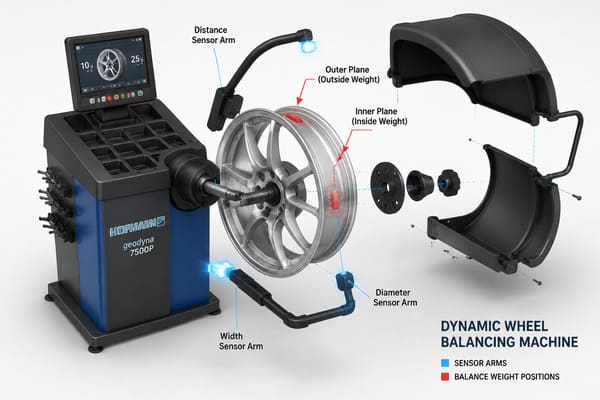
Wheel balancing is performed on a dynamic balancing machine, also called a spin balancer.10 The wheel is mounted on the machine’s spindle, spun at a set speed, and sensors measure the vibration forces at two planes11. The machine then calculates where and how much weight to add to bring the wheel into balance.
We once shipped a batch of 20-inch forged wheels to a customer in the United States. The installer reported that the dynamic balance readings were high — each wheel required 15g to 20g of counterweight to reach zero. For a well-made forged wheel, the normal range is under 5g.
We asked the customer to measure the mounting surface runout immediately. The results came back at 0.10mm to 0.12mm across the batch. The cause was a fixture that had worked loose during production, and it affected every wheel made during that shift. The counterweights were added, but the root cause was geometric — not mass distribution.
What High Balance Readings Actually Mean on Forged Wheels
| Balance Reading | Likely Cause | Correct Action |
|---|---|---|
| Under 5g | Normal for forged aluminum | Add weight as indicated |
| 5g – 10g | Minor geometric deviation or centering error | Check hub bore centering first |
| 10g – 20g | Mounting surface runout or fixture error | Measure runout before adding weight |
| Over 20g | Significant geometry problem | Do not add weight — investigate machining |
After that incident, we added a runout spot-check to every outgoing batch. We check a minimum of 30% of wheels per batch before shipment. If any wheel in the sample exceeds 0.05mm runout, the entire batch is held for re-inspection. This step has caught three batches since we introduced it.
How Does a Wheel Balancing Machine Work?
Most explanations of balancing machines stop at "it spins the wheel and finds the heavy spot." That is accurate but incomplete. For forged wheels specifically, the details matter more than the summary.
A dynamic balancing machine works by spinning the wheel on a precision spindle and measuring the vibration forces at two separate planes — typically the inner and outer rim edges. Sensors convert these forces into data. The machine calculates the exact location and weight needed at each plane to cancel the imbalance.
Here is what matters for forged wheels in particular. Forged aluminum has a much more uniform density than cast aluminum. The density variation between different areas of the same forged wheel is typically less than 2%. So when a forged wheel shows a high imbalance reading — say, 20g or more — it is almost never a material problem. It is a geometry problem. The wheel is not spinning around its true center.
There are two common reasons this happens. First, the hub bore of the wheel has clearance against the balancing machine’s spindle, so the wheel is not precisely centered when it spins. Second, the mounting surface has runout, which causes the wheel to wobble axially as it rotates. Both situations produce false readings on the balancing machine.
Centering Method Comparison on a Balancing Machine
| Centering Method | Centering Accuracy | Risk of False Reading |
|---|---|---|
| Bolt-hole fixed (lug-centric) | ±0.05mm or worse | High — common source of false imbalance |
| Tapered cone (hub-centric) | ±0.01mm | Low — recommended for forged wheels |
| Adapter plate (custom fit) | ±0.01mm or better | Very low — used for precision inspection |
We recommend that every shop using a balancing machine on forged wheels use a tapered cone centering fixture, not bolt-hole fixation. The tapered cone brings centering error down to within 0.01mm. Bolt-hole fixation can introduce 0.05mm or more of centering error. That 0.04mm difference can show up on the balance reading as 8g to 12g of false imbalance.
Adding weight to fix a centering error does not fix the wheel. It adds permanent mass to compensate for a removable error. The right approach is to center the wheel correctly first, then read the balance data.
Conclusion
Wheel balance starts with machining precision, not counterweights. The mounting surface, the process sequence, and the centering method all determine whether a wheel truly runs true. Tree Wheels produces forged wheels to ≤0.03mm runout — built for customers who need balance they can trust.
-
"[PDF] Vibration and Harsh Ride Troubleshooting – nhtsa", https://static.nhtsa.gov/odi/tsbs/2014/SB-10056335-4843.pdf. A vehicle dynamics or wheel-service engineering source should support that small axial or lateral runout at the wheel mounting interface can create cyclic displacement and vibration during rotation; the cited source may contextualize the mechanism rather than verify the exact 0.1 mm threshold. Evidence role: mechanism; source type: paper. Supports: A 0.1 mm deviation on the wheel flange face can translate into noticeable vibration at highway speeds.. Scope note: Likely supports the relationship between runout and vibration, but may not directly prove that 0.1 mm always causes vibration at highway speed. ↩
-
"Face Spline Wheel Hubs Explained: What Every Technician Needs …", https://www.youtube.com/watch?v=CiqI3AwnStI. An automotive engineering or wheel-service reference should define the wheel mounting face or flange face as the surface that seats against the vehicle hub, supporting the terminology and functional description. Evidence role: definition; source type: education. Supports: The wheel mounting surface, or flange face, is the rear flat surface of the wheel that contacts the hub.. ↩
-
"Rim runout…. 0.5mm standard!!! – KDXRIDER.NET", https://kdxrider.net/forums/viewtopic.php?t=5339. A wheel standard, inspection manual, or engineering specification should substantiate typical allowable mounting-face or wheel runout tolerances; if the cited document covers general wheel inspection rather than forged performance wheels specifically, it should be treated as contextual support. Evidence role: expert_consensus; source type: institution. Supports: High-performance forged wheels are commonly held to a mounting-surface runout tolerance around 0.05 mm.. Scope note: Public standards may specify broader wheel runout limits and may not identify 0.05 mm as an industry-wide high-performance forged-wheel standard. ↩
-
"A Review on Porosity Formation in Aluminum-Based Alloys – PMC", https://pmc.ncbi.nlm.nih.gov/articles/PMC10004325/. A materials science source should discuss how forging reduces porosity and can increase effective density relative to cast aluminum components; the source should be read cautiously if it does not confirm the article’s specific 10–15% range across wheel alloys. Evidence role: statistic; source type: paper. Supports: Forged aluminum can have higher effective density than cast aluminum because casting porosity is reduced or eliminated.. Scope note: The exact percentage may vary by alloy, casting process, and porosity level; many sources may support lower porosity without confirming a universal 10–15% density difference. ↩
-
"[PDF] Effects of Aluminum Plate Residual Stress on Machined-Part Distortion", https://www.osti.gov/servlets/purl/2448191. A machining-residual-stress study should support that material removal after forging can redistribute residual stresses and cause dimensional distortion, making process sequencing relevant to final surface accuracy. Evidence role: mechanism; source type: paper. Supports: Moving directly from rough machining to finish machining can leave residual-stress redistribution unaccounted for and affect final dimensional accuracy.. Scope note: The source may address machined aluminum components generally rather than wheel mounting faces specifically. ↩
-
"NDT of Residual Stress in Thick Aluminum Alloy Plates under … – PMC", https://pmc.ncbi.nlm.nih.gov/articles/PMC9787887/. A materials-processing source should document that interim aging or stress-relief intervals can reduce post-machining dimensional change in aluminum components by allowing residual stresses to relax or stabilize before final machining. Evidence role: mechanism; source type: paper. Supports: An aging or stabilization step between rough and finish machining can help control dimensional movement caused by residual stress.. Scope note: Support may be for stress relief or stabilization in aluminum generally, not specifically for 48-hour room-temperature aging of forged wheels. ↩
-
"Step 7 of the forging process: CNC face-machining. The lathe-turned …", https://www.facebook.com/ApexRaceParts/posts/step-7-of-the-forging-process-cnc-face-machining-the-lathe-turned-blanks-are-loa/1267851598723778/. A manufacturing or wheel-production reference should support that wheel mounting faces are typically finished by turning operations on CNC lathes to achieve flatness, concentricity, and runout control. Evidence role: general_support; source type: education. Supports: Wheel mounting surfaces are commonly finish-machined on CNC lathes.. Scope note: The source may describe common wheel manufacturing practice rather than every forged-wheel production line. ↩
-
"Computational Stability Analysis of Chatter in Turning", https://websites.umich.edu/~ykoren/uploads/Computational_stability_analysis_of_chatter_in_turning.pdf. A machining dynamics source should support that insufficient workholding stiffness can cause chatter, vibration, and dimensional error during turning operations, explaining why rigid fixturing matters for mounting-face accuracy. Evidence role: mechanism; source type: paper. Supports: Rigid clamping reduces vibration and dimensional error during CNC turning.. ↩
-
"[PDF] Rotating Machinery Rotor Balancing", https://rotorlab.tamu.edu/me459/Rotor%20Balancing/Rotating_Machinery_Rotor_Balancing.pdf. A balancing-metrology source should support that eccentric or misaligned mounting during balancing can introduce measurement error and produce apparent imbalance readings unrelated to true mass distribution. Evidence role: mechanism; source type: paper. Supports: Mounting-surface runout or misalignment can cause a balancing machine to report apparent imbalance that is actually geometric error.. Scope note: The source may discuss eccentric mounting or fixture error in balancing generally, not wheel flange runout specifically. ↩
-
"Balancing of rotating masses – Wikipedia", https://en.wikipedia.org/wiki/Balancing_of_rotating_masses. An automotive service or engineering reference should define dynamic wheel balancing as a spin-balancing procedure in which a rotating wheel assembly is measured for imbalance and corrected with counterweights. Evidence role: definition; source type: education. Supports: Wheel balancing is commonly performed on a dynamic, spin-type balancing machine.. ↩
-
"[PDF] Rotating Machinery Rotor Balancing", https://rotorlab.tamu.edu/me459/Rotor%20Balancing/Rotating_Machinery_Rotor_Balancing.pdf. A balancing theory or machine-dynamics source should support that dynamic balancing measures rotating imbalance in two correction planes, commonly corresponding to the inner and outer wheel planes. Evidence role: mechanism; source type: education. Supports: Dynamic wheel balancers measure imbalance effects in two planes to determine correction weights.. Scope note: The source may explain two-plane dynamic balancing generally rather than wheel balancers only. ↩