
If your wheels vibrate at highway speed and two balance jobs haven’t fixed it, the hub bore might be the problem. Most R32 owners never check this number.
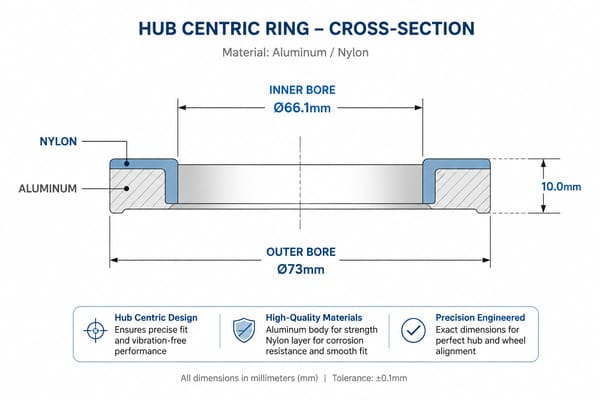
The Nissan Skyline R32 has a hub bore of 66.1mm1. This is the diameter of the axle hub that the wheel’s center hole must match. Any wheel with a bore smaller than 66.1mm will not fit. Any wheel with a bore larger than 66.1mm requires a hub centric ring to center it correctly.
The R32 is a car that attracts serious owners. Most of them research bolt pattern (5×114.32), offset, and sizing — and those numbers matter. But hub bore is the one spec that gets skipped, and it’s the one that causes the most frustrating post-purchase problems. This article covers what hub bore means, how to measure it, what goes wrong when it’s off, and what your options are when the number doesn’t match.
What Does Hub Bore Size Actually Mean for Your R32?
You’ve done your research on the R32. Bolt pattern, offset, sizing — all confirmed. But there’s one number most buyers skip, and it’s the one that causes vibration problems even after two balance jobs.
The hub bore is the center hole in the wheel. It slides over the raised hub on the axle. Nissan machined the R32’s hub to exactly 66.1mm in diameter. Every factory wheel was built to match that number. If the wheel’s center hole does not match the hub, the wheel cannot sit centered on the car.
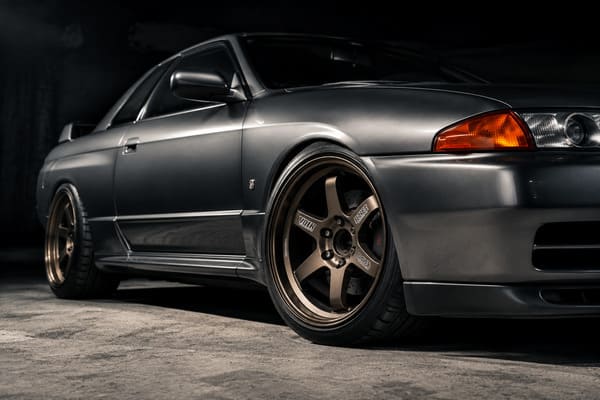
I want to share a case we handled last year. A customer came to us with an R32 that vibrated at anything above 100km/h. He had already bought a set of wheels from another supplier. The bolt pattern was correct — 5×114.3. The offset was correct. The size was correct. He had paid for two separate balance jobs. The vibration was still there. When we asked him the center bore of those wheels, he did not know. We helped him check. The wheels were bored to 73mm. No hub centric ring had been installed. The wheel was sitting off-center by nearly 3.5mm on each corner.
Why That Gap Is a Problem
The bolts were doing the centering work. That is not what wheel bolts are designed for. Bolts are designed to clamp the wheel against the hub face and hold it there under load3. They are not designed to correct for a wheel that is not centered on the hub in the first place. When a wheel sits 3.5mm off-center and spins at highway speed, it creates a rotational imbalance4. That imbalance shows up as vibration. No amount of balancing fixes it, because the balancing machine measures the wheel in isolation — it does not know the wheel is going to sit off-center when it goes on the car.
| Condition | What It Means |
|---|---|
| Bore = 66.1mm (hub centric) | Wheel is centered by the hub. Bolts clamp only. |
| Bore > 66.1mm, no hub ring | Wheel sits off-center. Bolts carry centering load. |
| Bore < 66.1mm | Wheel will not physically slide onto the hub. |
The hub bore is the number that tells you whether the wheel is truly centered on the car, or just bolted onto it. Those are two different things.
How Do You Measure the Hub Bore on a Nissan Skyline R32?
You found a set of wheels listed as "fits R32." The seller confirmed bolt pattern and offset. But if you haven’t verified the center bore of the wheel itself, you don’t have the full picture yet.
To measure hub bore, you need a caliper. Measure the inner diameter of the center hole in the wheel. For the R32, the axle hub measures 66.1mm. The wheel’s bore must match this number exactly, or be larger if you plan to use a hub centric ring. A ruler is not accurate enough for this measurement.
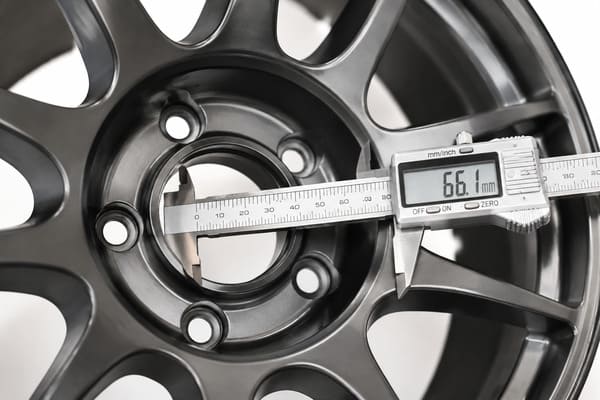
Here is where people make a common mistake. They measure the hub on the car — 66.1mm — and then they go buy a wheel listed as "R32 compatible" without checking the wheel’s own bore spec separately. Those are two different measurements. Both need to be confirmed. I have seen wheels sold as R32-compatible with a 73mm bore, a 70mm bore, and even a 67.1mm bore.
What Each Scenario Means in Practice
Some of those sizes work with a hub ring. Some do not. If the wheel bore is smaller than 66.1mm — say a supplier made an error or you ordered the wrong spec — the wheel will not physically slide onto the hub. It stops. You cannot force it. The only fix is remachining the wheel bore, which costs money and takes time, and it also affects the wheel’s structural warranty.
| Wheel Center Bore | Result on R32 Hub (66.1mm) | Solution |
|---|---|---|
| 66.1mm | Perfect hub centric fit | None needed |
| 67mm – 73mm+ | Wheel slides on, but gap exists | Hub centric ring required |
| Below 66.1mm | Wheel will not fit | Remachining required5 |
The practical step is this: before you place an order, confirm the wheel’s center bore spec in writing from the supplier. Ask for one number. 66.1mm. If the wheel bore is larger, ask about hub rings. If it is smaller, do not proceed. This is a five-minute check that prevents weeks of problems after delivery.
What Happens If You Use the Wrong Hub Bore on Your R32?
The bolt pattern fits. The wheel bolts on. Everything looks correct at a glance. But at highway speed, the steering wheel shakes — and no one at the shop can explain why.
If a wheel with a bore larger than 66.1mm is fitted to an R32 without a hub centric ring, the wheel sits off-center. At speed, that offset creates a rotational imbalance. This produces vibration in the steering wheel and the cabin floor. Standard wheel balancing cannot fix this problem, because the wheel is not centered on the car to begin with.
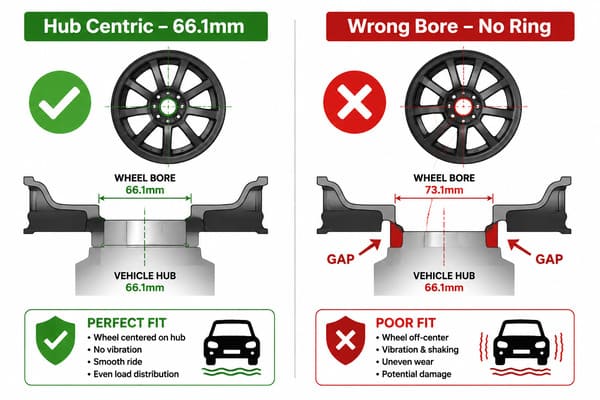
The customer I described earlier — after two failed balance jobs, he was starting to believe the wheels themselves were defective. They were not. The balance weights the shop added were compensating for an imbalance that could not actually be corrected by balancing. The balancing machine spins the wheel in isolation. It does not know that wheel will sit 3.5mm off-center when it goes onto the car. The root cause was never addressed.
The Long-Term Cost of Running This Way
A useful way to think about it: balancing a wheel that is off-center on the hub is like trying to balance a washing machine that is sitting on a tilted floor. You can add counterweights, but the tilt is still there.
Beyond vibration, there is a longer-term concern. Running a wheel off-center for months puts lateral load on the wheel bearings6. Bearings are designed to handle the radial load of the car’s weight7. They are not designed to handle the additional side load that comes from an off-center rotating mass. Over time, this accelerates bearing wear.
| Cost Comparison | Approximate Cost |
|---|---|
| Hub centric rings (set of 4) | $20 – $40 |
| Professional wheel balance job | $60 – $100 |
| Wheel bearing replacement (per corner, R32)8 | $200 – $400+ |
The cost of four hub centric rings is around $20 to $40 total. That is the comparison I give every customer who is deciding whether it matters. It matters.
Can You Use a Wheel with a Different Hub Bore on the R32?
You’ve found a set of forged wheels you want. The bore is 73mm, not 66.1mm. The supplier says they’ll work. Is that actually true, or is it a problem waiting to happen?
Yes, a wheel with a bore larger than 66.1mm can be used on the R32. A hub centric ring — machined from aluminum or nylon — fills the gap between the wheel bore and the hub9. When fitted correctly, it restores proper centering. This is a legitimate and widely used solution. The key word is "when fitted correctly."
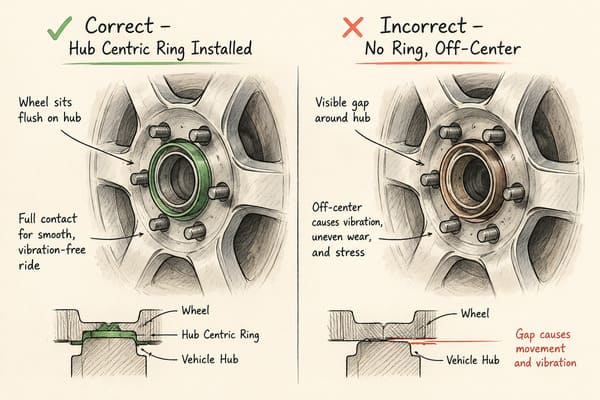
At Tree Wheels, we machine every forged wheel to the customer’s exact hub bore specification. For an R32 order, that means 66.1mm. The wheel slides onto the hub with no gap and no ring needed. This is the cleaner outcome. Hub rings are a real solution, but they are an extra part — and extra parts can be lost, forgotten, or left off.
Why "Universal Bore" Wheels Create This Problem
I have heard of this happening in practice. A customer’s wheels were removed for a tire swap at a shop that did not know the car. The hub rings were left sitting on the workbench. The wheels were reinstalled without them. The owner drove away. Three weeks later, the same vibration problem returned, and the same confusion started over again. No one connected it to the missing rings.
Most mass-market aftermarket wheels are produced with a "universal" bore — 73mm is the most common10 — because it covers more hub sizes across a wider range of car models. That is a production efficiency decision. It reduces tooling changes and allows higher production volume across different fitments.
| Wheel Type | Hub Bore Approach | Fitment Quality |
|---|---|---|
| Mass-market aftermarket | Universal bore (e.g. 73mm) | Requires hub ring for most cars |
| Custom forged (e.g. Tree Wheels) | Machined to spec (e.g. 66.1mm) | Hub centric from the start, no ring needed |
Custom forged wheels do not need to make that compromise. Each set is built for one car, one hub, one spec. When you order from us, we ask for your hub bore before production starts. That number goes into the machining spec. The result is a wheel that fits the way a factory wheel fits — because it was built to the same measurement.
Conclusion
The R32 hub bore is 66.1mm. Getting that number right at the point of order prevents vibration, bearing wear, and expensive fixes later. Tree Wheels machines every forged wheel to your exact hub bore spec — no guesswork, no hub rings required.
-
"Nissan Skyline VIII (R32) [1989 .. 1994]", https://www.wheel-size.com/size/nissan/skyline/r32-1989-1994/. OEM specifications confirm the hub bore diameter for proper wheel fitment matching. Evidence role: definition; source type: other. Supports: the official hub bore specification for the Nissan Skyline R32. Scope note: Specification should be verified across all R32 variants (GT-R, GTS-t, etc.) as some trim levels may differ ↩
-
"What Are the Best Wheel Styles for JDM Car Modifications?", https://treewheels.com/what-are-the-best-wheel-styles-for-jdm-car-modifications/. Factory specifications list the bolt pattern used across R32 model variants. Evidence role: definition; source type: other. Supports: the standard bolt pattern specification for the R32 Skyline. ↩
-
"What Hub Bore Does a Mitsubishi Lancer Evo 5 Actually Require?", https://treewheels.com/what-hub-bore-does-a-mitsubishi-lancer-evo-5-actually-require/. Automotive engineering references describe wheel fasteners as providing axial clamping force to secure the wheel against the mounting surface under operational loads. Evidence role: mechanism; source type: education. Supports: the engineering principle that wheel fasteners provide clamping force rather than centering. ↩
-
"ECCENTRIC ROTATING MASS MOTOR VIBRATIONAL …", https://mavmatrix.uta.edu/cgi/viewcontent.cgi?article=1048&context=honors_spring2020. Mechanical engineering principles establish that eccentric mass rotation generates periodic forces leading to vibration, with magnitude increasing with rotational speed. Evidence role: mechanism; source type: education. Supports: the mechanical principle that eccentric rotation produces vibration in rotating assemblies. ↩
-
"What Hub Bore Does a Chevrolet C10 Pickup Actually Require?", https://treewheels.com/what-hub-bore-does-a-chevrolet-c10-pickup-actually-require/. Wheel bore enlargement through remachining is technically feasible when performed within structural limits, though it may affect warranty coverage and must maintain sufficient wall thickness. Evidence role: general_support; source type: other. Supports: the process and considerations for wheel bore remachining. Scope note: Safety and warranty implications depend on specific wheel design and material ↩
-
"What Causes Wheel Bearings To Go Bad? – Universal Technical Institute", https://www.uti.edu/blog/automotive/what-causes-wheel-bearings-to-go-bad. Bearing engineering literature indicates that loads applied perpendicular to the primary load axis or eccentric to the bearing centerline can accelerate wear and reduce service life. Evidence role: mechanism; source type: education. Supports: the effect of lateral and eccentric loads on bearing service life. Scope note: Direct quantification of wear acceleration from specific wheel offset values would require controlled testing ↩
-
"How Do You Ensure Proper Brake Caliper Clearance When …", https://treewheels.com/how-do-you-ensure-proper-brake-caliper-clearance-when-upgrading-wheels/. Automotive wheel bearings are engineered to support primarily radial loads from vehicle weight and some axial loads from cornering, with load ratings specified for these conditions. Evidence role: mechanism; source type: education. Supports: the primary load directions automotive wheel bearings are designed to support. ↩
-
"Nissan Skyline R32 R33 R34 Front Wheel Bearing (All …", https://tfaspeed.com/products/nissan-skyline-r32-r33-r34-gtr-r32-gts4-front-wheel-bearing. Wheel bearing replacement costs for specialty and performance vehicles typically range from $200-$400+ per corner including parts and labor, varying by vehicle availability and shop rates. Evidence role: general_support; source type: other. Supports: typical cost ranges for wheel bearing replacement on performance vehicles. Scope note: Costs vary significantly by region, parts availability for older vehicles, and whether OEM or aftermarket components are used ↩
-
"Is 57.1mm the Correct Hub Bore for a BMW E30?", https://treewheels.com/is-57-1mm-the-correct-hub-bore-for-a-bmw-e30/. Industry sources indicate hub centric rings are typically manufactured from aluminum alloys or engineered plastics including nylon, selected based on strength and corrosion resistance requirements. Evidence role: general_support; source type: other. Supports: the common materials used in hub centric ring manufacturing. ↩
-
"Is 78.1mm the Correct Hub Bore for a Holden Kingswood?", https://treewheels.com/is-78-1mm-the-correct-hub-bore-for-a-holden-kingswood/. Aftermarket wheel industry practices commonly use 73mm as a universal bore diameter because it accommodates the hub sizes of many vehicle manufacturers. Evidence role: general_support; source type: other. Supports: the prevalence of 73mm as a universal bore size in aftermarket wheel manufacturing. Scope note: This is an industry convention rather than a standardized specification ↩