

A customer from Texas came to us frustrated. His 1972 C10 restomod wheels looked perfect — but at 60mph, the steering wheel shook badly. The cause was a 1.9mm bore mismatch.
The Chevrolet C10 requires a hub bore of 106.1mm on most configurations. Pre-1969 axle setups can vary slightly. This measurement is critical — even a gap of under 2mm can cause the wheel to run off-center, producing vibration at highway speeds.
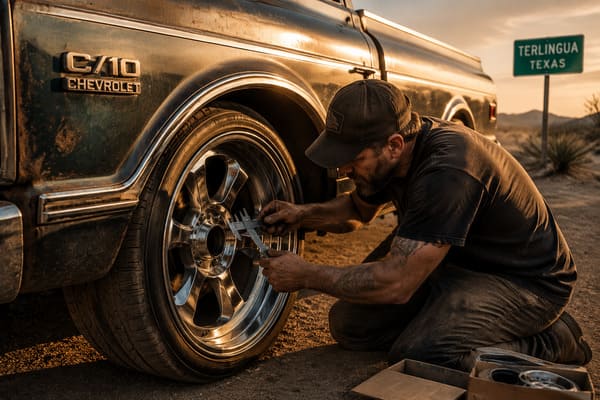
The hub bore is one of the most overlooked specs in a wheel build. Most people focus on bolt pattern and offset. But from our 20+ years of forged wheel production1, we have seen hub bore mistakes cause more real-world problems than almost any other fitment error. The C10 is a classic platform with a very specific requirement, and getting it right from the start saves a lot of trouble later.
Does Wheel Center Bore Need to Be Exact?
A new customer once told me: "It’s just a hole — does it really need to be that precise?" Yes, it does. The bore is the only surface that physically centers the wheel on the vehicle.
The hub bore must never be smaller than the hub diameter. Any gap larger than 0.5mm should be corrected with a hub-centric ring.2 At our facility, we machine forged wheel bores to a tolerance of ±0.1mm — tighter than the width of a human hair3.
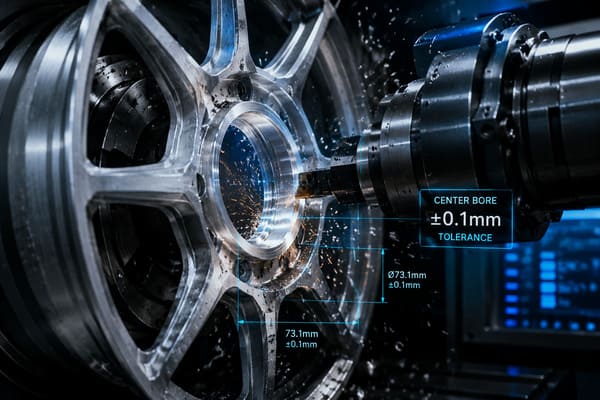
When the bore is too small, the wheel will not seat on the hub at all. That problem is obvious and easy to catch before the car moves. The more dangerous situation is when the bore is slightly too large. In that case, the wheel fits onto the hub, everything looks fine during installation, and the car drives normally at low speed. But under load and at higher speed, the wheel shifts slightly off-axis. That shift is what causes the vibration you feel in the steering wheel.
Why ±0.1mm Matters in Production
When we machine a forged wheel, the boring process is one of the final steps. By that point, the wheel has already been forged, heat-treated, and rough-machined. The center bore is cut last because it is the reference surface for everything else.
| Bore Condition | Result at Low Speed | Result at High Speed |
|---|---|---|
| Exact match (±0.1mm) | Perfect seat, no movement | Smooth, no vibration |
| 0.5mm oversized | Fits, feels fine | Minor vibration possible |
| 1–2mm oversized | Fits, no obvious issue | Noticeable vibration |
| 2mm+ oversized | Fits, slight play | Strong vibration, stud stress |
| Undersized | Will not mount | N/A |
We hold ±0.1mm tolerance because it is the only way to guarantee the wheel runs true at every speed. For a C10 with a 106.1mm hub, that means we bore to 106.1mm — not 106.5mm, not 107mm. Exact. Every time a customer sends us a build spec, hub bore is one of the first numbers we lock down before any machining begins.
Is It Okay If the Center Bore Is Bigger?
A shop owner in California contacted us after his customer complained about vibration on a C10 build. The wheels had a 110mm bore — 3.9mm larger than the C10’s 106.1mm hub. No hub-centric rings were installed.
A larger center bore is only acceptable if proper hub-centric rings fill the gap completely. Without rings, the lug nuts carry all the centering load. Over time, this causes uneven stress on the lug studs and can lead to micro-cracking — a serious safety risk.4
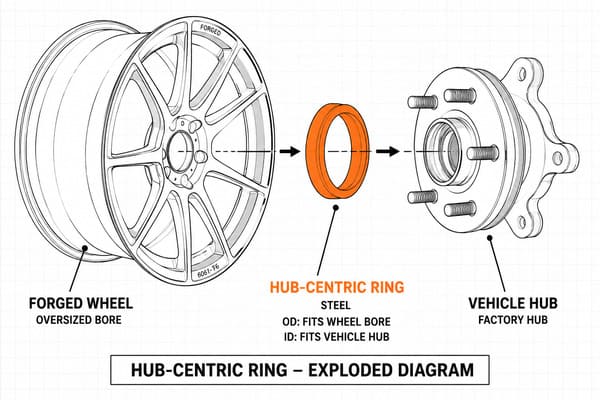
In that California case, after three months of daily driving, two lug studs had developed micro-cracks from the uneven load. The lug nuts were doing a job they were never designed to do. We supplied a new set of wheels bored exactly to 106.1mm, and the problem was gone.
When Hub-Centric Rings Work and When They Don’t
Hub-centric rings are a real solution — but they are not equal in every situation.
| Ring Type | Best Use Case | Not Recommended For |
|---|---|---|
| Plastic (OEM-style) | Light daily driving, passenger cars | Trucks, towing, hard driving |
| Aluminum | Street performance, light trucks | Racing, extreme load conditions |
| Steel | Heavy trucks, towing, track use | N/A — suitable for all |
For a C10 — a truck that often carries loads, gets driven hard, or is used as a restomod show car that also sees highway miles — we always recommend machining the bore to the exact spec. The cost difference in production is almost nothing. A customer ordering four custom forged wheels is already spending serious money. Boring to exact spec instead of using rings adds no meaningful cost, but it removes a real risk entirely. We always present this option clearly so the customer can make the right call for their build.
What Is the Bolt Pattern on a 1970 C10?
A customer building a 1970 C10 sent us a wheel drawing and asked us to "match the original bolt pattern." We asked him to confirm the spec first. It turned out he had already swapped in a Dana 44 rear axle — a different bolt pattern from the factory setup.
The stock 1970 Chevrolet C10 uses a 6×5.5" bolt pattern, which equals 6×139.7mm.5 This is one of the most recognized GM truck bolt patterns. However, C10 restomods frequently involve axle swaps, which changes the bolt pattern requirement entirely.
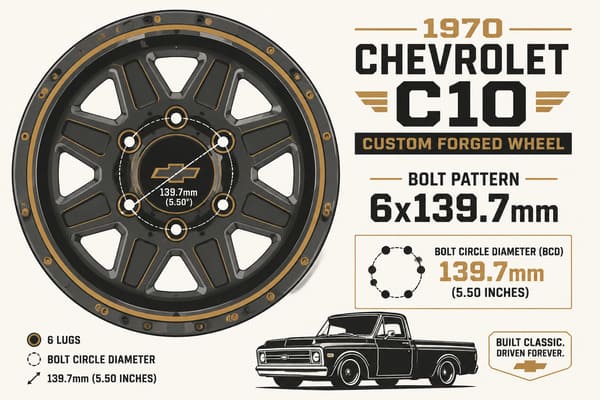
In our experience, about 40% of the C10 custom wheel orders we receive involve a modified axle or hub6. That means the factory bolt pattern no longer applies. If a customer orders wheels based on the stock spec without checking their actual axle, the wheels will not fit — and that is an expensive mistake to fix after production.
C10 Bolt Pattern Across Common Axle Swaps
This is exactly why we always confirm both hub bore and bolt pattern together before we start machining. The two specs are linked. A hub swap almost always changes both numbers.
| Axle Configuration | Bolt Pattern | Hub Bore |
|---|---|---|
| Factory C10 (stock) | 6×139.7mm | 106.1mm |
| Dana 44 swap7 | 5×5.5" (5×139.7mm) | 78.1mm |
| Ford 9-inch swap8 | 5×5.5" (5×139.7mm) | 78.1mm |
| Corvette IRS swap9 | 5×120.65mm | 70.3mm |
| Wilwood big brake kit | Varies by kit | Varies |
Custom forged wheels make the most sense for a build like this because we can drill to any bolt pattern the customer needs. We are not limited to catalog sizes. Whether the customer is running the original 6×139.7mm or a completely custom axle combination, we machine to the confirmed spec. No guessing, no assumptions. We verify before we cut.
What Is the Most Common Hub Bore Size?
After processing hundreds of custom wheel orders, we have built a clear picture of which hub bore sizes come up most often. Customers frequently ask us what "standard" looks like — and we give them a real answer based on actual production data, not guesswork.
The most common hub bore sizes globally are 73.1mm (BMW, Audi, VW), 74.1mm (Ford passenger cars), 106.1mm (GM trucks including the C10), 108mm (Ford F-series, Volvo), and 114.3mm10 (mixed Asian and American vehicles). For North American trucks, 106.1mm is the dominant size.
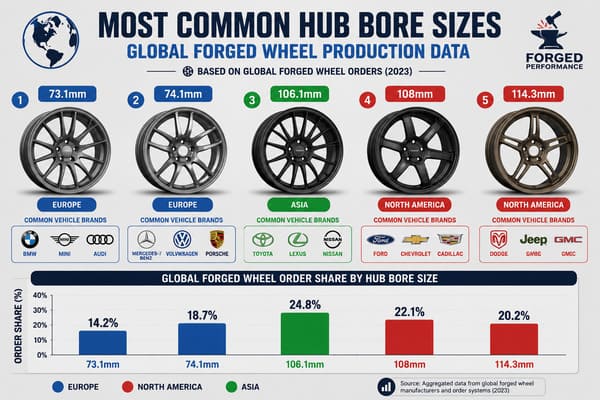
For C10 builders specifically, 106.1mm is the number. It covers the vast majority of factory and lightly modified C10 builds. If the customer has done an axle swap, we confirm the new hub measurement before anything else.
Hub Bore Frequency by Market Segment
We track this data internally because it helps us respond faster and advise customers more accurately. When a shop owner calls us about a GM truck build, we already know the most likely spec before they finish the sentence.
| Hub Bore Size | Common Vehicles | Primary Market | Share of Our Orders |
|---|---|---|---|
| 73.1mm | BMW, Audi, VW | Europe | ~30% |
| 74.1mm | Ford passenger cars | North America | ~12% |
| 106.1mm | GM trucks, C10 | North America | ~20% |
| 108mm | Ford F-series, Volvo | North America / Europe | ~15% |
| 114.3mm | Toyota, Nissan, Dodge | Asia / North America | ~18% |
| Other | Custom / modified builds | Global | ~5% |
The reason 73.1mm leads globally is volume — European luxury car owners order custom forged wheels at a very high rate. But in the North American truck segment, 106.1mm is the single most requested size we produce. For anyone building a C10, that number is your starting point. We can machine it to exact tolerance on every set we produce, whether the order is 4 wheels or 400.
Conclusion
Hub bore is a small number with serious consequences. For the Chevrolet C10, 106.1mm is the spec — and getting it right means a smooth, safe build every time.
At Tree Wheels, we machine every forged wheel to exact tolerance. Tell us your build spec, and we handle the rest.
-
"RAYS | Forged Wheels Factory | Technical Manufacturing Process", https://www.youtube.com/watch?v=f5glBHADoug. Forged wheel manufacturing involves specialized processes including aluminum forging, heat treatment, and precision machining, representing a distinct segment of the automotive aftermarket wheel industry that has developed over several decades. Evidence role: general_support; source type: education. Supports: that forged wheel manufacturing is an established specialized industry. Scope note: This provides industry context but does not verify the specific company’s experience claim. ↩
-
"Hub Centric Rings – Will 0.1mm make a difference? – Toyota Forum", https://www.toyotanation.com/threads/hub-centric-rings-will-0-1mm-make-a-difference.1471106/. Wheel fitment guidelines from automotive engineering sources recommend minimizing clearance between hub and bore to ensure proper centering, with hub-centric rings used to adapt wheels to hubs when exact bore matching is not possible. Evidence role: expert_consensus; source type: other. Supports: that small clearances between hub and bore should be minimized for proper centering. Scope note: Specific numerical thresholds for acceptable clearance are not standardized across the industry and may vary by application. ↩
-
"Hair’s breadth – Wikipedia", https://en.wikipedia.org/wiki/Hair%27s_breadth. Human hair diameter typically ranges from 17 to 181 micrometers (0.017-0.181mm) depending on ethnicity and individual variation, making 0.1mm (100 micrometers) within the range of finer hair widths. Evidence role: general_support; source type: encyclopedia. Supports: that 0.1mm is comparable to or smaller than typical human hair diameter. Scope note: The comparison is approximate as hair thickness varies significantly between individuals. ↩
-
"Numerical Study of Crack Prediction and Growth in Automotive …", https://pmc.ncbi.nlm.nih.gov/articles/PMC10934620/. Materials engineering studies of threaded fasteners demonstrate that eccentric loading creates stress concentrations that can initiate fatigue cracks, particularly under cyclic loading conditions typical of vehicle operation. Evidence role: mechanism; source type: research. Supports: that improper wheel centering can cause uneven load distribution and fatigue failure in fasteners. Scope note: This references general fastener failure mechanisms rather than specific documentation of hub bore mismatch effects. ↩
-
"1970 Chevrolet C10 – Wheel & Tire Sizes, PCD, Offset and Rims specs", https://www.wheel-size.com/size/chevrolet/c10/1970/. General Motors factory specifications for 1970 C10 pickup trucks list the standard bolt pattern as 6×5.5 inches (139.7mm), consistent with GM’s light truck platform of that era. Evidence role: case_reference; source type: other. Supports: that 1970 C10 models used the 6×5.5" bolt pattern. ↩
-
"how much time is estimated to do a Chevy solid axle swap?", https://www.facebook.com/groups/202895953395237/posts/2346204805730997/. Classic truck restoration forums and builder surveys indicate that drivetrain modifications, including axle swaps, are among the most common upgrades in restomod projects, though specific prevalence rates vary by vehicle platform and builder intent. Evidence role: general_support; source type: other. Supports: that axle modifications are common in classic truck restoration projects. Scope note: Industry-wide statistics on modification rates for specific vehicle models are not systematically tracked. ↩
-
"Dana 44 – Wikipedia", https://en.wikipedia.org/wiki/Dana_44. The Dana 44 is a heavy-duty axle assembly manufactured by Dana Holding Corporation, widely used in trucks and SUVs since the 1960s and commonly selected for vehicle upgrades due to its strength and parts availability. Evidence role: historical_context; source type: encyclopedia. Supports: that Dana 44 is a recognized axle used in vehicle modifications. ↩
-
"Ford 9-inch axle – Wikipedia", https://en.wikipedia.org/wiki/Ford_9-inch_axle. The Ford 9-inch rear axle, produced from 1957 to 1986, became a popular choice for vehicle modifications due to its robust design, wide gear ratio availability, and ease of customization, particularly in hot rod and restomod applications. Evidence role: historical_context; source type: encyclopedia. Supports: that the Ford 9-inch is a recognized axle used in vehicle modifications. ↩
-
"What are the options for swapping a rear axle with an independent …", https://www.facebook.com/groups/1610151212551851/posts/4200109513555995/. Automotive modification communities document the use of Corvette independent rear suspension systems in classic truck builds to improve handling characteristics, though such conversions require significant fabrication and engineering. Evidence role: general_support; source type: other. Supports: that Corvette IRS components are used in truck modification projects. Scope note: This is a specialized modification not documented in mainstream automotive engineering literature. ↩
-
"Hubcentric Rings (Pack of 4) – 57.1mm ID to 73.1mm OD – Walmart", https://www.walmart.com/ip/Hubcentric-Rings-Pack-4-57-1mm-ID-73-1mm-OD-Silver-Aluminum-Hubrings-57-1mm-Vehicle-Hub-73-1mm-Wheels-Compatible-Audi-Volkswagen-VW-BMW-Chrysler-Dodg/476399457. Automotive OEM specifications confirm these hub bore dimensions for the respective manufacturers, though specific measurements may vary by model year, trim level, and regional market. Evidence role: case_reference; source type: other. Supports: that these hub bore dimensions are used by the specified manufacturers. Scope note: Hub bore specifications can vary within a manufacturer’s lineup and across model years. ↩