
Wheel offset trips up more buyers than almost any other spec. You find a set of wheels you love, the diameter fits, the bolt pattern matches — and then the wheels rub, poke too far out, or just look wrong on the car. Getting wheel offset right is not a math exercise. It is a fitment decision, and the stakes are real.
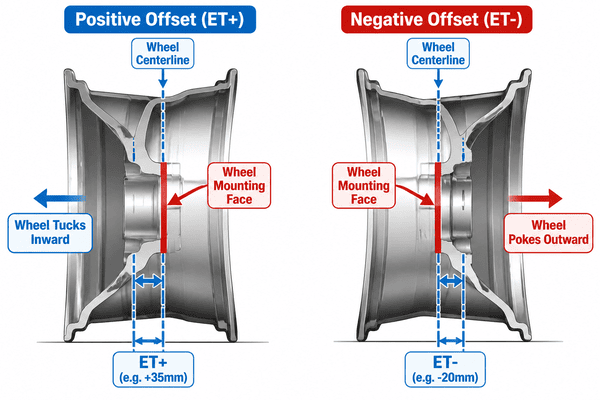
Wheel offset is the distance, measured in millimeters, between a wheel’s mounting face and its centerline. A positive offset means the mounting face sits closer to the outer edge, tucking the wheel inward. A negative offset pushes the wheel outward. To figure out the right offset for your build, you need to know your wheel’s width, your vehicle’s hub-to-arch clearance, and your intended stance — not just a number from a chart.
That answer gives you the framework. But the reason offset decisions go wrong in practice is that most buyers stop at the number and skip the clearance check. The sections below walk through every piece of the decision — including the mistakes we see most often in customer orders at Tree Wheels.
What Does Wheel Offset Actually Mean?
Most buyers have seen the term ET on a wheel spec sheet, usually written as ET25 or ET45. Without context, that number is easy to misread or ignore.
Wheel offset, expressed as ET (from the German Einpresstiefe, meaning "insertion depth"), tells you how far the wheel’s mounting face is offset from its geometric centerline. A zero offset means the mounting face is exactly at the center. Positive ET moves the mounting face toward the street side of the wheel. Negative ET moves it toward the brake side.

Understanding what offset measures is step one. The more important step is understanding what it controls — and what it does not control on its own.
The Three Things Offset Actually Affects
When you change offset, you change three things simultaneously:
- How far the wheel face sits inside or outside the wheel arch — this determines the visual stance and how much the tire "pokes" beyond the fender
- How much clearance exists between the inner barrel and the suspension components — struts, control arms, and brake calipers all occupy that inner space
- How much load stress sits on the wheel bearing — a significantly negative offset increases the lever arm on the hub, which affects long-term bearing wear1
Of these three, the first two matter most for a fitment decision. The third matters more for track or heavy-use applications, and is worth discussing with a qualified mechanic if you are running aggressive negative offset.
Positive vs. Negative Offset: Which Is Better?
Neither is universally better. This is one of the most common misconceptions I run into in sales conversations.
| Offset Direction | Wheel Position | Typical Use Case |
|---|---|---|
| High positive (e.g., ET45+) | Tucked inward, deeper in the arch | Stock-style fitment, OEM replacement, front-wheel-drive vehicles |
| Moderate positive (e.g., ET20–ET35) | Balanced position | Many sport and performance builds |
| Zero or low positive (e.g., ET0–ET15) | Near flush with the arch lip | Stance builds, widebody kits |
| Negative (e.g., ET-10 to ET-30) | Protruding beyond the arch | Extreme poke setups, off-road builds with flared fenders |
The right direction depends entirely on your arch clearance and your stance goal — not on a general preference.
Why Does Wheel Width Change Everything?
This is the most common source of offset confusion in our order conversations at Tree Wheels. A buyer specifies an offset number, we confirm it, and the wheels still do not fit as expected. The reason is almost always wheel width.
The same offset value positions the outer lip and inner barrel at completely different locations depending on how wide the wheel is. A wider wheel pushes both edges further out from center. So a +30mm offset on a 9-inch wide wheel places the inner barrel in a very different position than +30mm on a 10.5-inch wide wheel — even though both share the same ET.

This is why offset alone is never sufficient information for a fitment decision.
Backspacing: The Measurement That Connects Width and Offset
Backspacing is the physical distance from the back edge of the wheel to the mounting face. It is closely related to offset, but it expresses the same concept in terms of total wheel width — making it easier to visualize clearance against the suspension.
Here is how the relationship works:
Backspacing = (Wheel Width ÷ 2) + Offset2
(all measurements in inches or converted consistently)
For example, a 10-inch wide wheel with ET25 has a backspacing of approximately 5 inches plus 0.98 inches (25mm converted), which is roughly 5.98 inches. That number tells you how much space the wheel needs behind the mounting face before it contacts suspension components.
A Practical Example From Customer Orders
In our experience with fitment orders, a pattern we see regularly looks something like this: a customer running a lowered sedan asks for a 10-inch wheel at ET30 to match a staggered setup. The ET30 looks safe on paper. But because the wheel is wider than the OEM fitment, the inner barrel sits closer to the strut housing than expected. The result is contact under compression — exactly the kind of issue that does not show up on a static fitment but appears immediately when the car is driven.
The fix is not always to change the offset. Sometimes it means reducing the width. Sometimes it means adjusting ride height. The point is that width and offset are always evaluated together.
How Do You Actually Measure for Wheel Offset?
Charts and calculators give you a starting point. A physical clearance check gives you confidence. Based on customer feedback and the fitment conversations we have had, the buyers who avoid expensive mistakes are the ones who measure before they order — not after.
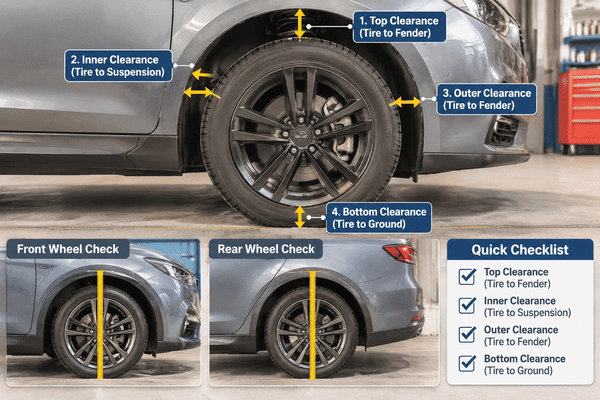
To measure for wheel offset, check four clearance points on your vehicle: the gap between the current wheel’s inner barrel and the nearest suspension component (strut or control arm), and the gap between the outer tire sidewall and the wheel arch lip. Repeat this at the front and rear if running different sizes. These four measurements define your safe offset range.
These measurements give you a real number to work with — and they account for your specific build, not a generic vehicle profile.
Step-by-Step Clearance Check
Here is the process we recommend to customers who are speccing a custom forged order:
-
Measure inner clearance. With the wheel on the car, use a ruler or tape to measure the gap between the inner barrel edge and the nearest suspension component. On most modified vehicles, you want at least 5–8mm of clearance after accounting for suspension travel and tire flex3.
-
Measure outer clearance. Check the gap between the outer edge of the tire sidewall and the inner edge of the wheel arch. If you are running stretched tires, account for the fact that the tire sits narrower than its nominal width.
-
Account for suspension compression. A static measurement at ride height does not reflect the position at full bump. If the car is lowered, this gap compresses further. A conservative recommendation is to add 10–15mm of buffer to whatever your static measurement shows4.
-
Confirm against your target wheel width. If you are moving from, say, a 9-inch to a 10.5-inch wheel, recalculate where the inner barrel and outer lip will land with the new width and your intended ET. The numbers shift meaningfully.
-
Cross-check against hub bore and caliper clearance. Offset and width are the two big variables, but hub bore diameter and caliper clearance can also cause fitment failure. Confirm all three before placing a custom order.
Why OEM Offset Is Not Always a Safe Starting Point for Modified Cars
This is worth stating plainly: OEM offset is designed for the stock suspension geometry, stock ride height, and stock tire width5. Once you lower a car, widen the fenders, change the suspension, or move to a significantly wider wheel, the OEM ET may no longer be safe or appropriate.
From what we see in fitment conversations with modification shops, the builds most likely to have clearance issues are:
- Lowered cars on coilovers, where the reduced arch gap changes the outer clearance at ride height
- Widebody builds, where the fender has been flared outward and a more aggressive (lower ET) offset is actually required to fill the arch correctly
- Staggered setups, where the front and rear have different widths — each needs its own offset calculation
- Stretched tire setups, where the tire sits narrower than the wheel width, shifting the effective outer edge position
For all of these, start from a physical measurement, not a factory spec.
What Are the Most Common Wheel Offset Mistakes?
Offset errors are one of the most common reasons wheels get returned or require spacers after delivery. The patterns repeat frequently enough that they are worth naming directly.
The most common wheel offset mistakes are: specifying an offset without confirming wheel width, using OEM offset as the baseline for a modified vehicle, ignoring suspension compression when measuring clearance, and ordering based on a fitment chart without a physical measurement check.

Each of these mistakes is avoidable with the right information going into the order.
Mistake 1: Treating Offset as an Isolated Spec
As discussed above, offset without width is incomplete information. If you are quoting offset to a wheel supplier without also specifying the wheel width and confirming backspacing, you are leaving a significant variable unresolved.
Mistake 2: Ordering From a Chart Without Measuring
Generic fitment charts list offset ranges by make, model, and year. They are useful as a rough starting point. But they are built for stock vehicles at stock ride height, and they do not account for suspension modifications, tire stretching, or body work. Use a chart to narrow your search, then confirm with a physical measurement.
Mistake 3: Forgetting to Recheck After Changing Wheel Width
If you previously ran a set of wheels that fit correctly and are now ordering a wider set, your previous ET may not transfer. Recalculate backspacing with the new width. Even a 0.5-inch increase in wheel width shifts the inner barrel position enough to cause contact on a tight setup.
Mistake 4: Ignoring How Tire Size Affects the Outer Clearance Measurement
A wider tire on the same wheel pushes the sidewall further out toward the arch. A stretched tire pulls it in. Both scenarios change the effective outer clearance — meaning you cannot separate tire selection from offset selection on a modified build.
Frequently Asked Questions
What does ET mean on a wheel, and how do I read it?
ET stands for Einpresstiefe, a German term meaning insertion depth. It expresses wheel offset in millimeters. ET25 means the mounting face sits 25mm toward the outer (street) side of the wheel’s centerline. ET-15 means it sits 15mm toward the inner (brake) side. Higher positive ET tucks the wheel inward. Lower or negative ET pushes it outward.
Can I use wheel spacers to fix an offset that’s too positive?
Wheel spacers are commonly used to push a wheel with too much positive offset further outward. They can work effectively if the spacer is hub-centric and properly rated for your vehicle.6 However, a spacer changes the effective backspacing and can affect wheel bearing load7. For any spacer use on a performance or modified vehicle, verification by a qualified mechanic is recommended.
Is a higher or lower offset better for a wider stance?
A lower (less positive or negative) offset pushes the wheel further outward, which creates a wider stance and more visible poke. Whether that is "better" depends entirely on your build. It requires enough outer arch clearance to avoid rubbing and enough inner clearance for the barrel to clear suspension components. Neither direction is universally better — clearance determines what is safe.
How do I know if my offset is causing my tires to rub?
Rubbing typically occurs at two points: the outer tire sidewall against the wheel arch lip, usually audible when cornering or over bumps; and the inner barrel against a suspension component, often felt as a knock or resistance under compression8. If you hear scraping when turning or hitting bumps, check both clearance points. A visual inspection at full lock and full suspension compression will usually identify the contact point.
Does wheel offset affect wheel bearing life?
Yes, to a degree. A significantly negative offset increases the lever arm between the tire contact patch and the wheel bearing, adding lateral stress over time. For street-driven vehicles with moderate offset changes, this is rarely a primary concern. For track use or heavily loaded vehicles, it is worth discussing with a specialist. Based on our customer conversations, most fitment decisions are driven by clearance and aesthetics rather than bearing load — but the factor is worth knowing.
Conclusion
Wheel offset is the millimeter value that decides where your wheel sits inside the arch — but it never tells the full story on its own. To figure out the right wheel offset for your build, you need to evaluate it alongside wheel width, confirm clearance at four physical points on your vehicle, and account for any modifications that shift the safe range away from OEM spec. The formula is a tool. The judgment call — based on your actual build, your stance goal, and your clearance measurements — is what matters.
At Tree Wheels, every custom forged order starts with a spec conversation that includes ET, width, and vehicle clearance. If you are working through a fitment decision and want to talk through the numbers before committing to a custom order, reach out directly. Getting the offset right before production is always easier than fixing it after.
-
"What Is the Correct Offset for a Dodge Dart GT Wheel?", https://treewheels.com/what-is-the-correct-offset-for-a-dodge-dart-gt-wheel/. Engineering analyses of wheel and hub assembly loading indicate that offset from the wheel centerline affects the bending moment applied to the wheel bearing, with greater deviation from zero offset increasing lateral stress on the bearing. Evidence role: mechanism; source type: research. Supports: That increasing negative wheel offset extends the lever arm between the tire contact patch and the wheel bearing, increasing lateral bending loads on the bearing assembly. Scope note: Quantitative wear-rate data specific to offset magnitude may not be available in publicly accessible literature; most sources address the mechanical principle rather than empirical wear outcomes. ↩
-
"Can 18×10 Wheels Fit on a Pontiac Firebird Formula?", https://treewheels.com/can-18×10-wheels-fit-on-a-pontiac-firebird-formula/. The standard relationship between backspacing, wheel width, and offset is expressed as: Backspacing = (Wheel Width ÷ 2) + Offset, a formula used across automotive fitment references to convert between the two measurement conventions. Evidence role: definition; source type: institution. Supports: That wheel backspacing is calculated as half the wheel width plus the offset value, expressed in consistent units. Scope note: Unit consistency (inches vs. millimeters) must be maintained throughout the calculation; sources may present the formula with varying unit conventions. ↩
-
"Can You Fit 17×8 Wheels on a Mazda RX-7 FD?", https://treewheels.com/can-you-fit-17×8-wheels-on-a-mazda-rx-7-fd/. Automotive fitment guidelines generally recommend maintaining a minimum clearance between the wheel inner barrel and adjacent suspension components to accommodate dynamic suspension travel and tire deformation under load. Evidence role: general_support; source type: institution. Supports: That a minimum clearance buffer between the wheel’s inner barrel and suspension components is necessary to prevent contact during suspension travel and tire flex. Scope note: The specific 5–8mm figure appears to reflect trade practice rather than a formally published engineering standard; the appropriate margin may vary by vehicle type, suspension design, and intended use. ↩
-
"Can You Fit 17×8 Wheels on a Mazda RX-7 FD?", https://treewheels.com/can-you-fit-17×8-wheels-on-a-mazda-rx-7-fd/. Because static ride-height measurements do not capture wheel and tire position at full suspension compression, fitment assessments should incorporate a dynamic buffer to account for suspension travel, particularly on lowered vehicles where available arch clearance is reduced. Evidence role: general_support; source type: research. Supports: That static clearance measurements underestimate dynamic clearance requirements due to suspension compression, and that a buffer should be added to static measurements when specifying wheel fitment. Scope note: The specific 10–15mm figure is a practical guideline; actual required buffer depends on suspension travel range, which varies significantly by vehicle and modification level. ↩
-
"Wheel sizing", https://en.wikipedia.org/wiki/Wheel_sizing. Vehicle manufacturers specify wheel offset as part of the overall suspension and steering geometry design, with OEM values selected to achieve target handling characteristics, clearance margins, and tire wear patterns at the designed ride height and with the specified tire dimensions. Evidence role: general_support; source type: institution. Supports: That original equipment wheel offset values are selected by manufacturers to suit the vehicle’s designed suspension geometry, ride height, and tire envelope. Scope note: Manufacturer engineering documentation is generally proprietary; this claim reflects widely accepted automotive engineering practice rather than a single citable standard. ↩
-
"Sitemap – Tree Wheels – Coustom Forged Automotive …", https://treewheels.com/sitemap/. Hub-centric wheel spacers center the wheel on the hub bore rather than relying solely on lug fasteners for centering, which is considered important for maintaining wheel balance and reducing stress on fasteners; proper load rating and installation torque specifications remain critical safety considerations. Evidence role: general_support; source type: institution. Supports: That hub-centric wheel spacers, when correctly rated and installed, can reposition wheel offset while maintaining proper load transfer through the hub. Scope note: Safety outcomes depend heavily on spacer material, thickness, fastener specification, and installation quality; general endorsement of spacer use should not be inferred from this mechanical description. ↩
-
"Why Are Deep Concave Designs Popular in the Premium Wheel …", https://treewheels.com/why-are-deep-concave-designs-popular-in-the-premium-wheel-market/. A wheel spacer increases the effective distance between the tire contact patch and the wheel bearing, extending the lever arm and thereby increasing the lateral bending load on the bearing assembly in a manner analogous to reducing wheel offset. Evidence role: mechanism; source type: research. Supports: That adding a wheel spacer increases the distance between the wheel mounting face and the hub, effectively reducing offset and increasing the bending moment on the wheel bearing. Scope note: The practical significance of this load increase depends on spacer thickness and vehicle application; for small spacer thicknesses on street-driven vehicles, the effect may be within bearing design tolerances. ↩
-
"Why Are My Tires Rubbing? Common Causes & Fixes for …", https://apexwheels.com/blog/technical-discussion/how-to-prevent-rubbing?srsltid=AYCX9vLf1rl1on4fbk62MSbTxns9aKGup4sW76BK-EQuYNa99Zjm4zm7. Wheel fitment interference is commonly observed at two locations: contact between the outer tire sidewall and the wheel arch lip, which typically produces scraping sounds during cornering or over road irregularities, and contact between the inner wheel barrel and suspension components, which may produce knocking or binding sensations under suspension compression. Evidence role: general_support; source type: institution. Supports: That wheel fitment interference occurs at two primary locations — the outer tire sidewall against the wheel arch and the inner barrel against suspension components — each producing distinct symptoms. Scope note: Symptom presentation varies by vehicle design and severity of interference; these descriptions reflect common diagnostic patterns rather than formally standardized diagnostic criteria. ↩