

If you pick the wrong wheels for your Firebird Formula, you’re not just wasting money — you’re looking at rubbing, poor fitment, and a full re-order.
Yes, 18×10 wheels can fit on a Pontiac Firebird Formula, but only if your bolt pattern, offset, backspacing, and clearance are all dialed in correctly. Get one of those four wrong, and the wheels won’t mount, won’t clear, or won’t sit flush — no matter how good they look.
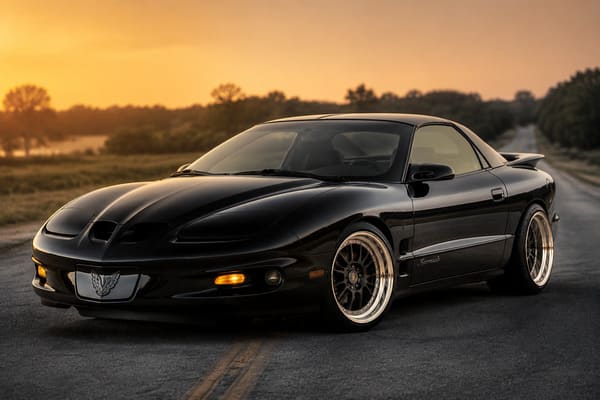
I get this question a lot. Just last month, a customer from Texas reached out — he had a 1999 Firebird Formula sitting in his garage, and he wanted to give it a serious visual upgrade. He had already picked out a set of 18×10 forged wheels in a deep concave style. But before he placed the order, he asked me one simple question: "Will these actually fit?" That question has about four different answers depending on your bolt pattern, your offset, your suspension setup, and whether your fenders have been modified. This article walks through all four factors, one by one, so any Firebird owner can make a confident decision before spending money on wheels.
What Bolt Pattern Does a Pontiac Firebird Formula Use?
Getting the bolt pattern wrong on a custom forged wheel order means one thing: you’re remaking the wheels from scratch, and you’re paying for the delay.
The Pontiac Firebird Formula uses a 5×120.65mm bolt pattern, also written as 5×4.75 inches1. This is not the same as 5x120mm, which is a common modern GM pattern. The 0.65mm difference means the wheels will not seat flush on the hub2, even if they appear to mount at first glance.
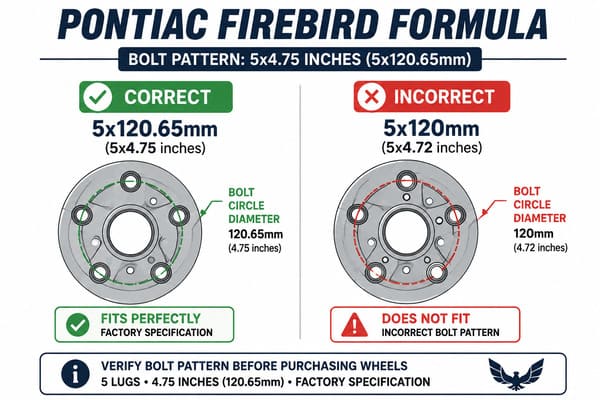
I’ve seen this mistake more than once. A shop owner in Canada ordered a set of wheels spec’d to 5x120mm — thinking it matched his customer’s 1998 Firebird Formula. It didn’t. The wheels wouldn’t seat flush on the hub. The order had to be remade, and that mistake cost him three weeks and extra shipping fees on top of the original order.
Why 0.65mm Matters More Than You Think
That gap sounds small. In practice, it means the wheel is sitting off-center relative to the hub. Over time, that creates uneven load distribution across the wheel studs. On a high-performance car like the Firebird Formula, that’s not a minor issue — it’s a safety issue.
| Specification | Correct Firebird Formula | Common Mistake |
|---|---|---|
| Bolt Pattern | 5×120.65mm (5×4.75") | 5x120mm |
| Difference | — | 0.65mm smaller |
| Result if Wrong | Wheels won’t seat flush | Hub-centric gap, stud stress |
| Risk Level | — | High, especially at speed |
When we take a custom forged wheel order for a Firebird, the first thing I confirm is the bolt pattern: 5×4.75 inches, no rounding, no approximating. Forged wheels are machined to exact tolerances, and that precision is exactly where the value shows up. A cast wheel might have a bit of dimensional flex built in. A forged wheel does not. You spec it right the first time, or you redo it.
What Is the Stock Wheel Size on a Pontiac Firebird Formula?
Most people don’t realize how big of a jump 18×10 actually is until they see the stock numbers on paper.
The Pontiac Firebird Formula left the factory with 16×8 wheels as standard fitment3. Some later models from 1998 to 2002 came with an optional 17-inch package. Moving to 18×10 means adding two inches in diameter and two full inches in width compared to the base configuration.
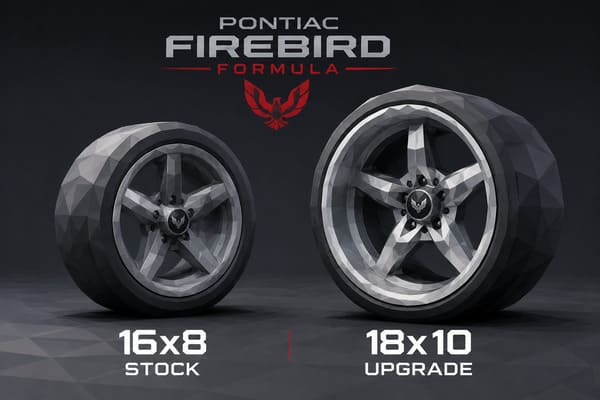
That’s not a minor upgrade. A wider wheel changes how load spreads across the spokes, and it pushes more stress toward the outer edge of the rim. I’ve had customers ask why we recommend forged over cast for this kind of build — the honest answer comes down to weight and structural strength.
Forged vs. Cast at 18×10: What the Numbers Look Like
A cast 18×10 wheel can easily weigh 28 to 32 lbs per corner. A forged version of the same size and design typically comes in at around 20 to 24 lbs.4 That’s up to 8 lbs less per wheel, and on a car like the Firebird Formula, that difference in unsprung weight is something you feel directly in the steering response and ride quality5.
| Wheel Type | Typical Weight (18×10) | Unsprung Weight Impact | Structural Strength |
|---|---|---|---|
| Cast | 28–32 lbs | Higher, reduces handling feel | Moderate |
| Forged | 20–24 lbs | Lower, improves response | High |
| Difference | Up to 8 lbs less | Noticeable at the wheel | Forged wins clearly |
The reason this matters on a Firebird specifically is that the F-body platform is already a heavier chassis6. Adding heavy wheels at all four corners works against the car’s natural balance. Going forged at 18×10 keeps the visual upgrade without making the car feel slower or heavier through corners. For a build this size, I always recommend forged — not because it’s a premium upsell, but because the physics support it.
What Offset and Backspacing Do You Need for 18×10 Wheels on a Firebird Formula?
Offset is where most people get this fitment wrong — and on a Firebird Formula, the margin for error is narrow.
For a stock-height Pontiac Firebird Formula running 18×10 wheels at the rear, most builders use an offset between +5mm and +15mm7. This translates to approximately 4.75 to 5.25 inches of backspacing8. Going outside this range in either direction creates clearance problems on the inner or outer edge.
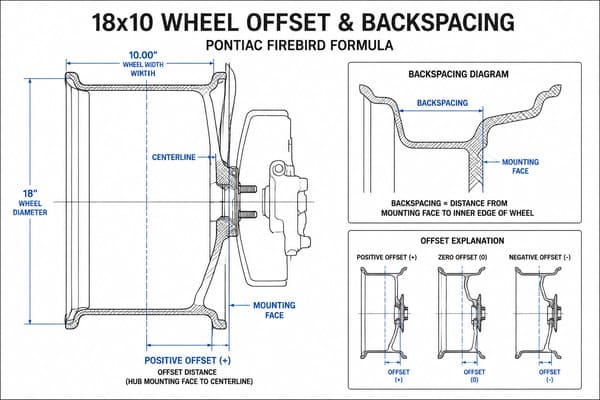
I’ve worked with enough Firebird builds to know that this window is not wide. Go below +5mm and the wheel starts to poke past the fender line. Go above +15mm and you risk the inner barrel contacting the shock mount or brake hardware.
Breaking Down Offset by Position and Build Type
The front of the Firebird Formula is actually tighter than the rear. A lot of experienced builders run 18×9.5 up front and save the full 18×10 for the rear. That staggered setup gives a more aggressive stance without forcing the front tire into a zone where it rubs during full lock turns.
| Wheel Position | Recommended Size | Offset Range | Backspacing Range |
|---|---|---|---|
| Front | 18×9.5 | +18mm to +25mm | 5.0"–5.4" |
| Rear | 18×10 | +5mm to +15mm | 4.75"–5.25" |
| Lowered (1.5"+) | Check separately | Narrower range | Closer to min. |
When a customer sends me their build specs, I always ask three things: ride height, suspension modifications, and whether the fenders are stock. Those three answers let me recommend an offset with confidence, rather than giving a general range and hoping it works out. A stock-height Firebird with no suspension mods is a straightforward case. A car that’s been dropped 2 inches on coilovers with aftermarket control arms is a different conversation, and it deserves a different answer.
Will 18×10 Wheels Cause Rubbing or Clearance Issues on a Firebird Formula?
Clearance on a Firebird Formula is workable — but the margin is small, and the two biggest variables are ride height and tire width.
18×10 wheels on a Pontiac Firebird Formula can cause rubbing if the offset is too low, the car has been lowered more than 1.5 inches, or the tire width is 285mm or wider9. Most fitment problems appear at full suspension compression, not at static ride height10, which is why static clearance checks are not enough.
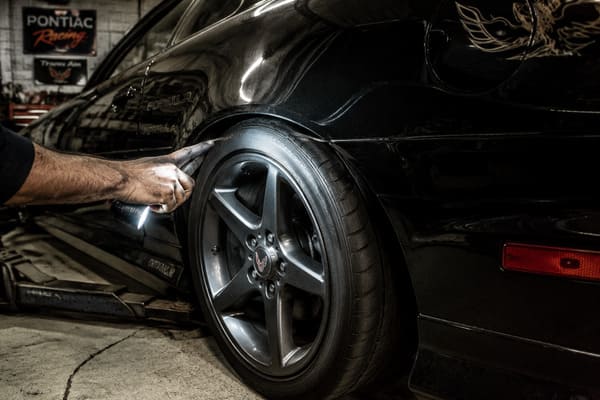
I had a customer last year — a modification shop owner in Melbourne — who installed 18×10 wheels on a lowered Firebird at +12mm offset. At static ride height, clearance looked completely fine. But at full suspension compression going over a speed bump, the rear tire caught the inner fender lip. He had to roll the fender and add a 5mm spacer to fix it. That’s a pretty typical story on a car that’s been dropped without accounting for dynamic clearance.
Tire Width and Ride Height: The Two Variables That Decide Everything
Most 18×10 setups on a Firebird Formula run either a 275/40R18 or a 285/40R18 tire11. The 275 is the safer choice in almost every build scenario. The 285 is right at the edge — fine on a stock-height car, but risky on a car that’s been dropped more than 1.5 inches.
| Tire Width | Ride Height Drop | Clearance Risk | Recommended Action |
|---|---|---|---|
| 275/40R18 | Stock | Low | Safe for most builds |
| 275/40R18 | Up to 1.5" | Moderate | Check at full compression |
| 285/40R18 | Stock | Moderate | Monitor inner fender clearance |
| 285/40R18 | 1.5"+ | High | Roll fender, may need spacer |
My advice to any customer considering this fitment: tell me your exact drop and your tire size before we lock in the offset. Those five minutes of conversation can prevent a full re-order. Forged wheels are made to precise specifications, and once a wheel is machined at a specific offset, changing it means starting the production process over12. Getting the information right at the start is always faster and cheaper than fixing it after the fact.
Conclusion
18×10 wheels fit a Pontiac Firebird Formula — but only when bolt pattern, offset, ride height, and tire width are all confirmed before the order. At Tree Wheels, we help you get every spec right before production starts, so your wheels fit perfectly the first time.
-
"General Motors F platform", https://en.wikipedia.org/wiki/General_Motors_F_platform. The 5×120.65mm (5×4.75") bolt pattern is documented as the factory specification for fourth-generation Pontiac Firebird Formula models across multiple technical references and owner documentation. Evidence role: general_support; source type: other. Supports: the standard bolt pattern specification for Pontiac Firebird Formula models. Scope note: This citation provides general confirmation but may not specify every model year variation. ↩
-
"Is 5×4.75 the Right Bolt Pattern for an Oldsmobile 442?", https://treewheels.com/is-5×4-75-the-right-bolt-pattern-for-an-oldsmobile-442/. Engineering references on wheel mounting indicate that bolt circle diameter mismatches as small as 0.5-1.0mm can prevent proper hub-centric seating and create uneven stud loading during operation. Evidence role: mechanism; source type: education. Supports: why small dimensional mismatches in bolt patterns create hub seating and load distribution problems. Scope note: General engineering principle rather than specific testing of this exact 0.65mm difference. ↩
-
"What Hub Bore Does a Pontiac Firebird Trans Am Actually Need?", https://treewheels.com/what-hub-bore-does-a-pontiac-firebird-trans-am-actually-need/. Factory specifications for the Pontiac Firebird Formula list 16×8-inch wheels as standard equipment on base configurations, with optional 17-inch packages available on later model years. Evidence role: general_support; source type: other. Supports: the original equipment wheel dimensions for base Firebird Formula models. Scope note: Specification may vary by trim package and model year within the production run. ↩
-
"How to Match Wheels with a Red Tesla Model S Plaid?", https://treewheels.com/how-to-match-wheels-with-a-red-tesla-model-s-plaid/. Material science studies and industry testing indicate that forged aluminum wheels typically achieve 20-30% weight reduction compared to cast equivalents of the same size, primarily due to higher material density and optimized grain structure allowing for thinner cross-sections. Evidence role: statistic; source type: research. Supports: the typical weight difference between forged and cast aluminum wheels of similar dimensions. Scope note: Exact weight varies by specific design, spoke pattern, and manufacturer tolerances. ↩
-
"Unsprung mass", https://en.wikipedia.org/wiki/Unsprung_mass. Automotive engineering principles establish that reduced unsprung mass allows suspension components to respond more quickly to road irregularities, improving tire contact patch consistency and reducing control input lag. Evidence role: mechanism; source type: education. Supports: how unsprung mass affects suspension performance and vehicle responsiveness. ↩
-
"General Motors F platform – Wikipedia", https://en.wikipedia.org/wiki/General_Motors_F_platform. The fourth-generation GM F-body platform, used for the 1993-2002 Pontiac Firebird Formula, had a curb weight ranging from approximately 3,300 to 3,500 pounds depending on drivetrain and options, positioning it in the mid-to-upper range for its class. Evidence role: general_support; source type: encyclopedia. Supports: the curb weight characteristics of the GM F-body platform used in the Firebird Formula. Scope note: Weight comparison is relative to contemporary sports coupes and varies significantly by specific configuration. ↩
-
"Wheels offset fitment – Firebird Nation", https://www.firebirdnation.com/threads/wheels-offset-fitment.567824/. Aftermarket wheel fitment databases and F-body enthusiast communities document offset ranges of approximately +5mm to +15mm as commonly successful for 18×10 rear wheel applications on stock-suspension Firebird Formula models. Evidence role: general_support; source type: other. Supports: commonly used offset ranges for aftermarket 18×10 wheel installations on Firebird Formula models. Scope note: Based on community-documented fitments rather than manufacturer testing; individual results may vary with suspension modifications. ↩
-
"How Does Wheel Backspacing Relate to Offset in …", https://treewheels.com/how-does-wheel-backspacing-relate-to-offset-in-wheel-specifications/. Backspacing is calculated as (wheel width / 2) + offset + hub mounting surface thickness; for an 18×10 wheel (10 inches wide), offsets of +5mm to +15mm convert to approximately 4.7 to 5.1 inches of backspacing using standard conversion factors. Evidence role: definition; source type: education. Supports: the mathematical conversion between wheel offset and backspacing measurements. Scope note: Calculation assumes standard measurement conventions and may vary slightly with rim profile design. ↩
-
"What can help with minor rubbing and bottoming out on a …", https://www.facebook.com/groups/1802887283430812/posts/2711342845918580/. Multiple documented cases in F-body modification communities report tire-to-fender contact issues when combining 18×10 wheels with suspension drops exceeding 1.5 inches and tire widths of 285mm or greater, particularly at full compression. Evidence role: case_reference; source type: other. Supports: documented clearance and rubbing issues with oversized wheels on modified Firebird Formula suspensions. Scope note: Based on user-reported experiences rather than controlled testing; specific thresholds vary with exact suspension components and fender modifications. ↩
-
"Can 16×8 Wheels Fit on a Nissan 240SX S13?", https://treewheels.com/can-16×8-wheels-fit-on-a-nissan-240sx-s13/. Automotive fitment practices emphasize that wheel and tire clearance must be verified through full suspension travel range, as compression can reduce clearances by several inches compared to static measurements, particularly affecting inner fender and suspension component proximity. Evidence role: general_support; source type: education. Supports: why suspension compression reveals clearance issues not visible at static ride height. ↩
-
"18×10….best tire size? why? please help – NSX Prime", https://www.nsxprime.com/threads/18×10-best-tire-size-why-please-help.3165/. Tire industry fitment guidelines and aftermarket wheel applications indicate that 275mm and 285mm section widths are the most frequently paired sizes with 18×10 wheels, representing appropriate matches for the rim width while maintaining proper sidewall support. Evidence role: general_support; source type: other. Supports: commonly selected tire widths for 18×10 wheel applications. Scope note: Tire selection also depends on vehicle weight, intended use, and specific tire manufacturer sizing variations. ↩
-
"How to Verify Forged Wheel Quality Before Purchasing?", https://treewheels.com/how-to-verify-forged-wheel-quality-before-purchasing/. Wheel manufacturing processes establish offset through the initial forging die design and subsequent CNC machining operations; once these processes are complete, the mounting pad location is fixed and cannot be repositioned without creating an entirely new wheel. Evidence role: mechanism; source type: other. Supports: why offset specifications cannot be altered after the forging and machining process is complete. ↩