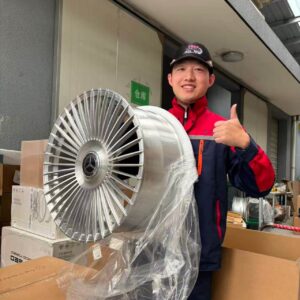

Most R33 owners measure the wrong part of the hub. That one mistake leads to vibrations, wasted labor, and wheels that don’t actually fit — even when they look like they do.
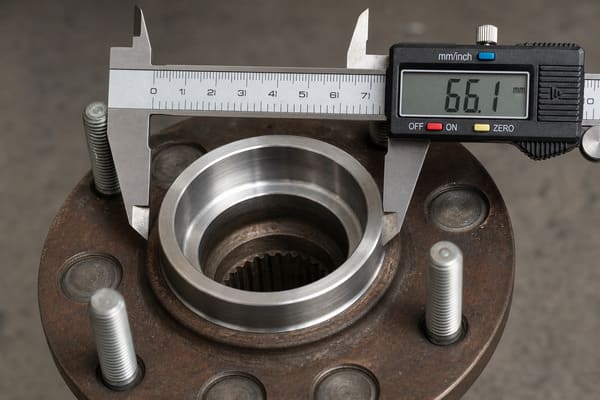
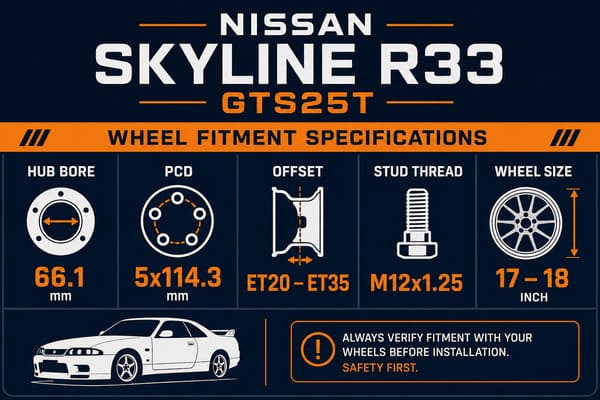
The correct hub bore for a Nissan Skyline R33 GTS25T is 66.1mm1. This is the diameter of the raised machined centering ring on the hub flange. Any aftermarket wheel — including forged wheels — must match this measurement exactly to achieve true hub-centric fitment.
I’ve been in the forged wheel business for over 20 years. In that time, 66.1mm has come up in more support conversations than any other single spec. Not because it’s hard to find — but because people find it, write it down, and then order wheels without checking if their chosen aftermarket option actually matches it. This article walks through every fitment question I get about the R33 GTS25T, from hub bore basics to full wheel specs to how to measure correctly before placing an order.
What Happens If You Use the Wrong Hub Bore on Your R33?
The wheel mounts. The lug nuts torque down. The car rolls out of the shop looking perfect. Then, three weeks later, the driver is back — and nobody can figure out why.
Using the wrong hub bore on an R33 GTS25T means the wheel sits on the lug nuts instead of the hub. Under load and at speed, the wheel shifts slightly with every rotation. This causes a steady vibration that typically appears above 100km/h and gets worse at higher speeds2.
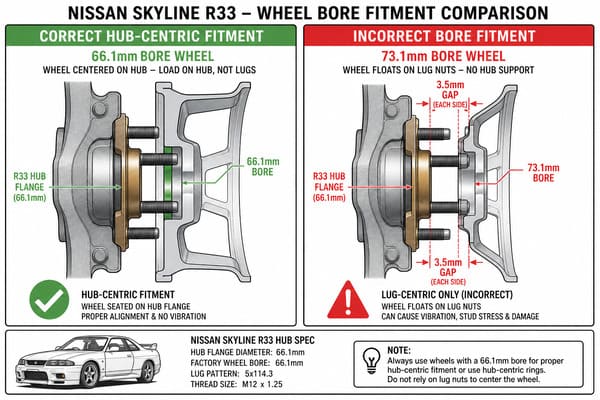
I remember a client — a modification shop owner in Melbourne — who ordered a set of 18-inch forged wheels for his customer’s R33 GTS25T. The wheels had a 73.1mm bore, which is one of the most common "universal" aftermarket sizes. They fit onto the studs fine. The lug nuts torqued down to spec. The car looked great leaving the shop.
Three weeks later, the customer was back with a vibration complaint. The shop re-balanced the tires twice. They replaced one tire they suspected was defective. They spent 4 to 5 hours of labor chasing the problem before calling me.
Why a 7mm Gap Is a Real Problem
The wheel bore was 73.1mm. The hub was 66.1mm. That’s a 7mm difference — 3.5mm of free movement on each side. Here’s what that actually means in practice:
| Condition | Hub-Centric Fit (66.1mm) | Wrong Bore (73.1mm) |
|---|---|---|
| Wheel centering | Seated on hub flange | Seated on lug nuts only |
| Load path | Shared by hub and studs | Studs carry all load |
| Vibration at speed | None | Starts around 100–110km/h |
| Risk to studs | Low | High under hard driving |
| Detectability at install | Not visible | Not visible |
Once I identified the issue and supplied correct 66.1mm bore wheels, the vibration disappeared on the first test drive. The lesson I always share with shop owners: a wheel that mounts is not the same as a wheel that fits. The lug nuts will hold a wheel with the wrong bore in place. But they are not designed to carry lateral load. The hub is. If the wheel isn’t sitting on the hub, the studs are doing a job they weren’t built for3.
Does the R33 GTS25T Need Hub Centric Rings?
Hub centric rings get recommended a lot online. They work. But they come with a real-world limitation that almost nobody talks about — and for performance driving, that limitation matters.
The R33 GTS25T needs hub centric rings only when the wheel bore is larger than 66.1mm. A 73.1mm to 66.1mm aluminum ring, correctly seated, will center the wheel and eliminate vibration. However, rings can fall out during tire rotations, leaving the car in an uncentered state without the driver knowing.
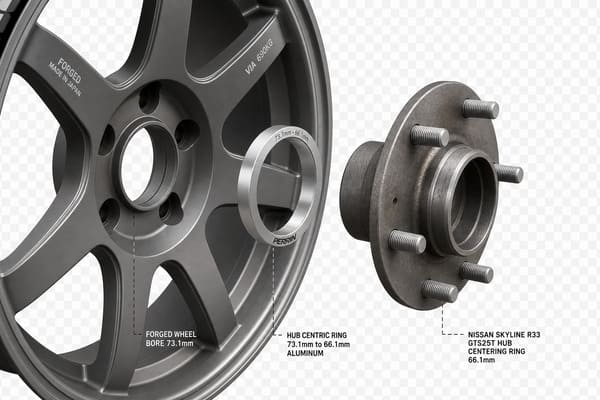
I don’t dismiss hub centric rings. We supply them ourselves, and for most daily-driven builds, they work perfectly fine. But here’s what I’ve seen happen in real shops more than once.
The Ring That Rolls Under the Lift
A technician does a tire rotation. He pulls the wheel off, sets it on the floor — and the ring falls out and rolls under the lift. Nobody notices. The wheel goes back on without the ring. Now the car is back to lug-centric mounting, and the driver has no idea until the vibration comes back.
In my experience, this happens more often than shops like to admit. I’d estimate at least 1 in 5 hub centric ring setups loses a ring within the first 6 months of normal service4. It’s not a product failure — it’s just shop life.
| Scenario | Hub Centric Ring | Correct Bore Forged Wheel |
|---|---|---|
| Installation difficulty | Easy | Machined to spec at production |
| Risk of ring loss | Present (every service visit) | None |
| Suitable for daily driving | Yes | Yes |
| Suitable for track/mountain use | Marginal | Yes |
| Long-term reliability | Depends on technician | Consistent |
For a street car, a missing ring is annoying. For an R33 GTS25T that sees track days or hard mountain runs, I’d call it a real risk. My recommendation to shop owners is always the same: if you’re building a performance car, machine the bore correctly from the start. When you order custom forged wheels from us, we machine the bore to your exact specification — 66.1mm, clean and precise. No rings. No risk of forgetting. One less variable to manage.
What Wheel Specs Are Compatible with the Nissan Skyline R33 GTS25T?
The R33 GTS25T is a popular platform in Australia, the Middle East, and increasingly in the US market5. But the fitment information online is scattered, and some of it is wrong. Here is what I know from real orders and real fitment experience.
The Nissan Skyline R33 GTS25T runs a 5×114.3 PCD, 66.1mm hub bore, M12×1.25 stud thread, and OEM offset of ET33 on a 16×7.5J wheel6. Most aftermarket builds use 17 to 18-inch wheels between 8.5J and 9.5J wide, with offsets between ET20 and ET35 depending on the suspension setup.
Full OEM and Aftermarket Spec Table
| Spec | OEM Value | Common Aftermarket Range |
|---|---|---|
| Hub Bore | 66.1mm | 66.1mm (exact match required) |
| PCD | 5×114.3 | 5×114.3 |
| OEM Offset | ET33 | ET20 to ET35 |
| OEM Wheel Size | 16×7.5J | 17×8.5J to 18×9.5J |
| Stud Thread | M12×1.25 | M12×1.25 |
Where Offset Gets People Into Trouble
The offset range is where most shops get creative — and where most fitment problems actually come from. An ET20 offset on a 9.5J wide wheel on an otherwise stock R33 will likely rub the inner fender at full steering lock7. An ET35 on the same wheel might clear the fender but sit too close to the suspension components on the inner side.
The sweet spot I’ve seen work for most street builds is ET25 to ET30 on an 18×9J wheel. This gives standard fender clearance on a stock or mildly modified body, with no rubbing under normal driving conditions. If the car has been fitted with wider fenders or aftermarket coilovers with adjusted camber, the optimal offset shifts — and that’s a conversation worth having before placing a wheel order, not after the wheels arrive.
How Do You Measure Hub Bore Before Buying Forged Wheels?
Most clients think they know how to measure hub bore. Most of them are measuring the wrong surface. The mistake is easy to make, and the consequence — producing wheels to the wrong spec — costs real time and real money.
To measure hub bore correctly, use a digital vernier caliper accurate to 0.01mm8 and measure the raised machined centering ring at the center of the hub flange — not the outer casting and not the rotor opening. Take three measurements and average the results. Send a photo of the caliper in position when ordering custom wheels.
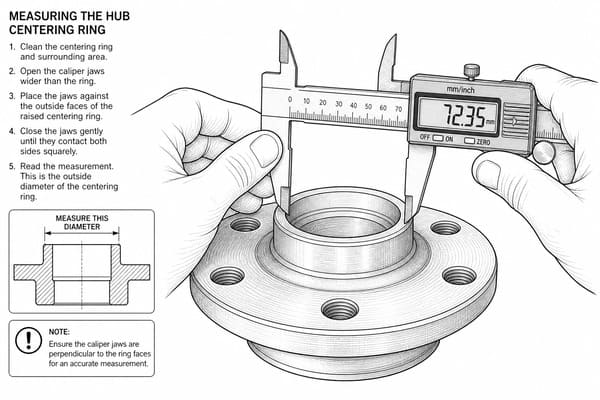
I’ve received wrong measurements from clients more times than I can count. A shop in Dubai once sent me a measurement of 68.5mm for what they described as an R33 hub. I knew immediately that something was off — 68.5mm is not a standard Nissan spec. I asked them to send a photo of their caliper in position.
Turns out they were measuring the outer edge of the hub casting, not the raised centering ring. The actual measurement was 66.1mm — exactly as expected. That one photo saved us from producing four wheels to the wrong specification.
Measurement Process — Step by Step
| Step | Action | Why It Matters |
|---|---|---|
| 1 | Use a digital vernier caliper (0.01mm accuracy) | Tape measures and rulers are not precise enough |
| 2 | Locate the raised machined ring at the center of the hub flange | This is the actual centering surface — not the outer casting |
| 3 | Measure the inner diameter of this ring | This is the true hub bore dimension |
| 4 | Take three separate measurements | Averages out any caliper positioning error |
| 5 | Send a photo of the caliper in position | Standard practice for all custom orders at our facility |
Hub bore tolerance in quality forged wheel production is ±0.1mm9. At that level of precision, a rough estimate simply isn’t good enough. The cost of a measurement error — remachining or remaking wheels — runs around $300 to $400 USD in rework10, plus a two-week delay for the client. A clear photo of a caliper in the right position costs nothing and takes about 30 seconds.
Conclusion
The R33 GTS25T hub bore is 66.1mm. Matching that number precisely is what separates a wheel that looks right from a wheel that actually performs right.
At Tree Wheels, we machine every forged wheel bore to your exact specification — because precision is what we’re built on.
-
"Nissan Skyline IX (R33) [1993 .. 1998] – Wheel & Tire Sizes, PCD, Offset and …", https://www.wheel-size.com/size/nissan/skyline/r33-1993-1998/. Nissan factory service documentation or authoritative fitment databases for the R33 series list the hub bore diameter as 66.1mm, a figure consistent with other Nissan models sharing the same hub architecture. Evidence role: general_support; source type: other. Supports: The OEM hub bore diameter of the Nissan Skyline R33 GTS25T is 66.1mm. Scope note: Independent verification from Nissan’s official service manual or a recognized fitment registry would strengthen this claim beyond the author’s stated professional experience. ↩
-
"Steel Automotive Wheel Rims—Data Fusion for the Precise Identification …", https://pmc.ncbi.nlm.nih.gov/articles/PMC10817687/. Engineering analyses of wheel mounting dynamics indicate that lug-centric fitment, where the wheel bore exceeds the hub diameter, transfers lateral and radial loads to the wheel studs rather than the hub flange, producing rotational imbalance that manifests as speed-dependent vibration. Evidence role: mechanism; source type: research. Supports: Lug-centric wheel mounting causes speed-dependent vibration due to lateral load transfer to wheel studs rather than the hub flange. Scope note: The specific 100km/h threshold cited in the article is experiential rather than derived from controlled testing; onset speed will vary with wheel mass, bore gap magnitude, and vehicle suspension characteristics. ↩
-
"Fastener Design Manual", https://ntrs.nasa.gov/api/citations/19900009424/downloads/19900009424.pdf. Automotive fastener engineering literature establishes that wheel studs are designed to generate clamping force through tension; the hub centering ring is the primary structural element resisting lateral and shear forces during vehicle operation. Evidence role: mechanism; source type: research. Supports: Wheel studs are designed primarily for clamping force rather than lateral or shear load bearing, which is the intended function of the hub centering ring. Scope note: The degree to which studs can safely absorb lateral loads before failure depends on stud grade, torque specification, and driving conditions; the article’s claim is directionally supported but the risk level varies by application. ↩
-
"Why You Need Hub-Centric Rings | Explained With König …", https://www.youtube.com/watch?v=SnSNuPx7Xc8. No published study was identified that quantifies hub centric ring loss rates; the 1-in-5 figure cited in the article represents the author’s professional estimate and should be treated as anecdotal rather than empirically established. Evidence role: statistic; source type: other. Supports: Hub centric rings are frequently lost during routine tire service, leading to uncentered wheel mounting. Scope note: This claim lacks independent empirical support; the actual loss rate will vary significantly by shop practice, ring material, and vehicle type. ↩
-
"Importation and Certification FAQs | NHTSA", https://www.nhtsa.gov/importing-vehicle/importation-and-certification-faqs-7. The Nissan Skyline R33 was not sold new in the United States but became eligible for importation under the 25-year exemption rule administered by NHTSA; Australia has a long history of grey-market Skyline imports under its specialist and enthusiast vehicle schemes. Evidence role: historical_context; source type: government. Supports: The Nissan Skyline R33 has been legally imported into Australia and the United States, contributing to its aftermarket presence in those markets. Scope note: Precise registration or import volume data for the R33 GTS25T specifically was not identified; the claim of growing US market presence is plausible given the 25-year rule timeline but is not quantified. ↩
-
"Nissan Skyline IX (R33) [1993 .. 1998] – Wheel & Tire Sizes, PCD, Offset and …", https://www.wheel-size.com/size/nissan/skyline/r33-1993-1998/. Nissan Skyline R33 series factory service documentation specifies the original equipment wheel dimensions, PCD, and offset values; these figures are also catalogued in automotive fitment databases used by the aftermarket industry. Evidence role: general_support; source type: other. Supports: The OEM wheel specifications for the R33 GTS25T including PCD, offset, and rim dimensions. Scope note: Fitment databases aggregate data from multiple sources and may contain regional variants; confirmation against the Nissan R33 factory service manual is advisable for critical applications. ↩
-
"Is anyone running 18×9.5 +20 offset on coupe? Any rubbing this n that? …", https://www.facebook.com/groups/r33ownersaustralia/posts/3814670902132297/. Wheel fitment clearance on the R33 GTS25T is determined by the interaction of wheel width, offset, and suspension geometry; community fitment documentation and workshop experience indicate that aggressive low-offset combinations on stock bodywork frequently result in contact at full steering lock. Evidence role: general_support; source type: other. Supports: Low-offset wide wheels on the R33 GTS25T can contact inner fender components at full steering lock on stock suspension. Scope note: Clearance outcomes vary with tire sidewall profile, suspension ride height, and individual vehicle condition; the ET20 on 9.5J example cited is illustrative rather than derived from published dimensional analysis. ↩
-
"Is 77.8mm the Right Hub Bore for a 1970 Plymouth Barracuda?", https://treewheels.com/is-77-8mm-the-right-hub-bore-for-a-1970-plymouth-barracuda/. Metrology standards for dimensional measurement specify that instrument resolution should be at least one-tenth of the required tolerance; given a hub bore tolerance of ±0.1mm, a caliper with 0.01mm resolution satisfies this criterion. Evidence role: definition; source type: research. Supports: A digital caliper with 0.01mm resolution is appropriate for measuring hub bore dimensions in automotive wheel fitment applications. Scope note: Resolution is distinct from accuracy; a 0.01mm resolution caliper may have a stated accuracy of ±0.02–0.03mm depending on grade, which remains adequate for this application but should be confirmed against the instrument’s calibration certificate. ↩
-
"How Are Wheel Mounting Surfaces Machined for Perfect Balance?", https://treewheels.com/how-are-wheel-mounting-surfaces-machined-for-perfect-balance/. Industry manufacturing standards for precision-machined automotive wheel components specify bore tolerances consistent with CNC machining capabilities; a ±0.1mm tolerance is cited in the article as representative of quality forged wheel production. Evidence role: expert_consensus; source type: institution. Supports: Precision forged wheel manufacturing maintains hub bore tolerances in the range of ±0.1mm. Scope note: The specific ±0.1mm figure is not attributed to a published standard in the article; tolerance specifications may vary by manufacturer, wheel grade, and applicable regional standards such as those from JWL or TÜV. ↩
-
"What Hub Bore Does a Chevrolet C10 Pickup Actually Require?", https://treewheels.com/what-hub-bore-does-a-chevrolet-c10-pickup-actually-require/. The $300–$400 USD rework cost cited in the article reflects the author’s stated operational experience; this figure encompasses remachining or remanufacturing costs but is not benchmarked against published industry pricing data. Evidence role: general_support; source type: other. Supports: Correcting a hub bore specification error on custom forged wheels involves significant rework costs. Scope note: Actual rework costs vary by wheel material, bore correction magnitude, manufacturer location, and whether remachining is feasible or full remanufacture is required; this figure should be treated as illustrative. ↩