
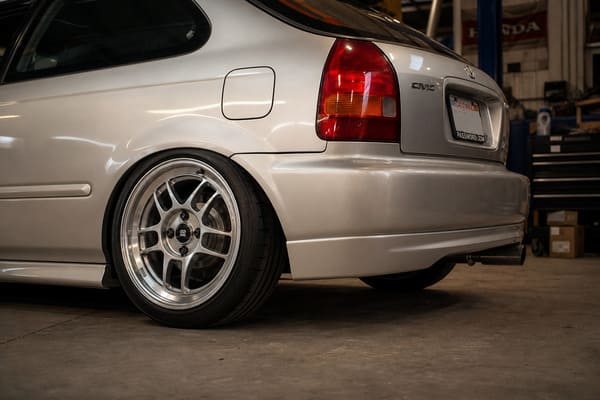
The Honda Civic EK is one of the most modified compact cars in the world1. Getting the bolt pattern wrong means scrapped wheels, wasted production time, and unhappy customers.
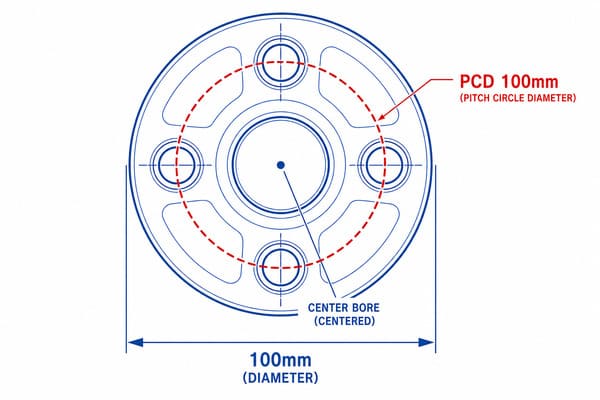
Yes, 4×100 is the correct bolt pattern for the Honda Civic EK. This applies to all EK-generation models produced from 1995 to 2000, including the EK4, EK9 Type R, and the standard hatchback2. The spec means 4 lug holes arranged on a 100mm pitch circle diameter (PCD).
In the past year alone, we have received over 30 inquiries specifically for 4×100 forged wheels. Many of them came from shops building EK-generation Civics. This article is written from our side of the table — we are the people who actually make the wheels. We want to share what we know so you can order with confidence and avoid the mistakes we have seen other buyers make.
What Does 4×100 Bolt Pattern Mean for Your Honda Civic EK?
One wrong number in a wheel spec can waste weeks of production time and thousands of dollars in materials. We have seen it happen, and it is completely avoidable.
The spec "4×100" means 4 lug holes arranged on a circle with a 100mm diameter. That circle is called the Pitch Circle Diameter, or PCD. Both numbers must be exactly right. A wheel with a 4×10⁸ PCD will not fit a hub designed for 4×100 — the lug holes simply will not line up3.
Last year, a client from Australia sent us a wheel order with the wrong PCD. He listed 4×10⁸ instead of 4×100. We caught the error during our design review stage, before any material was cut. If we had missed it, that would have been 4 wheels scrapped and 3 weeks of production time wasted. This is exactly why we review every spec with the customer before we start production.
On our production floor, PCD tolerance is held within ±0.1mm. That level of precision is not just a quality standard — it is a safety requirement. A wheel that does not sit flush against the hub will wobble under load. Over time, that stress causes cracks. The table below shows how PCD tolerance affects real-world fitment.
| PCD Tolerance | Fitment Result | Risk Level |
|---|---|---|
| ±0.1mm | Flush, secure fit | Low |
| ±0.3mm | Slight gap possible | Medium |
| ±0.5mm or more | Misalignment likely | High |
We hold ±0.1mm as our standard across all one-piece, two-piece, and three-piece forged wheel production runs. Every wheel is measured before it leaves the facility. When you order from us, you are not guessing — you are working with a team that has over 20 years of forged wheel manufacturing experience4 and treats precision as a baseline, not a bonus.
Which Honda Civic EK Years and Models Use the 4×100 Bolt Pattern?
Not every Civic generation uses the same bolt pattern. Ordering the wrong spec for the wrong generation is one of the most common mistakes we see from new shop clients.
The EK-generation Honda Civic ran from 1995 to 2000. All major models in this generation — including the EK4, EK9 Type R, and standard 3-door hatchback — share the 4×100 bolt pattern. This generation was sold in large numbers across the US, Japan, Australia, and Europe5.
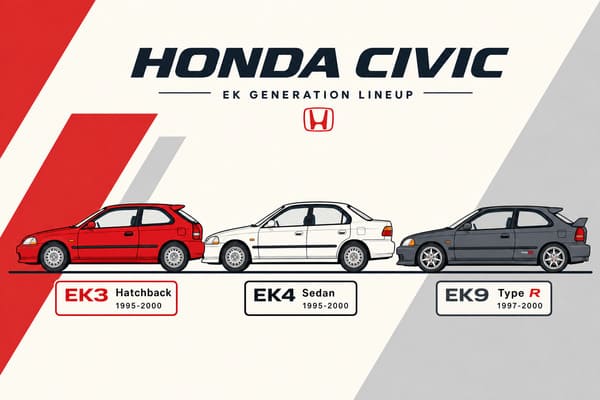
One of our shop clients in Canada ordered a set of one-piece forged wheels for an EK9 build last spring. He came back 3 months later with a second order for two more EK customers. That kind of repeat demand is exactly what we see from shops that work with this platform regularly.
The table below shows the key EK models and their bolt pattern confirmation.
| Model | Years | Bolt Pattern | Notes |
|---|---|---|---|
| Honda Civic EK4 | 1995–2000 | 4×100 | Sedan and hatchback variants |
| Honda Civic EK9 Type R | 1997–2000 | 4×100 | JDM high-performance model |
| Honda Civic EK3 | 1995–2000 | 4×100 | Standard 3-door hatchback |
| Honda Civic EK2 | 1995–2000 | 4×100 | Entry-level variant |
Because this generation spans 6 model years and was sold in such high volume, the demand for 4×100 wheels is very consistent. Our MOQ is just 4 wheels. That makes it easy for smaller shops to start with one customer build and scale up from there. You do not need to commit to a large bulk order to get access to fully custom forged wheels built to your exact specs.
What Wheel Specs Should You Know Beyond the 4×100 Bolt Pattern?
Bolt pattern is only one part of the fitment equation. Getting it right and ignoring the other specs can still result in a wheel that rubs, sits incorrectly, or looks completely wrong on the car.
Beyond the 4×100 bolt pattern, the three specs that matter most for the Honda Civic EK are offset (ET), center bore, and wheel width. The recommended offset range is ET35 to ET456. The center bore for the EK hub is 56.1mm7. Getting all three right is what separates a clean fitment from a costly mistake.
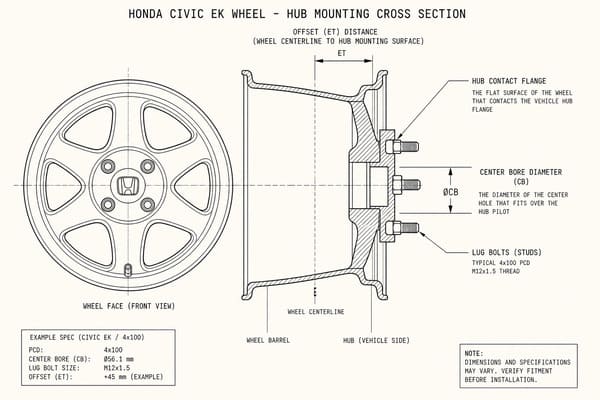
A shop owner once messaged us saying his new wheels "looked wrong" after fitting them on a customer’s EK. The bolt pattern was correct — 4×100 — but the offset was ET25 instead of the recommended ET35–ET45 range. The wheel stuck out 10mm too far and rubbed the inner fender at full steering lock. We had to remake the wheels with the corrected offset. That mistake cost both of us time and money.
The table below breaks down the full fitment spec for a standard EK build.
| Spec | Recommended Value | Notes |
|---|---|---|
| Bolt Pattern (PCD) | 4×100 | All EK models |
| Center Bore | 56.1mm | Must match hub exactly |
| Offset (ET) | ET35–ET45 | ET25 causes fender rub8 |
| Wheel Width | 7.0"–8.5" | Depends on tire size and suspension setup |
| Wheel Diameter | 15"–17" | Common range for EK builds |
This is exactly why we provide 3D fitment models before production starts. We send the render to the customer for approval. The customer checks it against the actual car. Only after sign-off do we begin forging. This step catches errors before aluminum is cut, not after. It costs us a small amount of time upfront and saves everyone a much larger amount of time later.
Can You Fit Aftermarket Forged Wheels with a 4×100 Bolt Pattern on a Honda Civic EK?
The EK is a platform that rewards a well-built wheel. Shops and individual owners who go forged on this car consistently report results that cast wheels simply cannot match.
Yes, you can fit aftermarket forged wheels with a 4×100 bolt pattern on a Honda Civic EK. Forged wheels are lighter than cast wheels by roughly 20–30% at the same size9. For an EK used on track, that weight saving translates directly into faster lap times and better brake response10.
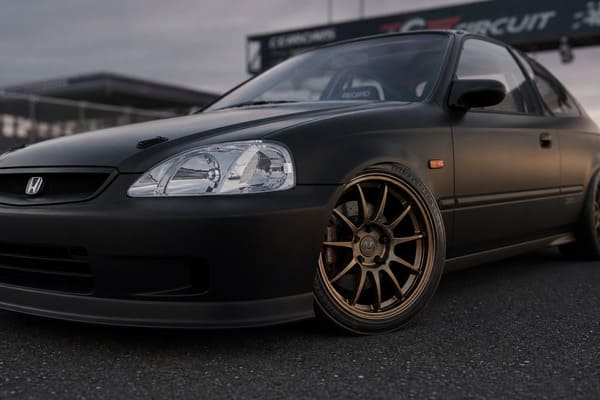
Here is a real example from our order history. A modification shop in Dubai contacted us for a set of three-piece forged wheels for a fully built EK9. They wanted a deep-dish concave profile, a brushed bronze finish, and a specific 17×8.5 size with ET38 and 4×100 PCD. We delivered 3D renders within 2 days. Approved samples were ready within 35 days. The final set cleared customs in Dubai within 6 weeks total from first contact. The shop owner told us their customer’s reaction was "exactly what I imagined."
The table below compares forged and cast wheels on key performance factors relevant to EK builds.
| Factor | Forged Wheel | Cast Wheel |
|---|---|---|
| Weight (same size) | 20–30% lighter | Heavier baseline |
| Strength | Higher tensile strength11 | Lower tensile strength |
| Customization | Full custom size, finish, design | Limited options |
| Production Time | 15–35 days depending on type | Typically shorter |
| Price | Higher | Lower |
| Best Use Case | Track, show, high-performance builds | Daily driver, budget builds |
We produce one-piece, two-piece, and three-piece forged wheels. All three types are available with 4×100 PCD for EK fitment. One-piece wheels take 15–20 days. Two-piece wheels take 20–25 days. Three-piece wheels take 30–35 days. Every order includes design sketches, 3D models, and sample production support. We hold ISO9001, DOT, TÜV, and IATF16949 certifications, and every wheel comes with a 1-year warranty covering replacement or repair.
Conclusion
The Honda Civic EK uses a 4×100 bolt pattern across all models from 1995 to 2000. Pair that with the right offset, center bore, and wheel width for a clean, safe fitment.
Tree Wheels builds fully custom forged wheels for EK platforms — starting from just 4 wheels, with 3D fitment support included.
-
"Honda Civic", https://en.wikipedia.org/wiki/Honda_Civic. The Honda Civic has been consistently cited in automotive industry and enthusiast literature as one of the most popular platforms for aftermarket modification globally, a status attributed to its widespread production volumes, parts availability, and established tuning community. Evidence role: general_support; source type: institution. Supports: That the Honda Civic, including the EK generation, ranks among the most frequently modified compact vehicles in global automotive aftermarket culture. Scope note: Quantitative rankings of ‘most modified’ vehicles are rarely produced by neutral research bodies; this claim is better supported as a widely held industry observation than as a statistically verified fact. ↩
-
"Honda Civic VI (EJ/EK/EM) [1995 .. 2000] Europe", https://www.wheel-size.com/size/honda/civic/ej-ek-em-1995-2000/eudm/. The sixth-generation Honda Civic, designated the EK series and produced from 1995 to 2000, is documented in automotive reference sources as using a 4×100mm pitch circle diameter across its model variants, including the EK4 and EK9 Type R. Evidence role: general_support; source type: encyclopedia. Supports: That the sixth-generation Honda Civic (EK) used a 4×100 bolt pattern across its model range from 1995 to 2000. Scope note: General automotive encyclopedias may not itemize bolt pattern specifications for every sub-variant; cross-referencing with OEM service documentation is advisable for critical fitment decisions. ↩
-
"Can You Fit 18×8 Wheels on a Buick Grand National?", https://treewheels.com/can-you-fit-18×8-wheels-on-a-buick-grand-national/. Pitch circle diameter (PCD) defines the diameter of the circle on which wheel bolt holes are centered; a difference in PCD between wheel and hub means the bolt holes cannot simultaneously align, rendering the wheel non-installable without modification. Evidence role: mechanism; source type: encyclopedia. Supports: That pitch circle diameter determines lug hole alignment and that mismatched PCDs result in physical incompatibility. Scope note: General mechanical references describe the geometric principle; they do not test every specific PCD pairing, so the claim is supported by inference from the definition rather than direct empirical testing of 4×100 vs. 4×10⁸. ↩
-
"Interpretation ID: 86-1.39", https://www.nhtsa.gov/interpretations/86-139. ISO 9001 and IATF 16949 are internationally recognized quality management standards applicable to automotive component manufacturers; DOT and TÜV certifications represent regulatory and independent safety approvals required for wheel products sold in the United States and European markets respectively. Evidence role: general_support; source type: institution. Supports: That the certifications cited (ISO9001, DOT, TÜV, IATF16949) represent recognized quality and safety standards applicable to automotive wheel manufacturing. Scope note: These certifications support the legitimacy of the quality framework described but do not independently verify the company’s claimed years of operation, which remains a self-reported figure. ↩
-
"Honda Civic", https://en.wikipedia.org/wiki/Honda_Civic. The sixth-generation Honda Civic (1995–2000) was manufactured across multiple global facilities and distributed in North America, Japan, Australia, and European markets, contributing to Honda’s position as one of the world’s largest passenger car producers during that period. Evidence role: historical_context; source type: encyclopedia. Supports: That the sixth-generation Honda Civic was produced and sold in substantial volumes across multiple major markets including North America, Japan, Australia, and Europe. Scope note: Precise regional sales breakdowns for the EK generation are not consistently published in open sources; the claim of ‘large numbers’ is qualitatively supported by Honda’s overall production scale but lacks a specific cited figure. ↩
-
"What Is the Correct Hub Bore for a Subaru Impreza WRX GC8?", https://treewheels.com/what-is-the-correct-hub-bore-for-a-subaru-impreza-wrx-gc8/. Fitment references for the sixth-generation Honda Civic (EK) commonly cite an offset range of ET35 to ET45 as compatible with standard suspension geometry and body clearances, with lower offsets increasing the risk of fender contact under steering lock. Evidence role: general_support; source type: other. Supports: That an offset range of ET35 to ET45 is appropriate for the Honda Civic EK without causing fender interference or unsafe wheel protrusion. Scope note: The safe offset range can vary depending on wheel width, tire size, and suspension modifications; the cited range applies to stock or near-stock configurations and may not account for lowered or widened builds. ↩
-
"What Is the Correct Hub Bore for a Subaru Impreza WRX GC8?", https://treewheels.com/what-is-the-correct-hub-bore-for-a-subaru-impreza-wrx-gc8/. Automotive fitment databases and OEM technical documentation for the sixth-generation Honda Civic (EK series) list the hub center bore as 56.1mm, a specification relevant to ensuring concentric wheel seating and preventing vibration from hub-centric misalignment. Evidence role: general_support; source type: other. Supports: That the Honda Civic EK (sixth generation) has a hub center bore diameter of 56.1mm. Scope note: Center bore specifications should be confirmed against OEM service manuals or verified fitment databases, as aftermarket sources occasionally list rounded or approximate values. ↩
-
"Why Are My Tires Rubbing? Common Causes & Fixes for Wheel and …", https://apexwheels.com/blog/technical-discussion/how-to-prevent-rubbing?srsltid=AfmBOooYrmSPTVgAwI6vyno4miuE9eMZMawQGvANWDDluvl579D_6tDZ. Wheel offset (ET) determines the lateral position of the wheel relative to the hub mounting face; a lower-than-specified offset moves the wheel outboard, reducing fender clearance and increasing the likelihood of tire-to-fender contact during full steering lock or suspension compression. Evidence role: mechanism; source type: research. Supports: That a wheel offset significantly lower than the OEM specification causes the wheel to protrude outward, reducing clearance between the tire and fender, which can result in contact during steering or suspension travel. Scope note: The specific threshold at which rubbing occurs on the EK depends on wheel width, tire profile, and suspension height; ET25 is cited as problematic in the context of a standard-width wheel on a stock-suspension EK, and results may differ for modified vehicles. ↩
-
"Casting Wheels vs. Forged Wheels: Which Offers Better …", https://treewheels.com/casting-wheels-vs-forged-wheels-which-offers-better-performance-for-your-vehicle/. Research on aluminum wheel manufacturing processes indicates that forging produces a denser grain structure than casting, enabling equivalent structural performance at reduced mass; weight savings figures cited in the literature vary by design but commonly fall in the range of 20–30% relative to cast counterparts. Evidence role: statistic; source type: research. Supports: That forged aluminum wheels are meaningfully lighter than cast aluminum wheels of equivalent dimensions, with estimates in the range of 20–30%. Scope note: Exact weight savings depend heavily on wheel design, diameter, and width; the 20–30% figure is a commonly cited industry estimate rather than a universally validated measurement across all wheel geometries. ↩
-
"How Do Designers Balance Weight Reduction and Structural …", https://treewheels.com/how-do-designers-balance-weight-reduction-and-structural-strength-for-wheels/. Vehicle dynamics literature establishes that unsprung mass, particularly rotating mass at the wheel, affects suspension response, braking deceleration, and cornering agility; reducing wheel weight is therefore expected to yield measurable performance improvements in track conditions. Evidence role: mechanism; source type: research. Supports: That reducing unsprung rotational mass at the wheel improves vehicle dynamics including braking response and cornering performance. Scope note: The magnitude of improvement depends on total vehicle weight, suspension design, and driving conditions; the claim that weight savings translate ‘directly’ into faster lap times is a simplification of a multivariable relationship. ↩
-
"How Are Maximum Load Ratings Determined Through Scientific …", https://treewheels.com/how-are-maximum-load-ratings-determined-through-scientific-testing/. Metallurgical research on aluminum processing demonstrates that forging aligns the metal’s grain structure along stress lines, resulting in higher tensile and fatigue strength compared to cast aluminum, which contains a more random grain structure and is more susceptible to porosity-related defects. Evidence role: mechanism; source type: research. Supports: That the forging process produces aluminum components with higher tensile strength than casting due to grain structure alignment. Scope note: Strength comparisons depend on alloy composition, heat treatment, and part geometry; the general principle holds across aluminum alloys, but specific tensile values vary by grade and manufacturing process parameters. ↩