
Most people talk about wheel weight reduction in terms of materials and processes. But the real balance point is not found in a lab. It is found in the customer’s actual use case. I once worked with a client who drove a modified GT-R. He wanted the lightest wheels possible. He wanted every spoke hollowed out as much as we could manage. But then he told me he runs mountain roads every weekend, covering more than 200 kilometers in a single trip. A mountain-road enthusiast and a luxury car owner who commutes to work have completely different needs when it comes to "light" and "strong." In wheel design, the first step is not choosing a material. It is figuring out who is driving the car and where.
Balancing weight and strength in wheel design means understanding the driver’s real use case first. Unsprung mass reduction delivers outsized handling benefits, but the wheel must still survive the specific loads it will face. Material choice, forging process, and simulation tools all work together to find that balance.
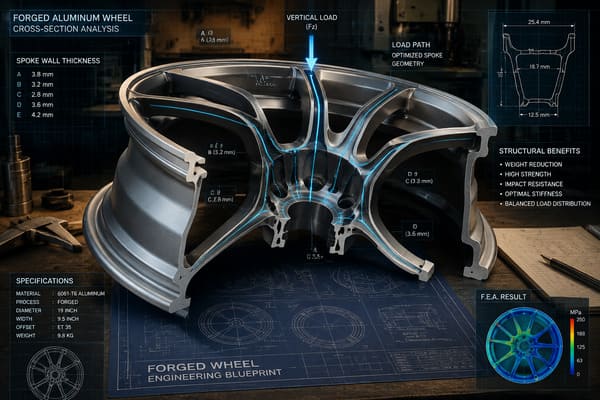
Every decision we make in wheel design starts with a question: what does this wheel actually need to survive? The answer changes everything, from wall thickness to spoke geometry to surface treatment. The sections below break down each part of that process, from why weight matters so much, to how we use simulation to make the final call.
Why Is Weight Reduction So Critical in Wheel Design?
Most customers come to us asking for lighter wheels because they look better or because a friend recommended it. Very few understand the physics behind it. That gap matters, because when customers understand why weight reduction works, they make better decisions about how far to push it.
Wheels are unsprung mass. Physics research shows that reducing unsprung mass by 1 kg affects handling and suspension response as much as reducing body weight by 7 to 10 kg1. This makes wheel weight one of the highest-leverage modifications any driver can make.
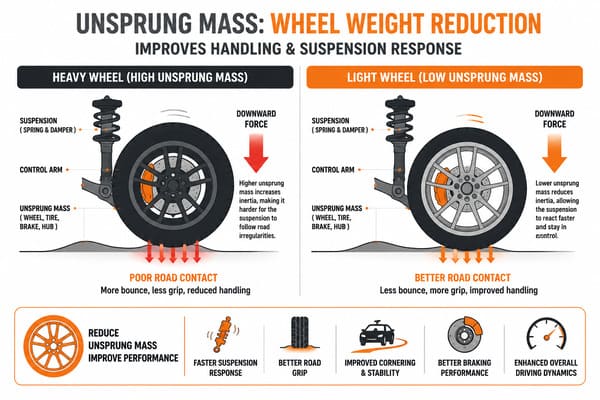
I explain it to customers this way. Imagine running while holding a heavy bag in your hand, versus strapping the same weight around your waist. The feeling is completely different. The bag in your hand swings, resists your movement, and drains your energy with every step. Wheel weight works the same way. Every rotation consumes energy and dulls your feel for the road surface.
The Real-World Impact of Unsprung Mass
One of our clients switched from factory wheels to a forged set that was 6 kg lighter in total. He told us the car felt "alive" afterward. Steering response was noticeably faster. That is not a placebo effect. It is physics working as expected.
| Scenario | Unsprung Mass Reduction | Equivalent Body Mass Reduction |
|---|---|---|
| Light street driving | 1 kg per wheel | 7–10 kg body weight |
| Track use | 1 kg per wheel | Up to 10 kg body weight |
| Mountain road driving | 1 kg per wheel | 7–10 kg + improved suspension tracking |
The reason the ratio is so high is that unsprung mass affects how quickly the wheel can follow road surface changes. A heavier wheel takes more force to push down onto the road after a bump. A lighter wheel stays in contact with the surface more consistently2. This directly affects braking, cornering grip, and steering feel. Weight reduction is not about impressive spec sheets. It is about what the car feels like to drive.
Why "Lighter Is Always Better" Is Wrong
The mountain-road GT-R client I mentioned earlier is a good example of why this matters. He wanted maximum weight reduction. But mountain roads mean repeated lateral impacts, uneven surfaces, and sustained high loads through corners. If we had followed his initial request and hollowed out every spoke as much as possible, the wheel might have failed under those conditions. The right answer was not the lightest possible wheel. It was the lightest wheel that could still handle his specific use case safely. That is the actual design problem we solve.
What Materials Do Engineers Use to Achieve the Best Strength-to-Weight Ratio?
There is a lot of noise in the market right now about carbon fiber wheels. Some suppliers present them as the ultimate solution. I want to give you a more honest picture, because the material choice is not as simple as picking the one with the best headline number.
Forged 6061 and 7075 aluminum alloys deliver a specific strength of 170 to 180 kN·m/kg3, with consistent performance under multi-directional impact loads. Carbon fiber offers higher tensile strength but is vulnerable to lateral impact and internal delamination that is invisible from the outside4.
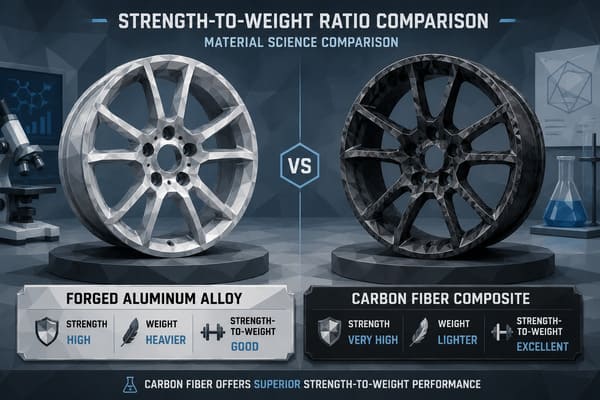
Carbon fiber has impressive tensile strength numbers. But tensile strength measures resistance to being pulled apart in one direction. Wheels do not fail that way. They fail under lateral impacts, like hitting a curb, or under repeated torsional loads through hard cornering. Carbon fiber handles those loads poorly compared to aluminum alloy. More importantly, when carbon fiber takes a hard lateral hit, it can delaminate internally. The damage is invisible from the outside. The wheel looks fine. But its structural integrity is already compromised.
Material Comparison for High-Performance Wheels
| Material | Specific Strength (kN·m/kg) | Impact Resistance | Damage Visibility | Repairability |
|---|---|---|---|---|
| Forged 6061 Aluminum | ~170 kN·m/kg | High, multi-directional | Visible deformation | Repairable in many cases |
| Forged 7075 Aluminum | ~180 kN·m/kg | High, multi-directional | Visible deformation | Repairable in many cases |
| Carbon Fiber | Very high (tensile only) | Poor lateral resistance | Internal delamination invisible | Generally not repairable |
| Cast Aluminum | Lower | Moderate | Visible cracking | Limited5 |
How We Use Material Properties in Wall Thickness Design
One of the biggest advantages of forged aluminum is that we can precisely control wall thickness distribution across the wheel. The rim edge takes the highest impact loads, so we keep enough thickness there to absorb those forces. The mid-section of the spokes carries lower stress in normal use, so we can bring that thickness down to below 4 mm. This targeted approach is what allows us to reduce overall wheel weight without reducing safety margins. The material is not the most expensive option. It is the most appropriate option for the full range of conditions the wheel will face.
How Does the Forging Process Improve Both Strength and Lightweight Performance?
The most common misunderstanding about forging is that it simply makes metal harder. Customers sometimes think forging is just a more intense version of casting. It is not. The difference is structural, and it explains why a forged wheel can be lighter and stronger at the same time.
Forging reorients the internal grain flow of the metal to follow the shape of the wheel6. This means the metal’s natural grain lines run parallel to the load paths. The result is significantly higher strength at the same weight compared to cast wheels, where grain structure is random.
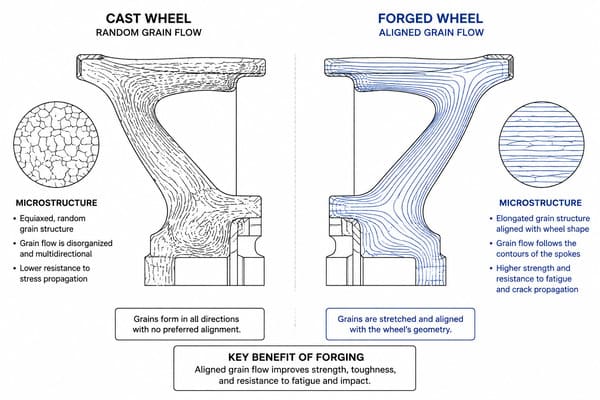
I use wood grain as an analogy when explaining this to customers. If you cut wood along the grain, it takes real effort to split it. If you cut across the grain, it breaks easily. The grain direction determines where the strength is. Casting is like pouring liquid metal into a mold and letting it solidify randomly. The grain has no preferred direction. Forging is like pressing and shaping the metal while controlling how the grain aligns. The grain ends up running in the direction the wheel actually needs to be strong.
Forging Performance vs. Casting: Test Data
We ran a comparison test using 19-inch wheels at the same target weight of 7 kg. The results were clear.
| Wheel Type | Radial Impact Load at Failure | Notes |
|---|---|---|
| Forged 7075 Aluminum | Over 1,000 kg | No cracking observed below this load7 |
| Low-Pressure Cast Aluminum | Approx. 680 kg | Cracking appeared at this load |
That difference is not because the forged wheel used more material. Both wheels weighed the same. The difference is that the forged wheel’s material was oriented in the direction the load actually travels. This is why we can remove more material from low-stress areas in a forged wheel without compromising safety. We are not just making a lighter wheel. We are making a wheel where the remaining material is doing its job more efficiently.
One-Piece, Two-Piece, and Three-Piece Forging
The forging approach also affects which wheel construction type is most appropriate for a given application.
| Construction | Forging Method | Weight | Customization | Best Use Case |
|---|---|---|---|---|
| One-Piece (Monoblock) | Single forged billet | Lightest8 | Limited post-forge | Track, performance street |
| Two-Piece | Forged center + rim | Medium | High | Custom fitment, wide body |
| Three-Piece | Forged center + two rim halves | Slightly heavier | Maximum | Deep dish, extreme custom builds |
Each construction type uses forging to maximize the strength of the most critical components. The choice between them depends on the customer’s weight target, fitment needs, and aesthetic goals.
What Role Does Finite Element Analysis (FEA) Play in Wheel Design?
FEA is not a validation tool in our process. It is a communication tool. This distinction matters more than it might sound. In custom wheel design, the most difficult conversations are not about engineering. They are about convincing a customer that their preferred design choice carries a risk they cannot see.
FEA simulates real-world stress distribution across a wheel under defined load conditions. It identifies stress concentration points before any physical material is cut9. This allows engineers to adjust geometry, spoke width, and wall thickness based on data rather than estimates.
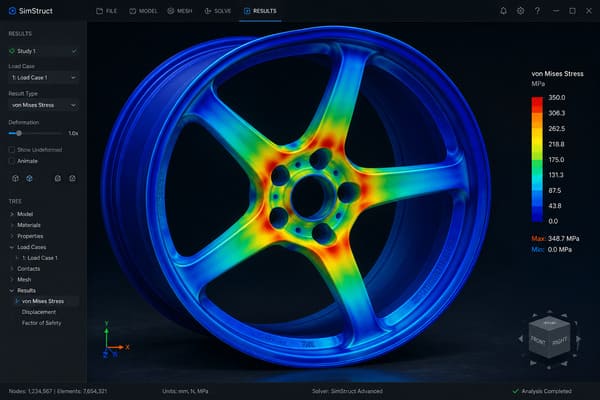
I want to give you a concrete example. A client came to us for a custom deep-dish five-spoke wheel. He wanted the spoke width reduced to 28 mm. His reason was purely visual. He said narrower spokes looked more refined. Our engineers ran the geometry through FEA under a simulated 65 km/h lateral impact condition. The peak stress at that spoke section reached 91% of the material’s yield strength. That left a safety margin of less than 10%10.
How FEA Turns Subjective Preferences Into Objective Decisions
We sent the stress map to the client. He looked at the color gradient showing where the material was close to its limit. He said, "Okay, you decide." We adjusted the spoke width to 34 mm. The safety margin came back up to above 35%. The wheel still looked refined. It was also safe.
| Design Parameter | Client’s Initial Request | FEA Result | Adjusted Design | Final Safety Margin |
|---|---|---|---|---|
| Spoke width | 28 mm | 91% of yield strength | 34 mm | 35%+ margin |
| Impact condition simulated | — | 65 km/h lateral | Same condition | Pass |
What FEA Checks in Our Wheel Design Process
FEA does not replace engineering judgment. It gives engineering judgment a language that customers can understand. A stress map is not abstract. It shows exactly where the wheel is working hard and where it has room. This is valuable in several specific situations.
- Spoke geometry changes requested by customers for aesthetic reasons
- Unusual fitment requirements that push spoke angles or offsets beyond standard ranges
- Ultra-lightweight targets where wall thickness is being pushed toward minimum limits
- New design concepts that have no previous production history to reference
Every custom wheel we produce goes through FEA before we cut any material. This is not a formality. It is the step where we catch problems that would otherwise only appear after the wheel is in use. In an industry where the product is safety-critical, that step is not optional.
Conclusion
Balancing weight and strength in wheel design means understanding use cases, choosing the right materials, using forging to align grain flow with load paths, and using FEA to validate every critical geometry decision before production begins.
At Tree Wheels, we bring 20+ years of forged wheel expertise to every custom order, from 4 wheels to full production runs.
-
"Unsprung mass – Wikipedia", https://en.wikipedia.org/wiki/Unsprung_mass. Vehicle dynamics literature on unsprung mass effects documents that reductions in unsprung mass yield disproportionately large improvements in wheel-to-road contact and suspension response relative to equivalent reductions in sprung mass, with commonly cited ratios ranging from 7:1 to 10:1, though exact figures vary by vehicle configuration and measurement methodology. Evidence role: statistic; source type: paper. Supports: The quantitative ratio between unsprung and sprung mass reduction in terms of handling and suspension response. Scope note: The precise ratio is model-dependent and may not apply uniformly across all vehicle types or driving conditions. ↩
-
"Unsprung mass – Wikipedia", https://en.wikipedia.org/wiki/Unsprung_mass. Vehicle dynamics engineering literature describes how unsprung mass magnitude influences the natural frequency of wheel hop and the rate at which the tire returns to the road surface after a disturbance; lower unsprung mass reduces wheel hop amplitude and improves contact patch consistency, which is associated with improved braking and lateral force generation. Evidence role: mechanism; source type: paper. Supports: That lower unsprung mass improves wheel-to-road contact consistency after surface irregularities, benefiting braking and cornering performance. Scope note: The magnitude of the effect is vehicle- and suspension-geometry-dependent and may be less perceptible on vehicles with highly compliant suspension tuning. ↩
-
"6061 aluminium alloy – Wikipedia", https://en.wikipedia.org/wiki/6061_aluminium_alloy. Published materials databases, including ASM International and NIST, document the tensile strength and density of 6061-T6 and 7075-T6 aluminum alloys, from which specific strength values in the range cited can be derived; forging temper and processing conditions affect final values. Evidence role: statistic; source type: institution. Supports: The specific strength values (strength-to-density ratio) of 6061 and 7075 aluminum alloys in forged condition. Scope note: Specific strength varies with temper designation and forging parameters; the cited range represents typical high-temper forged conditions rather than a single universal value. ↩
-
"In-situ detection of delamination reinitiation in carbon fiber … – PMC", https://pmc.ncbi.nlm.nih.gov/articles/PMC11422020/. Research on carbon fiber reinforced polymer (CFRP) impact behavior documents that low-velocity and lateral impacts can cause subsurface delamination and matrix cracking that are not detectable through visual inspection, a phenomenon sometimes termed barely visible impact damage (BVID) in aerospace and structural engineering literature. Evidence role: mechanism; source type: paper. Supports: That carbon fiber reinforced polymer composites can sustain internal delamination from impact that is not visible on the surface. Scope note: Most delamination research is conducted in aerospace contexts; direct studies on automotive wheel-specific lateral impact delamination are less common in open literature. ↩
-
"Cast vs Flow Formed vs Forged Wheels – The Real Difference", https://astforgedwheels.com/cast-vs-flow-formed-vs-forged-wheels-the-real-difference/. Comparative studies on aluminum wheel manufacturing processes document that low-pressure die cast wheels typically exhibit lower fatigue strength and impact resistance than forged counterparts of similar geometry, attributable to porosity and random grain orientation inherent in casting; these differences are reflected in industry test standards such as JWL and VIA. Evidence role: general_support; source type: paper. Supports: That forged aluminum wheels exhibit higher strength and different failure characteristics compared to cast aluminum wheels of equivalent weight. Scope note: Advances in casting technology, including squeeze casting and thixoforming, have narrowed but not eliminated the performance gap with conventional forging. ↩
-
"[PDF] effect of forging surface on fatigue behavoir of steels: a literature …", https://www.nrc.gov/docs/ML1516/ML15161A221.pdf. Materials engineering references, including ASM Handbook Vol. 14A on metalworking, describe how the plastic deformation in forging produces a refined, directional grain structure that follows the contour of the forged part, improving fatigue resistance and tensile strength along the primary load direction compared to cast components with random grain orientation. Evidence role: mechanism; source type: encyclopedia. Supports: That the forging process aligns metal grain flow with the part geometry, resulting in improved mechanical properties compared to casting. Scope note: The degree of improvement depends on alloy composition, forging temperature, reduction ratio, and post-forge heat treatment. ↩
-
"Numerical simulation on 90° impact test of aluminium alloy wheel …", https://pmc.ncbi.nlm.nih.gov/articles/PMC11549285/. Industry wheel testing standards such as JWL (Japan Light Alloy Wheel) and TÜV define minimum radial impact and fatigue load requirements for passenger car wheels; published performance data for forged 7075-T6 aluminum wheels in peer-reviewed and manufacturer technical literature generally supports substantially higher impact resistance compared to low-pressure cast aluminum wheels of equivalent dimensions. Evidence role: case_reference; source type: institution. Supports: The radial impact load capacity of forged 7075 aluminum wheels relative to cast aluminum alternatives. Scope note: The specific 1,000 kg figure cited is presented as internal test data; independent verification against a named standard and test protocol is not provided in the article. ↩
-
"3 piece wheels vs monoblock performance difference? – Facebook", https://www.facebook.com/groups/AudiClubNA/posts/10158851129132333/. Technical comparisons of wheel construction types in automotive engineering literature note that one-piece forged wheels eliminate the hardware and joining material required for multi-piece assemblies (bolts, barrel welds, and sealing compounds), which contributes to a weight advantage, though the magnitude depends on design specifics and target fitment. Evidence role: general_support; source type: other. Supports: That one-piece monoblock forged wheels are generally lighter than two-piece and three-piece constructions of equivalent size and load rating. Scope note: Weight comparisons between construction types are highly design-specific; a heavily machined monoblock may not always be lighter than an optimized two-piece design. ↩
-
"Forged Wheel FEA Tests – Finite Element Analysis", https://www.forgelitewheels.com/blog-posts/whats-fea-finite-element-analysis-a-brief-introduction. Published research on automotive wheel structural analysis demonstrates that FEA models, when properly validated against physical test results under standardized loading conditions (e.g., radial fatigue, cornering fatigue, and impact), can reliably predict stress concentration locations and relative safety margins, supporting its use as a pre-production design tool. Evidence role: expert_consensus; source type: paper. Supports: That finite element analysis is a validated method for predicting stress distribution and identifying failure-prone regions in automotive wheel designs prior to physical testing. Scope note: FEA accuracy depends on mesh quality, material model fidelity, and boundary condition assumptions; results require correlation with physical testing for safety-critical applications. ↩
-
"Margins of Safety – Joint Architecture Standard (JAS) Toolbox", https://jastoolbox.sandia.gov/topic/mechanical-specification/design-constraints/structural-integrity/margins-of-safety/. Structural engineering and automotive design standards generally specify safety factors well above 1.0 relative to yield strength for safety-critical components subject to dynamic and impact loading; a stress level at 91% of yield strength under a simulated impact condition would be considered insufficient margin in most engineering design codes, which typically require factors of safety of 1.5 or greater for such applications. Evidence role: expert_consensus; source type: institution. Supports: That a safety margin of less than 10% above yield strength is considered inadequate for safety-critical structural components such as wheel spokes under dynamic load conditions. Scope note: Specific safety factor requirements vary by standard, application, and whether the load case represents a peak or sustained condition. ↩