
Getting the wrong hub bore size on your GC8 causes steering wheel vibration, uneven wear, and real safety risks.1 Most people never check this number until something goes wrong.
The correct hub bore for the Subaru Impreza WRX GC8 is 56.1mm.2 This is a smaller center bore than most aftermarket wheels offer. If your wheel has a larger bore, you must use hubcentric rings to fill the gap. Without them, the wheel sits off-center and puts stress on the wheel bolts instead of the hub flange.
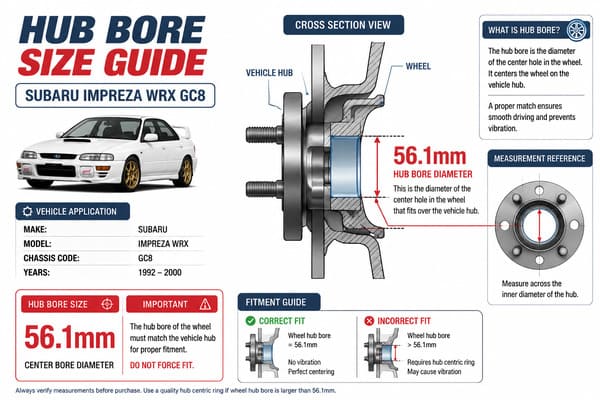
The hub bore is one of the most overlooked specs when buying aftermarket wheels. Most buyers focus on diameter, width, and bolt pattern. But the center bore is what actually positions the wheel correctly on the car. I want to walk you through everything you need to know about hub bore on the GC8, from what it means to how we handle it in production.
What Does Hub Bore Mean and Why Does It Matter for Your GC8?
Most people know their bolt pattern. Very few people know their hub bore. That gap in knowledge leads to vibration problems, worn bolt holes, and frustrated customers.
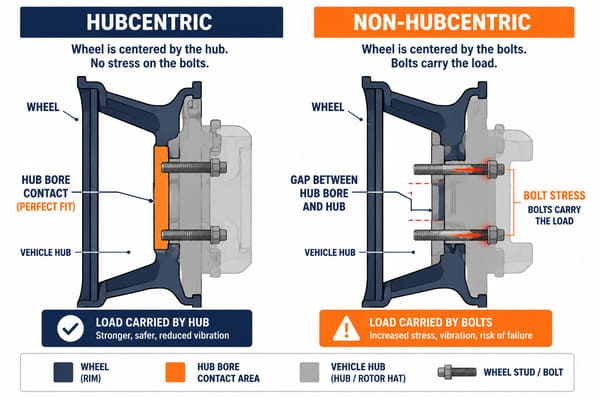
The hub bore is the diameter of the center hole in a wheel. It must match the diameter of the hub flange on your car. When the two sizes match perfectly, the wheel is centered by the hub itself. This is called hubcentric fitment.3 When they do not match, the wheel sits off-center unless a hubcentric ring is used to fill the gap.
I want to share a real example from a customer we worked with in Australia. He ordered a set of 18-inch forged wheels for his GC8. After about 80 kilometers of driving, he contacted me saying his steering wheel was shaking constantly. We assumed it was a wheel balancing issue. He went and had the wheels balanced, but the vibration was still there. He then sent me a photo of the fitment. I could see immediately what the problem was. The wheel center bore was 73.1mm. The GC8 hub flange is 56.1mm. That is a 17mm gap with no hubcentric ring installed. Once he fitted the correct rings, the vibration was gone the same day.
Why the Hub Bore Carries the Load
When a wheel is hubcentric, the center hole sits flush against the hub flange. The hub flange carries the weight and lateral forces of the vehicle. The wheel bolts hold the wheel in place, but they are not designed to carry side loads.4 When the center bore is too large and no ring is used, the bolts take all the side load. Over time, this causes the bolt holes in the wheel to wear out. In serious cases, it can cause the wheel to shift position while driving.
| Fitment Type | Load Carrier | Risk Level |
|---|---|---|
| Hubcentric (correct bore) | Hub flange | Low |
| Hubcentric ring installed | Hub flange via ring | Low to medium |
| No ring, oversized bore | Wheel bolts | High |
The GC8 hub flange at 56.1mm is on the smaller side for Japanese cars. This makes it even more important to confirm this number before ordering any aftermarket wheel.
What Is the Exact Hub Bore Size of the Subaru Impreza WRX GC8?
People ask this question all the time, and the answer should be simple. But there is a lot of wrong information online, and one wrong number can cause real problems.
The Subaru Impreza WRX GC8 has a hub bore of 56.1mm. This applies to both the front and rear hubs. The GC8 generation covers model years 1992 to 2000.5 This 56.1mm measurement is the OEM hub flange diameter and is the number you need to match when selecting or ordering aftermarket wheels.
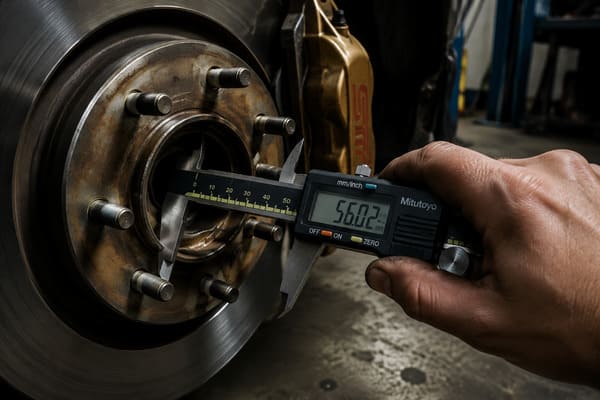
When we receive an order for GC8 wheels at Tree Wheels, the first parameter we confirm is the center bore. Not the diameter. Not the width. The center bore. This is because it is the most commonly forgotten number, and it is the one that causes the most post-delivery problems.
Why 56.1mm Is Easy to Get Wrong
Most standard aftermarket forged wheels are made with a center bore of 73.1mm or larger.6 Some are 74.1mm. These sizes fit a wide range of European and American vehicles. But 56.1mm is specific to a smaller group of Japanese cars. If a supplier does not specialize in Japanese fitments, they may not even stock this size.
Here is a comparison of common Japanese car hub bore sizes to show where the GC8 sits:
| Car Model | Hub Bore |
|---|---|
| Subaru Impreza WRX GC8 | 56.1mm |
| Toyota GR86 / BRZ7 | 56.1mm |
| Honda Civic (EK/EG) | 56.1mm |
| Nissan Skyline R34 | 66.1mm |
| Mitsubishi Lancer EVO | 67.1mm |
| Toyota Supra (A80) | 60.1mm |
The GC8 shares its 56.1mm bore with a few other Japanese platforms, but it is still a minority size in the wider aftermarket world. When we machine wheels for GC8 customers, we cut the center bore to exactly 56.1mm with a tolerance of ±0.1mm8. This means the wheel fits flush against the hub flange with no gap and no need for any additional parts.
What Happens If You Order the Wrong Size
If you order a wheel with a 73.1mm bore for a GC8, you have a 17mm gap between the bore and the hub. The wheel will sit on the bolts, not the hub. Vibration is the first symptom. Bolt hole wear comes next. The cost of fixing this after the fact is always higher than getting the bore right from the start.
Can You Use Hubcentric Rings to Fit Aftermarket Wheels on a GC8?
Hubcentric rings are a common solution when the wheel bore is larger than the hub flange. They work. But they are not always the best long-term answer.
Yes, you can use hubcentric rings to fit aftermarket wheels on a GC8. The rings fill the gap between the wheel’s center bore and the 56.1mm hub flange. For a wheel with a 73.1mm bore, you need a ring sized 73.1mm outer diameter and 56.1mm inner diameter. This centers the wheel correctly and removes vibration caused by an oversized bore.
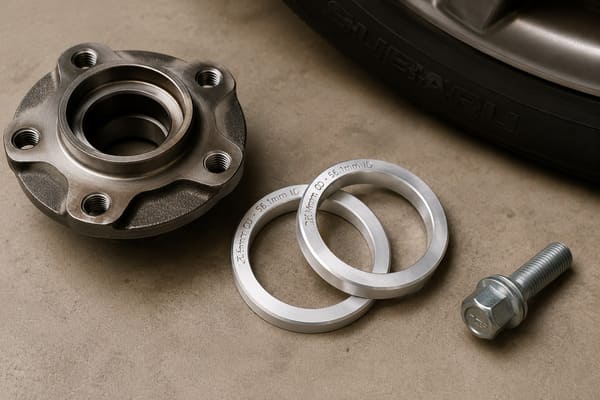
We supply hubcentric rings to customers when needed. They solve the fitment problem and they work well in most cases. But I have seen enough long-term cases to know they are a compromise, not the ideal solution.
Hubcentric Ring Materials and Their Lifespan
There are two main materials used for hubcentric rings: plastic (polycarbonate) and aluminum alloy. Both work, but they behave differently over time.
Plastic rings are cheaper and widely available. The problem is that plastic can degrade with heat.9 In hot climates or after hard driving, plastic rings can shrink slightly. When that happens, the wheel is no longer perfectly centered. I have seen this cause mild vibration to return after one to two years of use. One of our customers in the United States switched from plastic to aluminum alloy rings and reported that the fitment was still solid after nearly three years.
| Ring Material | Cost | Heat Resistance | Lifespan |
|---|---|---|---|
| Plastic (Polycarbonate) | Low | Moderate | 1–3 years |
| Aluminum Alloy | Medium | High | 3–5+ years |
If you are going to use hubcentric rings, aluminum alloy is the better choice. But if you are ordering custom forged wheels from a manufacturer like us, the cleaner solution is to have the center bore machined to 56.1mm from the start. The cost difference in production is almost nothing. The difference in long-term performance is significant. A ring is a fix. A correctly bored wheel is the right answer from the beginning.
What Wheel Specs Are Compatible with the Subaru Impreza WRX GC8?
Hub bore is just one number. To get a wheel that fits and performs correctly, you need to get several specs right at the same time. Most fitment problems come from the specs that people forget to check.
The Subaru Impreza WRX GC8 uses a 5×100 bolt pattern10 with a 56.1mm hub bore. The recommended wheel size is 16 to 18 inches in diameter with a width of 7 to 8.5 inches.11 The recommended offset (ET) is +48 to +53 for the front and slightly more flexible for the rear.12 These are the key specs needed for correct fitment.
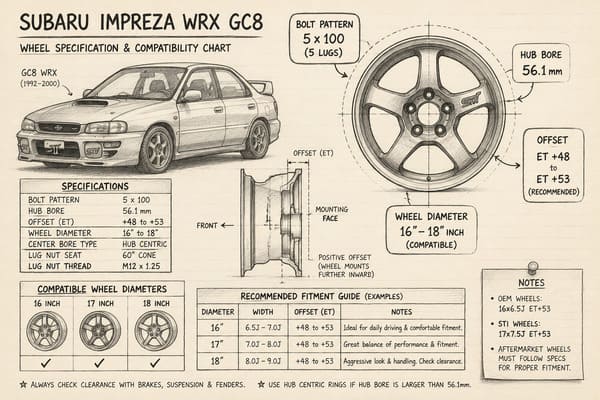
After handling dozens of GC8 wheel orders, I have noticed a clear pattern in where mistakes happen. The errors are almost never in the diameter or width. Those are the numbers people focus on. The real problems come from the specs that people treat as secondary.
The Most Common GC8 Fitment Mistakes
Based on our order history, here is the ranking of the most common spec errors for GC8 wheels:
1. Hub bore (most common) — Many customers forget to report this number entirely. They send bolt pattern, diameter, and width. They skip the center bore. This is the number one cause of post-delivery problems.
2. Offset (ET value) — The GC8 front and rear wheels have different recommended offsets. The front runs best at ET+48 to ET+53. The rear has a slightly wider acceptable range. If you use the same ET for front and rear without checking, you may get rubbing on the front or a fitment gap on the rear.
3. Wheel size selection — This is actually the least common error. Most customers get the diameter and width right.
Here is a full reference table for GC8 compatible wheel specs:
| Spec | Value |
|---|---|
| Bolt Pattern | 5×100 |
| Hub Bore | 56.1mm |
| Recommended Diameter | 16–18 inch |
| Recommended Width | 7–8.5 inch |
| Front Offset (ET) | +48 to +53 |
| Rear Offset (ET) | +45 to +53 |
| Center Bore (OEM) | 56.1mm |
How We Handle GC8 Orders at Tree Wheels
When a customer comes to us with a GC8 order, we go through every spec on this list before production starts. We confirm the center bore first. We then confirm the ET value separately for front and rear. We also ask whether the customer wants the bore machined to 56.1mm directly or if they prefer to use hubcentric rings. In almost every case, customers choose to have the bore machined directly once they understand the difference.
We can produce one-piece forged wheels for the GC8 in 15 to 20 days with the center bore cut to exact spec. The minimum order is four wheels. If you need a design sketch or 3D model before committing to production, we can provide that as part of our pre-order support.
Conclusion
The GC8 hub bore is 56.1mm. Get this number right before ordering any aftermarket wheel. Everything else follows from there.
Tree Wheels produces custom forged wheels with exact 56.1mm bore machining for GC8 fitment. Contact us to start your order.
-
"Can a 1mm or less difference between alloy wheel centre bore size …", https://www.reddit.com/r/AskEngineers/comments/1q6kxqm/can_a_1mm_or_less_difference_between_alloy_wheel/. Automotive engineering literature documents that improper wheel centering due to hub bore mismatch can result in vibration, uneven load distribution, and accelerated component wear, though the severity depends on driving conditions and the magnitude of the mismatch. Evidence role: mechanism; source type: education. Supports: Incorrect hub bore sizing can cause vibration and mechanical stress in wheel assemblies. Scope note: Sources typically address general wheel fitment principles rather than GC8-specific outcomes ↩
-
"Master thread of OEM Subaru Wheel Specs", https://www.rs25.com/threads/master-thread-of-oem-subaru-wheel-specs.253866/. Subaru factory specifications and automotive reference databases list the hub bore diameter for the GC8 Impreza WRX (1992-2000) as 56.1mm, consistent across front and rear hubs for this generation. Evidence role: definition; source type: other. Supports: The official hub bore specification for the Subaru Impreza WRX GC8. ↩
-
"Aftermarket wheel centering myths and facts – Facebook", https://www.facebook.com/groups/1939836749567520/posts/3050369031847614/. Automotive engineering references define hubcentric fitment as a wheel mounting configuration where the wheel’s center bore matches the vehicle’s hub diameter, allowing the hub to bear the vehicle’s weight and center the wheel, as opposed to lugcentric designs where wheel studs provide centering. Evidence role: definition; source type: education. Supports: The technical definition and function of hubcentric wheel fitment. ↩
-
"Are wheel bolts more reliable than wheel studs? – Facebook", https://www.facebook.com/groups/1939836749567520/posts/2175277796023413/. Mechanical engineering principles for wheel mounting indicate that in hubcentric designs, the hub flange is intended to bear lateral and vertical loads while wheel bolts provide clamping force, whereas improper fitment can transfer shear loads to fasteners not optimized for such stress. Evidence role: mechanism; source type: education. Supports: The intended load distribution between hub flanges and wheel fasteners in proper mounting. Scope note: General engineering principles rather than specific testing data on load failure modes ↩
-
"Subaru Impreza – Wikipedia", https://en.wikipedia.org/wiki/Subaru_Impreza. Automotive reference sources document the GC8 chassis code as designating the first-generation Subaru Impreza, produced from 1992 to 2000, with the WRX performance variant introduced in 1992 for Japanese markets and later expanding to other regions. Evidence role: historical_context; source type: encyclopedia. Supports: The production timeline for the GC8 Impreza generation. ↩
-
"Looking for hub centric ring recommendations for a 73.1 center bore …", https://www.facebook.com/groups/1850317701664849/posts/7856686027694623/. Aftermarket wheel industry practices commonly utilize larger center bore diameters such as 73.1mm or 74.1mm to accommodate multiple vehicle fitments, with hubcentric rings used to adapt these universal bores to specific vehicle hub dimensions. Evidence role: general_support; source type: other. Supports: Common center bore dimensions in aftermarket wheel manufacturing. Scope note: Based on industry practice rather than formal manufacturing standards documentation ↩
-
"What are the Wheel specifications | Toyota GR86 Forum", https://www.gr86.org/threads/what-are-the-wheel-specifications.1015/. Factory specifications for the Toyota GR86 and Subaru BRZ list a hub bore diameter of 56.1mm, matching the specification used on various Subaru models including the GC8 Impreza, reflecting shared platform engineering between Toyota and Subaru. Evidence role: case_reference; source type: other. Supports: Hub bore specifications for the Toyota GR86 and Subaru BRZ. ↩
-
"How to Bore Wheel Hub Centers – At Home! 69 GTO Currie Swap …", https://www.youtube.com/watch?v=cBLCE-Rcmng. Automotive wheel manufacturing practices typically specify hub bore tolerances in the range of ±0.1mm to ±0.2mm to ensure proper hubcentric fitment while allowing for thermal expansion and manufacturing variation, though specific tolerances may vary by manufacturer and application. Evidence role: general_support; source type: other. Supports: Appropriate machining tolerances for wheel hub bore dimensions. Scope note: Industry practice rather than a universal standard; optimal tolerance depends on materials and operating conditions ↩
-
"Molecular Pathways for Polymer Degradation during Conventional …", https://pmc.ncbi.nlm.nih.gov/articles/PMC10004996/. Materials science literature indicates that thermoplastic polymers including polycarbonate can experience dimensional changes, reduced mechanical properties, and degradation when exposed to elevated temperatures typical in automotive wheel hub environments, though the rate depends on specific polymer formulation and operating conditions. Evidence role: mechanism; source type: education. Supports: Thermal degradation characteristics of polymer materials used in automotive applications. Scope note: General polymer behavior rather than specific testing of hubcentric ring products ↩
-
"Bolt patterns | 5th Gen Subaru Impreza Forum", https://www.impreza5.com/threads/bolt-patterns.16184/. Subaru factory specifications list the bolt pattern for the GC8 Impreza WRX as 5×100mm (five lugs on a 100mm pitch circle diameter), a configuration shared with several other Subaru models from this era. Evidence role: definition; source type: other. Supports: The official bolt pattern specification for the GC8 Impreza WRX. ↩
-
"Subaru Impreza WRX STI GC/GF [1992 .. 2000] – Wheel-Size.com", https://www.wheel-size.com/size/subaru/impreza-wrx-sti/gc-gf-1992-2000/. Automotive fitment guides indicate that the GC8 Impreza WRX accommodates wheel diameters from 16 to 18 inches and widths from 7 to 8.5 inches without modification, though specific fitment depends on offset, tire size, and suspension configuration. Evidence role: general_support; source type: other. Supports: Appropriate wheel sizing ranges for the GC8 platform. Scope note: Fitment ranges represent common aftermarket practice rather than official Subaru recommendations ↩
-
"S202 Wheels on to GC8 | Subaru Impreza Owners Club – Type RA", https://www.type-ra.com/subaru-forum/threads/s202-wheels-on-to-gc8.38950/. Subaru OEM wheel specifications and aftermarket fitment databases indicate that the GC8 Impreza WRX uses wheel offsets in the ET+48 to ET+53 range for front wheels, with rear wheels accommodating a slightly wider offset range depending on wheel width and suspension setup. Evidence role: general_support; source type: other. Supports: Appropriate wheel offset ranges for GC8 fitment. Scope note: Optimal offset varies with wheel width and may require adjustment for modified suspension ↩