

Every month, we get the same question from customers: "Can you make 5×120 wheels for a 1969 Camaro?" The answer is no — and that 0.65mm difference matters more than you think.
The 1969 Chevrolet Camaro uses a 5×120.65mm bolt pattern, which is the metric equivalent of 5×4.75 inches. This is not the same as 5x120mm. The two specs are separate product lines and are not interchangeable without an adapter.
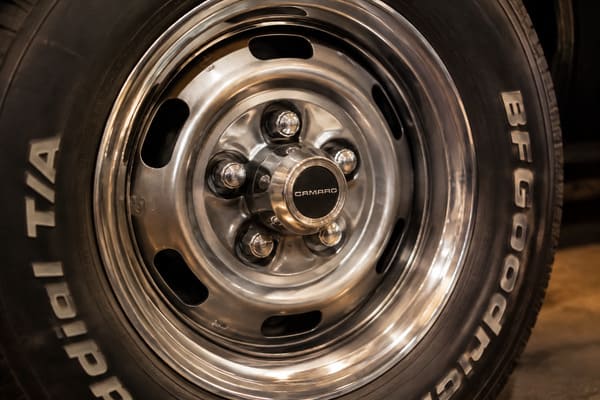
If you are restoring a classic Camaro, ordering custom forged wheels, or helping a customer spec out a fitment, this distinction is the first thing you need to get right. We will walk through the full picture — the unit conversion, which vehicles share this bolt pattern, how it differs from modern Camaro fitments, and which current GM models actually use 5x120mm.
What Is the Bolt Pattern of a 1969 Chevrolet Camaro?
We have seen this mistake hundreds of times. A customer sends over a wheel inquiry, lists the bolt pattern as 5×120, and everything looks fine — until we ask what year the car is.
The 1969 Chevrolet Camaro uses a 5×4.75-inch bolt pattern. When converted to millimeters, 4.75 inches × 25.4 = 120.65mm1. The correct spec is 5×120.65mm, not 5x120mm. These two bolt patterns are different and will not fit the same hub without modification.
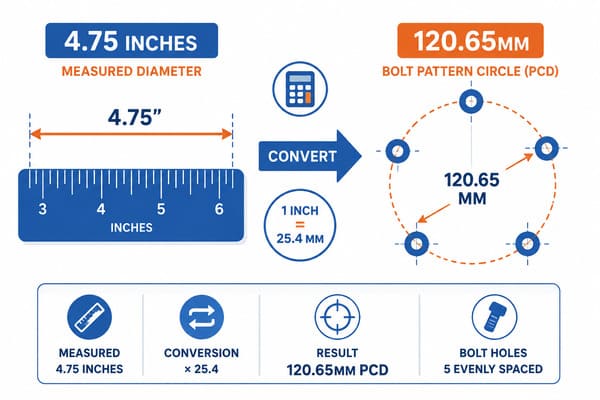
The root cause of this confusion is simple. American muscle cars from the 1960s and 1970s used inch-based measurements. GM listed its specs in inches at the time. Today, almost every global wheel catalog uses millimeters. When people convert 4.75 inches to millimeters and round the result, they get 120mm instead of 120.65mm. That rounding error is where the problem starts.
Why Does 0.65mm Matter So Much?
A difference of 0.65mm sounds small. In everyday life, it is. In wheel manufacturing, it is not.
| Tolerance Level | Effect |
|---|---|
| Within ±0.3mm | Acceptable fitment, bolts seat correctly |
| 0.3mm – 0.65mm error | Bolts may appear to fit but create stress on the hub2 |
| Over 0.65mm error | Bolt holes do not align, wheel cannot be mounted correctly |
When a wheel with the wrong PCD is forced onto a hub, the wheel sits off-center. At highway speeds, this causes vibration3. In serious cases, the stress on the bolts leads to bolt failure4. We have seen this reported by customers who purchased wheels labeled "fits Camaro" without a year-specific spec check. This is not a theoretical risk. It is a real outcome we have had to help customers deal with after the fact.
At Tree Wheels, every order for a 5×120.65mm fitment goes through a separate CNC drilling program. We do not share templates with our 5x120mm production line. Before we enter production, we send the customer a bolt pattern confirmation drawing to sign off on. This step takes about half a day. It prevents rework, disputes, and the kind of fitment problems described above.
What Vehicles Use the 5×120.65 Bolt Pattern?
A lot of customers assume the 1969 Camaro is a special case. It is not. The 5×4.75-inch bolt pattern was GM’s standard across a wide range of vehicles throughout the 1960s and 1970s.
The 5×120.65mm (5×4.75 inch) bolt pattern was used across many classic GM vehicles, including the 1967–1969 Chevrolet Camaro, 1964–1972 Chevelle, 1962–1979 Nova, 1963–1979 Corvette (select years), and the 1964–1974 El Camino.
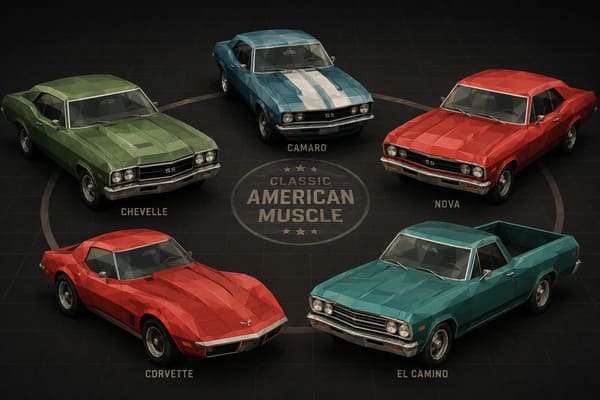
This bolt pattern sits at the center of the classic American car restoration and Restomod market. It is not a niche spec. It is the shared standard for an entire generation of GM vehicles.
Who Is Buying Wheels for These Cars?
We have noticed a consistent pattern in our inquiries. Customers who own a 1969 Camaro often also own one or two other classic GM vehicles from the same era. A single inquiry might cover a Camaro, a Chevelle, and a Nova — three different cars, same bolt pattern.
| Vehicle | Years | Bolt Pattern |
|---|---|---|
| Chevrolet Camaro | 1967–1969 | 5×120.65mm |
| Chevrolet Chevelle | 1964–1972 | 5×120.65mm |
| Chevrolet Nova | 1962–1979 | 5×120.65mm |
| Chevrolet Corvette | 1963–1979 (select) | 5×120.65mm |
| El Camino | 1964–1974 | 5×120.65mm |
This makes batch customization very efficient. Our minimum order quantity is 4 wheels. For a customer running two or three classic GM cars with the same bolt pattern, a single order can cover multiple vehicles at once. The drilling spec is confirmed once, and the same CNC program applies across all sets. This is one of the reasons we see repeat orders from classic car restoration shops — once the spec is confirmed and the process is clean, reordering is straightforward.
The demand for this bolt pattern is concentrated in the classic car restoration and Restomod segment. These buyers are not looking for catalog wheels. They want custom designs, specific offsets, and finishes that match the build they have in mind. That is exactly what forged wheel customization is built for.
Are Camaro Wheels 5×120?
This is the question that causes the most confusion. The short answer is: it depends on the year.
Not all Camaro wheels use the same bolt pattern. The 1969 Camaro uses 5×120.65mm. Modern Camaros from 2010 to 2024 use 5x120mm5. These two specs are not the same and cannot be swapped without an adapter plate.
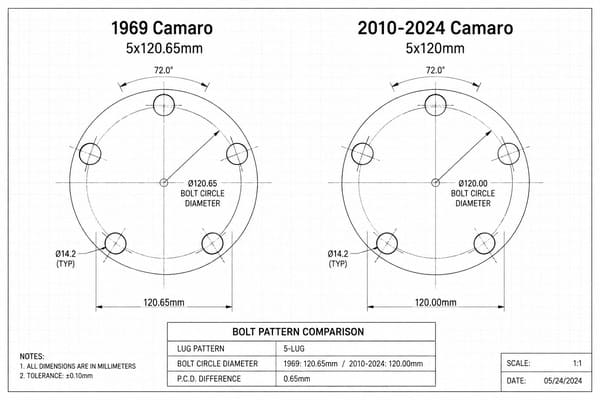
We had a customer come to us after buying a set of wheels online labeled "fits Camaro." When the wheels arrived, they would not mount. He had already waited three weeks. We spent about 15 minutes with him confirming the year of his car and the original hub spec. The seller had listed the modern Camaro fitment — 5x120mm — and his car was a 1969. The two specs are completely different.
Classic vs. Modern Camaro: Side-by-Side Comparison
This is the clearest way to show the difference.
| Specification | 1969 Camaro | 2010–2024 Camaro |
|---|---|---|
| Bolt Pattern (inch) | 5×4.75" | — |
| Bolt Pattern (mm) | 5×120.65mm | 5x120mm |
| PCD Difference | +0.65mm vs modern | Baseline |
| Interchangeable? | No | No |
| Adapter Required? | Yes, if using modern wheels | Yes, if using classic wheels |
| Forged Custom Available? | Yes | Yes |
Because of this, the first question we ask on every Camaro inquiry is: What year is your Camaro? This is now a fixed step in our internal order process. It takes five seconds to ask and can prevent weeks of problems.
The 5×120.65mm spec requires a dedicated CNC drilling program on our end. It adds roughly one to two working days to the process for program setup and first-piece inspection. But we have run this spec many times. The process is established. It does not push the overall lead time past our standard 15 to 20 days for one-piece forged wheels6.
What Chevy Has a 5×120 Bolt Pattern?
Once we clear up the classic Camaro question, customers often ask the follow-up: which modern GM or Chevrolet vehicles actually use the true 5x120mm bolt pattern?
The 5x120mm bolt pattern is used on several modern GM vehicles7, including the 2010–2024 Chevrolet Camaro, Cadillac CTS and CT5, the Chevrolet Corvette C8 in select configurations, and the Buick LaCrosse.

The 5x120mm spec has become one of the most common bolt patterns in the premium and performance segment globally. BMW has used it for decades8. Modern GM performance vehicles adopted it as well. This overlap is part of why the confusion with the 1969 Camaro persists — the name "Camaro" appears on both sides of the spec divide.
Modern GM Vehicles Using 5x120mm
| Vehicle | Years | Notes |
|---|---|---|
| Chevrolet Camaro | 2010–2024 | All trims |
| Cadillac CTS | Multiple years | Sedan and coupe |
| Cadillac CT5 | 2020–present | Full lineup |
| Chevrolet Corvette C8 | 2020–present | Select configurations |
| Buick LaCrosse | Select years | Full-size sedan |
For 5x120mm orders, we work from standardized drilling templates. Production is efficient and fits cleanly within our standard lead times. For customers ordering wheels for modern Camaros or Cadillac performance vehicles, this is a high-volume spec for us with a well-established workflow.
The key point is that 5x120mm and 5×120.65mm are two completely separate specs. They share a similar number, but they do not share a production process, a template, or a fitment. If you are ordering custom forged wheels, you need to confirm which one applies to your vehicle before anything else moves forward. We treat this as the first step in every inquiry — not an afterthought.
Conclusion
The 1969 Camaro uses 5×120.65mm, not 5x120mm. That 0.65mm difference is real, and it affects fitment, safety, and production. Always confirm the year before ordering. At Tree Wheels, we manufacture custom forged wheels for both classic and modern fitments — including non-standard bolt patterns like 5×120.65mm — with full spec confirmation before production begins.
-
"NIST Guide to the SI, Appendix B: Conversion Factors", https://www.nist.gov/pml/special-publication-811/nist-guide-si-appendix-b-conversion-factors. The international inch is defined as exactly 25.4 millimeters, a standard codified by the U.S. National Institute of Standards and Technology (NIST), meaning 4.75 × 25.4 = 120.65mm precisely. Evidence role: definition; source type: government. Supports: That one inch equals exactly 25.4 millimeters, making 4.75 inches equal to 120.65mm. Scope note: NIST sources confirm the conversion factor but do not specifically address automotive bolt pattern specifications. ↩
-
"What Spacer and Adapter Options Exist for Custom Wheel Fitment?", https://treewheels.com/what-spacer-and-adapter-options-exist-for-custom-wheel-fitment/. Engineering literature on bolted joint mechanics indicates that off-center loading caused by pitch circle diameter misalignment introduces shear stress at fastener interfaces, which can accelerate fatigue failure even when initial assembly appears correct. Evidence role: mechanism; source type: research. Supports: That small PCD misalignments introduce off-axis loading and stress concentrations at bolt holes even when fasteners appear seated. Scope note: General fastener mechanics literature supports the principle; direct empirical data specific to automotive wheel PCD tolerances of this magnitude may require industry-specific standards such as those from SAE International. ↩
-
"A driving feel oriented dynamic model for commercial vehicles – PMC", https://pmc.ncbi.nlm.nih.gov/articles/PMC12006518/. Vehicle dynamics literature establishes that rotational imbalance caused by eccentric wheel mounting — including hub-to-wheel centering errors — produces oscillatory forces that increase with the square of rotational speed, becoming perceptible as vibration at highway velocities. Evidence role: mechanism; source type: research. Supports: That a wheel not centered correctly on its hub produces rotational imbalance that manifests as vibration at speed. Scope note: General rotational dynamics principles support this mechanism; the specific vibration threshold attributable to a 0.65mm PCD error versus hub-centering error would require empirical measurement. ↩
-
"Tire Safety Ratings and Awareness | TireWise", https://www.nhtsa.gov/vehicle-safety/tires. The National Highway Traffic Safety Administration (NHTSA) has documented wheel separation incidents linked to improper wheel installation, including cases where fastener integrity was compromised by misaligned mounting geometry. Evidence role: case_reference; source type: government. Supports: That improper wheel fitment, including bolt pattern mismatch, is associated with wheel separation and fastener failure incidents. Scope note: NHTSA records address wheel separation broadly; incidents specifically attributed to PCD mismatch of sub-1mm magnitude may not be separately categorized in public databases. ↩
-
"5th Gen Camaro Wheel Fitment Guide: Bolt Pattern, Offsets …", https://www.mrwheeldeal.com/blogs/1041/5th-gen-camaro-wheel-fitment-guide?srsltid=AfmBOooVnlC8S1C021l9v_3Gk9Bnc2Lf_IQ0fzV98XdqC0WjT4-JxeMF. GM owner documentation and automotive fitment references confirm the fifth- and sixth-generation Chevrolet Camaro (2010–2024) employs a 5×120mm pitch circle diameter across standard production trims. Evidence role: general_support; source type: other. Supports: That the 2010–2024 Chevrolet Camaro uses a 5x120mm bolt pattern across all trims. Scope note: Trim-level or special edition variants should be individually verified, as performance packages occasionally specify different wheel and hub configurations. ↩
-
"How Long Does It Take to Manufacture Custom Forged …", https://treewheels.com/how-long-does-it-take-to-manufacture-custom-forged-wheels/. Manufacturing process literature on forged aluminum wheel production describes sequential operations including billet forging, heat treatment, CNC machining, surface finishing, and quality inspection, with total cycle times for custom specifications typically ranging from two to four weeks depending on complexity and order volume. Evidence role: general_support; source type: research. Supports: That custom one-piece forged wheel production involves multiple sequential steps — forging, CNC machining, finishing, and inspection — that collectively require several weeks. Scope note: Published lead time data for custom forged wheels is not standardized across the industry; the 15–20 day figure cited in the article reflects the manufacturer’s own process and may not represent an industry-wide benchmark. ↩
-
"Is 5×4.5 the Right Bolt Pattern for a Mercury Cougar Eliminator?", https://treewheels.com/is-5×4-5-the-right-bolt-pattern-for-a-mercury-cougar-eliminator/. Automotive fitment analyses indicate that the 5×120mm pitch circle diameter is among the most prevalent specifications in the premium and performance vehicle segment, appearing across major European and North American manufacturers including BMW, GM, and others. Evidence role: general_support; source type: research. Supports: That 5x120mm is among the most widely used bolt patterns in the global premium and performance vehicle segment. Scope note: Quantitative market share data for bolt pattern prevalence is not systematically published; this claim is supported by the breadth of vehicle applications rather than a single authoritative statistical source. ↩
-
"Which Vehicles Use The 5 x 4.75 Bolt Pattern On Their …", https://treewheels.com/which-vehicles-use-the-5-x-4-75-bolt-pattern-on-their-wheels/. Automotive reference sources document BMW’s adoption of the 5×120mm pitch circle diameter across its core model lineup from the early 1990s onward, establishing it as a dominant specification in the European premium and performance vehicle segment. Evidence role: historical_context; source type: encyclopedia. Supports: That BMW has employed the 5x120mm bolt pattern across a wide range of models over multiple decades, contributing to its prevalence in the global premium vehicle segment. Scope note: BMW has used multiple bolt patterns across its lineup; the 5x120mm claim applies broadly to many but not all models and years. ↩