
Every month, I get at least a dozen inquiries asking if an adapter can fix a bolt pattern mismatch. The answer is almost never what they expect.
Wheel spacers push your wheel outward to adjust track width. Wheel adapters convert one bolt pattern to another. Some products combine both functions. Each option has strict limits on thickness, thread engagement, and legal compliance — and none of them replace a properly spec’d custom wheel.
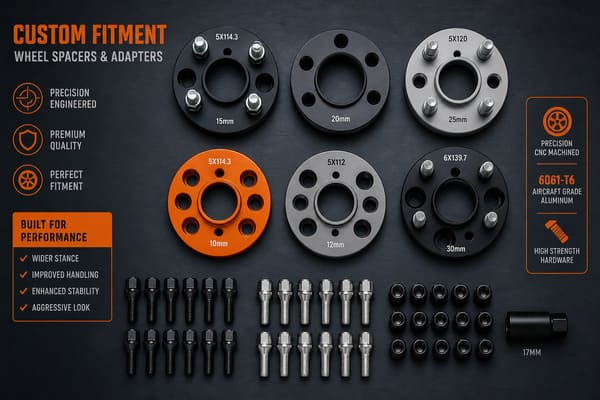
About 20% of all inquiries I receive start with the same question: "My car is 5×114.3, but I want to run a 5×120 wheel1 — can an adapter fix that?" Every single time, I ask them back: why not just order a forged wheel made to 5×114.3 from the start? There is usually a three-second pause. Then they say: "I didn’t know I could do that." Spacers and adapters exist because people are paying a price for compromising on specs. A truly custom forged wheel has the offset, bolt pattern, and hub bore built in from the design stage. The wheel itself is the solution. You don’t need patches. This article makes a point that goes against what most people assume — a spacer is not the end of customization. It is a signal that you haven’t actually customized anything yet.
Do Wheel Adapters Work as Spacers?
A customer running a modified Porsche 911 wanted two things at once: push the wheels out 30mm and convert from 5×130 to 5×1122. One supplier told him a single adapter could solve both problems — cheaper and simpler. Two months later, everything looked fine. In the third month, at 160 km/h, the steering wheel started shaking. The inspection found the load point had shifted and the bolt holes had begun to deform3.
A wheel adapter converts bolt patterns. A wheel spacer increases track width. They solve different problems. A combo adapter-spacer does both at once — which means you carry the risk of both at the same time.
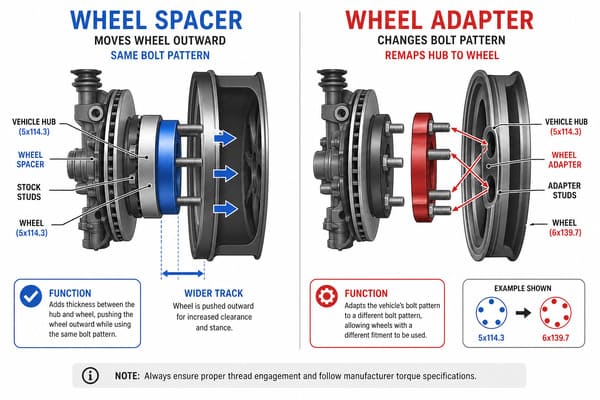
Adapters and spacers work on completely different principles. A spacer sits between the hub and the wheel to push the wheel outward. An adapter remaps the bolt pattern so a wheel with different bolt spacing can mount to your hub. The logic is not the same, and the stress each component handles is not the same.
What Happens When You Stack Both Functions Into One Part?
When a single piece has to manage track width offset and bolt pattern conversion at the same time, it carries a combined load that neither a standalone spacer nor a standalone adapter was designed to handle alone. The contact geometry changes. The stress distribution shifts. And if the part is not machined to extremely tight tolerances, small errors in either function compound into something much larger at highway speed.
| Function | Spacer | Adapter | Combo Unit |
|---|---|---|---|
| Adjusts track width | ✓ | ✗ | ✓ |
| Converts bolt pattern | ✗ | ✓ | ✓ |
| Risk factor | Single | Single | Compounded |
| Recommended use case | Minor width adjustment | Pattern-only mismatch | Not recommended |
The Porsche case I described is not rare. I have seen similar outcomes with BMWs, Audis, and modified JDM platforms. The problem is not that combo units are always dangerous. The problem is that they demand a level of manufacturing precision that most budget suppliers cannot deliver. If you can solve a problem with one component, never use two stacked together to do the same job. That rule applies even more when one component is already a compromise.
What Are the Different Types of Wheel Spacers?
Most people choose a spacer based on thickness. That is the wrong place to start. The type of spacer matters far more than how thick it is, and the difference between hub-centric and lug-centric comes down to one number — the hub bore diameter.
The two main types are hub-centric spacers, which center on the hub bore for precision alignment, and lug-centric spacers, which center on the lug nuts alone. Hub-centric spacers reduce vibration at high speed. The difference comes down to whether the center bore matches your vehicle’s hub exactly.
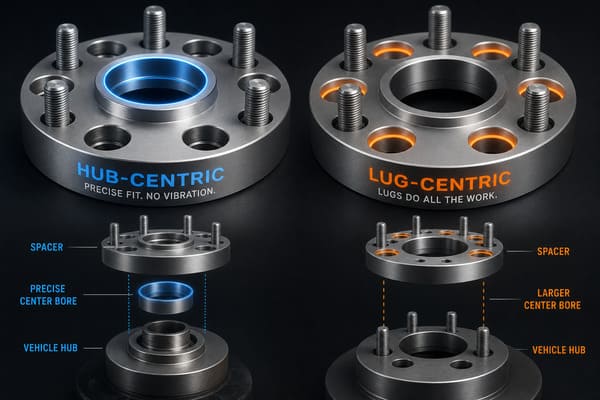
I have seen too many customers buy hub-centric spacers and still get vibration. Almost every time, the reason is the same: the spacer’s hub bore is 73.1mm but the actual vehicle hub is 72.6mm. A 0.5mm gap. At rest, you cannot see it. At 120 km/h and above, that 0.5mm is amplified into a vibration you feel through the entire car4.
Why Hub Bore Precision Is the Only Number That Matters
When we machine forged wheels at our facility, we hold hub bore tolerances to within 0.1mm5. That level of precision is what eliminates vibration at the wheel itself. But the moment a spacer enters the system, the precision chain breaks. Your wheel is accurate. Your hub is accurate. The spacer sitting between them is the weak link.
| Spacer Type | Centering Method | Vibration Risk | Best Use Case |
|---|---|---|---|
| Hub-centric | Hub bore contact | Low (if bore matches exactly) | Street and track use |
| Lug-centric | Lug nut pressure | Higher | Light-duty, low-speed use |
| Slip-on | No centering feature | Highest | Temporary fitment only |
| Bolt-on | Bolts to hub face | Low | Heavier offset applications |
The practical conclusion is straightforward. If you choose a hub-centric spacer, you must know your vehicle’s exact hub bore measurement — not the nominal spec from a catalog, the actual measured diameter of your specific hub. Then you match the spacer to that number within 0.1mm or less. If your spacer supplier cannot tell you the bore tolerance of their product, that is your answer about whether to buy it.
How Big Is Too Big for a Wheel Spacer?
The most repeated rule in the wheel modification industry is: anything over 25mm means you should just swap the wheel6. I think that number is too simple, and it can actually point people in the wrong direction. I had a customer who installed a 15mm spacer and still had a serious safety failure. The spacer thickness was not the problem.
There is no single "too big" thickness for a wheel spacer. The real safety limit is thread engagement length. Your lug bolt must have at least 10mm of effective thread engagement after the spacer is installed7. Spacer thickness only becomes dangerous when it reduces that engagement below the minimum.
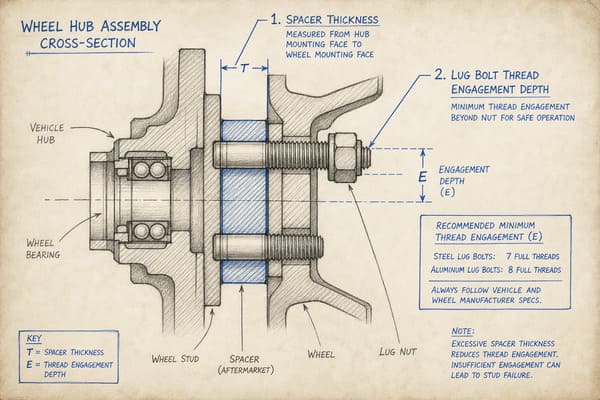
The customer I mentioned used his factory bolts after installing a 15mm spacer. Factory bolts on his vehicle had 12mm of thread engagement at stock configuration. After adding 15mm of spacer, the effective engagement dropped to less than 5mm. The wheel separated on a highway on-ramp at moderate speed8. The spacer was not too thick. The bolts were too short.
The Real Safety Calculation: Thread Engagement, Not Thickness
Almost every article about spacer size focuses on the millimeter number. Almost none of them explain the bolt math. Here is how the calculation actually works.
| Variable | Description | Safe Minimum |
|---|---|---|
| Original thread engagement | How deep factory bolt seats into hub | Measure before modifying |
| Spacer thickness | How far the wheel moves outward | Any, within load limits |
| New required bolt length | Original bolt + spacer thickness | Match exactly |
| Effective thread engagement | Remaining thread contact after spacer | 10mm minimum |
A 25mm spacer with the correct extended bolt is safer than a 15mm spacer with a factory bolt that is now 10mm too short. The thickness of the spacer determines which bolts you need. It does not determine whether the setup is safe on its own. Extended wheel bolts or wheel studs must be part of every spacer installation. This is the one detail that most DIY guides skip, and it is the detail that causes the most serious failures.
Are Wheel Adapters Legal?
I work with a shop owner in Sydney, Australia. Last year, he installed an adapter kit on a customer’s car. The car failed its annual inspection. The reason: the adapter did not have an Engineer’s Certificate, which is required in New South Wales for wheel modifications that change bolt pattern or offset beyond factory spec. The entire wheel setup had to come off. The total loss was over 2,000 Australian dollars.
Wheel adapter legality varies by country and region. The USA has no federal ban9. The EU requires TÜV certification for many adapter types10. Australia mandates engineering certification in several states11. The Middle East has almost no enforcement. Legal does not mean safe, and illegal does not always mean dangerous.
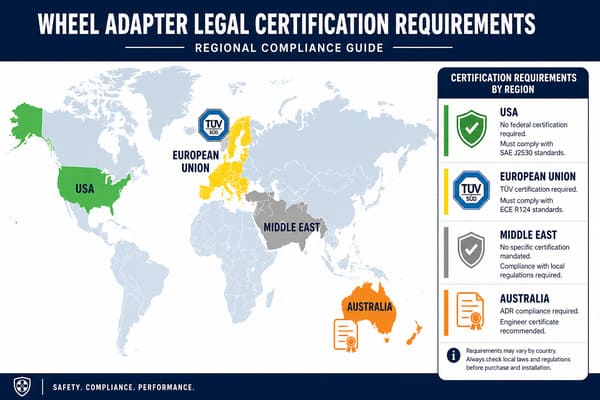
The certification question is not just a legal formality. It connects directly to liability. Our forged wheels carry DOT and TÜV certification12. Those certifications mean the wheel was designed, manufactured, and tested to specific safety standards. The moment a customer adds an uncertified adapter between the hub and the wheel, that certification chain breaks — at least in a legal sense.
How Legal Requirements Differ Across Our Key Markets
| Market | Legal Status | Certification Required | Enforcement Level |
|---|---|---|---|
| USA | No federal ban | DOT compliance for wheels | Moderate |
| EU / Germany | Regulated | TÜV approval common | High |
| Australia | State-dependent | Engineer’s Certificate (some states) | High |
| UAE / Middle East | Generally unrestricted | Not commonly required | Low |
| UK | MOT inspection applies | No dedicated adapter cert | Moderate |
The deeper point is this: legal compliance and physical safety are two separate questions, and both of them matter. An adapter that passes a legal inspection can still fail at speed if it is poorly machined. A certified forged wheel can still be part of an unsafe system if the adapter connecting it to the hub is substandard. I always tell customers: the certification on the wheel is only as strong as the weakest component in the fitment stack. You cannot wear body armor and leave the chest exposed. If you are buying a certified wheel, make sure every part between that wheel and your hub is held to the same standard.
Conclusion
Spacers and adapters are patches for spec mismatches. A properly designed custom forged wheel needs none of them. Every fitment question has a cleaner answer at the design stage.
Tree Wheels builds fully custom forged wheels to your exact bolt pattern, offset, and hub bore — no adapters needed.
-
"Is 5×114.3 the Right Bolt Pattern for a Mitsubishi Lancer Evo 4?", https://treewheels.com/is-5×114-3-the-right-bolt-pattern-for-a-mitsubishi-lancer-evo-4/. The 5×114.3mm pitch circle diameter (PCD) is among the most widely used bolt patterns globally, appearing on vehicles from manufacturers including Honda, Toyota, Nissan, and Hyundai, while 5x120mm PCD is common on BMW and select General Motors vehicles, making cross-pattern fitment a frequent aftermarket concern. Evidence role: definition; source type: encyclopedia. Supports: The dimensional specifications and prevalence of 5×114.3 and 5×120 bolt patterns across production passenger vehicles. Scope note: Bolt pattern usage data is typically aggregated by enthusiast databases rather than automotive standards bodies; manufacturer-specific fitment should always be confirmed against official vehicle documentation. ↩
-
"KP | Porsche Forged Wheels", https://treewheels.com/kp-porsche-forged-wheels/. The Porsche 911 uses a 5x130mm pitch circle diameter bolt pattern, while the 5x112mm PCD is the standard for a wide range of European vehicles including Audi, Volkswagen, and Mercedes-Benz models, making 5×130-to-5×112 one of the most commonly requested adapter conversions in the European enthusiast market. Evidence role: definition; source type: encyclopedia. Supports: The bolt pattern specifications of 5x130mm PCD for Porsche 911 and 5x112mm PCD for common European vehicles such as Audi, Volkswagen, and Mercedes-Benz. Scope note: Bolt pattern specifications can vary by model year and trim level; the figures cited reflect typical configurations rather than universal specifications across all production years. ↩
-
"Mechanics of Materials: Combined Loading", https://www.bu.edu/moss/mechanics-of-materials-combined-loading/. Engineering literature on stress concentration factors around fastener holes demonstrates that combined loading conditions — where a single component must simultaneously resist both shear and bending — significantly accelerate fatigue crack initiation compared to uniaxial loading scenarios. Evidence role: mechanism; source type: research. Supports: How combined or off-axis loading accelerates fatigue and deformation around fastener holes in aluminum or steel components. Scope note: General fastener fatigue literature may not directly test wheel adapter-spacer combo units; findings would be extrapolated from broader mechanical engineering principles. ↩
-
"Steering Wheel Vibration at Highway Speed — The Exact Diagnostic …", https://www.youtube.com/watch?v=_2jH84-w09c. Rotor dynamics theory establishes that even small eccentricities in rotating assemblies generate centrifugal forces proportional to the square of rotational speed, meaning a sub-millimeter hub misalignment that is imperceptible at low speed can produce significant vibration forces at highway velocities. Evidence role: mechanism; source type: research. Supports: How small eccentricities or mass imbalances in rotating wheel assemblies are dynamically amplified at higher rotational speeds, producing measurable vibration. Scope note: Published NVH research typically addresses wheel imbalance rather than hub bore mismatch specifically; the vibration magnitude for a 0.5mm gap would depend on vehicle mass, suspension geometry, and speed. ↩
-
"Steel Automotive Wheel Rims—Data Fusion for the Precise Identification …", https://pmc.ncbi.nlm.nih.gov/articles/PMC10817687/. Automotive wheel manufacturing standards, such as those published by ISO or SAE, specify dimensional tolerances for hub bore diameters to ensure concentricity and minimize vibration during vehicle operation. Evidence role: expert_consensus; source type: institution. Supports: Industry or standards-body specifications for acceptable hub bore dimensional tolerances in passenger vehicle wheel manufacturing. Scope note: Specific tolerance figures vary by wheel class and vehicle application; the 0.1mm figure cited in the article may reflect a proprietary or higher-than-minimum standard rather than a universal industry requirement. ↩
-
"What is the maximum safe thickness for wheel spacers?", https://www.facebook.com/groups/proawetechforum/posts/3943647172534034/. Commonly cited spacer thickness guidelines of approximately 25mm appear in aftermarket fitment literature as a practical heuristic, though this figure is not derived from a single published engineering standard; the underlying concern relates to changes in scrub radius, kingpin inclination, and bearing load geometry that become progressively more significant as spacer thickness increases. Evidence role: general_support; source type: research. Supports: The engineering basis or industry origin of commonly cited maximum thickness recommendations for wheel spacers. Scope note: The 25mm rule is a rule of thumb without universal standardization; actual safe thickness depends on vehicle suspension geometry, bearing specifications, and fastener engagement, as the article itself argues. ↩
-
"warning", https://static.nhtsa.gov/odi/rcl/2018/RCONL-18E065-6286.pdf. Fastener engineering guidelines, including those referenced in SAE standards, generally specify minimum thread engagement as a function of fastener diameter — often at least one times the bolt diameter — to ensure adequate clamp load and prevent thread stripping under dynamic loading. Evidence role: definition; source type: institution. Supports: Recognized engineering or fastener industry standards for minimum thread engagement length in automotive wheel fastener applications. Scope note: The specific 10mm figure may be a practical industry rule of thumb rather than a value drawn directly from a published standard; actual minimums depend on bolt diameter, thread pitch, and material. ↩
-
"transportation", https://www.ntsb.gov/safety/safety-studies/Documents/SIR9204.pdf. Vehicle safety databases, including NHTSA complaint and recall records, contain documented instances of wheel separation events linked to improper fastener engagement, including cases involving aftermarket wheel spacers installed with factory-length bolts. Evidence role: case_reference; source type: government. Supports: Documented cases of wheel separation events attributable to inadequate fastener thread engagement or improper wheel spacer installation. Scope note: Publicly available government databases may not always distinguish between thread engagement failure and other causes of wheel detachment; individual case details may be incomplete. ↩
-
"49 CFR Part 571 — Federal Motor Vehicle Safety Standards", https://www.ecfr.gov/current/title-49/subtitle-B/chapter-V/part-571. Federal Motor Vehicle Safety Standards (FMVSS) administered by NHTSA govern wheel performance requirements for new vehicles but do not include a specific federal prohibition on aftermarket wheel adapters; enforcement of aftermarket modification safety is largely left to state vehicle inspection regimes. Evidence role: general_support; source type: government. Supports: The scope of US federal motor vehicle safety standards as they apply (or do not apply) to aftermarket wheel adapters and spacers. Scope note: Absence of a federal ban does not imply federal approval; liability under state tort law and state vehicle codes may still apply, and individual state inspection requirements vary. ↩
-
"Marine Equipment Directive enters into force in the EEA", https://www.efta.int/media-resources/news/marine-equipment-directive-enters-force-eea. In Germany and other EU member states, aftermarket wheel modifications — including spacers and adapters — are subject to type-approval requirements under national road traffic regulations (e.g., Germany’s StVZO), with TÜV and similar technical inspection bodies issuing approval certificates for compliant components. Evidence role: general_support; source type: government. Supports: EU or member-state legal requirements for certification of aftermarket wheel modification components, including adapters and spacers. Scope note: TÜV is a German-based organization; ‘EU requirement’ is an oversimplification, as certification obligations are largely governed by national regulations rather than a single harmonized EU directive for this component category. ↩
-
"How to obtain engineer certificates for modified vehicle in NSW?", https://www.facebook.com/groups/566358020205271/posts/3156392337868480/. Australian state road authorities, including Transport for NSW, publish vehicle modification standards that require an engineer’s certificate for modifications affecting wheel track width or bolt pattern beyond manufacturer specifications. Evidence role: general_support; source type: government. Supports: Australian state government requirements for engineering certification of wheel modifications including adapters and spacers. Scope note: Requirements differ across Australian states and territories; the article’s claim that ‘several states’ require certification is directionally accurate but should be verified against each jurisdiction’s current standards, as regulations may be updated. ↩
-
"Interpretation ID: 86-1.39", https://www.nhtsa.gov/interpretations/86-139. DOT compliance for wheels in the United States is governed by FMVSS No. 110 and related standards, which specify load, impact, and dimensional requirements; TÜV approval in Germany and the EU involves independent technical testing against standards such as those defined in ECE Regulation No. 124, covering mechanical performance of replacement wheels for passenger vehicles. Evidence role: definition; source type: government. Supports: What DOT and TÜV wheel certifications require in terms of testing standards and regulatory scope. Scope note: DOT self-certification in the US places compliance responsibility on the manufacturer rather than requiring pre-market third-party testing, which differs from the TÜV independent approval process; the two systems are not equivalent in enforcement structure. ↩