
Most buyers searching for truck rims start with the wrong question. They ask, "What looks best on my pickup?" before confirming whether a rim will even fit. That sequence leads to incompatible orders, costly returns, and — in the worst cases — safety problems on the road. The right question is: "What fits, what handles my use case, and then what looks good?"
Choosing the right truck rims comes down to three non-negotiable specs — diameter and width, bolt pattern, and offset — confirmed against your specific vehicle make, model, and year. Get all three right first. Then evaluate material, load rating, certification, and aesthetics. Skipping that order is the single most common reason aftermarket rim purchases go wrong.

One quick note before we go further: this article is about pickup trucks — F-150s, RAM 1500s, Tundras, Silverados, and similar light-duty vehicles. It does not cover commercial or heavy-duty semi-trucks, which follow entirely different load and fitment standards. If you drive a light-duty or half-ton pickup, you’re in the right place.
The sections below walk through each decision layer in the order it actually matters. I’ve structured this as a framework, not a checklist, because your right answer depends on your truck, your use case, and what you plan to carry or tow.
Are You Starting With the Wrong Question About Truck Rims?
Most buyers I speak with arrive already committed to a size or a style. They’ve seen a set on Instagram or a friend’s truck, and they want the same thing. The problem is that "the same thing" may sit on a different vehicle with a different bolt pattern, different offset, and different tire package.
The wrong starting point is aesthetics. The right starting point is your vehicle’s spec sheet. Before contacting any supplier — including us — you need to know your truck’s bolt pattern, current rim diameter and width, hub bore size, and offset range. Without those four numbers, no supplier can responsibly confirm fitment.

When customers contact Tree Wheels asking about rims for their F-150, RAM, or Tundra, the first three questions we ask are always the same:
- What is your exact year, make, and model — including trim level?
- What is your current tire and rim size?
- What are you using the truck for — daily driving, towing/hauling, off-road, or show?
Those questions aren’t filler. They determine whether a wheel physically mounts, whether it clears your brakes and suspension, and whether it can handle your load requirements.
Why "One Size Fits All Trucks" Is a Dangerous Myth
Different pickup platforms use different bolt patterns, hub bore diameters, and offset ranges — even within the same brand across model years. A 2018 RAM 1500 uses a 6×139.7 bolt pattern, but so does a Toyota Tundra. They’re not interchangeable on every dimension because hub bore and offset differ.
Here are bolt patterns for some common US pickups:
| Vehicle | Bolt Pattern | Notes |
|---|---|---|
| Ford F-150 (2015–present) | 6×135 | Check offset carefully for aftermarket |
| RAM 1500 (2019–present) | 6×139.7 | Changed from 5-lug in earlier years |
| Chevrolet Silverado 1500 | 6×139.7 | Consistent across recent generations |
| Toyota Tundra | 6×139.7 | Same pattern, different hub bore than GM |
| Nissan Titan | 6×139.7 | Verify hub bore before ordering |
| Ford F-250/350 | 8×170 | Heavy-duty — different category entirely |
Important: This table is a general reference. Always verify specs against your vehicle’s owner manual or a reputable fitment database before ordering.
Getting the bolt pattern wrong means the wheel physically cannot mount. There is no workaround. I’ve seen buyers receive wheels they were certain would fit because "they looked right online," only to find out the bolt pattern was off by a single millimeter in spacing. That’s a complete return.
What Are the Three Specs That Actually Determine Fit?
Rim size, bolt pattern, and offset are the three variables I ask about in every customer conversation. Most buyers know roughly what size they want. Very few have confirmed their offset before reaching out to a supplier.
The three specs that determine whether a truck rim physically fits and performs safely are: (1) rim diameter and width matched to tire size and wheel well clearance, (2) bolt pattern matched exactly to the vehicle’s hub, and (3) offset, which controls how far the wheel sits inward or outward from the hub centerline. All three must be verified before any other consideration.

Each of these specs interacts with the others — and with your tire choice, brake caliper clearance, and suspension geometry. Here is how to think through each one.
Rim Diameter and Width
Rim diameter for light-duty pickup trucks typically ranges from 17 to 22 inches in the aftermarket. Width usually runs between 7.5 and 10 inches, depending on the tire profile you plan to run.
Key considerations:
- Larger diameter rims require lower-profile tires to maintain the same overall wheel diameter. This affects ride quality and can affect speedometer accuracy if not properly matched.
- Wider rims allow wider tires, which improves traction but can cause rubbing against wheel wells or suspension components — especially if offset isn’t adjusted accordingly.
- Wheel well clearance is not just about diameter. Width and offset together determine whether the tire clears the fender at full lock.
A common upgrade I see among F-150 and Silverado owners is moving from the stock 18-inch rim to a 20-inch or 22-inch. That’s a reasonable change, but it requires confirming that the tire package maintains correct overall diameter — otherwise handling, braking distance, and ADAS calibration can be affected1.
Bolt Pattern
As shown in the table above, bolt pattern is non-negotiable. It is a binary fit — either it mounts or it doesn’t. The bolt pattern is expressed as the number of bolts × the diameter of the bolt circle in millimeters (e.g., 6×139.7).
Do not assume that wheels from the same brand family share a bolt pattern across years. The RAM 1500 switched from a 5-lug to a 6-lug configuration.2 Always confirm against the specific year of your vehicle.
Offset
Offset is the measurement — in millimeters — between the wheel’s mounting face and its centerline.
- Positive offset pushes the wheel inward toward the vehicle. Common on stock passenger vehicles.
- Zero offset means the mounting face is exactly at the centerline.
- Negative offset pushes the wheel outward, giving that wider, aggressive stance many truck owners want.
For trucks, offset matters beyond aesthetics. Too much negative offset puts stress on wheel bearings and suspension components over time.3 Too much positive offset risks contact between the inner barrel and brake calipers or suspension parts.
Most US pickup trucks run factory offset values between +18mm and +44mm. Aftermarket fitment often involves adjusting offset for a wider stance, but I always recommend that buyers check the manufacturer’s recommended offset range — or consult a fitment specialist — before specifying a custom offset.
Why Does Wheel Material Matter for Trucks Specifically?
Pickup truck owners aren’t just looking for rims that look good. Many tow trailers, carry payloads, or drive on rough terrain. Material choice under those conditions is a functional decision, not a cosmetic one.
For trucks used in towing, hauling, or off-road driving, forged wheels offer a meaningful strength-to-weight advantage over cast wheels under sustained stress. A forged wheel is produced from a single billet of aluminum under high pressure, which results in a denser grain structure than cast alternatives. This is a relevant distinction for trucks that regularly carry loads — not a luxury upsell.

This is a point I make often in customer conversations, particularly with buyers who are comparing forged wheels against lower-priced cast options. The price difference is real. So is the performance difference under specific conditions. The question is whether your use case justifies it.
Forged Wheels: What the Difference Actually Means
Forged aluminum wheels are manufactured by applying high pressure to a heated aluminum billet. The result is a wheel with tightly compacted grain structure throughout.4
Cast wheels are manufactured by pouring molten aluminum into a mold. The process is faster and less expensive, but it can introduce porosity (small air pockets) within the material.5
What this means for truck owners:
- Trucks that regularly tow near their rated capacity experience lateral and torsional stress on rims that casual drivers don’t.
- Trucks used off-road encounter impact loads from rocks, ruts, and uneven surfaces that compressed forged material handles more consistently.
- Weight matters too. Forged wheels tend to be lighter for equivalent strength — lower unsprung weight improves handling response and reduces wear on suspension components over time6.
When Cast Wheels Are a Reasonable Choice
Not every pickup truck owner needs forged wheels. If your use case is primarily urban daily driving, light highway use, and occasional aesthetics upgrades — and you’re not regularly near your truck’s tow or payload rating — a quality cast wheel from a certified manufacturer may be entirely sufficient.
The key word is certified. More on that below.
Tree Wheels’ Production Approach
At Tree Wheels, we produce one-piece, two-piece, and three-piece forged wheels from our partner manufacturing facility, which carries over 20 years of forged wheel production experience. I state this as context for who we are — not as a claim about what our wheels do under specific load conditions, which individual buyers should evaluate based on their application and consult a fitment professional for complex requirements.
Do Certifications Actually Matter When Buying Truck Rims?
Certification is one of the most skipped steps in the buying process — especially among individual buyers purchasing online. It matters more than most people realize, and the consequences of skipping it aren’t just about product quality.
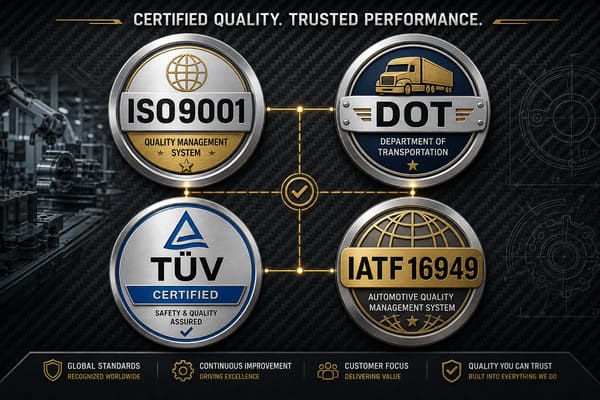
Certifications like DOT (US), TÜV (Europe and Australia), and ISO 9001 are not marketing badges. They are documents confirming that a wheel has met defined safety and manufacturing quality standards. For truck owners driving on public roads — especially those towing or carrying loads — purchasing uncertified rims creates real liability exposure. Buyers should request and verify these documents before completing any aftermarket rim purchase.
What Each Certification Actually Covers
| Certification | Issuing Body | Relevance |
|---|---|---|
| DOT | US Department of Transportation | Required for road-legal use in the USA |
| TÜV | German Technical Inspection Association | Recognized in Germany, Australia, and many export markets |
| ISO 9001 | International Organization for Standardization | Confirms quality management system — process-level assurance |
| IATF 16949 | International Automotive Task Force | Automotive-specific quality standard for manufacturers |
A few points worth naming directly:
- DOT certification is the baseline for road-legal use in the US. Wheels without DOT marking sold for on-road use are non-compliant. For buyers in the US, this is a due-diligence item, not optional.
- TÜV certification is widely recognized in Australia7 and is relevant for buyers in that market.
- Certifications should be verifiable. Ask the supplier for documentation. A reputable manufacturer will provide it without hesitation.
At Tree Wheels, our wheels carry ISO 9001, DOT, TÜV, and IATF 16949 certifications. I recommend that every buyer — regardless of which supplier they’re evaluating — request copies of current certification documents and check their validity dates.
How Does Intended Use Affect Which Truck Rims You Should Choose?
The same pickup truck can be used in radically different ways, and rim selection should reflect that. A truck that hauls materials five days a week has different rim requirements than a weekend show truck or a vehicle used for overlanding.
Your truck’s primary use case — daily commuting, towing and hauling, off-road driving, or show — should directly influence your rim choice. Specifically, it affects the material you choose, the offset range you consider, and the load rating you need to confirm with your supplier before ordering.

Use Case Comparison
| Use Case | Material Priority | Offset Consideration | Key Risk to Avoid |
|---|---|---|---|
| Daily driving (urban/highway) | Cast or forged both viable | Match factory range | Prioritizing style over clearance |
| Towing/hauling loads | Forged preferred | Conservative offset | Underestimating load rating |
| Off-road (trails, rough terrain) | Forged preferred | Negative offset for clearance | Ignoring impact resistance |
| Show/aesthetics focus | Either, visual finish priority | Aggressive negative offset | Forgetting road compliance |
Off-Road Use: A Specific Note
Off-road truck owners often want the most aggressive stance possible — wide tires, negative offset, larger diameter. These choices work, but they require careful confirmation that:
- The tire/rim combination fits within the wheel well at full suspension articulation
- The offset doesn’t overload wheel bearings under trail conditions
- The wheel is strong enough to absorb impact loads from rocks and ruts
I regularly speak with buyers in Australia and the US who run their Tundras and Silverados on demanding terrain. The common mistake I see is specifying extreme negative offset for aesthetics without accounting for what that means on a loaded trail. The rim choice needs to serve the terrain, not just the parking lot.
Frequently Asked Questions
What bolt pattern do most full-size US pickup trucks use?
Most full-size US pickup trucks — including the RAM 1500, Chevrolet Silverado 1500, GMC Sierra 1500, Toyota Tundra, and Nissan Titan — use a 6×139.7mm bolt pattern. The Ford F-150 uses a different pattern: 6×135mm. Always verify against your specific year and model before ordering.
Can I put any size rim on my pickup truck as long as it fits the bolt pattern?
No. Bolt pattern alone does not confirm fitment. You also need to verify offset, hub bore size, and that the rim diameter and width are compatible with your tire size and wheel well clearance. A rim that mounts on the hub can still rub against suspension components or brake calipers if offset is incorrect.
Are forged wheels worth the extra cost for a daily-driver pickup?
It depends on use. If you regularly tow, haul heavy payloads, or drive on rough terrain, forged wheels offer meaningful strength-to-weight advantages over cast alternatives. For light daily driving with no significant load requirements, a quality certified cast wheel may be entirely sufficient. Evaluate your use case first, then decide.
What does DOT certification mean for truck rims?
DOT certification indicates that the wheel meets the US Department of Transportation’s standards for road-legal use. For buyers in the US, rims without DOT marking are non-compliant for on-road use. Request certification documentation from any supplier and verify its validity before purchasing.
How do I find my truck’s current offset?
Your truck’s factory offset is listed in the owner’s manual under wheel specifications. You can also find it through reputable fitment databases by entering your year, make, model, and trim level. When ordering aftermarket rims, confirm with your supplier that the specified offset falls within a safe range for your vehicle.
Conclusion
Choosing the right truck rims for your pickup is a compatibility decision before it’s an aesthetic one. The primary keyword — truck rims — represents a purchase that goes wrong most often when buyers skip the spec work and lead with style. Start with bolt pattern, rim diameter and width, and offset. Confirm those against your specific vehicle. Then evaluate material based on your use case — forged for demanding load or off-road applications, certified cast as a viable alternative for lighter duty. And always request certification documentation, particularly DOT for US buyers.
Before you contact any supplier — including Tree Wheels — gather these five pieces of information:
- Year, make, model, and trim of your pickup
- Current rim diameter and width
- Bolt pattern (verify, don’t assume)
- Factory offset value
- Your primary use case (daily, towing/hauling, off-road, or show)
With those specs in hand, we can give you a real fitment recommendation — not a guess. Reach out to Tree Wheels to request a fitment check or a custom quote for one-piece, two-piece, or three-piece forged wheels tailored to your truck.
-
"Analysis of Advanced Driver-Assistance Systems for Safe and …", https://pmc.ncbi.nlm.nih.gov/articles/PMC11479187/. Automotive safety research and ADAS system documentation indicate that wheel speed sensors calibrated to OEM tire rolling circumference will produce inaccurate speed and distance inputs to ABS, electronic stability control, and forward collision warning systems when non-OEM tire sizes alter the effective rolling radius, potentially degrading system performance. Evidence role: mechanism; source type: research. Supports: That changes to overall tire and wheel diameter affect wheel speed sensor readings, which in turn influence ADAS functions including ABS, stability control, and collision avoidance systems that rely on accurate speed data.. Scope note: The severity of ADAS degradation depends on the magnitude of the diameter change and the specific system architecture; some modern vehicles include recalibration procedures for tire size changes, and the effect varies significantly across manufacturers and model years. ↩
-
"RAM 1500 Bolt Pattern: Replacements and Upgrades", https://www.williamsonchrysleruxbridge.com/ram-1500-bolt-pattern-replacements-and-upgrades/. Automotive specification records indicate that the RAM 1500 underwent a bolt pattern change from a 5×139.7 to a 6×139.7 configuration during a generational redesign, a detail critical for owners of transitional model years selecting aftermarket wheels. Evidence role: historical_context; source type: other. Supports: The specific model year in which the RAM 1500 transitioned from a 5-lug to a 6-lug bolt pattern configuration.. Scope note: The precise model year of this transition should be confirmed against Stellantis/Chrysler official documentation or a verified OEM parts database, as secondary sources vary in accuracy. ↩
-
"Scrub radius", https://en.wikipedia.org/wiki/Scrub_radius. Automotive engineering literature describes how wheel offset determines the scrub radius and the moment arm through which lateral forces act on hub bearings; greater negative offset increases this moment arm, elevating bearing load under cornering and braking conditions. Evidence role: mechanism; source type: education. Supports: That increasing negative wheel offset raises the mechanical moment arm acting on wheel bearings and suspension components, increasing stress and accelerating wear.. Scope note: Quantitative wear data specific to pickup truck platforms under defined offset deviations is not widely published in open academic literature; this mechanism is well-established in engineering principles but empirical truck-specific studies are limited. ↩
-
"Comparison of Mechanical and Corrosion Properties Between …", https://pmc.ncbi.nlm.nih.gov/articles/PMC12842727/. Materials science research on aluminum alloy processing documents that hot forging produces a refined and directionally aligned grain structure with reduced porosity compared to gravity or low-pressure casting, contributing to higher fatigue strength and impact resistance in the finished component. Evidence role: mechanism; source type: research. Supports: That the forging process produces a refined, aligned grain structure in aluminum alloys that results in superior mechanical properties compared to casting, which can introduce porosity and random grain orientation.. Scope note: Published studies typically address aluminum alloy properties in general industrial contexts; peer-reviewed research specifically benchmarking forged versus cast automotive wheel performance under truck load conditions is less commonly available in open literature. ↩
-
"How Are Maximum Load Ratings Determined Through Scientific …", https://treewheels.com/how-are-maximum-load-ratings-determined-through-scientific-testing/. Foundry engineering and materials science literature identifies gas porosity and shrinkage porosity as characteristic defect types in cast aluminum components, arising from dissolved hydrogen and volumetric contraction during solidification; these defects are associated with reduced fatigue life in structural applications. Evidence role: mechanism; source type: research. Supports: That aluminum casting processes are susceptible to porosity formation, which can reduce the mechanical integrity of the finished part.. Scope note: Modern low-pressure die casting and counter-pressure casting techniques used in premium wheel manufacturing significantly reduce porosity compared to gravity casting; the article’s characterization applies most directly to lower-grade casting methods. ↩
-
"How to Match Wheels with a Green Lamborghini Aventador?", https://treewheels.com/how-to-match-wheels-with-a-green-lamborghini-aventador/. Vehicle dynamics research establishes that unsprung mass — comprising wheels, tires, brake assemblies, and associated components — directly influences the natural frequency of wheel hop and the ability of the suspension to maintain tire contact with the road surface; lower unsprung mass reduces wheel hop amplitude and the peak forces transmitted through suspension joints. Evidence role: mechanism; source type: research. Supports: That reducing unsprung mass improves wheel-to-road contact consistency, handling response, and reduces dynamic loads transmitted to suspension components.. Scope note: The magnitude of handling improvement attributable specifically to wheel weight reduction varies with suspension design, vehicle mass, and driving conditions; studies quantifying this effect for light-duty pickup trucks specifically are limited in open literature. ↩
-
"Australian Design Rules", https://en.wikipedia.org/wiki/Australian_Design_Rules. Australian vehicle standards administered through the Department of Infrastructure, Transport, Regional Development, Communications and the Arts establish requirements for aftermarket wheel compliance; TÜV certification from accredited German testing bodies has been referenced in state-level vehicle modification codes as evidence of structural adequacy for wheel approval. Evidence role: general_support; source type: government. Supports: That TÜV certification is accepted or recognized under Australian vehicle modification and aftermarket parts standards.. Scope note: Wheel certification acceptance in Australia is administered at the state and territory level through individual vehicle modification codes, and the specific acceptance of TÜV documentation varies by jurisdiction; buyers should verify with their relevant state authority. ↩