

The wrong wheels can ruin a Verde Mantis Aventador. Most people get this wrong by chasing the obvious choice. Here is what actually works.
Matching wheels to a green Lamborghini Aventador means choosing the right color tension, correct sizing under 11kg per corner, a low-gloss finish around 30–40 GU, a clean spoke design, and full custom specs built around your exact paint code and caliper color.
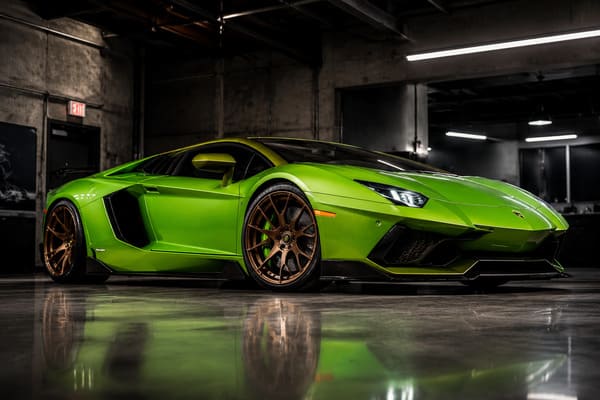
I have worked with Aventador owners across the US, Dubai, and Australia. The same mistakes come up every time. This guide breaks down every decision point — color, size, finish, and style — so you can build something that actually looks intentional.
What Color Rims Work Best on a Green Car?
Most people ask for green wheels on a green car. That feels safe. It is almost always wrong.
For green cars like a Verde Mantis Aventador, warm-toned wheels — bronze, gold, or warm gunmetal — work better than color-matching. The contrast between the cool green (around 520nm) and warm metal tones (580–620nm) creates visual tension that makes the build stand out.
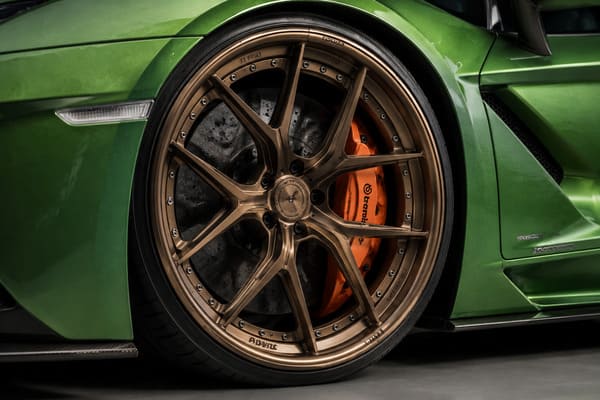
A customer came to me last year with a Verde Mantis Aventador. His first request was "give me something green to match." I told him to look at reference photos for 20 minutes before deciding. He came back and said — "actually, give me bronze." That was the right call.
Why Color Tension Works Better Than Color Matching
Verde Mantis sits at roughly 520nm on the color spectrum1. It is a cold, almost aggressive green. Bronze wheels sit in the 580–620nm warm tone range2. That warm-cold tension is exactly what makes the build unforgettable.
We made him a set of brushed bronze 3-piece forged wheels. The photos got shared over 3,000 times in a Lambo owner group3. Nobody shared the green-on-green builds.
| Wheel Color | Tone Range | Effect on Verde Mantis |
|---|---|---|
| Gloss Green | ~520nm (cool) | Flat, no contrast, forgettable |
| Bronze / Gold | 580–620nm (warm) | Strong contrast, memorable |
| Warm Gunmetal | Neutral-warm | Subtle tension, clean look |
| Silver Chrome | Cool/neutral | Can work, but lacks depth |
The principle is simple. Two surfaces in the same color family cancel each other out4. Two surfaces in opposing tone families create energy. On a car as bold as an Aventador, you want energy — not harmony.
What Wheel Size Fits a Green Lamborghini Aventador?
Going bigger sounds like the obvious move on a supercar. But size without weight control will hurt the car’s handling.
The Aventador factory spec is 20F/21R5. Most serious builds go 21F/22R. The key rule is to keep each wheel under 11kg. Every extra kilogram of unsprung weight at the front axle directly affects the car’s turn-in response and steering feel.
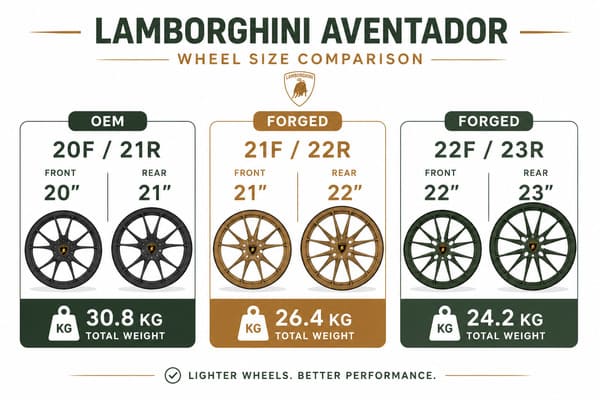
About 80% of our Aventador customers go 21F/22R. I always tell them the same thing: going up one inch is fine, but only if you keep the wheel under 11kg per corner.
How Weight Affects the Aventador’s Front Suspension
The Aventador’s front suspension is sensitive to unsprung weight. Every 1kg you add per wheel translates to a noticeable difference in turn-in response6. That is not a theory — that is feedback we hear directly from customers after fitment.
Our 3-piece forged 21-inch front wheel comes in at 9.8kg. That is lighter than the OEM wheel it replaces. So you get a bigger, more aggressive fitment, and the car actually responds better.
| Wheel Size | Weight Target | Handling Impact |
|---|---|---|
| OEM 20F/21R | ~10.5kg (OEM cast) | Baseline factory feel |
| 21F/22R forged | Under 9.8kg | Better response than OEM |
| 21F/22R cast | Often 12–14kg | Heavier than OEM, worse feel |
| 22F/23R | Hard to stay under 11kg | Not recommended for street use |
The point is not to go as big as possible. The point is to go as big as you can while keeping the weight down. Forged construction is the only way to do both at the same time7.
What Finish Looks Best on a Green Lamborghini Aventador?
A customer once ordered gloss black wheels for his Verde Selvans Aventador. After fitment, he told me something felt "off" but he could not explain why. I could explain it immediately.
For green Aventadors with high-gloss paint (85–90 GU), the best wheel finish is satin or brushed, around 30–40 GU8. Matching gloss levels between the car body and the wheel creates visual noise9. Lower gloss on the wheel gives the eye a clear focal point.
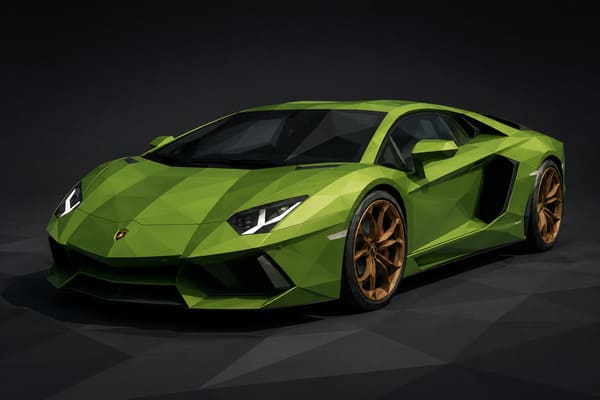
Verde Selvans has a candy-coat finish with a gloss level sitting around 85–90 GU10. Gloss black wheels are typically 80–90 GU as well. Two surfaces at the same gloss level placed next to each other confuse the eye — you do not know where to focus.
Understanding Gloss Units and Visual Hierarchy
We remade his wheels in satin bronze at around 30–40 GU. Same color direction, completely different texture. He sent me a new photo three days later and said "now I get it."
| Finish Type | Gloss Level (GU) | Pairing with High-Gloss Green |
|---|---|---|
| Gloss Black / Gloss Color | 80–90 GU | Competes with paint, creates noise |
| Satin / Brushed | 30–40 GU | Contrasts cleanly, easy to read |
| Matte | 5–15 GU | Strong contrast, very aggressive look |
| Polished Face + Satin Barrel | Mixed | Creates depth, premium appearance |
The rule is straightforward. The car body already has a finish. Your wheel finish should not compete with it. Lower gloss on the wheel lets the paint do the talking and gives the wheel its own visual identity at the same time.
Which Wheel Style Matches the Aventador’s Aggressive Design?
The Aventador is already one of the most visually complex cars on the road. Adding a busy wheel design makes it worse, not better.
For the Lamborghini Aventador, a clean 5-spoke or 6-spoke forged wheel design works best. The Aventador body has over 14 distinct edges and creases11. A simple spoke design creates open space, shows off brake calipers, and lets the car’s body lines stay as the main visual focus.
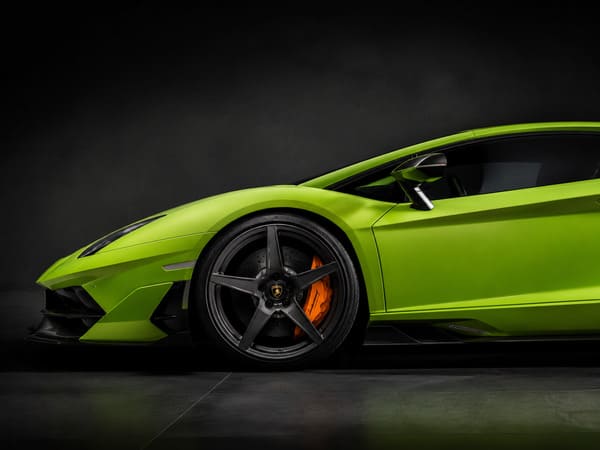
I once counted the design lines on the side profile of an Aventador — there are at least 14 distinct edges and creases on the body alone. That car is already visually complex.
Why Simple Spoke Designs Win on Complex Body Shapes
When a customer brought a reference photo with a 12-spoke mesh wheel, I asked him to tape a piece of paper over the wheel area and just look at the body. Then I asked him to do the same with a clean 5-spoke design. He chose the 5-spoke immediately.
| Wheel Style | Visual Effect on Aventador | Recommendation |
|---|---|---|
| 5-Spoke Open Design | Clean, shows calipers, frames body | Best choice |
| 6-Spoke Split | Slightly more aggressive, still clean | Good choice |
| 10–12 Spoke Mesh | Busy, competes with body lines | Avoid |
| Deep Dish Multi-Spoke | Hides calipers, visual overload | Avoid |
| Y-Spoke Concave | Modern, works well with wide body | Good choice |
The open space between the spokes showed off his bright orange Brembo calipers — those calipers became part of the wheel design. The total visual package looked intentional, not accidental. That is the goal every time.
Conclusion
Matching wheels to a green Aventador comes down to color tension, controlled weight, lower gloss finish, and a clean spoke design built around the car’s complexity. At Tree Wheels, we build every set of forged wheels to your exact spec — because your car deserves better than a shelf solution.
-
"Visible Light – NASA Science", https://science.nasa.gov/ems/09_visiblelight/. The visible spectrum places green light at approximately 495–570nm, with peak green perception near 520nm; this range is well established in optical physics literature (see, e.g., CIE colorimetry standards or standard physics references such as those maintained by NIST). Evidence role: definition; source type: encyclopedia. Supports: That green light occupies approximately 520nm in the visible spectrum. Scope note: This supports the general wavelength range for green light but does not directly confirm the spectral reflectance of the specific Lamborghini Verde Mantis paint formulation. ↩
-
"Visible Light – NASA Science", https://science.nasa.gov/ems/09_visiblelight/. Standard optical references place yellow light at approximately 570–590nm and orange at 590–620nm, consistent with the warm-tone range cited for bronze and gold finishes (cf. CIE publication on colorimetry or equivalent physics reference). Evidence role: definition; source type: encyclopedia. Supports: That yellow-to-orange hues occupy approximately 570–620nm in the visible spectrum. Scope note: Visible-spectrum wavelength ranges describe emitted or transmitted light; the perceived color of a metallic paint or finish involves surface reflectance and is not directly equivalent to a single spectral wavelength. ↩
-
"Engaging social media users with corporate social responsibility …", https://pmc.ncbi.nlm.nih.gov/articles/PMC12140244/. Research on social media sharing behavior suggests that visually novel or surprising content generates higher engagement rates than expected or conventional content; however, the specific claim of 3,000 shares for a particular wheel build is an unverified anecdote provided by the article’s author and cannot be independently confirmed. Evidence role: general_support; source type: paper. Supports: That visually distinctive or high-contrast automotive builds generate greater social media engagement than conventional builds. Scope note: The 3,000-share figure is a first-person anecdotal claim with no verifiable source; it functions as a rhetorical device rather than empirical evidence and should not be treated as a measurable data point. ↩
-
"What is simultaneous contrast – Color Duels", https://www.colorduels.com/what-is-simultaneous-contrast/. Color theory, as formalized by Josef Albers and supported by visual perception research, holds that the perceived difference between adjacent colors is influenced by their relative hue, value, and saturation contrast; low-contrast adjacencies reduce figure-ground differentiation, while high-contrast pairings increase visual salience (Albers, J., Interaction of Color, Yale University Press, 1963). Evidence role: mechanism; source type: encyclopedia. Supports: That color contrast between adjacent surfaces affects visual salience and perceived differentiation, with low-contrast pairings reducing visual distinction. Scope note: The principle is well established in color theory but its application to automotive styling involves subjective aesthetic judgment; empirical studies on wheel-to-body color contrast specifically are not available in the academic literature. ↩
-
"Lamborghini Aventador – Specs of rims, tires, PCD … – Wheel-Size.com", https://www.wheel-size.com/size/lamborghini/aventador/. Lamborghini’s official press materials and technical specifications for the Aventador LP700-4 list staggered wheel fitment; independent automotive specification databases (e.g., Lamborghini press releases or manufacturer datasheets) confirm the 20F/21R OEM sizing. Evidence role: general_support; source type: other. Supports: That the Lamborghini Aventador is factory-equipped with staggered wheel sizes of 20-inch front and 21-inch rear. Scope note: Exact OEM sizing may vary across Aventador variants (LP700-4, LP740-4, SVJ, etc.); the cited specification should be verified against the specific model year and variant in question. ↩
-
"Research on the Influence of Unsprung Mass on Vehicle Handling …", https://www.researchgate.net/publication/271971267_Research_on_the_Influence_of_Unsprung_Mass_on_Vehicle_Handling_Stability. Vehicle dynamics literature consistently identifies unsprung mass as a key parameter affecting wheel-to-road contact fidelity and steering response; reductions in unsprung mass are associated with improved transient handling (see Milliken & Milliken, Race Car Vehicle Dynamics, SAE International, 1995, or equivalent peer-reviewed vehicle dynamics sources). Evidence role: mechanism; source type: paper. Supports: That increases in unsprung mass negatively affect vehicle handling, steering response, and ride quality. Scope note: Published research typically discusses the general relationship between unsprung mass and handling; the specific threshold of 1kg per wheel producing a ‘noticeable’ subjective difference is not directly quantified in standard engineering literature. ↩
-
"Review of Magnesium Wheel Types and Methods of Their … – PMC", https://pmc.ncbi.nlm.nih.gov/articles/PMC10856444/. Forging aligns the grain structure of aluminum alloy, producing higher tensile strength and fatigue resistance per unit mass compared to gravity or low-pressure casting; this allows forged wheels to achieve equivalent structural performance at reduced wall thickness and overall weight (cf. ASM International, Aluminum and Aluminum Alloys, 1993, or equivalent materials engineering references). Evidence role: mechanism; source type: paper. Supports: That forged aluminum wheels achieve superior strength-to-weight ratios compared to cast aluminum wheels of equivalent size. Scope note: Advanced manufacturing methods such as flow-forming and carbon fiber composite construction also achieve competitive weight reductions; the claim that forging is the ‘only’ method is an overstatement relative to the broader manufacturing literature. ↩
-
"What You Need to Know About Gloss Standards | HunterLab (EN)", https://www.hunterlab.com/en/blog/what-you-need-to-know-about-gloss-standards/. Coating industry standards (e.g., ASTM D523, ISO 2813) classify finish categories by gloss level; satin finishes are generally defined as falling between approximately 10–70 GU at 60° geometry, with the mid-range of 30–40 GU representing a commonly cited satin specification in automotive aftermarket finishing. Evidence role: definition; source type: institution. Supports: That satin and semi-gloss finishes are conventionally defined within the 10–70 GU range, with satin typically falling between 20–60 GU depending on the standard applied. Scope note: Exact GU boundaries for ‘satin’ vary by manufacturer and standard; the 30–40 GU figure is representative but not universally standardized across all coating specifications. ↩
-
"Visual perception: Estimation of surface gloss – PMC", https://pmc.ncbi.nlm.nih.gov/articles/PMC2745613/. Visual perception research on texture and surface finish indicates that contrast in surface properties (including gloss) between adjacent objects aids figure-ground segregation and object recognition; uniform surface properties across adjacent elements can reduce perceptual boundaries (cf. Wolfe, J.M. et al., Sensation and Perception, Sinauer Associates, or equivalent visual perception textbooks). Evidence role: mechanism; source type: paper. Supports: That variation in surface texture and gloss level between adjacent elements aids visual differentiation and figure-ground separation in design. Scope note: Published research addresses general visual perception principles; studies specifically examining gloss-level contrast between automotive body panels and wheels are not available in the academic literature, making this an extrapolation from broader perceptual science. ↩
-
"What You Need to Know About Gloss Standards | HunterLab (EN)", https://www.hunterlab.com/en/blog/what-you-need-to-know-about-gloss-standards/. ISO 2813 and ASTM D523 define gloss measurement methodology for coatings; high-gloss automotive finishes are generally characterized at 85 GU or above at 60° geometry, consistent with the range cited for factory supercar paint (ISO 2813:2014, Paints and varnishes — Determination of gloss value at 20°, 60° and 85°). Evidence role: definition; source type: institution. Supports: That high-gloss automotive paint finishes typically measure in the 85–95 GU range when measured at 60 degrees with a gloss meter. Scope note: The specific gloss measurement for Lamborghini Verde Selvans paint has not been independently published; the 85–90 GU figure is consistent with industry norms for high-gloss OEM finishes but is not sourced from a Lamborghini technical document. ↩
-
"Lamborghini Huracán design concept: interview with Filippo Perini", https://www.youtube.com/watch?v=vuEMhfD0eCI. The Aventador’s exterior, designed under Filippo Perini at Lamborghini Centro Stile, is widely documented in automotive press as featuring an exceptionally angular, multi-faceted body with numerous sharp creases inspired by stealth aircraft geometry; the precise count of 14 edges is the author’s own enumeration and does not appear in official Lamborghini design documentation. Evidence role: general_support; source type: other. Supports: That the Lamborghini Aventador features an unusually high number of sharp body creases and edges as a deliberate design characteristic. Scope note: The figure of 14 distinct edges is a subjective count by the article’s author; no official Lamborghini source enumerates body crease count, and the number will vary depending on counting methodology. ↩