
Last year, a modification shop in Los Angeles ordered 20 sets of wheels for a mixed batch of customer cars. Three sets came back. That’s a 15% failure rate from one fitment gap.1
Wheel fitment is not a single measurement. It covers four specs: bolt pattern, hub bore, offset, and diameter. European, Japanese, and American vehicles each follow different standards for all four. Getting one wrong means the wheel either won’t mount — or worse, it mounts but fails under load.
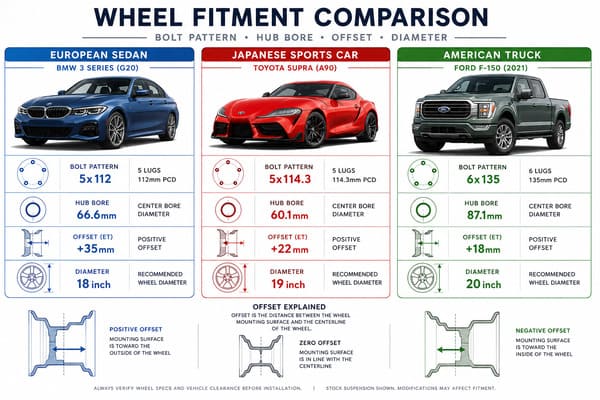
In forged wheel manufacturing, we see fitment mismatches every week. Most of them are avoidable. The problem is that most buyers focus on one spec — usually bolt pattern — and assume the rest will work itself out. It won’t. This article breaks down exactly how fitment requirements differ across the three major vehicle markets, so you can order with confidence and avoid the kind of problems that Los Angeles shop had to deal with.
What Is Wheel Fitment and Why Does It Matter for Your Car?
A customer once sent me a photo of a cracked wheel after six months of use. The bolt pattern matched his car perfectly. But the offset was 12mm too shallow, and the wheel had been bearing load unevenly on every single turn2.
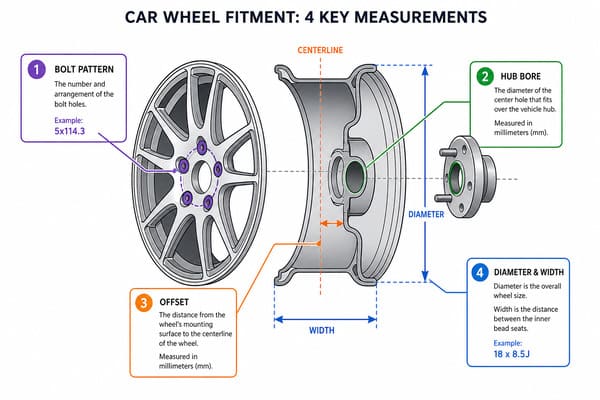
Wheel fitment refers to whether a wheel physically and mechanically matches a specific vehicle. It involves four key measurements: bolt pattern, hub bore, offset, and diameter.3 All four must be correct at the same time. A wheel that fits on three out of four specs is not a wheel that fits.
The cracked wheel story is one I come back to often when customers ask why fitment requires so much detail upfront. The wheel looked fine after installation. It mounted without any visible issue. The problem built up over thousands of kilometers of uneven stress distribution before it became visible — and by then, the structural damage was already done.
Why "It Mounted Fine" Is Not the Same as "It Fits Correctly"
A wheel that goes on without resistance can still be wrong. This is one of the most dangerous misconceptions in wheel modification. Here is what each spec controls, and what happens when it is off:
| Fitment Spec | What It Controls | Risk If Wrong |
|---|---|---|
| Bolt Pattern | Whether the wheel can physically bolt to the hub | Wheel cannot mount, or bolts under-engage |
| Offset | How far the wheel sits in or out from the hub face | Uneven load distribution, bearing wear, rubbing4 |
| Hub Bore | Whether the wheel centers on the axle | Vibration at speed, gradual stress on lug nuts |
| Diameter & Width | Clearance inside the wheel arch and brake system | Brake caliper contact, arch rubbing, incorrect speedometer5 |
The reason we ask customers for all four specs before we start machining is simple. A forged wheel is not adjustable after production. If we cut it to the wrong offset, the wheel is wrong. There is no fix short of remaking it from the start. That is why fitment documentation is not an optional step in our ordering process — it is the first step.
How Do Bolt Patterns Differ Between European, Japanese, and American Cars?
In our production records, roughly 40% of custom orders from US customers are for American trucks and SUVs. Almost all of them use 5×127 or 6×139.7. Yet a BMW 3 Series also has five lugs. The two wheels are completely incompatible.
Bolt patterns are written as the number of lugs multiplied by the bolt circle diameter in millimeters. European vehicles most commonly use 5×112 and 5×120. Japanese vehicles use 5×114.3 and 4×100. American trucks and SUVs use 5×127, 5×135, and 6×139.7.6 Same lug count does not mean interchangeable fitment.
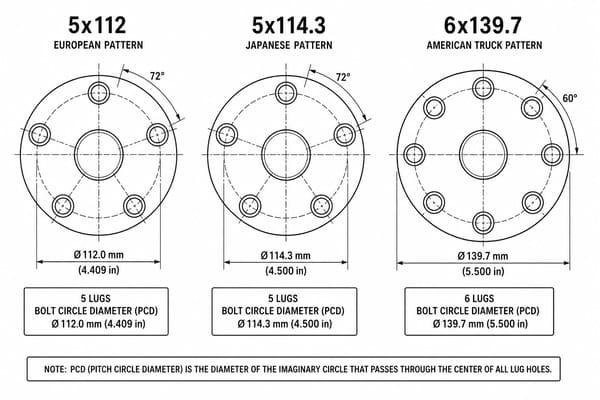
When customers from our UK and Dubai markets order wheels for European luxury vehicles, the bolt pattern is almost always 5×112 or 5×120. When Australian customers order for Japanese performance cars, we see 5×114.3 and 4×100 consistently. The difference in bolt circle diameter between a 5×112 and a 5×114.3 is only 2.3mm — but it is enough to make the wheel physically impossible to mount correctly.7
A Regional Breakdown of the Most Common Bolt Patterns
The table below reflects what we actually see in our order data across different markets. These are not theoretical specs — they come from real customer orders across the US, UK, Australia, Canada, and Dubai.
| Vehicle Origin | Common Models | Bolt Pattern |
|---|---|---|
| European | BMW 3/5 Series, Mercedes C/E Class | 5×112, 5×120 |
| European | Volkswagen Golf, Audi A4 | 5×112 |
| European | Porsche 911, Cayenne | 5×130 |
| Japanese | Toyota Camry, Honda Civic | 5×114.3 |
| Japanese | Mazda MX-5, Honda Fit | 4×100 |
| Japanese | Nissan GT-R, Subaru WRX | 5×114.3 |
| American | Ford F-150 | 5×135 |
| American | Chevrolet Silverado, GMC Sierra | 6×139.7 |
| American | RAM 1500 (older models) | 5×139.7 |
| American | Jeep Wrangler | 5×127 |
One thing that surprises many customers is how many different bolt patterns exist within a single brand. Ford alone uses 5×10⁸, 5×114.3, 5×135, and 6×139.7 depending on the model8. This is why we always ask for the specific model and year — not just the brand. Brand name alone is not enough information to confirm bolt pattern.
What Are the Standard Wheel Sizes for European, Japanese, and American Vehicles?
When we started taking international orders in early 2025, a pattern appeared almost immediately. Customers from Dubai ordering for Mercedes S-Class and Audi A8 requested 20" or 21" wheels. Australian customers modifying Nissan GT-Rs and Subaru WRXs asked for 18" or 19". US truck customers wanted 20" to 22" — but with load ratings some other markets never ask about.
Wheel diameter and width requirements vary significantly by region and vehicle type. European luxury vehicles typically run 18" to 21". Japanese performance cars sit between 17" and 19". American trucks and SUVs commonly use 18" to 22" with higher structural load requirements. The same diameter number does not mean the same wheel.
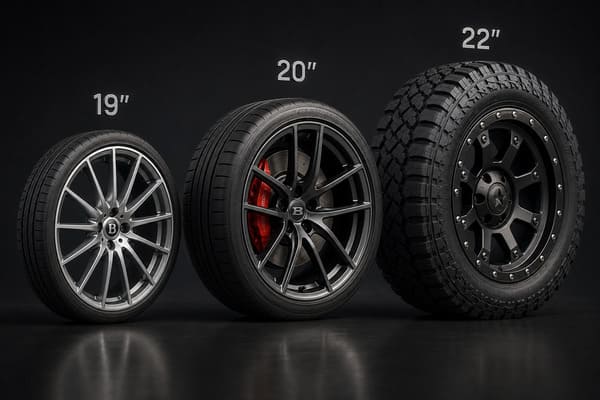
The load rating point is one that catches people off guard. A 20" wheel for a Mercedes GLE and a 20" wheel for a Ford F-250 are not even close to the same product. The F-250 wheel may need to support over 1,500 kg per corner under full load. That requires a fundamentally different forging spec, a different material thickness, and a different structural design — even if the visual style looks similar.
Size and Load Requirements by Vehicle Category
Here is how wheel size and structural demands break down across the three markets based on the orders we process:
| Market | Vehicle Type | Typical Diameter | Width Range | Load Requirement |
|---|---|---|---|---|
| European | Luxury sedan (S-Class, A8) | 20"–21" | 8.5"–10" | Standard passenger |
| European | Performance (BMW M, AMG) | 19"–20" | 9"–10.5" | Moderate, track-tolerant |
| Japanese | Sports/performance (GT-R, WRX) | 18"–19" | 8.5"–9.5" | Moderate |
| Japanese | Standard passenger | 16"–17" | 6.5"–7.5" | Standard passenger |
| American | Full-size truck (F-150, Silverado) | 20"–22" | 8.5"–9.5" | High load rated |
| American | Heavy duty truck (F-250, RAM 2500) | 18"–20" | 8"–9" | Very high load rated |
| American | SUV (Tahoe, Yukon) | 20"–22" | 8.5"–10" | High load rated |
We record load rating requirements on every truck and SUV order from North American customers now. Early on, we produced a set of 22" wheels for a customer’s Chevrolet Silverado with a standard load spec because he didn’t mention payload use. He was using the truck commercially. The wheels performed fine visually, but we recommended he upgrade to a higher-rated version once we understood his actual use case. The diameter was right. The structural spec was not.
How Does Hub Bore Size Affect Wheel Fitment Across Different Car Brands?
A customer from Canada ordered four wheels for his BMW 5 Series. The bolt pattern was right. The offset was right. The size was right. He drove 3,000 km and called us about a vibration problem that appeared above 110 km/h. The hub bore was wrong.
Hub bore is the diameter of the center hole in the wheel. It must match the center spigot on the vehicle’s hub. European vehicles typically use 56.1mm to 66.5mm. Japanese vehicles range from 54.1mm to 67.1mm. American trucks use larger bores, often 78.1mm or above.9 A mismatch causes vibration and stress on lug nuts over time10.
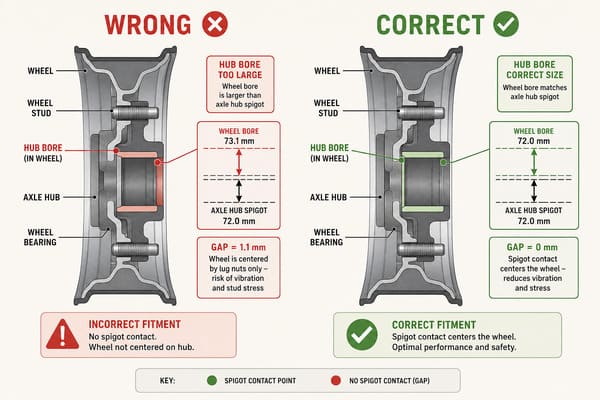
The Canada customer’s case is the one I use most often to explain why hub bore is not optional information. We had used a standard 72.6mm bore with hub-centric rings included — a common approach when the exact bore spec isn’t confirmed11. The rings shifted slightly over 3,000 km. We remachined all four wheels to 66.5mm, the correct spec for his BMW, and the vibration disappeared entirely. That one job is why we now request hub bore spec on every single order, no exceptions.
Hub Bore Reference Guide by Market and Brand
Hub bore specs vary by brand, model, and even model year. The table below covers the most common specs we work with across our main markets:
| Market | Brand / Model | Hub Bore (mm) |
|---|---|---|
| European | BMW 3/5/7 Series | 66.5 |
| European | Mercedes-Benz C/E/S Class | 66.9 |
| European | Audi A4/A6/A8 | 57.1 |
| European | Volkswagen Golf / Passat | 57.1 |
| European | Porsche 911 / Cayenne | 71.6 |
| Japanese | Toyota Camry / RAV4 | 60.1 |
| Japanese | Honda Civic / Accord | 64.1 |
| Japanese | Nissan GT-R / 370Z | 66.1 |
| Japanese | Subaru WRX / STI | 56.1 |
| American | Ford F-150 | 87.1 |
| American | Chevrolet Silverado | 78.1 |
| American | RAM 1500 | 77.8 |
| American | Jeep Wrangler | 71.5 |
The reason hub bore is so often overlooked is that the wheel will physically mount even with the wrong bore — especially when a hub-centric ring is used. The problem doesn’t appear until the vehicle is moving. By the time the vibration shows up, the lug nuts have often been under abnormal lateral stress for thousands of kilometers. Hub bore is not the most glamorous spec, but it is the one most likely to create a problem that is genuinely hard to trace back to its source.
Conclusion
Fitment across European, Japanese, and American vehicles differs in all four key specs: bolt pattern, hub bore, offset, and diameter. Getting all four right at the same time is the only acceptable standard. At Tree Wheels, we build every forged wheel to your exact vehicle specs — no guesswork, no compromises.
-
"FINAL RESEARCH REPORT", https://ppms.cit.cmu.edu/media/project_files/16_-_UTC_Tire_Tread_Final_Report.pdf. Aftermarket wheel fitment errors represent a documented source of product returns and safety incidents; however, comprehensive industry-wide return rate statistics specific to fitment mismatches are not widely published in peer-reviewed literature. Evidence role: general_support; source type: research. Supports: Industry or consumer safety data on the prevalence of aftermarket wheel fitment errors and associated product return or failure rates. Scope note: Direct statistical verification of a 15% return rate attributable solely to fitment gaps is unavailable; general industry reports may provide contextual but not confirmatory support. ↩
-
"Study on the failure mechanism and improvement measures of bearings …", https://pmc.ncbi.nlm.nih.gov/articles/PMC12644720/. Automotive engineering analyses indicate that wheel offset directly affects the scrub radius and load distribution at the hub; deviations from the manufacturer-specified offset shift bending moments onto wheel bearings and suspension components, accelerating fatigue. Evidence role: mechanism; source type: research. Supports: Engineering literature explaining how deviations in wheel offset alter the load path through the hub assembly, increasing stress on wheel bearings and the wheel structure itself. Scope note: The specific threshold of 12mm offset deviation causing structural cracking depends on vehicle design and load conditions; general engineering principles support the mechanism but do not confirm this specific case. ↩
-
"Wheel sizing", https://en.wikipedia.org/wiki/Wheel_sizing. Automotive engineering references and wheel manufacturer technical documentation define wheel fitment compatibility in terms of bolt circle diameter and lug count, center bore diameter, offset (the distance from the wheel’s mounting face to its centerline), and rim diameter and width, all of which must match vehicle specifications simultaneously. Evidence role: definition; source type: institution. Supports: That wheel fitment is conventionally characterized by the four parameters of bolt pattern, hub bore, offset, and rim diameter and width. Scope note: Some references additionally include load rating and thread specification as fitment parameters; the four-parameter framework presented here reflects common practice rather than a single universally codified standard. ↩
-
"Scrub radius", https://en.wikipedia.org/wiki/Scrub_radius. Vehicle dynamics and suspension geometry literature documents that wheel offset directly determines scrub radius; a shallower offset than specified increases scrub radius, amplifying lateral forces transmitted through the hub bearing, while an excessively deep offset can cause tyre-to-arch or wheel-to-suspension contact under compression. Evidence role: mechanism; source type: research. Supports: That deviations from specified wheel offset alter scrub radius geometry, increasing hub bearing loads and potentially causing contact between the tyre or wheel and the vehicle’s suspension or body structure. Scope note: The magnitude of bearing wear acceleration depends on offset deviation, vehicle mass, and usage profile; published fatigue life data specific to offset-induced bearing overload is limited. ↩
-
"Can 18×9 Wheels Fit on a Nissan 180SX Without Rubbing?", https://treewheels.com/can-18×9-wheels-fit-on-a-nissan-180sx-without-rubbing/. Automotive engineering references establish that vehicle speedometers are calibrated to a specific tyre rolling circumference determined by the OEM wheel and tyre combination; substituting a wheel and tyre with a different overall diameter changes the distance travelled per wheel revolution, introducing a proportional speedometer error. Evidence role: mechanism; source type: education. Supports: That changing wheel diameter alters the tyre’s rolling circumference, causing the vehicle speed sensor or speedometer to display an inaccurate reading. Scope note: The degree of speedometer inaccuracy depends on the combined effect of wheel diameter and tyre aspect ratio; wheel diameter alone does not determine rolling circumference without accounting for the mounted tyre profile. ↩
-
"Which Vehicles Use The 5 x 4.75 Bolt Pattern On Their …", https://treewheels.com/which-vehicles-use-the-5-x-4-75-bolt-pattern-on-their-wheels/. OEM wheel specifications published by major manufacturers and compiled in automotive reference databases confirm that 5×112 and 5×120 predominate in European production vehicles, while 5×114.3 and 4×100 are standard across Japanese manufacturers, and 5×127, 5×135, and 6×139.7 are characteristic of North American truck platforms. Evidence role: general_support; source type: institution. Supports: That the listed bolt patterns correspond to OEM specifications for the stated vehicle markets and manufacturers. Scope note: Bolt patterns vary by model year and platform within each manufacturer; regional generalizations reflect the most common configurations rather than universal standards. ↩
-
"Bolt Circle dims", https://www.aps.anl.gov/files/APS-Uploads/DD/Procedurals/Bolt_Circle_dims.pdf. Automotive fastener and wheel mounting standards specify that lug holes must align within tight positional tolerances with hub studs; a bolt circle diameter discrepancy of 2.3mm exceeds these tolerances, preventing full thread engagement and safe clamping load. Evidence role: mechanism; source type: research. Supports: That lug hole positioning in a wheel manufactured to one bolt circle diameter cannot safely accommodate the hub stud pattern of a different bolt circle diameter, even when the difference is small. Scope note: The specific tolerance values differ across standards bodies and manufacturers; the claim of physical impossibility is directionally supported but precise tolerance limits require reference to applicable standards such as those from SAE or ISO. ↩
-
"What cars have a 5×10⁸ bolt pattern?", https://www.quora.com/What-cars-have-a-5×108-bolt-pattern. Ford Motor Company’s published vehicle specifications and aftermarket fitment databases document at least four distinct bolt circle diameters across its product range, including 5×10⁸ on European-market models, 5×114.3 on certain crossovers, 5×135 on the F-150, and 6×139.7 on Super Duty trucks. Evidence role: case_reference; source type: institution. Supports: That Ford Motor Company employs multiple distinct bolt circle diameter specifications across its passenger car, truck, and SUV platforms. Scope note: Specific bolt pattern assignments may change with model year or platform revision; verification against the OEM specification sheet for the target model year is recommended. ↩
-
"Wheel Bolt Patterns Explained: Find Your PCD", https://curvaconcepts.com/resources/wheel-bolt-pattern-guide/. Wheel fitment reference databases and OEM specification sheets confirm that European passenger vehicles predominantly use hub bore diameters between approximately 56 mm and 67 mm, Japanese vehicles cluster in a similar range, and North American truck platforms require substantially larger center bores, commonly 78 mm or greater. Evidence role: general_support; source type: institution. Supports: That hub bore diameters for European, Japanese, and American vehicles fall within the stated ranges as documented in OEM wheel fitment specifications. Scope note: Hub bore specifications are model- and year-specific; the stated ranges represent common configurations and do not account for outliers or special-edition platforms. ↩
-
"Is 77.8mm the Right Hub Bore for a 1970 Plymouth Barracuda?", https://treewheels.com/is-77-8mm-the-right-hub-bore-for-a-1970-plymouth-barracuda/. Engineering analyses of wheel mounting systems establish that hub-centric designs rely on the center bore for wheel location, with lug fasteners providing clamping force only; when the bore exceeds hub spigot diameter, lug nuts assume a centering role, generating oscillatory imbalance forces and shear stress on fastener shanks. Evidence role: mechanism; source type: research. Supports: That a wheel with a center bore larger than the hub spigot shifts centering responsibility to the lug nuts, inducing vibration at speed and imposing lateral shear loads on fasteners not designed to carry them. Scope note: The severity of vibration and fastener stress depends on bore clearance magnitude, vehicle speed, and load; controlled experimental data specific to this failure mode is limited in publicly available literature. ↩
-
"HOW TO INSTALL HUB CENTRIC RINGS & Why You Need Them!", https://www.youtube.com/watch?v=j0z_uxsn8dY. Hub-centric rings, typically manufactured from aluminum or high-density plastic, are documented in aftermarket wheel fitment literature as a standard accommodation for center bore discrepancies; they restore hub-centric location when a wheel’s bore exceeds the vehicle’s hub spigot diameter. Evidence role: general_support; source type: research. Supports: That hub-centric rings are an accepted aftermarket method for adapting wheels with oversized center bores to hub spigots of smaller diameter. Scope note: Engineering guidance generally notes that hub-centric rings are a secondary solution; material creep, thermal cycling, and improper fitment of the rings themselves can reintroduce centering error over time. ↩