

The 180SX is one of the most iconic drift platforms ever built1. Get the fitment wrong on an 18×9 setup, and you will be grinding fenders within a week.
Yes, 18×9 wheels can fit a Nissan 180SX without rubbing — but only with the right offset and tire size. For a stock 180SX, ET25–ET28 front and ET20–ET25 rear, paired with 225/40R18 tires, is the most reliable combination to avoid rubbing at the fender and strut.

Last year, a customer came to us wanting 18×9 forged wheels for his daily-driven 180SX. He had no fender work done, stock suspension, and a tight budget. We told him upfront: at the wrong offset, you will rub. We spec’d him at ET28 front and ET25 rear, paired with 225/40R18, and it cleared. But that specific combination only worked because we measured carefully. One millimeter of offset in the wrong direction can be the difference between a clean fit and a grinding fender. The sections below break down every part of that decision so you can make the right call for your own build.
What Is the Stock Wheel Size on a Nissan 180SX?
Most people are surprised when they find out the 180SX left the factory on 195/60R14 wheels2. That is a 14-inch rim with a tall, narrow tire — basically the opposite of what most modern builds are running.
The Nissan 180SX came stock with 14-inch wheels and 195/60R14 tires. Moving to an 18×9 setup means adding 4 inches of rim diameter and 3.5 inches of rim width, which places the wheel in a completely different position relative to the fender arch, strut, and inner guard.
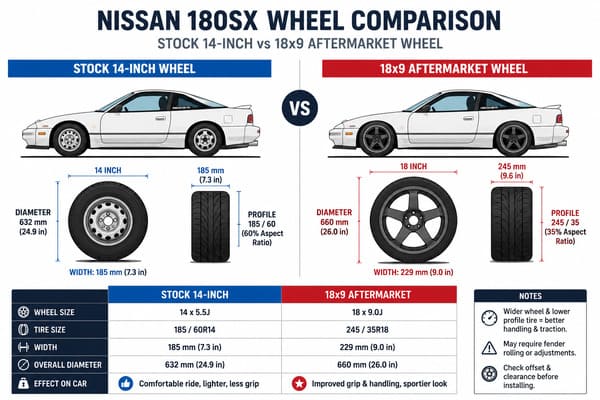
I have seen builders skip this calculation entirely and then wonder why their brand new wheels are chewing through their fender liner after two weeks of driving. The jump from 14 to 18 inches is not just a visual change — it changes every clearance measurement in the wheel arch.
Why the Size Difference Matters More Than People Think
When you go from a 14-inch stock wheel to an 18×9, the physical geometry of the wheel arch changes in three key ways. The rim sits higher relative to the inner guard. The wider barrel pushes closer to the strut. And the larger diameter reduces the gap between the top of the tire and the fender lip. Each of these changes creates a new rubbing risk that did not exist with the stock setup.
Here is a simple comparison of the stock setup versus a typical 18×9 upgrade:
| Spec | Stock (OEM) | 18×9 Upgrade |
|---|---|---|
| Rim Diameter | 14 inches | 18 inches |
| Rim Width | ~5.5 inches | 9 inches |
| Tire Size | 195/60R14 | 225/40R18 |
| Overall Tire Diameter | ~622mm | ~640mm |
| Section Width | 195mm | 225mm |
The overall diameter difference is smaller than most people expect — only about 18mm. But the section width jumps by 30mm, and that extra width is what creates the clearance problem3 at the inner guard and strut. This is why offset selection becomes the most important decision in the entire fitment process. A wider wheel at the wrong offset will rub in places that are very difficult to fix without fender work or suspension changes.
What Offset and Backspacing Work Best for 18×9 Wheels on a 180SX?
Offset is the single most important number when fitting 18×9 wheels on a 180SX. Pick the wrong number and the wheel either hits the strut housing or pokes past the fender — neither is acceptable.
For 18×9 wheels on a Nissan 180SX, ET20 to ET30 is the reliable offset window. ET25–ET28 works best at the front for street use. ET20–ET25 works at the rear. Going below ET18 at the front requires fender trimming, and going above ET32 risks strut contact under suspension compression.
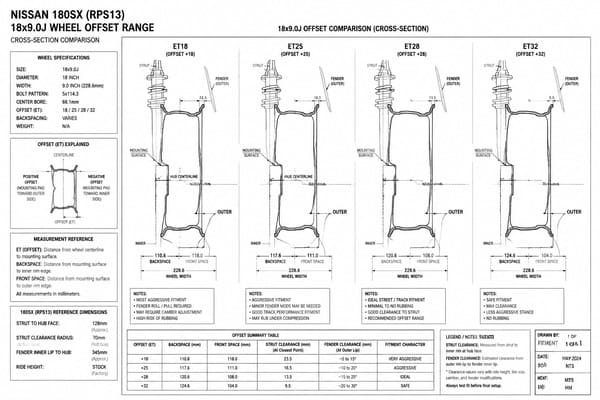
After working with multiple 180SX builds, I have found that ET20 to ET30 is the reliable window for 18×9 on this car. One customer ran ET18 on his front axle and it looked aggressive, but he had to trim his front fender liner by about 15mm to make it work at full lock. Another customer chose ET32 because he wanted a safer fitment, but the wheel tucked too far in and hit the strut housing under compression.
How Steering Lock Affects Front Offset Choice
The front axle is always the harder side to spec on the 180SX. Steering lock changes the clearance angle in a way that does not exist at the rear. At full lock on a 180SX, the wheel swings inward by roughly 30 to 35 degrees4. That movement alone can create a rubbing point that does not exist when the wheel is pointed straight.
Here is a breakdown of how different front offsets behave on a stock 180SX with 18×9 wheels:
| Front Offset | Fitment Behavior | Fender Work Needed? |
|---|---|---|
| ET18 or lower | Aggressive flush/poke look | Yes — fender liner trim required |
| ET20–ET22 | Slight poke, rubs at full lock | Usually yes — minor liner trim |
| ET25–ET28 | Flush to slightly tucked, minimal rub risk | No — works on stock fenders |
| ET30–ET32 | Tucked look, strut contact risk under compression | No fender work, but strut clearance check needed |
The rear offset is more forgiving because there is no steering movement. Most builders run ET20 to ET25 at the rear without any issues, as long as ride height stays within a reasonable range. Drop the car more than 40mm on stock fenders and the rear will start making contact with the arch under hard compression5. For a daily-driven street build, staying at ET25 front and rear gives the safest fitment without needing any bodywork.
Will 18×9 Wheels Rub on a Stock Nissan 180SX?
This is the question every 180SX owner asks before placing a wheel order. The honest answer is not what most people want to hear.
On a completely stock Nissan 180SX with no fender work and no suspension modifications, 18×9 wheels will most likely rub at the front inner fender liner during full steering lock. The rear is more forgiving. Rubbing risk increases significantly if the car is lowered more than 40mm.
I have had at least three customers come back to us after fitment reporting a light rub at the front arch during low-speed turning. In all three cases, the issue was at the inner guard, not the outer lip. The outer lip clearance was fine — it was the inner fender liner that made contact at full steering lock.
Where Rubbing Actually Happens on the 180SX
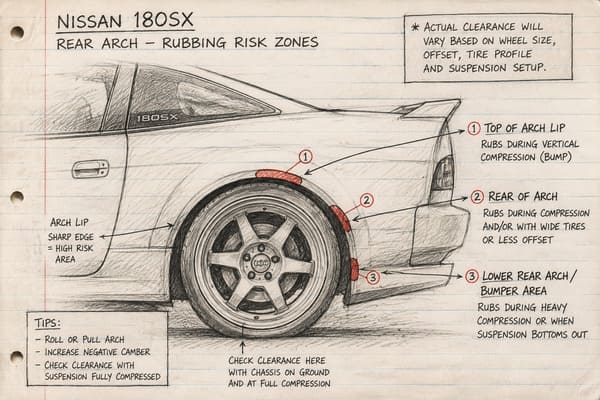
There are three common rubbing points on the 180SX when running 18×9 wheels. Knowing where each one happens helps you decide what modifications — if any — are worth doing before the wheels go on.
Front inner fender liner at full steering lock is the most common problem. This is a plastic liner that can be trimmed or pulled back without affecting the structural integrity of the car. Most builders do this as a basic step before fitting any wheel wider than 8 inches.
Rear arch under compression is the second most common issue. When the car drops hard over a bump or during aggressive cornering, the tire can touch the arch lip. Rolling the rear fenders — a simple process using a fender rolling tool — removes this risk6 without changing the look of the car.
Front strut housing under compression is the least common but the most serious. This happens when offset is too high (too much positive, wheel pushed inward). It does not cause a rubbing noise — it causes direct metal contact between the wheel barrel and the strut body. This is a safety issue7, not just an aesthetic one.
| Rubbing Location | When It Happens | Fix |
|---|---|---|
| Front inner liner | Full steering lock | Trim or pull liner back |
| Rear arch lip | Hard compression, lowered ride height | Roll fenders |
| Front strut housing | High offset + suspension compression | Reduce offset or adjust suspension |
What Tire Size Should You Pair With 18×9 Wheels on a 180SX?
Tire size is the last piece of the fitment puzzle, and it has a bigger effect on the final result than most people realize. The wrong tire on an 18×9 rim can create rubbing even when the offset is correct.
For a street build, 225/40R18 is the recommended tire size for 18×9 wheels on a Nissan 180SX. It gives a proper contact patch, a sidewall that absorbs road bumps8, and an overall diameter close to stock. Drift builds often use 205/40R18 or 215/40R18 for stretch fitment.
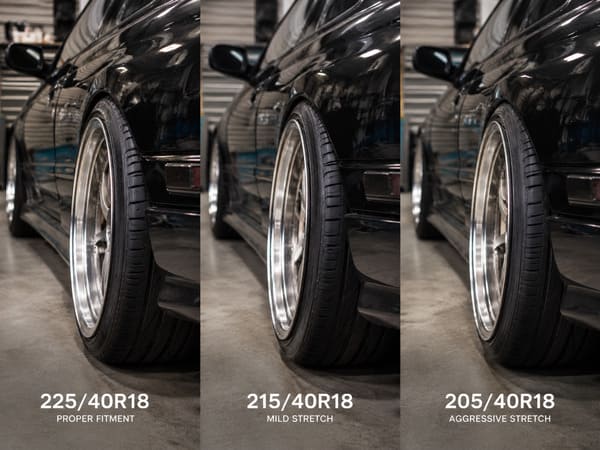
For drift builds where stretch is part of the aesthetic, customers often go down to 215/40R18 or 205/40R18. A 205 on a 9-inch rim gives roughly 20mm of stretch on each side9, which pulls the tire bead outward and reduces the effective width at the fender. I had one customer running 205/40R18 on 18×9 at ET22 on his dedicated track 180SX, and it sat perfectly under a 20mm rolled fender with zero rubbing, even at full lock.
Comparing Tire Options for 18×9 on the 180SX
Different tire widths on the same 18×9 rim produce very different fitment results. Here is how the three most common choices compare:
| Tire Size | Rim Fit | Stretch Level | Street Use | Drift Use |
|---|---|---|---|---|
| 225/40R18 | Proper fill | None | Best choice | Acceptable |
| 215/40R18 | Slight stretch | Mild (~10mm per side) | Good | Good |
| 205/40R18 | Stretched | Aggressive (~20mm per side) | Not ideal | Common choice |
For a daily driver, I always recommend 225/40R18 as the starting point. The sidewall is tall enough to absorb road imperfections, the contact patch is wide enough for safe street driving, and the overall diameter stays close enough to stock that the speedometer error stays within an acceptable range10. For a dedicated drift or track car, 205/40R18 with a rolled fender gives a cleaner aggressive look and still clears without rubbing. The key is matching the tire choice to the offset — a stretched tire at a low offset and a properly filled tire at a higher offset can both work, but they need to be treated as a single system, not two separate decisions.
Conclusion
Fitting 18×9 wheels on a Nissan 180SX is possible without rubbing, but only when offset, tire size, and ride height are treated as one combined decision — not separate choices. At Tree Wheels, we build fully custom forged wheels to your exact spec, so your 180SX fits right the first time.
-
"Nissan 180SX – Wikipedia", https://en.wikipedia.org/wiki/Nissan_180SX. The Nissan 180SX, produced from 1988 to 1998 and sharing its platform with the S13 Silvia, became closely associated with the development of competitive drifting in Japan during the 1990s, a period documented in motorsport histories covering the origins of D1 Grand Prix and related grassroots drift events. Evidence role: historical_context; source type: encyclopedia. Supports: The Nissan 180SX’s historical association with drifting as a motorsport discipline, particularly in Japan. Scope note: The characterization of ‘most iconic’ is subjective; other S-chassis variants and competing platforms are also widely cited in drift motorsport literature. ↩
-
"Nissan 180SX – Wikipedia", https://en.wikipedia.org/wiki/Nissan_180SX. Nissan’s original equipment specifications for the 180SX (RPS13) listed 14-inch wheels with 195/60R14 tires; this figure is referenced in model documentation and enthusiast technical registries covering the S-chassis platform. Evidence role: definition; source type: encyclopedia. Supports: The factory-standard wheel diameter and tire size fitted to the Nissan 180SX at production. Scope note: Factory specifications may vary by model year and regional market; a single authoritative source covering all variants may not exist in a single document. ↩
-
"ISO 5775", https://en.wikipedia.org/wiki/ISO_5775. Tire section width, as defined by standards bodies such as ETRTO or TRA, measures the widest point of an unmounted inflated tire; this dimension directly governs lateral clearance between the tire sidewall and adjacent chassis components including inner fender liners. Evidence role: definition; source type: institution. Supports: The definition of tire section width as a standardized measurement and its relationship to physical clearance within the wheel arch. Scope note: The article’s specific claim that section width is the primary clearance concern over diameter is contextual to the 180SX geometry and is not universally generalizable without chassis-specific measurement data. ↩
-
"Gktech V2 S13 S14 S15 Bolt On Angle Kit RCC Kit – Install – YouTube", https://www.youtube.com/watch?v=2EiKLPzlTzM. The steering lock angle of the 180SX front axle, which governs the maximum inward sweep of the front wheel during turning, is a chassis-specific parameter documented in Nissan’s factory service manuals and referenced in S-chassis suspension modification guides. Evidence role: definition; source type: other. Supports: The maximum steering lock angle of the Nissan 180SX front axle as a chassis specification. Scope note: The 30–35 degree figure cited in the article is an approximation; the precise value may differ between stock and modified steering setups, and the original source for this specific figure is not identified in the article. ↩
-
"Is 2.5 inches of travel enough on lower rear of 3-link suspension?", https://www.facebook.com/groups/390013295930025/posts/848212790110071/. Reducing ride height on a strut-based suspension system decreases the available upward suspension travel before the tire contacts the wheel arch; the specific threshold at which contact occurs depends on the combination of lowering amount, spring rate, damper travel, tire section height, and wheel offset, making a universal figure applicable only as an approximation for a given build configuration. Evidence role: general_support; source type: other. Supports: That reducing ride height beyond a certain threshold on the 180SX reduces available suspension travel and increases the likelihood of tire-to-arch contact under compression. Scope note: The 40mm figure is presented as a general guideline for stock fenders; actual contact thresholds vary with tire size, offset, and suspension component choices, and no primary measurement data is cited. ↩
-
"Best method to repair cracked paint from fender rolling? – ClubLexus", https://www.clublexus.com/forums/is-2nd-gen-2006-2013/639402-best-method-to-repair-cracked-paint-from-fender-rolling.html. Fender rolling involves using a dedicated rolling tool to fold the inner lip of the wheel arch upward or inward, increasing clearance between the tire and arch; the process is widely documented in automotive modification literature as a reversible or semi-reversible modification, though it carries a risk of paint cracking at the fold if the metal is not adequately heated beforehand. Evidence role: mechanism; source type: other. Supports: The fender rolling process as a method for increasing wheel arch clearance by reshaping the inner lip of the fender. Scope note: The article’s claim that fender rolling does not change the look of the car is subjective; visible results depend on the degree of roll applied and the original fender profile. ↩
-
"[PDF] VEHICLE EQUIPMENT AND INSPECTION REGULATIONS", https://www.pa.gov/content/dam/copapwp-pagov/en/penndot/documents/public/dvspubsforms/bmv/bmv-manuals/pub_45-inspections-regulations/pub-45.pdf. Regulatory frameworks governing vehicle roadworthiness, such as those published by national transport authorities, identify unintended contact between wheel assemblies and suspension or steering components as a basis for vehicle defect classification, as such contact can impair steering response and cause component fatigue. Evidence role: expert_consensus; source type: government. Supports: That interference between rotating wheel components and suspension strut housings constitutes a safety hazard affecting vehicle handling and structural integrity. Scope note: The article does not specify a jurisdiction; applicable safety standards vary by country, and the precise regulatory language covering this scenario differs between frameworks. ↩
-
"[PDF] Tire Contact Patch Characterization through Finite Element …", https://vtechworks.lib.vt.edu/bitstream/handle/10919/82708/Mathews_Vayalat_T_T_2016.pdf. Tire contact patch geometry is influenced by section width, inflation pressure, and vertical load; a wider section width generally increases contact patch area, while a higher aspect ratio provides greater sidewall deflection, which contributes to vibration absorption on uneven road surfaces — principles documented in tire engineering literature from institutions such as the Tire and Rim Association and academic vehicle dynamics research. Evidence role: mechanism; source type: research. Supports: The relationship between tire section width, aspect ratio, and the resulting contact patch area and sidewall compliance characteristics relevant to street driving. Scope note: The article’s recommendation of 225/40R18 as the optimal street tire is specific to the 180SX application; contact patch and compliance characteristics also depend on tire construction, compound, and inflation pressure, which are not addressed. ↩
-
"How to Calculate the PERFECT Tire Stretch – YouTube", https://www.youtube.com/watch?v=NJpJITRFrjg. Tire stretch is commonly estimated by subtracting the tire’s nominal section width from the rim width in millimeters and dividing by two to obtain the per-side deviation; for a 205mm tire on a 228.6mm (9-inch) rim, this yields approximately 11.8mm per side, though actual deformation at the bead and sidewall may differ from this nominal calculation. Evidence role: mechanism; source type: other. Supports: The method for estimating tire stretch as the difference between the rim width and the tire’s nominal section width, distributed across both sidewalls. Scope note: The 20mm per-side figure stated in the article differs from the nominal calculation, suggesting the author may be measuring a different reference point; the precise measurement methodology is not defined in the article. ↩
-
"How much to increase or decrease tire size for speedometer …", https://www.facebook.com/groups/2582861995366601/posts/3920136411639146/. Vehicle speedometers are calibrated to the rolling circumference of the OEM tire; regulations in many jurisdictions, including UN Regulation No. 39 on speedometer equipment, permit a defined positive error margin but prohibit readings below actual speed, meaning a larger-than-stock tire diameter can cause the speedometer to under-read and potentially exceed legal tolerances. Evidence role: mechanism; source type: government. Supports: That changes in tire rolling circumference caused by non-OEM tire sizing affect speedometer readings, and that regulatory tolerances exist for permissible speedometer error. Scope note: Applicable speedometer accuracy regulations vary by country; the article does not specify a jurisdiction, and the threshold for ‘acceptable’ error is not defined. ↩