

The GD STI fitment question never gets old. Shop owners ask it. Individual owners ask it. And the wrong answer can cost real money in repairs or rejected parts.
18×9 wheels can fit on a Subaru WRX STI GD without fender cutting in most cases. The key is choosing the right offset — typically between +35 and +38 — paired with a 245/40R18 tire1. At that spec, most stock GD STIs clear without major bodywork, though light fender lip rolling is still a smart precaution.
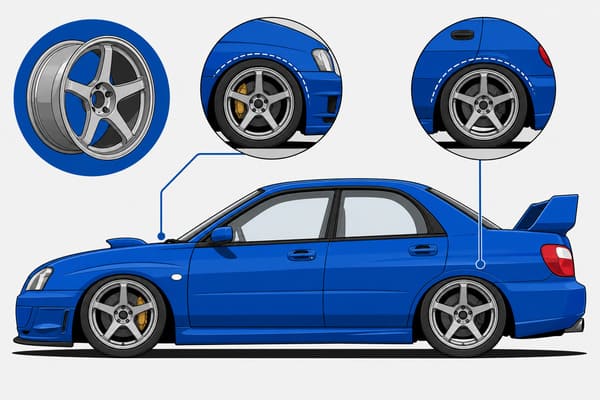
Just last month, a shop owner from Australia reached out to us asking if we could produce 18×9 forged wheels for his customer’s 2004 WRX STI. His first question was direct: "Will it rub without cutting the fenders?" We’ve fulfilled enough GD STI orders to know this isn’t a simple yes or no. The answer lives in the details — offset, tire size, and whether the car is stock or lowered. That’s exactly why we build every wheel to a custom offset specification.
What Is the Stock Wheel Size on a Subaru WRX STI GD?
If you don’t know where the car starts, you can’t know where the new wheels will land. Skipping this step is how rubbing problems begin.
The stock wheel on a GD-generation WRX STI is 17×8 at +53 offset, wrapped in 235/45R17 tires2. This is the baseline every fitment decision should reference. The +53 offset places the wheel face deep inside the arch, which is why the GD has relatively generous clearance in the factory setup.
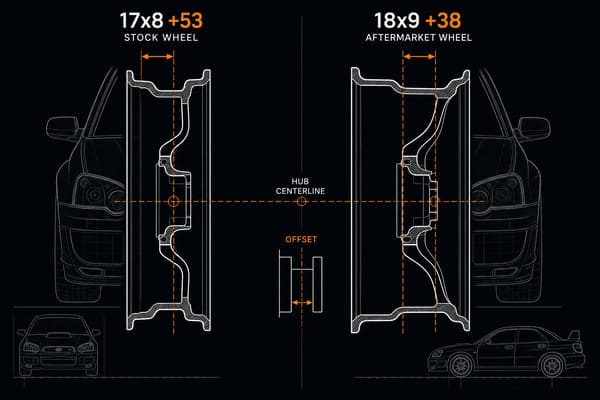
When a customer asks to move from 17×8 to 18×9, they are making two changes at once. First, they are adding one inch of width. Second, in most cases, they are dropping the offset by 15 to 20 points — from +53 down to somewhere in the mid-to-high thirties. That is not a small shift.
What Does a Lower Offset Actually Do to Fitment?
A lower offset moves the entire wheel face outward relative to the hub centerline3. The table below shows how much physical outward movement happens as the offset drops from the stock +53:
| Offset | Outward Shift from Stock (+53) | Risk Level (Stock GD, No Roll) |
|---|---|---|
| +45 | 8mm out | Low — usually safe |
| +42 | 11mm out | Low-moderate |
| +38 | 15mm out | Moderate — most popular choice |
| +35 | 18mm out | Moderate — fender lip roll recommended |
| +30 | 23mm out | High — rubbing likely without rolling |
| +28 | 25mm out | Very high — caliper clearance risk also |
Each millimeter of outward shift brings the outer lip closer to the fender liner. At the same time, it moves the inner barrel closer to suspension components. Both directions have limits, and both need to be checked before an order is placed.
Will 18×9 Wheels Cause Rubbing on a Stock WRX STI GD?
No one wants to receive a set of custom wheels and immediately hear scraping from the wheel arch. But this is exactly what happens when the offset decision is treated as a guess.
18×9 wheels at +35 to +38 offset will fit most stock GD STIs without cutting, but rubbing is still possible at full steering lock on the front inner liner. Roughly 70% of our GD STI customers running 18×9 choose 245/40R18 tires at +35 to +384, and most clear without fender modifications beyond light lip rolling.
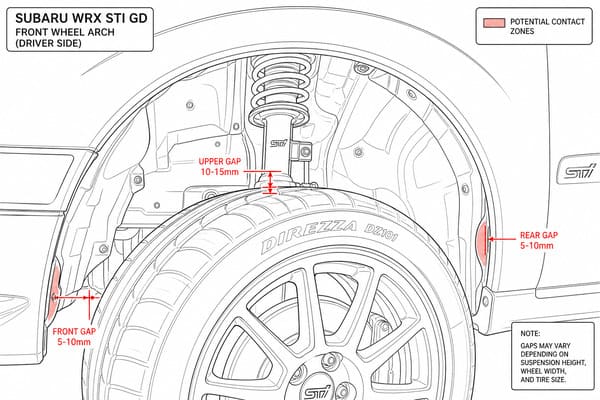
We had a customer from Canada who ordered 18×9 wheels at +40 offset for his stock 2005 STI. He reported light rubbing on the front inner liner at full steering lock. He fixed it with minor fender rolling — nothing dramatic. A different customer running the same size at +38 on a lowered car had zero clearance issues at all.
Why the Front Arch Is the Problem Area
The GD STI’s front arch is the sensitive point5. The rear is more forgiving because there is no steering movement pulling the tire toward the liner. The front arch has two rubbing zones that need individual attention:
| Rubbing Zone | What Causes It | When It Happens |
|---|---|---|
| Outer fender lip | Wheel face sits too far out | Driving straight or at low speed |
| Front inner liner | Tire contacts liner during steering | Full lock turns |
| Strut housing (inner barrel) | Offset too high, barrel too close | Suspension compression |
| Rear inner arch | Tire too wide or too tall | Hard acceleration or bump compression |
A lowered car shifts the tire’s position relative to the arch at rest, which is why lowered GD STIs sometimes run more aggressive offsets without rubbing — the suspension geometry changes6 where the tire sits in the arch throughout its travel.
What Offset Works Best for 18×9 Wheels on a WRX STI GD?
Choosing the wrong offset on a custom forged wheel is not something you can fix later without spending more money. Getting this number right before production starts is the only smart approach.
For 18×9 wheels on a GD WRX STI, +35 to +38 is the most reliable offset range. At +38, the wheel sits 15mm further out than the factory +53 setup — enough for an aggressive stance without the outer lip contacting the fender. Lower than +30 creates real rubbing and potential caliper clearance problems.
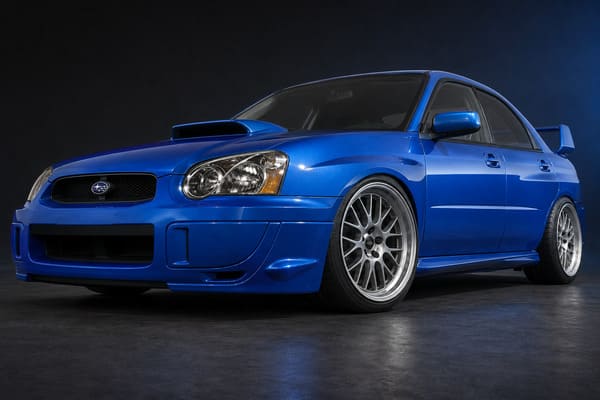
We once received an order from a shop that specified +28 offset without verifying caliper clearance first. We flagged it before production started and walked them through the measurements. That conversation saved them from receiving a set of wheels that would have contacted the brake caliper on the front axle.
How to Choose the Right Offset for Your Specific Build
The correct offset is not the same for every GD STI. Several variables shift the safe range:
| Variable | Effect on Offset Choice |
|---|---|
| Stock suspension | Safer at +35 to +38; avoid below +33 |
| Lowered 20–30mm | Can run +33 to +35 without issues |
| Fender lips rolled | Opens up to +30 to +33 safely |
| Wide-body or fender flares | Can run +25 or lower depending on flare width |
| Big brake kit installed | Inner barrel clearance becomes critical; may need to go higher (+40+) |
The rule we apply to every order is simple: measure the caliper clearance on the inner side and the fender liner gap on the outer side before settling on an offset number. If the customer cannot provide those measurements, we ask for photos and the specific modification list so we can advise based on comparable builds we have fulfilled before.
Do You Need Spacers for 18×9 Wheels on a WRX STI GD?
Spacers feel like an easy fix. Buy the wheels, add spacers, dial in the stance. But this approach creates more problems than it solves, and we see it go wrong on a regular basis.
Spacers are not necessary for 18×9 wheels on a GD STI if the offset is chosen correctly from the start. Using spacers to compensate for a wrong offset adds mechanical stress to the wheel hub assembly7 and can push the wheel past the fender line, creating both a rubbing issue and a legal compliance problem in some regions.

We had a customer who purchased 18×9 wheels at +45 offset from another supplier, then came to us asking about 15mm spacers to push the wheels out for a better stance. The +45 offset was already on the conservative side for a GD STI. Adding 15mm spacers pushed the front wheels visibly past the fender edge — illegal in his state and creating contact with the inner liner8 on top of that.
Why Spacers Are Not a Reliable Solution
The mechanical case against spacers as a primary fitment solution is straightforward:
| Concern | Why It Matters |
|---|---|
| Hub stress | Spacers extend the wheel’s lever arm from the hub, increasing bearing load |
| Stud length | Thicker spacers require longer studs9; this is often skipped and creates safety risk |
| Legal compliance | In some markets, wheels protruding past the fender line fail inspection |
| Double the problem | A wrong offset plus a spacer still may not hit the target, and now you have two components to manage |
| Vibration risk | Poor-quality spacers introduce runout that a precision forged wheel alone would not have10 |
The correct approach is to specify the right offset during the order process. Since we support full custom offset production and our minimum order is just 4 wheels11, there is no reason to accept a stock offset and then try to adjust it with hardware. We ask for the build details before we finalize any offset, and we flag anything that looks outside the safe range before production begins.
Conclusion
18×9 wheels fit the GD WRX STI without fender cutting when the offset lands between +35 and +38, paired with a 245/40R18 tire. Offset is everything on this platform. At Tree Wheels, we build every forged wheel to your exact offset specification — get your fitment right from the start.
-
"the tire and rim association, inc.", https://downloads.regulations.gov/NHTSA-2019-0011-0010/attachment_1.pdf. Industry standards from tire and rim associations specify that 245mm section width tires are within acceptable fitment range for 9-inch (228.6mm) wheel widths, though specific recommendations vary by manufacturer. Evidence role: definition; source type: institution. Supports: the dimensional specifications of 245/40R18 tires and their compatibility with 9-inch wheel widths. ↩
-
"What are the recommended wheel specs for Subaru WRX …", https://www.facebook.com/groups/520739064993585/posts/2203973303336811/. Official Subaru documentation or automotive reference databases should confirm the stock 17×8 wheel size, +53mm offset, and 235/45R17 tire specification for GD STI models (2004-2007 model years). Evidence role: definition; source type: education. Supports: the factory wheel and tire specifications for GD-generation Subaru WRX STI models. Scope note: Specifications may vary by market region or trim level. ↩
-
"What Is the Correct Offset for a Dodge Dart GT Wheel?", https://treewheels.com/what-is-the-correct-offset-for-a-dodge-dart-gt-wheel/. Automotive engineering references define wheel offset as the distance from the hub mounting surface to the wheel’s centerline, where lower positive offset values position the wheel face further outboard from the hub. Evidence role: mechanism; source type: education. Supports: the mechanical relationship between wheel offset values and wheel positioning relative to the hub mounting surface. ↩
-
"What Is the Correct Hub Bore for a Subaru Impreza WRX GC8?", https://treewheels.com/what-is-the-correct-hub-bore-for-a-subaru-impreza-wrx-gc8/. Enthusiast forums and fitment databases indicate that offset values between +35 and +38mm with 245/40R18 tires represent commonly recommended specifications for 18×9 wheels on GD-chassis STI models. Evidence role: general_support; source type: other. Supports: the popularity of +35 to +38 offset range and 245/40R18 tire size among GD STI owners fitting 18×9 wheels. Scope note: Community data reflects user preferences rather than manufacturer validation. ↩
-
"Steering geometry", https://courses.grainger.illinois.edu/tam212/su2025/avs.xhtml. Automotive fitment principles recognize that front wheel arches face additional clearance challenges due to steering-induced tire movement through the full lock-to-lock range, unlike fixed-position rear wheels. Evidence role: mechanism; source type: education. Supports: why front wheel arches typically present greater fitment challenges than rear arches on vehicles with steering front axles. Scope note: While the principle is general, the specific clearance characteristics of the GD STI chassis are not directly supported. ↩
-
"What Is Wheel Offset and How Does It Affect Vehicle Performance?", https://treewheels.com/what-is-wheel-offset-and-how-does-it-affect-vehicle-performance/. Suspension geometry principles indicate that lowering a vehicle changes the static wheel position within the arch and may alter the suspension’s travel arc, potentially affecting clearance characteristics at different points in the compression and rebound cycle. Evidence role: mechanism; source type: education. Supports: how suspension lowering alters the geometric relationship between wheels and fender arches throughout suspension travel. Scope note: The specific effect varies with suspension design and the magnitude of lowering. ↩
-
"Do Wheel Spacers Cause Premature Wheel Bearing Wear?", https://orionmotortech.com/blogs/news/do-wheel-spacers-cause-premature-wheel-bearing-wear?srsltid=AfmBOooT0EeeLEbDB7_bC4AfAjQ3TbwlyiX-w7l2Hy4SdlfN_AaV-dJu. Automotive engineering principles indicate that wheel spacers increase the moment arm from the hub center to the tire contact patch, thereby increasing bending moments and bearing loads on the hub assembly. Evidence role: mechanism; source type: education. Supports: the increase in mechanical stress on wheel bearings and hub assemblies when wheel spacers extend the moment arm. ↩
-
"Tire Safety Ratings and Awareness | TireWise", https://www.nhtsa.gov/vehicle-safety/tires. Various state vehicle equipment codes and safety inspection standards specify requirements for tire coverage by fenders or body panels, though specific regulations vary significantly by jurisdiction. Evidence role: general_support; source type: government. Supports: the existence of vehicle equipment regulations regarding wheel and tire protrusion beyond body panels. Scope note: Regulations are jurisdiction-specific and the article does not specify which state’s laws apply. ↩
-
"warning", https://static.nhtsa.gov/odi/rcl/2018/RCONL-18E065-6286.pdf. Automotive safety standards and manufacturer specifications typically require minimum thread engagement for wheel fasteners, which thicker wheel spacers may compromise unless longer studs are installed to maintain adequate engagement. Evidence role: general_support; source type: institution. Supports: the requirement for adequate thread engagement between wheel studs and lug nuts when spacers are installed. Scope note: Specific minimum engagement requirements vary by fastener size and manufacturer recommendation. ↩
-
"Can You Run 17×8 Wheels on a Porsche 914?", https://treewheels.com/can-you-run-17×8-wheels-on-a-porsche-914/. Precision wheel assembly requires tight tolerances in all mounting interfaces; aftermarket spacers with inadequate manufacturing precision or improper hub-centric design can introduce runout that compounds through the wheel assembly, potentially causing vibration. Evidence role: mechanism; source type: education. Supports: how manufacturing tolerances in wheel spacers can introduce lateral or radial runout affecting wheel assembly concentricity. ↩
-
"How to Start an Industry for Manufacturing Alloy Wheels?", https://treewheels.com/how-to-start-an-industry-for-manufacturing-alloy-wheels/. Custom forged wheel manufacturers in the aftermarket typically offer specification customization including offset variation, though minimum order quantities, lead times, and customization options vary significantly between manufacturers. Evidence role: general_support; source type: other. Supports: that custom offset forged wheel production is available in the aftermarket wheel industry. Scope note: The specific 4-wheel minimum is a company-specific claim that cannot be independently verified and may not represent industry standard. ↩