
If you’ve ever stared at a spec sheet and wondered whether "forged" and "machined" are opposites, competitors, or just two words manufacturers throw around interchangeably, you’re not alone. Wheel hub terminology confuses buyers at every level — and that confusion leads to real purchasing mistakes. Understanding what these terms actually mean is the first step toward choosing correctly.
Wheel hubs can be both machined and forged — these are not mutually exclusive terms. Most high-end forged wheel hubs undergo CNC machining as a final step to achieve precise tolerances and surface finish. So the real question is not "machined or forged?" but rather which manufacturing process forms the wheel’s core structure, and whether that process matches your specific performance and budget requirements.
The distinction matters more than most buyers realize — but not for the reasons spec sheets suggest. Once you understand how these processes interact, the better question becomes: which outcome do you actually need from your wheels? That depends on your vehicle, your use case, and how much you’re willing to pay.
What does "forged" actually mean for wheel hubs?
Customers often ask us whether forged wheels are simply more expensive cast wheels with better marketing. That misunderstanding is more common than it should be — and it regularly causes buyers to overpay or under-specify.
Forging forms the wheel hub by pressing or hammering aluminum alloy under high pressure while the metal is heated but not melted. This compresses the grain structure of the alloy, producing a denser, more consistent material than casting.1 The result is a hub with higher strength-to-weight ratios compared to cast equivalents in the same alloy family.2
Understanding what forging does — and does not do — is the foundation for every downstream purchasing decision. It is not a magic upgrade; it is a specific structural outcome with specific trade-offs.
What forging changes about the metal
When aluminum billet is forged under pressure, several things happen simultaneously:
- Grain alignment: The metal’s crystalline grain structure flows and aligns with the shape of the part, rather than forming randomly as it does in casting.
- Porosity reduction: Air pockets and voids that commonly form in cast parts are largely eliminated.
- Consistent density: The finished hub has more uniform material properties across its cross-section.
These changes matter most when the wheel operates under dynamic stress — hard cornering, heavy braking, off-road impacts, or sustained high-speed load. They matter less for a daily commuter wheel that never approaches its rated load or speed limits.
What forging does not guarantee
Forging is a process, not a quality certificate. The outcome depends heavily on:
- Alloy selection — a low-grade aluminum forging may underperform a premium cast alloy in some applications3
- Die design — poorly designed tooling produces forgings with uneven material flow
- Heat treatment — post-forge thermal processing determines final hardness and fatigue resistance
- Quality control — process consistency between batches varies by manufacturer
Our manufacturing partner has over 20 years of forged wheel production experience, and from conversations with their team, one point comes up consistently: buyers who specify "forged" without specifying alloy grade and heat treatment are leaving significant performance variables undefined.
Forging configurations buyers will encounter
| Configuration | Description | Typical Use Case |
|---|---|---|
| One-piece forged | Entire wheel forged from a single billet | Track, performance, weight-critical builds |
| Two-piece forged | Forged center joined to a spun or forged barrel | Custom fitment, stepped lip applications |
| Three-piece forged | Forged center, inner barrel, outer barrel bolted together | Deep custom builds, extreme size flexibility |
Each configuration has a different lead time, cost structure, and customization ceiling. At Tree Wheels, our one-piece forged wheels typically ship in 15–20 days; two-piece runs 20–25 days; three-piece requires 30–35 days.
What does "machined" mean, and how does it relate to forging?
This is where most of the terminology confusion lives. Buyers encounter "machined finish" or "CNC machined" on spec sheets and assume it refers to a separate manufacturing category. In practice, it almost never does — at least not in isolation.
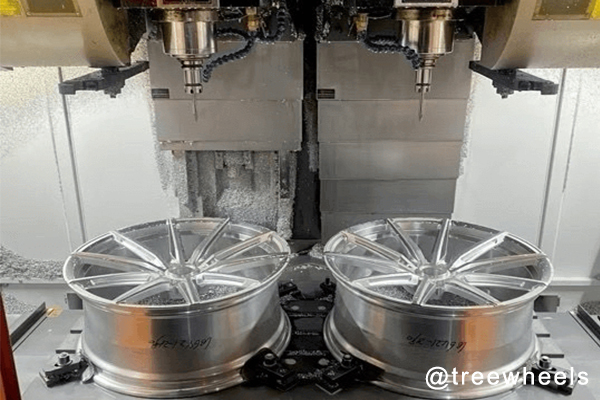
Machining, in the context of wheel hubs, refers to the CNC (Computer Numerical Control) cutting and milling performed after the primary forming step — whether that step was forging or casting. Machining removes excess material, creates precise bolt-circle geometry, cuts the center bore, and produces the surface finish. A "machined wheel" is not a standalone product type; it is a finishing description.
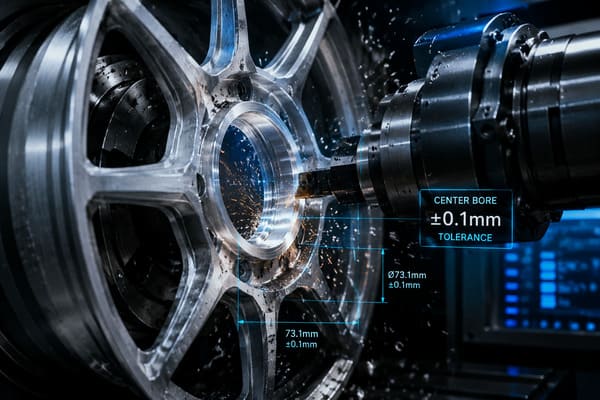
This is the detail that collapses the false binary in the original question. All quality forged wheels are also machined — but not all machined wheels are forged.
Where machining adds value in wheel production
Machining serves several functions that forging alone cannot achieve:
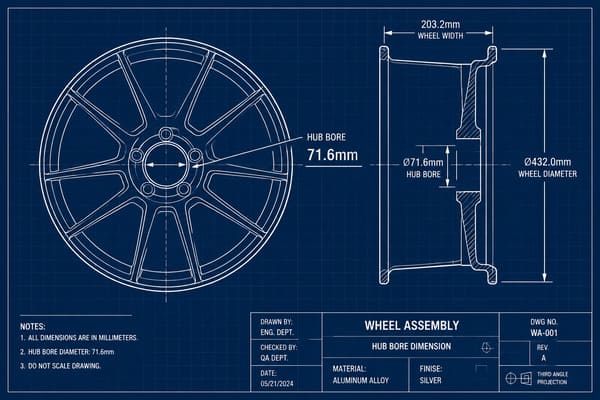
- Dimensional precision: Forging produces a near-net shape, but bolt patterns, center bores, and seat angles require tight tolerances that only CNC machining can reliably deliver. Even a 0.1mm variance in center bore can cause vibration at speed.4
- Surface finish options: Machined faces, lips, and spokes allow for polished, brushed, or contrast finishes that are visually distinct from painted or powder-coated surfaces.
- Weight removal: Targeted material removal through machining can reduce final wheel weight without compromising structural integrity, since the designer knows where stress concentrations are lowest.
- Custom fitment geometry: Offset, backspacing, and hub-centric fit all depend on precise machining, not on the forging step alone.
When buyers encounter "machined" as a standalone claim
Some wheels — particularly in the mid-market — are described primarily as "CNC machined" rather than "forged" or "cast." In most cases, these are:
- Cast aluminum wheels with machined faces — a low-cost base with a premium-looking surface finish
- Flow-formed wheels with machined details — a rotary-pressed barrel (stronger than pure casting, lighter than full forging) with CNC finishing
- Forged wheels with decorative machining — the most performance-oriented category, where machining serves both functional and aesthetic purposes
The buyer’s job is to ask: machined from what? The answer determines structural performance, not the machining step itself.
How should buyers choose between forged and cast-machined wheels?
This is the question that actually matters. In our experience working with modification shops and individual enthusiasts, the wrong choice almost always comes from optimizing for the wrong variable — usually "looks" or "brand prestige" — rather than the requirements of the specific application.
The right wheel choice depends on four variables: vehicle weight and load requirements, performance intent (daily driving versus track use), weight sensitivity of the build, and budget tolerance. Forged wheels justify their price premium in high-stress applications. For moderate daily-use builds, a quality cast-machined wheel often delivers adequate performance at lower cost.
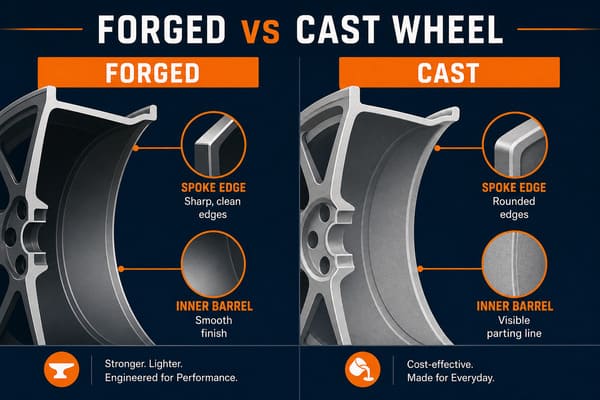
Working through these variables systematically is more useful than any blanket recommendation.
Variable 1: Vehicle weight and load
Heavier vehicles — trucks, SUVs, performance sedans with large engines — generate more stress at the wheel interface during cornering and braking. In these applications, the grain-aligned structure of a forged hub provides a meaningful structural advantage over cast alternatives of similar weight.
For lighter vehicles, the structural delta between a well-made cast wheel and a forged wheel may be smaller than the price difference suggests.
Variable 2: Performance intent
| Use Case | Forged Recommended? | Reasoning |
|---|---|---|
| Daily commute, moderate speed | Optional | Cast machined performs adequately; forged is a premium upgrade |
| Track days, autocross | Yes | Dynamic load cycles and impact exposure justify structural investment |
| Drag racing | Application-specific | Straight-line stress profile differs from cornering load; consult specialist |
| Off-road use | Yes | Impact resistance and fatigue life matter significantly |
| Luxury / show vehicle | Preference-driven | Visual customization and finish quality may outweigh structural specs |
Variable 3: Weight sensitivity
Unsprung weight — the mass below the suspension — directly affects ride quality, handling response, and braking distance.5 Forged wheels, because of their higher strength-to-weight ratio, can achieve the same load rating as cast wheels at lower mass. For performance builds, this matters. For show vehicles or standard road use, the perceptible difference is smaller.
Variable 4: Budget and order quantity
Forged wheels cost more per unit. At Tree Wheels, our minimum order quantity is 4 wheels — which accommodates both individual buyers and small shops. But buyers should understand that the per-unit premium for forged over cast is real, and it is justified by the manufacturing process, not just by branding.
If budget is constrained and the application is moderate, a quality cast-machined wheel from a certified supplier is not a bad choice. The mistake is spending forged money on a cast product because the spec sheet used the word "machined."
Frequently Asked Questions
Are all forged wheels also CNC machined?
Yes, in virtually all cases. Forging produces a near-net shape, but precision dimensions — bolt pattern, center bore, and seat geometry — require CNC machining to meet fitment tolerances. When you buy a forged wheel, you are buying a part that has undergone both processes.
Can a machined finish improve the strength of a cast wheel?
No. Machining removes material and shapes geometry; it does not alter the base material’s grain structure or density. A cast wheel with a machined face is still a cast wheel structurally. The machining improves dimensional precision and appearance, not load capacity.
How do I verify if a wheel is genuinely forged?
Ask the supplier for documentation: material certificates (specifying alloy grade), process records, and third-party certifications. Certifications such as TÜV, DOT, and ISO 9001 indicate tested and audited production standards.6 Treat verbal claims as starting points, not conclusions — request documentation before committing to an order.
Does forged mean the wheel will never crack or fail?
No. Forged wheels have better fatigue resistance than cast equivalents under comparable conditions7, but they can still fail under sufficient impact, improper fitment, overloading, or manufacturing defects. No wheel is unconditionally failure-proof. Application-specific load ratings should always be verified against your vehicle’s requirements.
Is a three-piece forged wheel stronger than a one-piece forged wheel?
Not necessarily. Three-piece wheels offer greater customization flexibility — size, offset, barrel depth — but the joints between sections introduce variables that a monoblock one-piece wheel avoids.8 For maximum structural continuity, one-piece forged is generally preferred. Three-piece designs are chosen primarily for fitment flexibility and visual customization, not outright strength.
Conclusion
The question "are wheel hubs machined or forged?" turns out to have a straightforward answer: most high-quality wheel hubs are both. Forging builds the structural core; machining delivers the precision finish and fitment geometry. Understanding that these are complementary steps — not competing categories — removes most of the confusion buyers bring to this decision.
What actually determines the right wheel hub choice is your specific use case: vehicle weight, performance intent, weight sensitivity, and budget. Forged wheels earn their premium in demanding applications. For moderate daily use, a well-certified cast-machined wheel may be entirely sufficient. The worst outcome is paying for a process without understanding what outcome that process delivers for your application.
If you’re evaluating wheel hubs for a modification project — whether you’re a shop owner sourcing for clients or an enthusiast building your own vehicle — Tree Wheels is happy to walk through your specific requirements. We work with both B2B and B2C buyers, with a minimum order of just 4 wheels and full customization support. Contact us to start a conversation about what your application actually needs.
-
"The Effect of the Forging Process on the Microstructure … – PMC", https://pmc.ncbi.nlm.nih.gov/articles/PMC10386272/. Research in materials science confirms that hot forging of aluminum alloys reorients the crystalline grain structure along the direction of deformation, reducing porosity and improving mechanical uniformity relative to cast counterparts; see, e.g., ASM International handbooks on aluminum forming processes. Evidence role: mechanism; source type: research. Supports: That forging aligns and compresses the grain structure of aluminum alloys, resulting in improved density and material consistency compared to casting.. Scope note: General metallurgical literature covers aluminum forging broadly; direct comparison to wheel hub geometries specifically may require application-specific studies. ↩
-
"How Do Designers Balance Weight Reduction and Structural …", https://treewheels.com/how-do-designers-balance-weight-reduction-and-structural-strength-for-wheels/. Comparative studies of aluminum alloy processing routes report that forged specimens typically achieve tensile and fatigue strengths 10–30% higher than die-cast equivalents at similar mass, attributable to reduced porosity and improved grain alignment (see peer-reviewed literature in journals such as the Journal of Materials Processing Technology). Evidence role: statistic; source type: research. Supports: That forged aluminum components exhibit higher strength-to-weight ratios than cast aluminum components of equivalent alloy composition.. Scope note: Exact ratios vary substantially by alloy grade, forging temperature, and heat treatment; published figures may not map directly to specific wheel hub geometries. ↩
-
"How Do Designers Balance Weight Reduction and Structural …", https://treewheels.com/how-do-designers-balance-weight-reduction-and-structural-strength-for-wheels/. Materials engineering literature demonstrates that alloy selection exerts a substantial influence on mechanical properties independent of forming process; high-strength casting alloys such as A356-T6 can achieve tensile properties that exceed those of forgings produced from lower-strength alloy series, indicating that process alone does not determine performance hierarchy. Evidence role: general_support; source type: research. Supports: That alloy composition has a significant independent effect on mechanical performance, such that a higher-grade cast alloy can outperform a lower-grade forged alloy in specific mechanical properties.. Scope note: Direct comparisons depend heavily on specific alloy designations, temper conditions, and the mechanical property of interest; generalizations across all applications are not supported. ↩
-
"Is 77.8mm the Right Hub Bore for a 1970 Plymouth Barracuda?", https://treewheels.com/is-77-8mm-the-right-hub-bore-for-a-1970-plymouth-barracuda/. Automotive engineering standards for hub-centric wheel fitment specify center bore tolerances typically within ±0.1–0.2 mm to ensure concentric seating; deviations beyond these limits introduce rotational imbalance that manifests as vibration, particularly at highway speeds, as discussed in wheel fitment and balancing technical literature. Evidence role: statistic; source type: research. Supports: That small dimensional variances in wheel center bore, on the order of tenths of a millimeter, can produce measurable vibration at vehicle operating speeds.. Scope note: The specific threshold at which vibration becomes perceptible depends on vehicle speed, suspension compliance, and tire balance; 0.1 mm is cited as an illustrative figure and may not represent a universal industry standard. ↩
-
"Unsprung mass", https://en.wikipedia.org/wiki/Unsprung_mass. Vehicle dynamics literature establishes that unsprung mass — components not isolated by the suspension — influences wheel contact force variation, suspension response frequency, and braking deceleration; reductions in unsprung weight are associated with improved road-holding and shorter stopping distances, as discussed in automotive engineering texts and SAE technical papers. Evidence role: mechanism; source type: research. Supports: That reducing unsprung mass improves ride quality, handling response, and braking performance in wheeled vehicles.. Scope note: The magnitude of the effect depends on suspension geometry, vehicle speed, and road surface; perceptible differences for typical road use may be modest compared to track or performance applications. ↩
-
"FMCSA – Department of Transportation", https://www.fmcsa.dot.gov/. TÜV certification involves independent safety and performance testing by accredited German technical inspection bodies; DOT compliance denotes conformance with U.S. Federal Motor Vehicle Safety Standards administered by the National Highway Traffic Safety Administration; ISO 9001 certifies a manufacturer’s quality management system processes rather than the product itself, as defined by the International Organization for Standardization. Evidence role: definition; source type: institution. Supports: That TÜV, DOT, and ISO 9001 represent distinct certification frameworks covering safety testing, regulatory compliance, and quality management system auditing respectively.. Scope note: ISO 9001 certifies process management, not product performance; its inclusion alongside TÜV and DOT may overstate its role as a direct product safety indicator. ↩
-
"Training high-strength aluminum alloys to withstand fatigue", https://pmc.ncbi.nlm.nih.gov/articles/PMC7566492/. Fatigue testing of aluminum alloy specimens consistently shows that forged material exhibits longer fatigue life under cyclic stress than cast equivalents, attributed to reduced porosity and aligned grain structure that impede crack initiation and propagation; this finding is reported across multiple studies in journals such as the International Journal of Fatigue and Materials Science and Engineering. Evidence role: expert_consensus; source type: paper. Supports: That forged aluminum components demonstrate superior fatigue life compared to cast aluminum components under cyclic loading conditions.. Scope note: Fatigue performance is sensitive to alloy composition, surface finish, and loading mode; results from standardized test specimens may not directly predict service life in complex wheel hub geometries. ↩
-
"Three textbook analyses of fatigue in the bolted tension joint", https://www.myweb.ttu.edu/amosedal/documents/BTJfatigue.pdf. Structural analysis of multi-piece wheel assemblies identifies fastener joints as potential sites of fretting fatigue and stress concentration under cyclic loading, whereas monoblock designs eliminate these interfaces; this distinction is discussed in automotive component fatigue literature and wheel design engineering references. Evidence role: mechanism; source type: research. Supports: That bolted or welded joints in multi-piece wheel assemblies introduce stress concentrations and potential failure modes absent in monoblock one-piece designs.. Scope note: Well-engineered three-piece wheels with properly torqued fasteners and appropriate joint design can perform reliably in most applications; the structural disadvantage is most relevant under extreme or repeated high-load conditions. ↩