
If you’re shopping for a fully forged wheel, you’ve probably noticed that every supplier seems to use the same language. The phrase appears on budget listings and premium catalogs alike — with almost nothing to help you tell them apart. That gap between marketing copy and verifiable reality is exactly where buyers lose money.
A fully forged wheel is a wheel manufactured entirely from a single billet of aluminum alloy, shaped under extreme heat and pressure without any casting step in the structural process. No molten metal is poured into a mold. The grain structure of the metal is compressed and aligned during forging, which produces a denser, stronger wheel at a lower weight than a cast equivalent1 — verified through certifications like DOT and TÜV, not supplier claims alone.

The definition above is a starting point, not a purchasing decision. Knowing what "fully forged" means doesn’t protect you from buying the wrong product. What protects you is knowing how to evaluate a supplier’s claim against observable, verifiable signals — and understanding which forging format actually fits your application.
Is "fully forged" a technical specification or a marketing term?
Buyers we’ve spoken with often ask whether there’s a regulated standard behind the phrase "fully forged." The honest answer is: not in the way most people assume.
The term "fully forged" has no universal, legally enforced definition in the aftermarket wheel industry. Suppliers apply it freely. That doesn’t make all claims false — but it means the label alone carries no verification weight. Your job as a buyer is to look past the label.
What the process actually involves
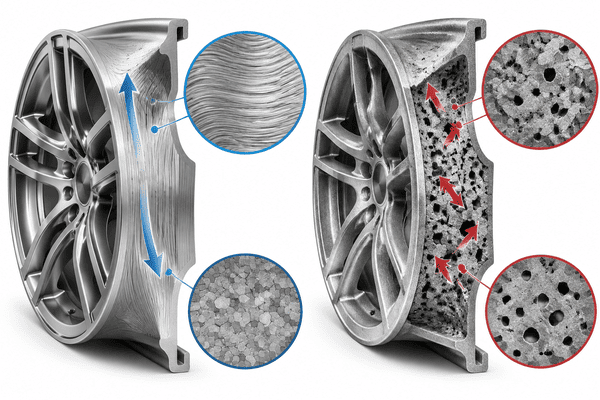
A genuinely fully forged wheel begins with a solid aluminum billet — a cylindrical block of alloy, typically 6061-T6 or 70752. That billet is heated and pressed under thousands of tons of force into a rough wheel shape (this is called die forging or closed-die forging3). The part is then CNC-machined to its final geometry.
Nothing is poured. No liquid metal is involved in forming the structural component.
Compare this to the two common alternatives:
| Wheel Type | Process | Key Characteristic |
|---|---|---|
| Fully forged | Billet pressed under high pressure, CNC-finished | Compressed grain structure, no porosity4 |
| Cast | Molten aluminum poured into mold | Faster, lower cost, more porosity risk |
| Flow-formed (cast hybrid) | Cast center, barrel roller-stretched | Partial strength benefit, sometimes marketed as "forged" |
The third row is where buyers get caught. Flow-formed wheels — also called "spin-formed" or "flow-forged" — use a casting as their starting point. The barrel is stretched under rollers to improve its properties. This is a legitimate manufacturing process with real performance benefits over standard casting. But it is not a fully forged wheel. Some suppliers blur this distinction deliberately.
Why the distinction matters in practice
The performance difference between a genuine forged wheel and a casting hybrid is not always visible to the eye. It shows up in:
- Weight: A fully forged wheel in the same size will typically weigh less than a flow-formed equivalent. Exact figures vary by design and size, but weight is a useful first-pass check.
- Price structure: Fully forged wheels cost more to produce. If a price looks suspiciously low for the size and construction claimed, that’s a signal worth investigating — not celebrating.
- Lead time: Genuine forged wheel production involves billet procurement, die pressing, and CNC machining. At Tree Wheels, a one-piece forged wheel takes 15–20 days from order. A supplier quoting 3–5 days on a "forged" wheel at a low MOQ should prompt questions about what’s actually being produced.
A common question we receive from shop owners goes something like: "I found a supplier offering forged wheels at half the price — is that a better deal?" In most cases, that price gap is a red flag for casting hybrids or unverified material claims, not a sign of better sourcing efficiency.
How do you verify a forged wheel claim before buying?
Supplier claims are easy to make and hard to disprove without testing. But there are practical verification checkpoints that don’t require a metallurgy lab.
Most buyers skip verification because they don’t know what to look for. That’s the exact gap that misleading suppliers exploit. A few structured checks significantly reduce your exposure to misrepresented products.

Check for third-party certifications — and ask for documentation
Certifications like DOT (U.S. Department of Transportation), TÜV (German technical inspection standard), ISO9001, and IATF16949 are issued by independent bodies. They are not self-declared. A supplier with genuine certifications can produce documentation on request.
What to do:
- Ask for certification documents, not just logos on a website
- Verify that the certification covers the specific product line you’re purchasing, not just the factory in general
- Cross-reference the certificate number with the issuing body where possible
These certifications don’t prove that every wheel is forged. But they do indicate that the supplier operates under a quality management system that can be audited — which meaningfully raises the cost and risk of misrepresentation.
Evaluate the weight
Weight is an imperfect but accessible proxy. Fully forged wheels made from aerospace-grade aluminum alloy are lighter than cast wheels of the same size and design5. Request the exact weight specification for the product you’re evaluating and compare it against known benchmarks for that size and construction.
A 19-inch forged monoblock wheel in a standard five-spoke design should typically be noticeably lighter than its cast equivalent. If a supplier’s "forged" wheel is heavier than comparable verified forged products, that’s worth querying directly.
Examine the supplier’s MOQ and production logic
At Tree Wheels, our minimum order is 4 wheels — aligned with genuine billet-based production economics. A supplier claiming to sell fully forged custom wheels with an MOQ of 1 at very low cost may be drawing from cast inventory and relabeling it, or working from a fundamentally different (and unverified) process.
This isn’t a hard rule — some suppliers absorb setup costs differently. But production logic is a coherent signal. Ask how the wheel is produced, what the billet material is, and how custom sizing is handled. A supplier with a real forging process will answer these questions specifically.
Does the type of forged wheel construction change what you’re buying?
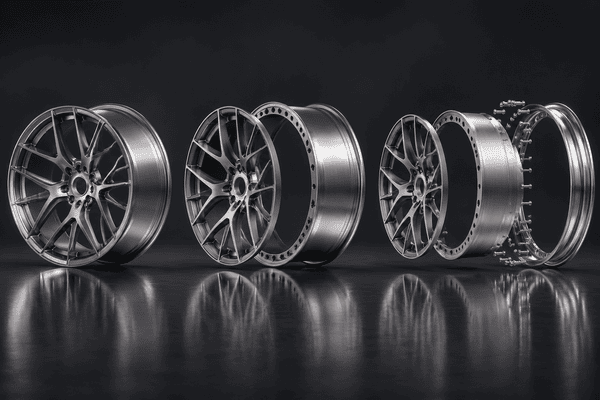
"Fully forged" refers to the material and forming process, not the assembly format. A forged wheel can be one piece, two pieces, or three pieces — and these formats serve different purposes.
Buyers who understand the process but overlook the format often select a technically correct wheel that’s wrong for their specific vehicle or use case.
How construction format maps to application
The forging process applies to the center disc (and in some formats, the barrel components). What differs across formats is how the wheel is assembled and what flexibility that gives you.
One-piece (monoblock) forged wheels are machined from a single forged blank. There are no joints, no hardware, no sealing surfaces. They offer the cleanest structural integrity and the lowest maintenance requirement. For street-driven luxury or performance vehicles where fitment is standard, this is typically the most straightforward choice.
Two-piece forged wheels pair a forged center with a forged or spun barrel, bolted together. This allows greater customization of offset and width without retooling the center design. For custom fitment on modified vehicles, two-piece construction gives the builder more flexibility.
Three-piece forged wheels add a separate outer barrel component, bolted to both the inner barrel and the center. This format maximizes width and offset customization — critical for track builds, wide-body applications, and extreme fitment projects. The trade-off is hardware maintenance: the bolts and seals need periodic inspection.
| Format | Best For | Key Trade-off |
|---|---|---|
| One-piece | Street, daily driver, standard fitment | Least fitment flexibility |
| Two-piece | Modified street, show builds | Requires assembly quality assurance |
| Three-piece | Track, wide-body, extreme custom | Hardware maintenance required |
None of these formats is categorically superior. The right choice depends on your fitment requirements, maintenance tolerance, and use case — not on which format sounds more premium.
At Tree Wheels, buyers working on complex custom builds often ask us to help map their fitment specs to the right format early in the conversation. That’s a more productive starting point than defaulting to the most expensive option.
Frequently Asked Questions
What is the difference between a forged wheel and a cast wheel?
A forged wheel is shaped from a solid aluminum billet under high pressure, which compresses the metal’s grain structure and reduces porosity. A cast wheel is made by pouring molten aluminum into a mold. Forged wheels are typically lighter and stronger, but they cost more to produce and require longer lead times6.
Is a flow-formed wheel the same as a fully forged wheel?
No. A flow-formed wheel starts as a cast blank. The barrel is stretched under rollers to improve its properties, but the structural process is not equivalent to full forging from a billet. Flow-formed wheels offer performance advantages over standard casting, but they should not be marketed or purchased as fully forged.
How can I tell if a wheel is genuinely forged?
Ask for third-party certification documents (DOT, TÜV), request the exact weight specification, and ask the supplier to describe the production process in detail. Compare the quoted lead time and price against known forged production benchmarks. Supplier-stated claims should always be cross-checked against these observable signals.
Does a forged wheel need special installation?
Forged wheels follow the same installation fundamentals as any performance wheel — correct torque specs, hub-centric fitment, and appropriate lug hardware. However, for two-piece and three-piece forged wheels, the assembly hardware (bolts and seals) should be verified for condition periodically. Consult a qualified technician for vehicle-specific installation guidance.
What certifications should a forged wheel supplier have?
Reputable forged wheel suppliers should hold independently issued certifications relevant to your market. For the U.S., DOT compliance is the baseline. TÜV certification is widely recognized in European and international markets. ISO9001 and IATF16949 indicate audited quality management systems7. Always request documentation rather than relying on logos alone.
Conclusion
A fully forged wheel is defined by its manufacturing process — solid billet, no casting, compressed grain structure — but the label alone is not a reliable buying signal. The real evaluation happens when you cross-check supplier claims against certifications, production logic, weight specs, and lead time structures. Construction format — one-piece, two-piece, or three-piece — is a separate variable that should match your specific fitment and use case, not just your budget ceiling.
If you’re evaluating fully forged wheel suppliers for your shop or your next custom build, start with verifiable documentation, not marketing language. At Tree Wheels, we’re happy to walk through production specs, share certification documents, and help match the right format to your application. Contact us directly to start the conversation.
-
"(PDF) Reviews on the Influences of Alloying elements …", https://www.academia.edu/31952342/Reviews_on_the_Influences_of_Alloying_elements_on_the_Microstructure_and_Mechanical_Properties_of_Aluminum_Alloys_and_Aluminum_Alloy_Composites. Research in aluminum alloy processing confirms that closed-die forging produces a refined, directionally aligned grain structure that reduces porosity and increases tensile strength relative to cast equivalents of the same alloy composition. Evidence role: mechanism; source type: research. Supports: That forging aligns and compresses grain structure in aluminum alloys, resulting in superior mechanical properties compared to casting. Scope note: Specific strength and weight differentials vary by alloy grade, part geometry, and design; general metallurgical findings may not map precisely to finished wheel products. ↩
-
"MATERIALS DATA HANDBOOK Aluminum Alloy 7075", https://ntrs.nasa.gov/api/citations/19670004550/downloads/19670004550.pdf. 6061-T6 and 7075 are well-characterized wrought aluminum alloys; 6061-T6 offers good corrosion resistance and weldability, while 7075 provides higher tensile strength, both properties documented in ASM International and related materials databases. Evidence role: definition; source type: encyclopedia. Supports: That 6061-T6 and 7075 are established aluminum alloy grades with documented mechanical properties relevant to structural automotive applications. Scope note: Alloy selection in commercial wheel production is manufacturer-dependent; these grades are common but not universally mandated by any single industry standard. ↩
-
"Closed Die Forging – an overview", https://www.sciencedirect.com/topics/engineering/closed-die-forging. Closed-die forging, also termed impression-die forging, is a process in which a workpiece is compressed between two dies containing the negative profile of the finished part, constraining metal flow and producing near-net-shape components with controlled grain structure, as described in standard manufacturing engineering references. Evidence role: definition; source type: encyclopedia. Supports: That closed-die forging is a specific metalworking process in which metal is pressed between two dies that contain a precut profile of the desired part. ↩
-
"How Are Maximum Load Ratings Determined Through Scientific …", https://treewheels.com/how-are-maximum-load-ratings-determined-through-scientific-testing/. Porosity in cast aluminum arises from gas entrapment and solidification shrinkage during mold filling; research in casting metallurgy documents that pores act as stress concentrators that reduce fatigue life and tensile strength, defects that are absent in wrought forged components where the billet is worked in the solid state. Evidence role: mechanism; source type: research. Supports: That aluminum castings are susceptible to porosity defects that reduce mechanical properties, and that forging eliminates this defect mode. Scope note: Modern casting techniques such as low-pressure casting and vacuum-assisted casting reduce but do not entirely eliminate porosity; the severity of the comparison depends on the specific casting process used. ↩
-
"Aluminium alloy", https://en.wikipedia.org/wiki/Aluminium_alloy. Alloys such as 7075-T6, commonly associated with aerospace structural applications, are documented in materials references as having tensile strengths exceeding 500 MPa at densities near 2.81 g/cm³, enabling weight reduction relative to lower-grade cast alloys when used in equivalent structural geometries. Evidence role: definition; source type: encyclopedia. Supports: That aluminum alloys designated for aerospace use, such as 7075, have documented high strength-to-weight ratios that support weight reduction in structural applications. Scope note: The term ‘aerospace-grade’ is not a formally standardized commercial designation; its use in wheel marketing may refer to alloy composition without implying aerospace certification or testing. ↩
-
"How Much Can Lightweight Forged Wheels Improve Fuel …", https://treewheels.com/how-much-can-lightweight-forged-wheels-improve-fuel-economy/. Materials engineering literature consistently reports that forged aluminum alloy components exhibit higher tensile strength, fatigue resistance, and lower porosity than gravity-cast or low-pressure-cast equivalents, contributing to weight reduction at equivalent structural performance targets. Evidence role: general_support; source type: research. Supports: That forged aluminum components generally exhibit higher strength-to-weight ratios than cast aluminum components of equivalent geometry. Scope note: Quantitative differences depend heavily on alloy selection, part design, and heat treatment; published comparisons for generic aluminum alloys may not directly reflect finished wheel product performance. ↩
-
"IATF 16949", https://en.wikipedia.org/wiki/IATF_16949. ISO 9001 is an internationally recognized quality management system standard published by the International Organization for Standardization, requiring documented processes and third-party audits; IATF 16949 is an automotive-sector extension developed by the International Automotive Task Force that adds sector-specific requirements for production part quality. Evidence role: definition; source type: institution. Supports: That ISO9001 and IATF16949 are internationally recognized quality management standards requiring third-party audits. Scope note: These certifications govern process management and documentation practices; they do not independently verify the material composition or manufacturing method of specific products. ↩