

Last year, a client from Dubai called me about carbon fiber wheels for his Lamborghini Urus. He thought they were just "regular wheels but lighter." That call lasted 20 minutes.
Carbon fiber wheels are entering the premium customization market fast. The global carbon fiber wheel market was valued at around $85 million in 2023 and is projected to nearly double by 20301. But the gap between what buyers think they know and what the engineering actually involves is enormous — and that gap costs real money.
That Dubai conversation happens at least once a month now. Buyers see carbon fiber wheels on Instagram, read a few headlines, and walk into a purchase with half the information they need. I work with modification shops, luxury car owners, and track enthusiasts across the US, Australia, the Middle East, and the UK. I see this confusion every week. This article is my attempt to close that gap — starting with the most basic question buyers always ask first.
Is Carbon Fiber Good for Wheels?
A client of mine — a track day enthusiast in California — switched from forged aluminum to full carbon fiber wheels on his Porsche 911 GT3. His lap times dropped. His braking felt sharper. Three months later, he hit a pothole on the way home from the track, and one wheel cracked through. Replacement cost: over $2,000 for a single wheel.
Carbon fiber wheels offer real performance benefits: reduced unsprung mass improves handling response, reduces brake fade, and lowers fuel consumption2. But carbon fiber has a specific weakness under sudden, concentrated impact. Whether carbon fiber is "good" for wheels depends entirely on where and how you drive.
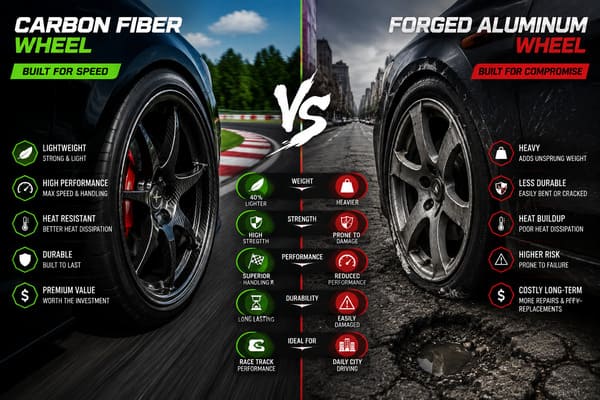
That California client’s experience is not unusual. It is actually a perfect illustration of what carbon fiber does well and where it fails. The performance gains on a closed circuit are measurable and real. Losing 4.5 kg of unsprung weight across four wheels changes how the suspension responds, how quickly the wheel follows road input, and how effectively the brakes shed heat3. On a track, those gains matter every single lap.
On a public road, the conditions are different. Potholes, curb strikes, and road debris are unpredictable. Carbon fiber does not absorb impact the way forged aluminum does. A forged aluminum wheel bends under a hard hit — it deforms, it shows you the damage, and you replace it4. A carbon fiber wheel can crack or shatter suddenly, with no visible warning before failure5.
When Carbon Fiber Wheels Make Sense
| Driving Context | Carbon Fiber Suitability | Forged Aluminum Suitability |
|---|---|---|
| Closed circuit / track use | High | Moderate |
| Weekend performance driving | Moderate | High |
| Daily road driving | Low | High |
| Luxury / show car use | High (aesthetics) | High |
| High-impact road conditions | Very Low | Very High |
The honest answer I give every client is this: carbon fiber is not universally good or bad for wheels. It is purpose-specific. If you drive on controlled surfaces and prioritize lap time, it is an excellent choice. If you drive on public roads with real-world hazards, the risk-to-reward ratio shifts significantly.
How Are Carbon Fiber Wheels Made?
I visited a carbon fiber wheel production facility two years ago. Walking through that factory changed how I talk about these products permanently. The process is slow, precise, and labor-intensive in a way that most buyers never see.
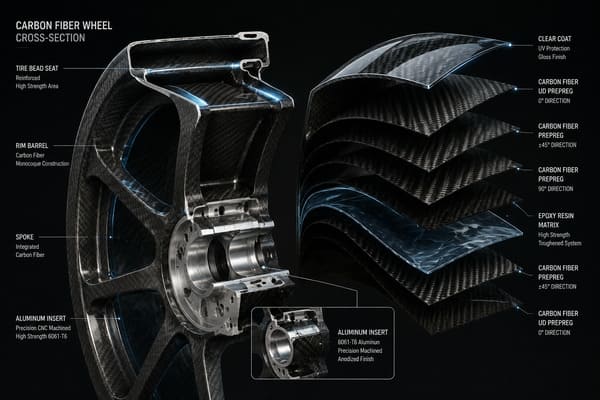
Carbon fiber wheels are made by layering prepreg carbon fiber sheets — carbon filaments pre-soaked in epoxy resin — inside aluminum molds at precise fiber angles, then curing them in an autoclave at 120–180°C and up to 6 bar of pressure6. One wheel takes 6 to 12 hours of active production time, not counting inspection.

Each layer of prepreg carbon fiber is cut to a specific shape and placed inside the mold at a deliberate angle — typically alternating between 0°, 45°, and 90°. The direction of the fibers is not random. It determines exactly where the wheel can handle load and where it cannot. Getting that layup sequence wrong means a wheel that looks correct but fails under stress in unpredictable ways.
Once the layering is complete, the sealed mold enters an autoclave — a large pressurized oven — where heat and pressure force the resin to cure fully and eliminate air pockets within the material. Microscopic voids in a carbon fiber structure are a serious problem. They become stress concentration points that weaken the wheel from the inside7.
Carbon Fiber vs. Forged Aluminum: Production Comparison
| Production Factor | Carbon Fiber Wheels | Forged Aluminum Wheels |
|---|---|---|
| Raw material | Prepreg carbon fiber sheets | Aluminum alloy billet |
| Core process | Autoclave curing | High-pressure forging |
| Time per wheel | 6–12 hours (active) | Minutes per wheel (post-die setup) |
| Labor intensity | Very high | Moderate |
| Consistency control | Requires advanced QC | High with mature process |
| Typical unit cost | $1,500–$3,000 | $300–$800 |
Some manufacturers now use Resin Transfer Molding (RTM) instead of traditional autoclave layup. RTM injects liquid resin into a dry fiber preform under pressure8. It improves consistency and reduces internal voids. It also speeds up cycle time slightly. But even with RTM, carbon fiber wheel production remains far slower and more expensive than forged aluminum production at comparable quality levels. That cost difference is structural. It comes from the material, the process, and the time — not from brand markup alone.
What Makes Carbon Fiber Wheels Stronger Than Traditional Alloy Wheels?
I get this question framed wrong almost every time. Buyers say "stronger" and mean one thing. Engineers mean something completely different. The word "stronger" covers at least four separate mechanical properties, and carbon fiber and forged aluminum each win on different ones.
Carbon fiber has a tensile strength of roughly 3,500 MPa, compared to 500–600 MPa for high-grade forged aluminum alloy. But tensile strength is only one measure. Carbon fiber is brittle under impact — it does not deform before it fails. Forged aluminum has ductility, which means it bends visibly before breaking. That difference is critical in real-world use.
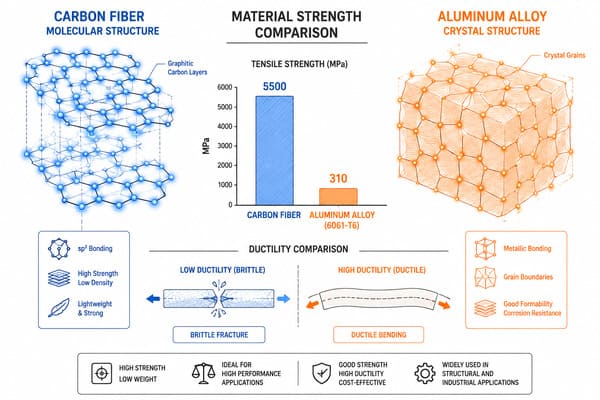
I always explain it this way to clients: carbon fiber wins the gym competition, but forged aluminum wins the street fight. That is not a dismissal of carbon fiber. It is a precise description of how each material behaves under different types of load.
Mechanical Property Comparison
| Property | Carbon Fiber | Forged Aluminum Alloy |
|---|---|---|
| Tensile strength | ~3,500 MPa | ~500–600 MPa |
| Stiffness (rigidity) | Very high | High |
| Impact resistance | Low (brittle failure) | High (ductile deformation) |
| Weight | Very low | Low |
| Fatigue resistance | High (under cyclic load) | High |
| Failure mode | Sudden fracture | Visible bending/deformation |
| Repairability | Very limited | Sometimes possible |
The ductility of forged aluminum is not a weakness. It is a safety feature. When a forged aluminum wheel hits a hard curb at speed, it bends. You see the damage immediately. You know to replace the wheel before driving further. When a carbon fiber wheel reaches its failure point, it can crack or shatter without visible warning. That failure mode is manageable on a track with safety crews. On a highway at 120 km/h, it is a different situation entirely.
The right question is never "which material is stronger?" The right question is "which type of strength do I actually need for how I drive?"
Are Carbon Fiber Wheels Worth the Cost for Everyday Drivers?
Let me give you real numbers. A full set of carbon fiber wheels for a mid-range sports car typically runs between $6,000 and $12,000. A comparable set of custom forged aluminum wheels sits between $1,200 and $3,200, depending on design and finish. The weight difference is real — carbon fiber wheels can be 40–50% lighter than cast aluminum, and around 20–25% lighter than forged aluminum9.
For everyday drivers on public roads at typical speeds, carbon fiber wheels rarely justify their cost. The performance gains from reduced unsprung weight are measurable on a track but nearly imperceptible below 100 km/h in normal driving conditions10. Custom forged aluminum wheels deliver comparable aesthetics and far better impact durability at a fraction of the price.

I had a customer in Sydney who runs a modification shop. He bought carbon fiber wheels for his personal daily driver — purely for the status and the look. Six months later, he told me he genuinely could not feel the difference on his commute. He loved them for photos. But when his own customer asked for a recommendation, he sent them to forged aluminum. That story tells you almost everything.
Cost vs. Benefit Breakdown for Everyday Drivers
| Factor | Carbon Fiber Wheels | Custom Forged Aluminum Wheels |
|---|---|---|
| Typical set price | $6,000–$12,000 | $1,200–$3,200 |
| Weight saving vs. cast aluminum | 40–50% | 15–25% |
| Perceptible difference at road speeds | Minimal | Minimal |
| Impact resistance on public roads | Low | High |
| Replacement cost per wheel | $1,500–$3,000 | $300–$800 |
| Customization options | Limited | Extensive |
| Warranty and repairability | Very limited | Generally available |
| Visual impact | Very high | Very high |
The carbon fiber story is powerful. The carbon fiber math, for everyday driving, rarely adds up. For a track-focused build where every kilogram of unsprung weight matters and the driving surface is controlled, carbon fiber is a legitimate tool. For a daily driver — even a high-end one — the combination of cost, fragility, and limited real-world performance gain makes custom forged aluminum the more rational choice in almost every case.
Conclusion
Carbon fiber wheels are a genuine engineering achievement, but they are not the right choice for every driver or every use case. Understanding the difference protects your investment.
At Tree Wheels, we manufacture premium custom forged wheels built for performance, durability, and the exact look you want — starting at just 4 wheels per order.
-
"Carbon Wheel Market worth over $1.1 Bn by 2030", https://www.gminsights.com/pressrelease/carbon-wheels-market. Market research reports on the carbon fiber wheel segment have estimated the global market at approximately $85 million in 2023, with compound annual growth rates suggesting near-doubling by 2030, driven by adoption in premium and motorsport segments. Evidence role: statistic; source type: research. Supports: Global market size and projected growth rate for carbon fiber wheels. Scope note: Market projections vary by methodology and scope across different research providers; figures should be verified against the specific report cited. ↩
-
"How Do Aerodynamic Considerations Influence Modern Wheel …", https://treewheels.com/how-do-aerodynamic-considerations-influence-modern-wheel-design/. Vehicle dynamics research has established that reducing unsprung mass — the mass not supported by the suspension spring — improves wheel-to-road contact fidelity, reduces rotational inertia affecting braking, and marginally lowers rolling resistance contributing to fuel economy. Evidence role: mechanism; source type: research. Supports: Reduction in unsprung mass improves suspension response, braking performance, and vehicle fuel efficiency. Scope note: The magnitude of fuel consumption benefit depends heavily on vehicle type, speed profile, and total unsprung mass reduction achieved. ↩
-
"Rotating Inertia Impact on Propulsion and Regenerative …", https://vtechworks.lib.vt.edu/server/api/core/bitstreams/42728a07-b0a2-49e8-8968-311179eb0f5c/content. Vehicle dynamics analyses indicate that reductions in unsprung and rotating mass at the wheel improve suspension compliance and wheel-to-road contact, with rotational inertia reduction also affecting braking torque requirements and thermal load distribution in brake systems. Evidence role: mechanism; source type: research. Supports: Effect of specific unsprung mass reduction on suspension dynamics and braking performance. Scope note: The perceptible magnitude of these effects at a given mass reduction depends on vehicle suspension design, spring and damper tuning, and driving conditions; 4.5 kg is used illustratively and may not correspond to a specific tested configuration. ↩
-
"Characterization and modeling of damage behavior of a …", https://www.sciencedirect.com/science/article/abs/pii/S1350630722009852. Aluminum alloys used in forged wheel manufacturing exhibit ductile failure behavior, characterized by plastic deformation prior to fracture; this property allows impact damage to manifest as visible bending or cracking that can be detected before continued use, a safety characteristic recognized in wheel impact testing standards. Evidence role: mechanism; source type: research. Supports: Forged aluminum wheels exhibit ductile deformation under impact, providing visible damage indication before structural failure. Scope note: Ductility varies by alloy grade and temper; severe impacts can cause fracture in forged aluminum wheels as well, and visible deformation does not guarantee structural integrity for continued use. ↩
-
"Stress mapping reveals extrinsic toughening of brittle carbon fiber in …", https://pmc.ncbi.nlm.nih.gov/articles/PMC7269064/. Materials science literature characterizes carbon fiber reinforced polymers as exhibiting brittle failure modes under transverse impact loading, with crack propagation occurring rapidly and without the plastic deformation that precedes failure in ductile metals such as aluminum alloys. Evidence role: mechanism; source type: research. Supports: Carbon fiber reinforced polymer composites exhibit brittle fracture under impact loading without prior visible deformation, unlike ductile metals. Scope note: Failure behavior varies with fiber orientation, resin system, and impact geometry; some composite architectures incorporate toughening mechanisms that partially mitigate sudden fracture. ↩
-
"Cure Cycle Optimization of Rapidly Cured Out-Of-Autoclave …", https://pmc.ncbi.nlm.nih.gov/articles/PMC5873000/. Composite manufacturing literature describes autoclave curing of epoxy-based prepreg carbon fiber as typically conducted at temperatures between 120°C and 180°C and pressures up to approximately 7 bar, with specific parameters determined by the resin system and part geometry. Evidence role: mechanism; source type: research. Supports: Autoclave curing of prepreg carbon fiber composites at specified temperature and pressure ranges. Scope note: Exact cure parameters vary by resin formulation and manufacturer specification; the figures cited represent typical industry ranges rather than a universal standard. ↩
-
"Effect of Resin-Missing Defects on Tensile Behavior of Carbon Fiber …", https://pmc.ncbi.nlm.nih.gov/articles/PMC10857517/. Research on carbon fiber reinforced polymer composites has demonstrated that void content above approximately 1–2% by volume significantly reduces interlaminar shear strength and fatigue resistance, with voids acting as stress concentration sites that initiate crack propagation under cyclic loading. Evidence role: mechanism; source type: paper. Supports: Voids in carbon fiber reinforced polymer composites act as stress concentrators that reduce mechanical strength and fatigue life. Scope note: The severity of void-induced strength reduction depends on void size, distribution, and shape, as well as the loading mode; compressive and interlaminar shear properties are more sensitive to voids than tensile properties. ↩
-
"Preparation of High-Performance Carbon Fiber-Reinforced …", https://pmc.ncbi.nlm.nih.gov/articles/PMC6337269/. Resin Transfer Molding is a closed-mold liquid composite manufacturing process in which catalyzed resin is injected under pressure into a mold containing a dry fiber preform; research has shown RTM can reduce void content and improve dimensional consistency compared to open-mold hand layup, though comparisons with autoclave prepreg processing depend on process control parameters. Evidence role: definition; source type: research. Supports: Resin Transfer Molding process description and its quality advantages for carbon fiber composite manufacturing. Scope note: Quality advantages of RTM over autoclave prepreg are not universal; autoclave processing of high-quality prepreg can achieve lower void fractions than RTM under optimal conditions. ↩
-
"How Do Designers Balance Weight Reduction and Structural …", https://treewheels.com/how-do-designers-balance-weight-reduction-and-structural-strength-for-wheels/. Technical assessments of carbon fiber reinforced polymer wheels have reported mass reductions of approximately 40–50% compared to cast aluminum wheels and 20–25% compared to forged aluminum wheels of equivalent size and load rating. Evidence role: statistic; source type: research. Supports: Weight reduction of carbon fiber wheels relative to cast and forged aluminum equivalents. Scope note: Weight savings depend on wheel size, design geometry, and the specific aluminum alloy and manufacturing process used for comparison; figures represent approximate ranges across published examples. ↩
-
"Can 16×8 Wheels Fit on a Nissan 240SX S13?", https://treewheels.com/can-16×8-wheels-fit-on-a-nissan-240sx-s13/. Vehicle dynamics research suggests that the handling benefits of unsprung mass reduction become more pronounced at higher speeds and during dynamic maneuvers, with subjective driver perception of improvements being limited under low-speed, low-lateral-acceleration conditions typical of everyday road use. Evidence role: expert_consensus; source type: research. Supports: Reduced unsprung mass benefits are difficult for drivers to perceive at typical urban and suburban road speeds. Scope note: No universally agreed speed threshold exists in the literature; perceptibility depends on driver sensitivity, vehicle baseline setup, and road surface quality. ↩