
Most people think aerodynamics is the main reason to upgrade wheels. It is not. But weight, strength, and design still matter more than you think.
Aerodynamics rarely drives wheel choices for everyday drivers. What actually matters is unsprung weight, structural strength, and design flexibility. Forged wheels deliver all three. They let you get the look you want while keeping the wheel lighter and stronger than cast alternatives.

I have asked many customers who came to us for custom wheels: "Why do you want to change your wheels?" Not one person said "I want to optimize aerodynamics." They said things like "I want my car to look more aggressive" or "the stock wheels are ugly." That is completely normal. Aerodynamics is something Red Bull’s racing engineers worry about. It is not something a Mustang owner needs to lose sleep over. But there is one thing every single customer needs to care about: the safety baseline. A wheel must be strong enough. That is non-negotiable. Everything else — weight, design, finish — builds on top of that foundation.
How Does Wheel Shape Affect Airflow Around a Vehicle?
Most buyers spend hours researching aerodynamic wheel profiles. But for 99% of road cars, that research changes almost nothing on the road.
Wheel shape only produces meaningful aerodynamic effects above 200 km/h1. Below that speed, the airflow difference between a flat-faced wheel and an open-spoke design is too small to measure in real driving. For everyday use, wheel shape is a visual decision, not an aerodynamic one.
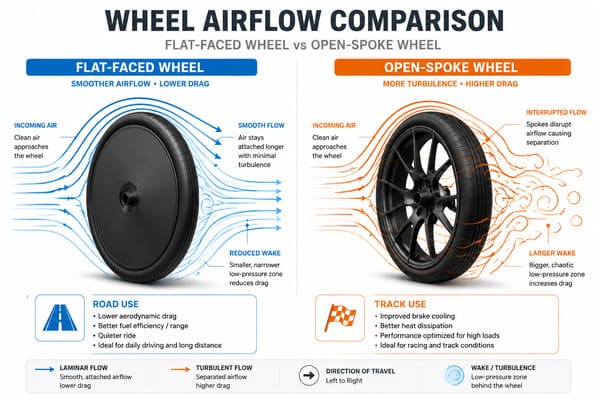
I had a customer who spent a lot of time studying aerodynamic wheel profiles. He eventually chose a design that performed well in wind tunnel testing. His car was a daily commuter sedan with a top speed of around 120 km/h. At that speed, the aerodynamic difference from wheel shape would save him roughly 0.01 liters of fuel per 100 kilometers2. That number is not a typo. It is genuinely that small.
When Does Wheel Shape Actually Matter?
The table below shows how driving context changes the relevance of aerodynamic wheel design.
| Driving Context | Top Speed | Aero Impact from Wheel Shape | Practical Relevance |
|---|---|---|---|
| Daily commute | 60–120 km/h | Negligible | None |
| Highway driving | 120–160 km/h | Very low | Minimal |
| Track / motorsport | 200+ km/h | Measurable | High |
| Professional racing | 250+ km/h | Significant | Critical |
For road cars, the shape of a wheel matters because of how it looks sitting in the arch. A deep-dish profile, a mesh design, or a Y-spoke layout — these choices define the visual identity of the build. That is a real reason to choose a shape. Aerodynamics at normal road speeds is not. The only exception is if you are running a car on a closed circuit regularly. At sustained high speeds, a more enclosed wheel face can reduce drag meaningfully. But that is a small slice of the market. For the rest of us, pick the shape that looks right on the car.
What Role Do Spoke Patterns Play in Aerodynamic Performance?
Customers often ask whether 5-spoke or 10-spoke wheels are better for aerodynamics. The honest answer is: it depends on your speed, and probably does not matter for your car.
On a racetrack, fewer spokes with larger open areas allow air to pass through more freely, giving a slight aerodynamic advantage3. For street use, the more important difference is weight. A 5-spoke forged wheel is typically 10–15% lighter than a 10-spoke version of the same size4.
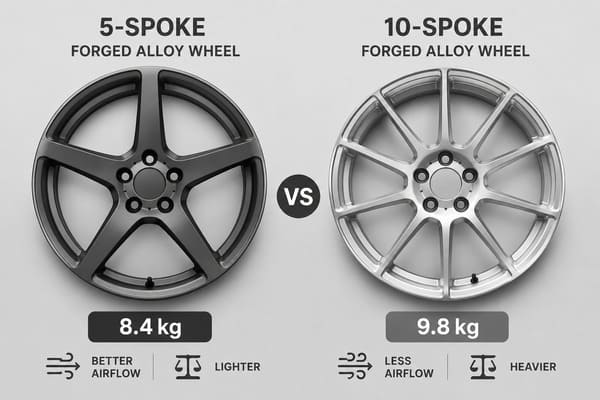
A customer once asked me directly: "Which is better aerodynamically, 5-spoke or 10-spoke?" I gave him a straight answer. On a track, a 5-spoke design has slightly better airflow through the wheel because the open area is larger. But he drove a modified street car and never went near a track. So I shifted the conversation to what would actually affect his driving.
Spoke Count, Weight, and Real-World Impact
| Spoke Pattern | Open Area | Typical Weight (18-inch forged) | Aero Benefit | Street Driving Impact |
|---|---|---|---|---|
| 5-spoke | High | ~7.5–8.5 kg | Low to moderate | Better weight saving |
| 7-spoke | Medium-high | ~8–9 kg | Low | Good balance |
| 10-spoke | Medium | ~9–10.5 kg | Very low | More material, more weight |
| Mesh / multi-spoke | Low | ~10–12 kg | Minimal | Heavier, visual focus |
Fewer spokes generally means less material used in the wheel structure. A 5-spoke forged wheel in the same size as a 10-spoke version can be 10–15% lighter. That weight reduction is not coming from aerodynamic engineering. It is coming from the simple fact that there is less metal in the wheel. And less metal, when the structural integrity is maintained through forging, means a lighter wheel that your suspension, brakes, and steering can all respond to faster. That is the real reason spoke count matters for street drivers. Not airflow. Weight.
How Does Wheel Weight Influence Vehicle Efficiency and Handling?
Wheel weight is the one performance variable that every driver can feel immediately, regardless of whether they drive on a track or a highway.
Wheels are unsprung mass. Reducing unsprung weight improves suspension response, braking performance, and steering feel5. Replacing four cast wheels weighing 12 kg each with forged wheels at 8 kg each removes 16 kg of unsprung mass6 — a change most drivers notice within the first few minutes.
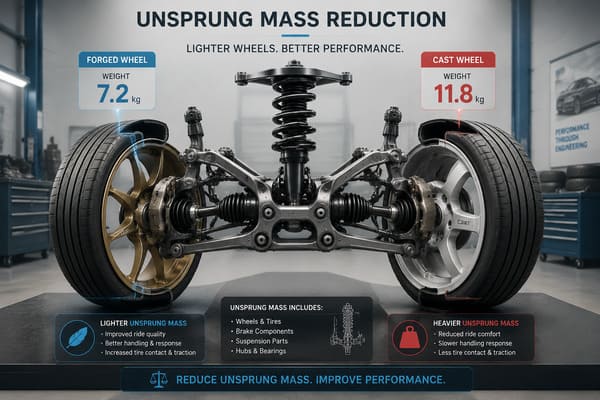
One of our customers replaced his factory cast wheels — around 12 kg each — with our forged wheels at approximately 8 kg each. Four wheels. Total weight reduction of 16 kg. He sent me a message a few days after fitting them. He said: "The brakes feel sharper than before, and the steering is lighter." That is not a placebo effect. That is physics.
Why Unsprung Weight Matters More Than Total Vehicle Weight
| Weight Type | Location | Effect on Handling | Driver Perception |
|---|---|---|---|
| Sprung mass (body, engine) | Above suspension | Moderate effect on inertia | Hard to feel directly |
| Unsprung mass (wheels, brakes) | Below suspension | Direct effect on suspension speed | Felt immediately in steering and braking |
The suspension has to control the movement of the wheel. A heavier wheel takes more force and more time to change direction. A lighter wheel follows road inputs faster7. This means the suspension can do its job better. Braking distance shortens slightly. Steering response becomes more direct8. The car feels more connected to the road. None of this requires a racetrack to notice. It shows up on the first corner you take after fitting the new wheels. This is the real reason customers buy lightweight forged wheels. Not aerodynamics. Just the feeling of a better-responding car.
How Do Forged Wheels Improve Aerodynamic and Performance Outcomes?
Forging does not make a wheel more aerodynamic by itself. What it does is make your chosen design achievable at a lower weight and higher strength than casting allows.
Forged wheels use a denser, more uniform grain structure than cast wheels9. This allows thinner cross-sections without sacrificing strength. The result is a wheel that can carry complex spoke designs, aggressive offsets, and custom profiles while remaining significantly lighter than a cast equivalent.
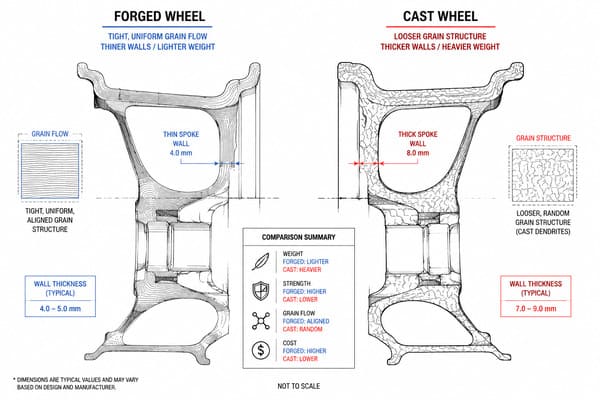
I tell customers this regularly: the value of forging is not that it makes your wheel "more aerodynamic." The value is that the design you want — the look you chose — can be built lighter and stronger than it could be in cast aluminum.
Forged vs Cast: Same Design, Different Outcomes
| Design Type | Cast Version Weight | Forged Version Weight | Reason for Difference |
|---|---|---|---|
| Simple 5-spoke | ~10 kg | ~7.5 kg | Thinner walls possible with forging |
| Complex multi-spoke | ~13–14 kg | ~8.5–9.5 kg | Cast needs thicker walls for strength |
| Deep-dish aggressive offset | ~12–13 kg | ~8–9 kg | Forging handles stress concentration better |
Take a complex multi-spoke design as an example. In casting, the manufacturer has to increase wall thickness to make sure the spokes are strong enough. That adds weight. The same design in forged aluminum can use thinner walls because the material itself is denser and more consistent. The result is a wheel that can be 3–5 kg lighter per corner while meeting the same or higher strength standards. Our wheels carry ISO9001, DOT, TÜV, and IATF16949 certifications10. That is not marketing language. Those certifications mean the wheel has been tested to real structural standards. You are buying a look you love. Forging gives you that look in a package that is lighter, stronger, and built to last.
Conclusion
Aerodynamics matters at racing speeds. For most drivers, wheel weight and structural strength are what make a real difference every day.
Tree Wheels builds forged wheels that are lighter, stronger, and fully customized to your exact specifications — with a 1-year warranty and global delivery.
-
"Investigation of Drag Reduction Technologies for Light-Duty …", https://pmc.ncbi.nlm.nih.gov/articles/PMC7153308/. Aerodynamic drag forces scale with the square of velocity, meaning wheel-induced drag contributions at low speeds are disproportionately small relative to those observed at sustained high speeds; this relationship is documented in vehicle aerodynamics literature examining drag coefficient components across speed ranges. Evidence role: mechanism; source type: paper. Supports: That aerodynamic drag from wheel geometry becomes measurable or significant only at higher vehicle speeds. Scope note: A source may confirm the physics of drag scaling without specifying 200 km/h as a precise threshold for wheel shape effects. ↩
-
"Drag Reduction: The Pursuit of Better Fuel Economy", https://illumin.usc.edu/drag-reduction-the-pursuit-of-better-fuel-economy/. Research into vehicle aerodynamic component contributions has found that wheel and wheel-well drag can account for a notable share of total aerodynamic drag, yet the absolute fuel consumption savings from wheel shape optimization at urban and suburban speeds are generally marginal. Evidence role: statistic; source type: paper. Supports: That aerodynamic improvements from wheel design yield very small fuel consumption gains for passenger cars at typical road speeds. Scope note: A source is unlikely to reproduce the exact figure of 0.01 L/100 km; it would provide general magnitude context rather than direct confirmation of this specific value. ↩
-
"Evaluation of wind tunnel interference on numerical prediction of …", https://www.sciencedirect.com/science/article/pii/S0167610522000502. Aerodynamic studies of rotating wheel assemblies have examined the relationship between wheel face geometry and drag generation, finding that spoke configuration and open area affect the interaction between the rotating wheel and surrounding airflow, with implications for drag at elevated speeds. Evidence role: mechanism; source type: paper. Supports: That wheel spoke geometry and open area influence aerodynamic drag, with more open designs generally reducing resistance at high speeds. Scope note: Published research more commonly addresses closed versus open wheel configurations in motorsport contexts; direct comparison of 5-spoke versus 10-spoke street wheel aerodynamics at track speeds may not be specifically documented. ↩
-
"[PDF] Bicycle Wheel Spoke Patterns and Spoke Fatigue 1 – Duke University", https://people.duke.edu/~hpgavin/papers/HPGavin-Wheel-Paper.pdf. Engineering analyses of wheel structural design indicate that spoke count directly affects total material volume and thus wheel mass, with lower spoke counts enabling meaningful weight reductions when structural integrity requirements are maintained. Evidence role: general_support; source type: research. Supports: That spoke count influences total wheel mass due to differences in material volume, with fewer spokes generally resulting in lighter wheels. Scope note: The specific 10–15% figure may not appear in published literature; a source would support the directional relationship rather than confirm this precise range. ↩
-
"[PDF] Mass Reduction for Light-Duty Vehicles for Model Years 2017–2025", https://www.nhtsa.gov/sites/nhtsa.gov/files/documents/13250e-peerreviewsummaryreport_final-112818-v3-tag.pdf. Vehicle dynamics literature establishes that unsprung mass directly affects the ability of the suspension system to maintain tire contact with the road surface; lower unsprung mass reduces the inertia the suspension must overcome, improving response to road inputs and enhancing braking and steering feedback. Evidence role: mechanism; source type: paper. Supports: That reducing unsprung mass improves suspension response, braking, and steering feel through faster wheel-to-road contact dynamics. ↩
-
"Cast vs. Forged Wheels (Comparing EXACT Sizes) – YouTube", https://www.youtube.com/watch?v=KjgyrEo5GcU. Comparative assessments of cast and forged aluminum wheel manufacturing have documented significant mass differences attributable to the denser grain structure achievable through forging, which permits thinner cross-sections while maintaining structural performance. Evidence role: statistic; source type: research. Supports: That forged aluminum wheels are substantially lighter than cast aluminum wheels of equivalent size, with representative weight ranges in the figures cited. Scope note: Exact weight figures vary by wheel size, design complexity, and manufacturer; a source would confirm the general magnitude of the weight advantage rather than the specific 12 kg and 8 kg values. ↩
-
"10.3 Dynamics of Rotational Motion: Rotational Inertia", https://pressbooks.online.ucf.edu/phy2054jr/chapter/dynamics-of-rotational-motion-rotational-inertia/. Vehicle dynamics principles establish that wheel rotational inertia, which scales with mass and radius, resists changes in angular velocity; heavier wheels therefore require greater torque to accelerate and decelerate, which affects both drivetrain efficiency and the speed at which the suspension can respond to road surface variations. Evidence role: mechanism; source type: paper. Supports: That wheel mass increases rotational inertia, requiring greater force to accelerate or decelerate the wheel and slowing suspension response to road inputs. ↩
-
"Research on vehicle lateral stability control under low-adhesion …", https://pmc.ncbi.nlm.nih.gov/articles/PMC12654942/. Vehicle dynamics research examining the effects of unsprung mass variation has found that lighter wheel assemblies improve tire contact patch stability and reduce the inertial resistance to wheel deceleration, contributing to shorter braking distances and more responsive steering under dynamic conditions. Evidence role: general_support; source type: paper. Supports: That reducing wheel mass produces measurable improvements in braking distance and steering responsiveness. Scope note: The magnitude of braking distance improvement from wheel mass reduction alone is typically small and may be difficult to isolate from other variables in real-world testing. ↩
-
"Development of Al–Mg–Si alloy performance by addition of grain …", https://pmc.ncbi.nlm.nih.gov/articles/PMC10305821/. Materials science research on aluminum alloy processing demonstrates that forging induces grain refinement and alignment along stress paths, producing a more uniform and denser microstructure than gravity or pressure die casting, which is associated with improved tensile strength and fatigue resistance. Evidence role: mechanism; source type: paper. Supports: That the forging process produces a refined, aligned grain structure in aluminum alloys that results in superior mechanical properties compared to casting. ↩
-
"Interpretation ID: 86-1.39 – NHTSA", https://www.nhtsa.gov/interpretations/86-139. ISO 9001 specifies requirements for quality management systems; DOT certification indicates compliance with U.S. Federal Motor Vehicle Safety Standards for wheels; TÜV certification involves independent structural and safety testing by a German technical inspection authority; IATF 16949 specifies quality management requirements specific to automotive production. Evidence role: definition; source type: institution. Supports: That the cited certifications represent independently verified quality and structural standards applicable to automotive wheels. Scope note: Certification scope and testing rigor differ across standards; ISO 9001 and IATF 16949 address manufacturing process quality rather than direct structural performance of individual wheel designs. ↩