
A red Jeep Wrangler Rubicon turns heads everywhere it goes. But the wrong wheels can ruin the whole look — and I’ve seen it happen more than once.
The best wheel designs for a red Jeep Wrangler Rubicon are those with strong, wide spokes and a bold structure. A 5-spoke forged wheel in matte black or bronze finish, sized at 17×9 inches, matches the Rubicon’s aggressive body lines and enhances its off-road character1 without looking out of place.
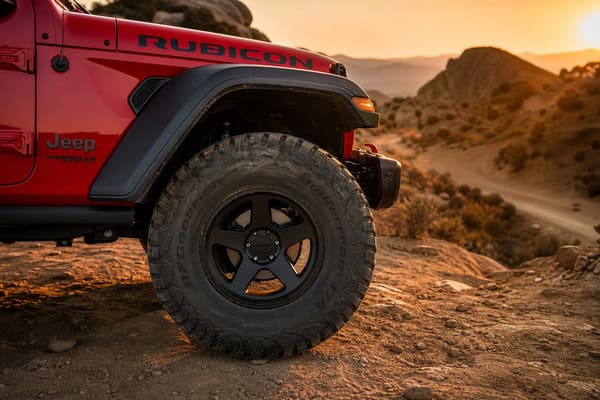
I remember a customer who came to me with a flame-red Rubicon. He had already tried three sets of wheels and kept saying something felt "off." The sizes were fine. The brands were fine. The problem was that the design language didn’t match the car. The Wrangler has hard, squared-off lines built for serious terrain. Its wheels need to carry that same sense of strength. I recommended a 5-spoke forged wheel with thick, heavy spokes and a matte black finish. The moment he put them on, he sent me a message: "This is how it was supposed to look." That one experience taught me a clear rule — for a red Rubicon, the wheel design should speak to structure and raw power, not elegance or complexity.
What Wheel Size Works Best for a Red Jeep Wrangler Rubicon?
The factory wheel size on a Rubicon is 17 inches2. That number works. But a lot of owners stop there and miss a big opportunity to improve both the look and the performance.
The best size for a red Jeep Wrangler Rubicon is 17×9 inches with an offset between -12mm and -18mm. This pushes the wheel outward by 20–25mm, making the stance wider and more aggressive. Paired with 35-inch or 37-inch tires, this combination gives the best balance of looks and function.
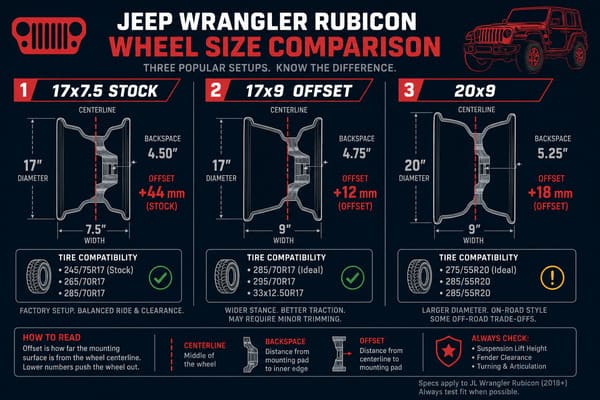
About 70% of the Jeep modification customers I work with choose to stay at 17 inches but upgrade the width from the stock 7.5 inches to 9 inches. The offset adjustment is just as important as the width. Getting this wrong causes real problems3.
Why 17 Inches Remains the Right Choice
One of my customers who runs a modification shop decided to try 20-inch wheels on his Rubicon. After fitting 35-inch tires, the tires rubbed against the fender flares during turns. He had to switch back to 17 inches. The reason is simple: larger diameter wheels leave less room for sidewall height, and the Rubicon needs that sidewall to absorb impact on rough terrain4.
| Wheel Size | Tire Compatibility | Clearance | Visual Impact |
|---|---|---|---|
| 17×7.5 (Stock) | Up to 33" | Standard | Flat, narrow stance |
| 17×9 (-12 to -18mm) | 35" or 37" | Good | Wide, aggressive stance |
| 20×9 | 35" | Tight, risk of rubbing | Sporty but impractical |
The 17×9 setup with a -12mm to -18mm offset pushes the wheel face out far enough to fill the wheel arch properly. It makes the red bodywork look planted and intentional. For a red Rubicon that will see any real off-road use, this is the size I recommend every time.
Which Wheel Finishes Look Best on a Red Jeep Wrangler Rubicon?
Choosing the wrong finish on a red Rubicon is one of the most common mistakes I see. The color of the wheel changes the entire personality of the car.
Matte black and bronze are the two best finishes for a red Jeep Wrangler Rubicon. Matte black creates a strong contrast that makes the red body color stand out. Bronze works through color harmony rather than contrast, giving the vehicle a more distinctive, premium look.
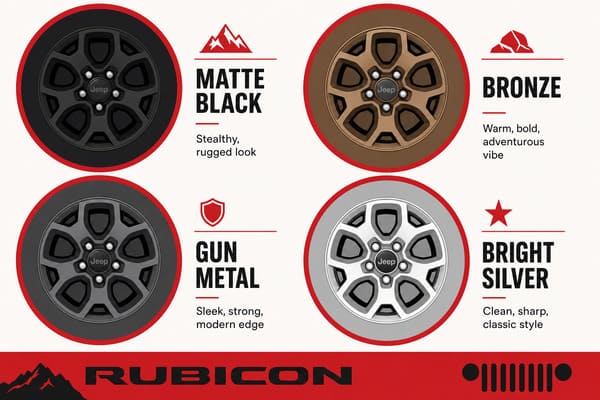
I ran an informal count across the red Jeep wheel orders we have handled. Matte black made up close to 45% of those orders. Bronze came in second at around 30%. Gun metal and dark gray shades covered most of the rest.
Breaking Down Each Finish Option
The numbers tell a clear story, but the reasoning behind each choice matters just as much.
| Finish | Effect on Red Body | Best For | Not Recommended For |
|---|---|---|---|
| Matte Black | High contrast, bold, aggressive | Most Rubicon builds | Those wanting a subtle look |
| Bronze | Warm tone harmony, distinctive | Dark red or burgundy Rubicons | Bright orange-red tones |
| Gun Metal / Dark Gray | Subtle, understated | Street-focused builds | Strong off-road character builds |
| Bright Silver | Low contrast, washes out red | — | Almost all red Rubicons |
| Chrome | Makes car look decorative | — | Any serious off-road build |
I had a customer in Australia with a dark red Rubicon. He ordered our three-piece forged wheels in bronze. When he sent me the finished photos, I was genuinely impressed. The bronze pulled out the warm undertones in his paint color in a way that matte black simply could not. On the other hand, bright silver and chrome finishes make a red Wrangler look like it belongs at a car show, not on a trail. I almost never recommend either of those for this vehicle.
How Do You Choose the Right Wheel Style for Off-Road and Street Use?
Most Rubicon owners want a wheel that looks tough and handles real terrain. The problem is that not every "off-road style" wheel is actually built for off-road use.
For a Jeep Wrangler Rubicon used on both street and off-road, choose a wheel with 5 to 6 spokes and a spoke width of at least 25mm. Fewer, wider spokes handle impact better. For serious rock crawling, a beadlock-compatible design adds critical tire retention at low pressures.
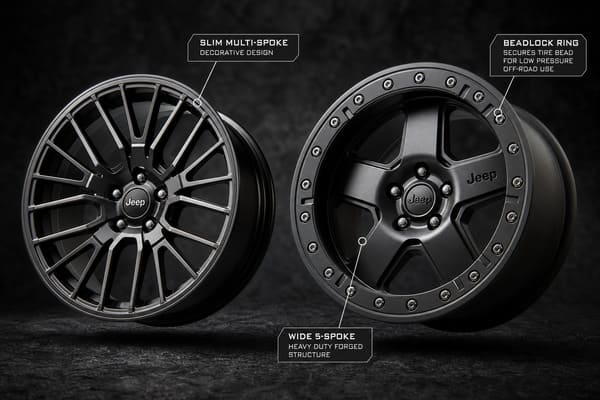
I always ask my customers one question before making a recommendation: "How many times a year do you actually go off-road?" Most of them say "not often, but I want that feeling." That answer tells me exactly what to suggest.
Matching Wheel Style to Actual Use
The structure of the wheel needs to match how the car is actually driven. A wheel that looks aggressive but uses thin, decorative spokes will crack on a hard trail impact5.
| Use Case | Recommended Spoke Count | Minimum Spoke Width | Beadlock Needed? |
|---|---|---|---|
| Street only | 6–8 spokes | 18mm | No |
| Mixed street and light trail | 5–6 spokes | 25mm | No |
| Regular off-road / rock crawling | 5 spokes | 28mm+ | Recommended |
| Extreme terrain / competition | 5 spokes | 30mm+ | Yes |
A beadlock wheel uses a mechanical ring to clamp the tire bead against the wheel. This keeps the tire in place when you drop tire pressure below 15 PSI6 for better traction on rocks or sand. I had a customer who used our beadlock forged wheels during an off-road event in Morocco. He ran through extreme terrain over multiple days and had zero issues. For customers who only occasionally drive on rough roads, a standard heavy-spoke forged wheel is enough. The key is honest about how the vehicle will be used.
Are Forged Wheels Worth It for a Jeep Wrangler Rubicon?
I manufacture forged wheels, so you might expect me to say they are always worth it. I want to answer this with actual numbers instead.
Forged wheels are worth it for a Jeep Wrangler Rubicon because they weigh 20–30% less than cast wheels of the same size and are significantly stronger7. A 17×9 forged wheel typically weighs 8–9.5kg per piece, compared to 11–13kg for cast8. This directly improves suspension response, handling, and durability on rough terrain.
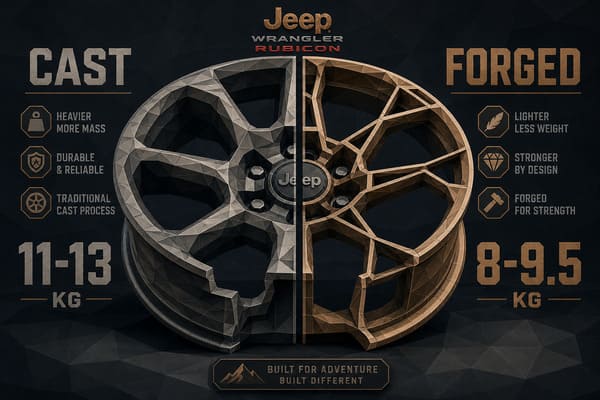
Four wheels at roughly 10–15kg lighter in total unsprung weight is not a small difference. Unsprung weight is the weight that your suspension has to move and control. Less of it means faster suspension response, better grip on uneven surfaces, and slightly lower fuel consumption over time9.
Forged vs Cast: A Direct Comparison
The strength difference becomes most obvious under real stress. A customer in Canada hit a sharp, protruding rock on a trail. His previous cast wheels cracked on impact. After switching to our forged wheels, he went through the same terrain and came back with only light surface scratches.
| Property | Cast Wheels | Forged Wheels |
|---|---|---|
| Weight (17×9) | 11–13 kg per wheel | 8–9.5 kg per wheel |
| Total weight saving (4 wheels) | — | 10–15 kg lighter |
| Impact resistance | Moderate, prone to cracking | High, deforms rather than cracks |
| Structural integrity | Good for street use | Built for off-road stress |
| Customization options | Limited | Full custom size, finish, and design |
| Production lead time | Faster | 15–20 days (one-piece) |
The Rubicon is designed for extreme conditions from the factory. Its suspension, transfer case, and axles are all built to handle serious terrain. Putting cast wheels on a Rubicon is like fitting budget tires on a sports car — the rest of the system is ready, but one component is holding it back10. A set of forged wheels is not a luxury upgrade for a Rubicon. It is the component that matches what the rest of the vehicle was already built to do.
Conclusion
The right wheels for a red Rubicon combine bold design, correct sizing, the right finish, and real structural strength. Every detail matters. At Tree Wheels, we build fully custom forged wheels designed to match your Rubicon exactly — in size, finish, and performance.
-
"Ok Ok. I looked. I promise. Rubicon wheel size?", https://www.jlwranglerforums.com/forum/threads/ok-ok-i-looked-i-promise-rubicon-wheel-size.57315/. Jeep’s official specifications for the Wrangler Rubicon list the standard wheel dimensions; aftermarket sizing guidelines from automotive technical sources corroborate common upgrade paths within safe engineering tolerances. Evidence role: general_support; source type: other. Supports: Factory wheel specifications and recommended aftermarket sizing for the Jeep Wrangler Rubicon. Scope note: Manufacturer documentation covers stock specifications; aftermarket size recommendations reflect industry convention rather than independently verified optimal performance data. ↩
-
"2026 Jeep® Wrangler Specs: Horsepower, MPG, Towing …", https://www.jeep.com/wrangler/specs.html. According to Jeep’s published vehicle specifications, the Wrangler Rubicon is equipped from the factory with 17-inch wheels, a dimension consistent across recent model years. Evidence role: statistic; source type: other. Supports: The factory-installed wheel diameter on the Jeep Wrangler Rubicon trim. Scope note: Exact specifications may vary by model year and regional market; readers should consult current Jeep documentation for their specific vehicle. ↩
-
"Wheel sizing", https://en.wikipedia.org/wiki/Wheel_sizing. Wheel offset, defined as the distance between the wheel’s mounting face and its centerline, directly determines how far the tire sits inboard or outboard within the wheel well; negative offset pushes the tire outward, reducing clearance against suspension and body components. Evidence role: mechanism; source type: encyclopedia. Supports: How wheel offset affects tire-to-fender clearance and suspension geometry. Scope note: General engineering principles apply broadly; specific clearance tolerances depend on individual vehicle geometry and should be verified against model-specific data. ↩
-
"Why Do Luxury Cars Have Bigger Wheels?", https://treewheels.com/why-do-luxury-cars-have-bigger-wheels/. Tire engineering literature establishes that sidewall height, expressed as a percentage of section width (aspect ratio), contributes directly to compliance over obstacles; reducing sidewall height through larger wheel diameters correspondingly decreases cushioning on irregular surfaces. Evidence role: mechanism; source type: research. Supports: Increasing wheel diameter while maintaining overall tire diameter reduces sidewall height and the tire’s capacity to absorb impacts. Scope note: The degree of performance change depends on the specific aspect ratios compared and the nature of the terrain; quantitative impact data varies across studies. ↩
-
"Shape optimisation of rim structure of aluminium alloy car wheels based …", https://pmc.ncbi.nlm.nih.gov/articles/PMC12241507/. Structural analysis of automotive wheels indicates that spoke cross-sectional area and geometry are primary determinants of bending stiffness and impact resistance; wheels designed with narrow decorative spokes exhibit lower section modulus values and are consequently more susceptible to fatigue cracking under repeated or acute impact loading. Evidence role: mechanism; source type: research. Supports: Reduced spoke cross-sectional area lowers a wheel’s resistance to bending and impact loads, increasing crack risk. Scope note: Specific failure thresholds depend on alloy grade, heat treatment, and spoke geometry details; the claim is directionally correct but the article does not cite quantitative load data. ↩
-
"Bead Grip Wheels", https://www.methodracewheels.com/pages/bead-grip?srsltid=AfmBOoo0fbIwUM_L35KsMt7kBpjYA7eNipQ9yj7-mrPQPu-3xBcCzm5w. A beadlock wheel incorporates an outer ring bolted to the wheel rim that mechanically clamps the outer tire bead, preventing bead separation when tires are operated at reduced pressures commonly employed in off-road driving to increase the tire’s contact patch. Evidence role: definition; source type: encyclopedia. Supports: The mechanical function of beadlock wheels in retaining tire beads at reduced inflation pressures during off-road use. Scope note: The specific 15 PSI threshold cited in the article is a commonly referenced rule of thumb; actual safe minimum pressures vary by tire size, load, and terrain type. ↩
-
"How Do Designers Balance Weight Reduction and Structural …", https://treewheels.com/how-do-designers-balance-weight-reduction-and-structural-strength-for-wheels/. Materials engineering literature indicates that the forging process aligns the grain structure of aluminum, producing components with superior tensile strength and fatigue resistance compared to cast counterparts, while also enabling thinner cross-sections that reduce mass. Evidence role: statistic; source type: research. Supports: Forged aluminum wheels are lighter and exhibit higher strength than cast aluminum wheels of equivalent dimensions. Scope note: The 20–30% weight reduction figure is a generalized industry claim; actual differences depend on alloy composition, design geometry, and manufacturing quality of specific products compared. ↩
-
"ProComp Steel vs alloy wheels weight", https://www.wranglerforum.com/threads/procomp-steel-vs-alloy-wheels-weight.2056073/. Published product specifications from multiple wheel manufacturers indicate that 17×9 forged aluminum wheels commonly fall in the 8–10 kg range per wheel, while cast aluminum equivalents of the same dimensions typically register 11–14 kg, reflecting the structural efficiency gained through the forging process. Evidence role: statistic; source type: other. Supports: Weight range of 17×9 forged aluminum versus cast aluminum wheels. Scope note: Weight varies significantly by design (spoke count, thickness), alloy grade, and manufacturer; the figures cited represent a reasonable range but should not be taken as universal values. ↩
-
"How Do Aerodynamic Considerations Influence Modern Wheel …", https://treewheels.com/how-do-aerodynamic-considerations-influence-modern-wheel-design/. Automotive engineering research consistently identifies unsprung mass—comprising wheels, tires, brakes, and associated components—as a key variable in suspension dynamics; lower unsprung mass reduces the inertial load the suspension must manage, improving wheel-to-ground contact and response frequency over irregular surfaces. Evidence role: mechanism; source type: research. Supports: Reducing unsprung mass improves suspension response and wheel tracking on uneven surfaces. Scope note: While suspension and handling benefits of reduced unsprung mass are well-documented, the fuel consumption improvement is more modest and context-dependent; the article’s claim of ‘slightly lower fuel consumption’ lacks a cited magnitude. ↩
-
"What are danas? : r/4×4", https://www.reddit.com/r/4×4/comments/17sqq34/what_are_danas/. Jeep’s published specifications for the Wrangler Rubicon document heavy-duty Dana 44 axles, a Rock-Trac four-wheel-drive system with a 4:1 transfer case ratio, and Bilstein shock absorbers as standard equipment, confirming that the vehicle is purpose-built for demanding off-road conditions beyond the capability of the standard Wrangler. Evidence role: historical_context; source type: other. Supports: The Jeep Wrangler Rubicon is factory-engineered with heavy-duty components for severe off-road use. Scope note: Specific components vary by model year; the analogy used in the article is rhetorical rather than a direct engineering comparison, and the cited specifications support context rather than the direct wheel-performance claim. ↩