
Most buyers look at the final price and ask "why is this so expensive?" But the better question is: "what am I actually paying for?"
The cost gap between a one-piece and a three-piece forged wheel can easily be $200–$500 per wheel1. That gap comes down to three things: the number of separate components, the machining complexity at each step, and the labor hours required for assembly and quality checks.
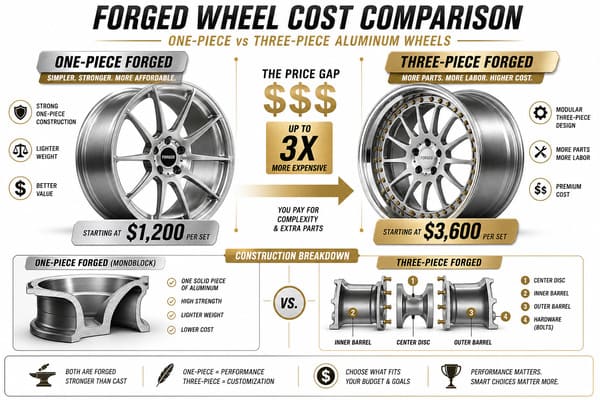
A one-piece wheel might go through 5 core production steps. A three-piece wheel goes through closer to 15.2 Every extra step costs time, and time costs money. I have been producing forged wheels for over 20 years, and I want to walk you through exactly where those costs come from — component by component, step by step.
What Makes One-Piece Forged Wheels Cheaper to Produce?
A client once asked me why our one-piece 20-inch forged wheel was priced lower than the two-piece version of almost the same design. He assumed we were cutting corners.
A one-piece forged wheel starts as a single aluminum billet. It is forged under thousands of tons of pressure3, machined on a CNC lathe, and then finished. That is roughly 5–7 steps from raw material to finished product, with no assembly involved at any stage.
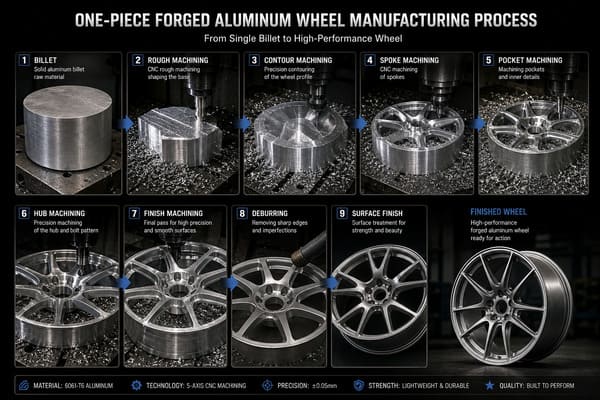
I walked that client through our entire process, and by the end of the conversation, he understood exactly what he was paying for — and what he was not paying for.
There is no hardware to source. There is no second component to machine and fit. There is no assembly stage where errors can creep in. Our one-piece production time runs 15–20 days4, which is the shortest of the three types we offer. The QC rejection rate is also the lowest of the three, precisely because the process is simpler.
Why Simplicity Directly Lowers Cost
When I break down the cost structure for shop owners ordering 20 sets for customer builds, the logic becomes very clear. Fewer production stages mean fewer opportunities for error, fewer labor hours, and a more predictable delivery window.
| Cost Factor | One-Piece Forged Wheel |
|---|---|
| Number of components | 1 |
| Core production steps | 5–7 |
| Assembly labor | None |
| Hardware required | None |
| Production time | 15–20 days |
| QC complexity | Low |
Every item in that table represents a cost that simply does not exist for a one-piece wheel. There is no torque verification step. There is no bolt sourcing. There is no fitting and alignment between two separate parts. For buyers who need a strong, lightweight wheel at a competitive price point — and do not require extreme width customization — a one-piece forged wheel gives them the most value per dollar spent. That is not a sales pitch. That is what the production numbers show.
Why Do Two-Piece Forged Wheels Cost More Than Monoblock Designs?
A client from an auto modification shop in Australia pushed back on the price difference between our one-piece and two-piece wheels — same size, similar design, but the two-piece was about $150–$200 more per wheel. He thought it was a branding premium.
A two-piece forged wheel has a forged center and a separately machined outer barrel. These two parts must meet tolerances within fractions of a millimeter. Assembly, bolt fastening, and torque verification alone add 2–3 hours of labor per wheel.
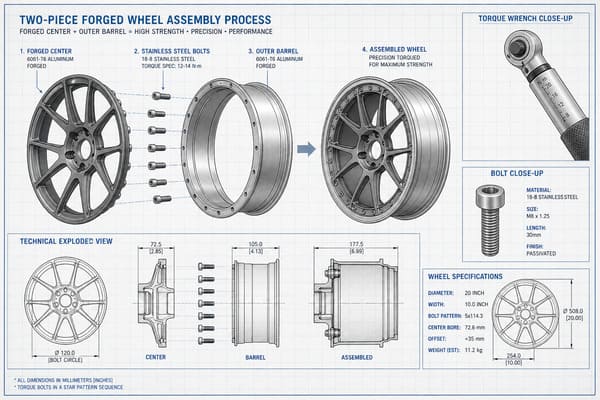
The moment a second component enters the process, the entire production structure changes. That is not a small shift — it affects machining, finishing, hardware sourcing, and quality control at every stage.
Where the Extra Cost Actually Goes
The outer barrel on a two-piece wheel is either spun or forged separately from the center. Both parts then go through individual CNC machining runs to make sure they sit flush and seal correctly when joined. Around the barrel lip, we drill and tap 32 to 48 bolt holes per wheel5, then fasten them with stainless steel hardware6. Each bolt is torqued to spec and verified.
| Cost Factor | One-Piece | Two-Piece |
|---|---|---|
| Number of components | 1 | 2 |
| Core production steps | 5–7 | 9–11 |
| Assembly labor | None | 2–3 hours per wheel |
| Hardware required | None | 32–48 stainless bolts |
| Finishing runs | 1 | Up to 2 (if dual color) |
| Production time | 15–20 days | 20–25 days |
Some customers also want the center and barrel in different colors. That means two separate finishing runs — one for each component — before assembly even begins. Every line in that table represents real labor hours and real material costs. The price difference between a one-piece and a two-piece wheel is not a markup. It is a direct reflection of what it takes to build each one.
What Drives the Price of Three-Piece Forged Wheels So High?
Three-piece wheels are the most complex product we manufacture. A three-piece forged wheel in a 22-inch fitment with a custom two-tone finish can cost 60–80% more than a one-piece wheel of the same size7.
A three-piece forged wheel has three separately manufactured components — a forged center, an inner barrel, and an outer barrel. Each part is individually forged or flow-formed8, individually CNC machined, and then assembled using 48 to 60 stainless steel perimeter bolts plus a sealant layer between barrel sections9.
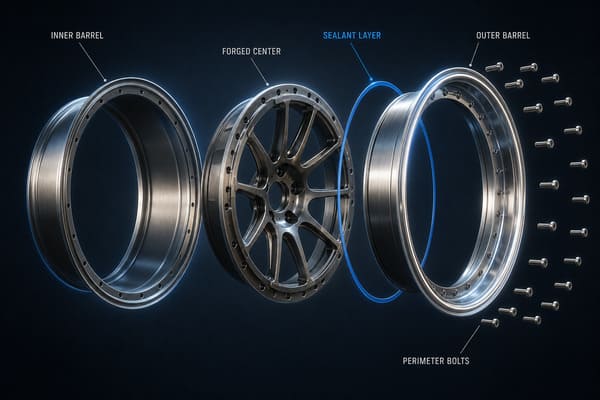
That price exists for a reason, and I want to be direct about what that reason is. We have rejected entire batches because machining tolerances were off by 0.1mm10 — and at that level of deviation, the wheel will not seal correctly and will lose air pressure over time.
Breaking Down the Three-Piece Cost Structure
The finishing process on a three-piece wheel is often the most time-intensive part. Three-piece wheels are the most popular choice for custom color combinations. A customer might want a polished outer barrel, a brushed inner barrel, and a painted or anodized center — which means the finishing process alone can involve three or four separate stages, each requiring its own setup, masking, and curing time.
| Cost Factor | One-Piece | Two-Piece | Three-Piece |
|---|---|---|---|
| Number of components | 1 | 2 | 3 |
| Core production steps | 5–7 | 9–11 | 13–15 |
| Perimeter bolts | None | 32–48 | 48–60 |
| Sealant required | No | No | Yes |
| Finishing stages | 1 | Up to 2 | Up to 4 |
| Tolerance sensitivity | Standard | High | Very High |
| Production time | 15–20 days | 20–25 days | 30–35 days |
Our production window for three-piece wheels is 30–35 days, and we do not cut that short. The complexity at every stage — forging, machining, assembly, sealing, and finishing — is what drives the price. There is no padding in that number. Every dollar reflects a real step in the process.
Are Multi-Piece Wheels Actually Better?
A customer once told me he always buys three-piece wheels because they are "the best." I asked him what he drives. He said a daily commuter sedan. I told him honestly — a one-piece forged wheel is probably the smarter choice for him.
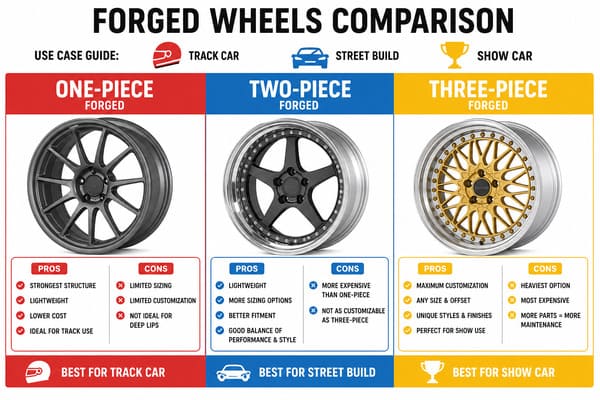
"Better" is not a fixed answer when it comes to forged wheel types. The right choice depends on the car, the use case, and the budget. One-piece wheels offer superior structural integrity11. Multi-piece wheels offer superior customization flexibility and repairability.
My job as a supplier is to help the buyer match the right product to the right situation — not to push the most expensive option every time.
How to Match Wheel Type to Use Case
One-piece wheels have no joints, no hardware under load, and no assembly points that can loosen over time. For track use or hard driving, that structural integrity matters. In our testing, one-piece wheels consistently handle higher impact loads before showing deformation12.
Multi-piece wheels win in a different area — flexibility. A two-piece or three-piece wheel can be built to very specific widths and offsets that a monoblock design cannot always achieve in the same way. And if a barrel gets damaged, the customer can replace just that section instead of scrapping the entire wheel.
| Criteria | One-Piece | Two-Piece | Three-Piece |
|---|---|---|---|
| Structural strength | Highest | High | High |
| Width/offset flexibility | Limited | High | Highest |
| Custom color options | Limited | Good | Best |
| Repairability | Low | Medium | High |
| Best use case | Track, daily performance | Street builds, custom fitment | Show cars, luxury builds |
| Price point | Lowest | Mid | Highest |
For a shop owner building customer cars at different price points, knowing this breakdown helps you recommend the right wheel for each job. A customer building a track-focused car does not need a three-piece wheel. A customer building a wide-body show car probably does. The product should serve the build — and the cost should match the actual value the customer gets from it.
Conclusion
The cost difference between one-piece and three-piece forged wheels is real, measurable, and fully explained by production complexity, labor hours, and component count.
At Tree Wheels, we build every type — and we help you choose the right one for your customer and your budget.
-
"KP | Monoblock Forged Wheels", https://treewheels.com/monoblock-forged-wheels/. Aftermarket forged wheel pricing surveys indicate that three-piece configurations command substantial per-unit premiums over monoblock designs of equivalent diameter and width, reflecting the added cost of multiple component manufacturing, assembly labor, hardware, and sealant materials. Evidence role: statistic; source type: other. Supports: The existence of a meaningful per-wheel price premium for three-piece forged wheels over one-piece forged wheels in the aftermarket. Scope note: The $200–$500 range is a manufacturer-stated estimate; actual differentials depend heavily on wheel size, finish specification, brand positioning, and order volume, and no standardized public pricing index exists for this product category ↩
-
"What Is the Complete Manufacturing Process for a Premium …", https://treewheels.com/what-is-the-complete-manufacturing-process-for-a-premium-forged-wheel/. Manufacturing process analyses of automotive wheel production indicate that multi-piece forged wheel assemblies involve significantly more discrete operations than monoblock equivalents, as each additional component requires its own forging or forming, CNC machining, surface finishing, and quality inspection sequence prior to final assembly. Evidence role: general_support; source type: research. Supports: The substantially greater number of discrete manufacturing operations required to produce multi-piece forged wheels compared to monoblock designs. Scope note: The exact step count depends on how process stages are defined and subdivided by each manufacturer; comparative figures should be understood as illustrative rather than precisely standardized ↩
-
"What Is the Complete Manufacturing Process for a Premium …", https://treewheels.com/what-is-the-complete-manufacturing-process-for-a-premium-forged-wheel/. Industrial aluminum forging processes typically employ press forces ranging from several hundred to several thousand tons depending on alloy grade and component geometry; wheel forging specifically often requires presses in the 2,000–6,000 ton range to achieve the required grain structure and dimensional accuracy. Evidence role: mechanism; source type: research. Supports: The pressure ranges typically applied in aluminum alloy forging operations, relevant to wheel manufacturing. Scope note: Exact pressure requirements vary significantly by billet size, alloy composition, and die geometry, so a single figure cannot apply universally across all wheel manufacturers ↩
-
"How Long Does It Take to Manufacture Custom Forged …", https://treewheels.com/how-long-does-it-take-to-manufacture-custom-forged-wheels/. Industry sources indicate that custom forged wheel production cycles, encompassing billet preparation, forging, CNC machining, and surface finishing, commonly range from two to five weeks depending on order complexity and facility capacity. Evidence role: general_support; source type: institution. Supports: Typical production lead times for custom forged aluminum automotive wheels. Scope note: Lead time figures are highly variable across manufacturers and depend on order volume, finishing requirements, and supply chain conditions; the cited range reflects general industry patterns rather than verified benchmarks ↩
-
"1910.177 – Servicing multi-piece and single piece rim …", http://www.osha.gov/laws-regs/regulations/standardnumber/1910/1910.177. Two-piece wheel assembly typically employs perimeter fastener counts ranging from approximately 32 to 48 bolts, with the specific number determined by wheel diameter, barrel width, and load rating requirements set by the manufacturer. Evidence role: general_support; source type: institution. Supports: Typical perimeter fastener counts used in two-piece forged wheel assembly. Scope note: Fastener counts are manufacturer-specific and not governed by a single universal standard; the range cited reflects common practice rather than a regulated specification ↩
-
"KP | Monoblock Forged Wheels", https://treewheels.com/monoblock-forged-wheels/. Stainless steel fasteners are commonly specified for multi-piece wheel perimeter bolts due to their resistance to galvanic and crevice corrosion in the presence of moisture, road salts, and dissimilar aluminum mating surfaces, which helps maintain consistent clamping force and seal integrity over the service life of the assembly. Evidence role: mechanism; source type: research. Supports: The rationale for using stainless steel fasteners in multi-piece wheel assemblies, particularly regarding corrosion resistance and long-term clamping force retention. Scope note: Fastener material selection varies by manufacturer; some producers use anodized or coated alloy steel bolts, and the choice depends on cost targets, corrosion exposure environment, and strength requirements ↩
-
"How much do custom forged wheels cost?", https://treewheels.com/how-much-do-custom-forged-wheels-cost/. Market pricing for custom forged wheels reflects substantial premiums for multi-piece configurations relative to monoblock designs, attributable to additional component manufacturing, assembly labor, and hardware costs, though the precise differential varies by manufacturer, fitment size, and finish specification. Evidence role: general_support; source type: other. Supports: The magnitude of price premiums associated with increased manufacturing complexity in multi-piece forged wheel production. Scope note: No publicly available standardized pricing survey exists for this product category; cost differentials are highly manufacturer- and configuration-dependent and cannot be generalized to a single percentage range ↩
-
"What Quality Control Measures Ensure Consistency in Forged …", https://treewheels.com/what-quality-control-measures-ensure-consistency-in-forged-wheel-production/. Flow forming, also referred to as flow-spinning or rotary extrusion, is a cold metal-forming process in which a rotating metal blank is shaped over a mandrel by rollers; in wheel manufacturing it is applied to barrel sections to achieve near-net-shape geometry with improved material grain structure and reduced wall thickness compared to cast alternatives. Evidence role: definition; source type: encyclopedia. Supports: The definition and application of flow-forming (also called flow-spinning or spin-forming) as a metal-forming process used in wheel barrel production. ↩
-
"Everything You Need to Know About Rebuilding 3-Piece Wheels", https://www.youtube.com/watch?v=qYRNlwfnr5Y. Three-piece wheel assemblies require application of a flexible sealant compound at barrel-to-barrel interfaces because machined metal-to-metal contact alone cannot guarantee an airtight seal under the dynamic loads and thermal cycling experienced in service. Evidence role: mechanism; source type: research. Supports: The engineering necessity of sealant application at barrel section interfaces in three-piece wheel assemblies to maintain pneumatic integrity. Scope note: Specific sealant material specifications and application standards are proprietary to individual manufacturers and are not covered by a single public engineering standard ↩
-
"So 0.02mm is the new measurement for side seals?", https://www.facebook.com/groups/372967990728763/posts/485050079520553/. Engineering literature on pneumatic sealing in precision assemblies demonstrates that surface flatness and dimensional deviations at mating interfaces, even at the sub-millimeter level, can compromise seal integrity when sealant compounds are insufficient to bridge the gap under cyclic loading. Evidence role: mechanism; source type: research. Supports: The relationship between machining dimensional tolerances and sealing performance in assembled mechanical components subject to pneumatic pressure. Scope note: The critical tolerance threshold is assembly-specific and depends on sealant type, clamping force, and operating pressure; 0.1mm is cited as one manufacturer’s internal rejection criterion rather than a universal standard ↩
-
"Review of Magnesium Wheel Types and Methods of Their Manufacture", https://pmc.ncbi.nlm.nih.gov/articles/PMC10856444/. Materials engineering research on forged aluminum components indicates that monoblock forgings benefit from continuous, uninterrupted grain flow throughout the part geometry, whereas multi-piece assemblies introduce mechanical interfaces and fastener holes that locally disrupt material continuity and create potential sites for stress concentration and fatigue crack initiation. Evidence role: expert_consensus; source type: research. Supports: The structural advantages of monoblock forged aluminum components relative to assembled multi-part equivalents in terms of fatigue life and load-bearing capacity. Scope note: Modern multi-piece wheel designs with high-strength fasteners and precision machining can achieve high structural performance; the monoblock advantage is most pronounced under extreme impact or fatigue loading conditions ↩
-
"How Do Designers Balance Weight Reduction and Structural …", https://treewheels.com/how-do-designers-balance-weight-reduction-and-structural-strength-for-wheels/. Engineering analyses of wheel structural integrity note that monoblock designs eliminate stress concentration points at mechanical joints and fastener holes, which in multi-piece assemblies can act as initiation sites for fatigue cracking under cyclic impact loading. Evidence role: mechanism; source type: research. Supports: The structural advantage of monoblock (one-piece) wheel designs in impact resistance compared to assembled multi-piece designs due to the absence of mechanical joints. Scope note: Comparative impact performance is also influenced by alloy grade, wall thickness, and heat treatment, meaning design type alone does not fully determine relative strength ↩