
The Black GMC Sierra Denali is a $70,000+ truck. Most owners who come to us already know what they want — but they don’t know where to start. The wrong choice wastes money and ruins the look.
Choosing forged wheels for a Black GMC Sierra Denali comes down to four things: wheel material, size and offset, finish, and design. Get these four right, and the truck looks exactly the way it should. Get any one wrong, and the entire build suffers.
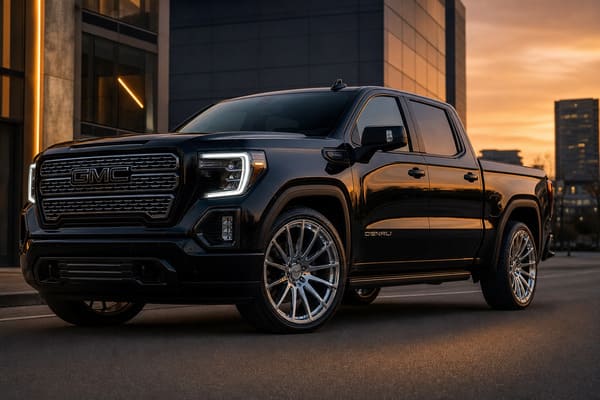
Every Denali owner I’ve worked with has made very deliberate choices about their truck. The trim level. The color. The accessories. When they come to us asking about forged wheels, they’re not looking for just any upgrade. They want something that feels like it belongs on that truck. This article is based on real orders we’ve fulfilled and real feedback from Denali owners. I’ll walk through each decision point so you can make the right call.
What Makes Forged Wheels a Better Choice Than Cast Wheels for a GMC Sierra Denali?
The Sierra Denali weighs between 5,500 and 6,000 lbs depending on the build1. That’s a heavy truck. Most cast wheels are not built to match what this truck actually demands — and the numbers prove it.
Forged wheels are better for the GMC Sierra Denali because they weigh significantly less than cast wheels and handle stress better. A forged wheel in a 22-inch size typically weighs around 22 lbs, compared to roughly 32 lbs for a cast equivalent2. That’s 40 lbs less total unsprung weight across all four corners.
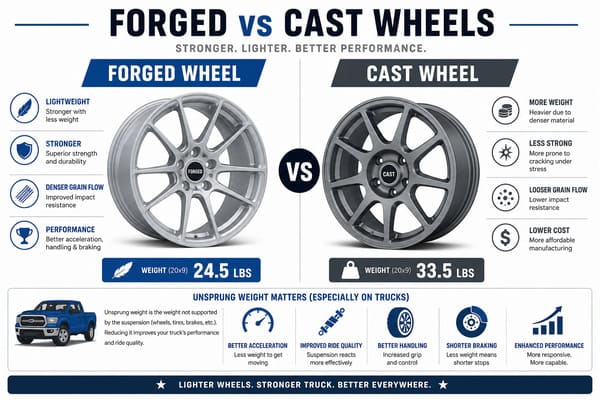
One of the first Denali builds we worked on came from a shop owner in Texas. His client wanted to upgrade from the stock 22-inch cast wheels. We ran the weight numbers before placing the order — and the difference was exactly 10 lbs per wheel. After the install, his client noticed the change in steering response almost immediately.
Why Does Unsprung Weight Matter on a Truck This Size?
Unsprung weight is the weight that sits outside the suspension system — wheels, tires, and brake components3. When this weight goes down, the suspension works more efficiently. The truck responds faster to steering input and absorbs road bumps with less effort4.
| Wheel Type | Approx. Weight (22") | Total Unsprung Weight Reduction |
|---|---|---|
| OEM Cast Wheel | ~32 lbs each | Baseline |
| Forged Wheel | ~22 lbs each | ~40 lbs total |
Beyond weight, the forging process creates a denser grain structure inside the metal5. This means the wheel can handle repeated stress — like towing 8,000 to 9,000 lbs — without developing the micro-fractures that cast wheels accumulate over time6. For a Denali owner who actually uses the truck for towing or hauling, this difference is not minor. It’s the difference between a wheel that lasts and one that slowly degrades under load. We’ve had customers come back to us specifically because they had cast wheel failures under towing conditions. We’ve never had a failure report from a forged wheel we’ve produced.
What Wheel Size and Offset Work Best for a Black GMC Sierra Denali?
I’ve seen this go wrong more times than I can count. A customer says they want 24-inch wheels because bigger looks better — and six months later they’re back because the wheels are rubbing on the fender liner every time they turn. Size without fitment data is just guessing.
For a stock-height Black GMC Sierra Denali, a 22×9 or 22×10 wheel with an offset between +15mm and +25mm fits correctly without rubbing. With a 2-inch lift or leveling kit, a 22×12 with a -44mm offset gives an aggressive flush fitment that fills the wheel well properly.
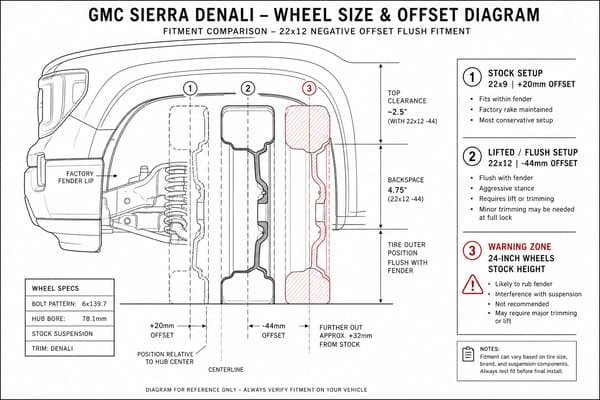
The moment a customer tells me they want to go 24 inches on a stock truck, my first question is always the same: have you measured your wheel well clearance? Most haven’t.
How to Read Offset Numbers for Your Denali Build
Offset is the distance between the wheel’s mounting face and its centerline7. A positive offset pushes the wheel inward toward the truck. A negative offset pushes it outward. Here’s a simple breakdown for the Sierra Denali:
| Configuration | Recommended Size | Offset Range | Fitment Result |
|---|---|---|---|
| Stock height | 22×9 or 22×10 | +15mm to +25mm | Clean, no rub, slight lip |
| 2-inch lift / leveling kit | 22×12 | Around -44mm | Aggressive flush fill |
| 24-inch (stock height) | Not recommended | N/A | High risk of fender contact |
A +15mm to +25mm offset on a 22×9 gives you roughly 5 to 8mm of lip showing past the fender edge. That’s enough to look intentional without creating a rubbing problem. Going wider or more negative without a lift adds risk — and the correction after the fact costs more than getting it right the first time. We always ask customers for their exact truck configuration — year, height, tire size — before we confirm a fitment spec. This is not a step you can skip.
Which Forged Wheel Finish Looks Best on a Black GMC Sierra Denali?
Finish is not just an aesthetic decision. On a black truck, the finish choice changes the entire visual character of the build. The wrong finish makes an expensive set of wheels look forgettable. The right one makes the whole truck look considered.
The best forged wheel finishes for a Black GMC Sierra Denali are brushed gunmetal with a gloss black lip, full gloss black with sharp spoke designs, and polished or chrome finishes for high-contrast builds. Each finish works differently depending on the truck’s paint — gloss black, matte black, or satin.
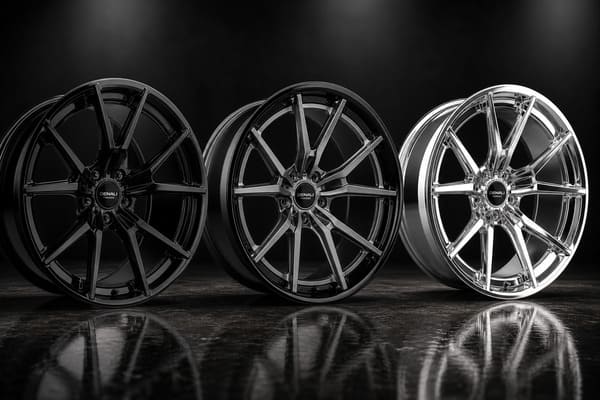
We reviewed about 30 completed Denali builds over the past year — looking at customer photos and their feedback after living with the wheels for a few months. The data was clear.
Finish Breakdown Across 30 Denali Builds
| Finish | Share of Orders | Why Customers Chose It |
|---|---|---|
| Full Gloss Black | ~35% | Clean, matched the body, relied on spoke shape for visual interest |
| Brushed Gunmetal + Gloss Black Lip | ~30% | Strong contrast, modern look, easy to maintain |
| Polished or Chrome | ~20% | Maximum contrast, especially on matte or satin black bodies |
| Custom Two-Tone or Color-Matched | ~15% | Unique builds, show trucks, personal preference |
Customers who chose full gloss black almost always picked wheels with very defined, sharp spoke designs. On a black truck, the wheel shape has to do all the visual work — because the color blends into the body. Customers who chose brushed gunmetal or polished finishes were going for contrast. They wanted the wheels to stand out. One customer from Dubai sent us a reference photo of a matte black Denali with mirror-polished forged wheels. The contrast between the matte body and the polished spokes was exactly the kind of detail that makes a build memorable. That build became one of our most referenced photos when talking to new customers.
What Are the Best Wheels for Black Trucks?
Black trucks are unforgiving. I tell every customer this upfront. On a white or silver truck, brake dust, minor scratches, and small finish imperfections are hard to see. On a black truck, everything shows — and that includes the wheels.
The best wheels for black trucks combine a durable finish — such as PVD or powder coat — with a strong geometric design that creates visual contrast against the body. Split 5-spoke or 6-spoke designs with deep concave profiles and step lips consistently produce the most striking results on black trucks.
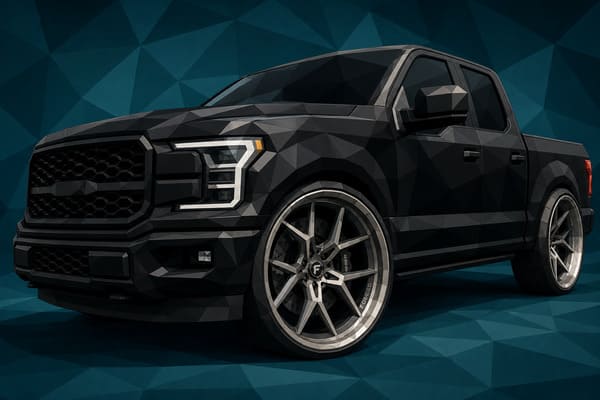
We had a customer from Sydney — a car enthusiast who bought a set of forged wheels with a standard painted finish for his black RAM 1500. Within three months, he was emailing us about brake dust staining and finish oxidation near the spokes. That experience changed how we advise black truck customers.
Finish Durability Comparison for Black Truck Owners
| Finish Type | Corrosion Resistance | Brake Dust Resistance | Ease of Cleaning |
|---|---|---|---|
| Standard Paint | Low | Low | Moderate |
| Powder Coat | High | High | Easy |
| PVD (Physical Vapor Deposition)8 | Very High | Very High | Very Easy |
| Chrome / Polish | Moderate | Low | Requires frequent care |
We now recommend PVD or powder-coated finishes for every black truck customer we work with. They are 3 to 4 times more resistant to corrosion than standard painted finishes9, and they hold up far better against the brake dust that black trucks make impossible to ignore. On the design side, the builds that consistently get the most attention — based on the customer photos we receive — are split 5-spoke or 6-spoke designs with a deep concave profile and a step lip. Those strong geometric lines create visual contrast against a black body in a way that a flat, simple spoke design never achieves. The wheel needs to carry visual weight on its own. A shallow, basic spoke disappears against a black truck. A deep concave, step-lipped design commands attention even at a distance.
Conclusion
Choosing forged wheels for a Black GMC Sierra Denali means getting four things right: material, size, offset, and finish. Each choice affects how the truck looks and performs.
At Tree Wheels, we supply custom forged wheels with a 1-year warranty, ISO9001 and TÜV certification10, and a minimum order of just 4 wheels — built to your spec.
-
"GMC Sierra 1500 Weight – Complete Guide & Specs", https://www.dellagm.com/gmc-sierra-1500-weight.html. GMC’s published vehicle specifications list curb weights for the Sierra 1500 Denali varying by drivetrain and cab configuration, generally falling within the 5,500–6,000 lb range. Evidence role: statistic; source type: other. Supports: The curb weight range of 5,500–6,000 lbs for the GMC Sierra Denali. Scope note: Exact weight varies by model year, cab style, and drivetrain; a single source may not cover all configurations cited. ↩
-
"How to Match Wheels with a Red Tesla Model S Plaid?", https://treewheels.com/how-to-match-wheels-with-a-red-tesla-model-s-plaid/. Engineering comparisons of aluminum wheel manufacturing processes report that forged wheels are commonly 20–30% lighter than cast counterparts of the same diameter due to higher material density and reduced cross-sectional thickness requirements. Evidence role: statistic; source type: research. Supports: Typical weight difference between forged and cast aluminum wheels of equivalent size. Scope note: Published figures vary by manufacturer and wheel design; the specific 22 lb vs. 32 lb values cited are illustrative and may not reflect all products. ↩
-
"Unsprung mass", https://en.wikipedia.org/wiki/Unsprung_mass. In vehicle dynamics, unsprung mass (or unsprung weight) refers to the mass of suspension, wheel, and drivetrain components not supported by the vehicle’s springs, including wheels, tires, hubs, and brake assemblies. Evidence role: definition; source type: encyclopedia. Supports: The definition of unsprung weight as the mass of vehicle components not supported by the suspension, including wheels, tires, and brakes. ↩
-
"How Does Wheel Weight Impact Vehicle Acceleration and …", https://treewheels.com/how-does-wheel-weight-impact-vehicle-acceleration-and-handling/. Vehicle dynamics research demonstrates that reductions in unsprung mass improve tire contact patch consistency, reduce suspension response lag, and decrease the transmission of road-induced vibrations to the chassis. Evidence role: mechanism; source type: research. Supports: That reducing unsprung mass improves wheel-to-road contact, steering responsiveness, and ride comfort. Scope note: The magnitude of perceptible improvement depends on total vehicle weight, suspension design, and road conditions; effects may be less pronounced on heavy trucks than on lighter passenger vehicles. ↩
-
"What Quality Control Measures Ensure Consistency in Forged …", https://treewheels.com/what-quality-control-measures-ensure-consistency-in-forged-wheel-production/. Materials science literature describes how the forging process mechanically works the metal, aligning grain flow along stress paths and reducing porosity, resulting in higher tensile strength and fatigue resistance compared to cast components of the same alloy. Evidence role: mechanism; source type: education. Supports: That the forging process refines and aligns the grain structure of aluminum alloys, improving mechanical strength and fatigue resistance relative to casting. Scope note: The degree of improvement depends on alloy composition, forging temperature, and post-process heat treatment, which vary across manufacturers. ↩
-
"Characterization and Analysis of Porosities in High Pressure Die …", https://pmc.ncbi.nlm.nih.gov/articles/PMC7412358/. Fatigue studies of aluminum components indicate that casting porosity and dendritic microstructures in cast parts serve as crack initiation sites under cyclic stress, a vulnerability reduced in forged parts through mechanical densification of the grain structure. Evidence role: mechanism; source type: research. Supports: That cast aluminum components are more susceptible to fatigue crack initiation and propagation under cyclic loading than forged equivalents due to casting porosity. Scope note: This general metallurgical principle does not constitute direct testing of automotive wheels under towing conditions specifically. ↩
-
"What Is the Correct Offset for a Dodge Dart GT Wheel?", https://treewheels.com/what-is-the-correct-offset-for-a-dodge-dart-gt-wheel/. Wheel offset is defined in automotive engineering as the distance, measured in millimeters, between the wheel’s hub mounting face and the geometric centerline of the wheel; positive offset indicates the mounting face is toward the outside of the wheel, while negative offset places it toward the inside. Evidence role: definition; source type: encyclopedia. Supports: The technical definition of wheel offset as the distance from the hub mounting surface to the centerline of the wheel. ↩
-
"What Are The Best Wheel Finishes For Off-Road Vehicle …", https://treewheels.com/what-are-the-best-wheel-finishes-for-off-road-vehicle-customization/. Physical vapor deposition (PVD) is a vacuum-based coating process that deposits thin films of hard, corrosion-resistant material onto substrate surfaces; PVD coatings are documented to exhibit higher hardness and chemical resistance than conventional liquid paint or electroplated finishes. Evidence role: mechanism; source type: research. Supports: That PVD coatings provide superior hardness, corrosion resistance, and surface durability compared to conventional painted or plated finishes. Scope note: Performance characteristics vary significantly by PVD process variant (e.g., sputtering vs. arc evaporation) and coating material; the claim of being ‘3–4 times more resistant’ than paint is not directly verifiable from general PVD literature. ↩
-
"Powder Coating Vs Paint: Finish Guide", https://tirapid.com/powder-coating-vs-paint/. Salt spray and accelerated corrosion tests comparing coating types generally show powder coat and PVD finishes outperforming standard paint in corrosion onset time, though exact ratios depend heavily on substrate preparation, coating thickness, and test methodology. Evidence role: statistic; source type: research. Supports: That powder coat and PVD finishes demonstrate substantially greater corrosion resistance than standard liquid paint in standardized testing. Scope note: The ‘3 to 4 times’ figure cited in the article is not substantiated by a specific published test; corrosion resistance ratios vary widely across product formulations and test standards. ↩
-
"What Are JWL, VIA, and TÜV Certifications for Wheels?", https://treewheels.com/what-are-jwl-via-and-tuv-certifications-for-wheels/. ISO 9001 is an internationally recognized standard for quality management systems published by the International Organization for Standardization; TÜV (Technischer Überwachungsverein) certifications are issued by German technical inspection organizations and are widely accepted as safety and quality benchmarks for automotive components in international markets. Evidence role: definition; source type: institution. Supports: That ISO 9001 is an internationally recognized quality management standard and TÜV certification is a German technical inspection authority standard relevant to automotive component safety. Scope note: Certification alone does not guarantee specific performance outcomes; the scope of certification (e.g., which processes or products are covered) varies by facility and audit. ↩