
If you’ve ever searched "forged wheels" and landed on a list of luxury brands, you already know the frustration. The question of which brands use forged wheels sounds simple, but the answer most articles give leaves modification shop buyers and car enthusiasts no closer to an actual decision. The real question is whether forged wheels make sense for your vehicle and use case.
Forged wheels are used by premium OEM brands including Porsche, BMW M-series, Ferrari, Lamborghini, and Audi RS-line as factory fitment — but OEM usage is only part of the story. Any performance or mid-luxury vehicle with compatible bolt pattern, offset, and load rating specifications is a legitimate candidate for aftermarket forged wheels. Brand prestige does not determine fitment eligibility; your use case and wheel specifications do.

Knowing which brands ship forged wheels from the factory is useful context. But it’s a starting point, not a ceiling. The more valuable question is what those OEM choices tell you about when and why forged construction is worth choosing — and how that logic applies to your build.
Which brands come with forged wheels from the factory?
Buyers often ask whether their car "qualifies" for forged wheels based on its badge. The underlying fear is real: nobody wants to spend on a premium upgrade that turns out to be mismatched to their platform. Understanding which OEM brands already specify forged wheels helps anchor that conversation.
Several major manufacturers choose forged aluminum wheels as standard or optional fitment on their performance and flagship models. These choices are made for documented engineering reasons — primarily weight reduction and structural integrity under high-load conditions — not exclusively for brand image.
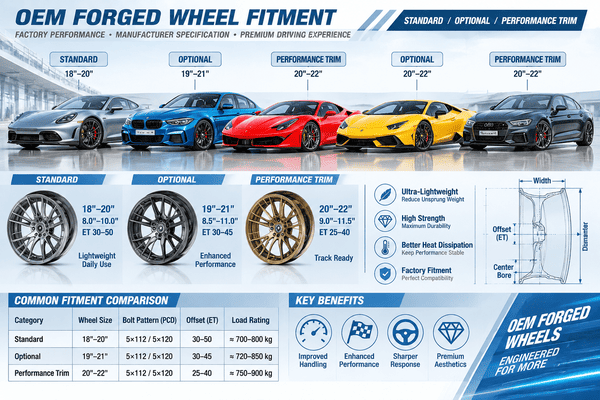
Here is a working reference list of brands and models known to use or offer forged wheels as factory fitment, based on published manufacturer specifications:
Premium European Brands
| Brand | Model Examples | Forged Wheel Usage |
|---|---|---|
| Porsche | 911 Turbo S, GT3, Taycan Turbo | Standard or option on performance trims |
| BMW | M3, M4, M5, M8 Competition | M Performance forged options |
| Mercedes-Benz | AMG GT, AMG C63 | AMG forged-spec fitment |
| Audi | RS6, RS7, R8 | RS and S-line forged variants |
| Ferrari | 296 GTB, SF90, F8 Tributo | Factory forged standard |
| Lamborghini | Huracán, Urus Performante | Forged standard on performance models |
American Performance Brands
| Brand | Model Examples | Forged Wheel Usage |
|---|---|---|
| Chevrolet | Corvette Z06, C8 Stingray | Factory forged on Z51 and Z06 |
| Ford | Shelby GT500 | Factory forged 20-inch wheels |
| Dodge | Challenger SRT Hellcat, Viper | Performance trim forged options |
Asian Performance Brands
| Brand | Model Examples | Forged Wheel Usage |
|---|---|---|
| Toyota | GR86, Supra A91 | Limited edition forged options |
| Honda | Civic Type R (FL5) | Factory forged on select markets |
| Lexus | RC F Track Edition | Carbon-forged or BBS forged option |
| Genesis | GV80, G80 Sport | Optional upgraded forged fitment |
A Few Important Clarifications
- "Factory forged" often means an option, not standard. On many models, forged wheels are a trim-level upgrade or dealer-added package. Buyers verifying this should check the original window sticker or build sheet.
- Manufacturer specifications vary by market. The Civic Type R, for example, ships with forged wheels in some regions and cast in others.1 Always verify against the specific market build.
- This list is not exhaustive. Manufacturers update specifications across model years. Treat this as a research starting point, not a definitive spec sheet.
Does your vehicle brand matter when choosing aftermarket forged wheels?
We regularly hear from Mustang GT owners, WRX STI drivers, and Supra enthusiasts asking whether forged wheels are really "for their car." The concern usually isn’t budget — it’s whether they’re making a category error. The good news is that brand hierarchy has very little to do with aftermarket forged wheel compatibility.
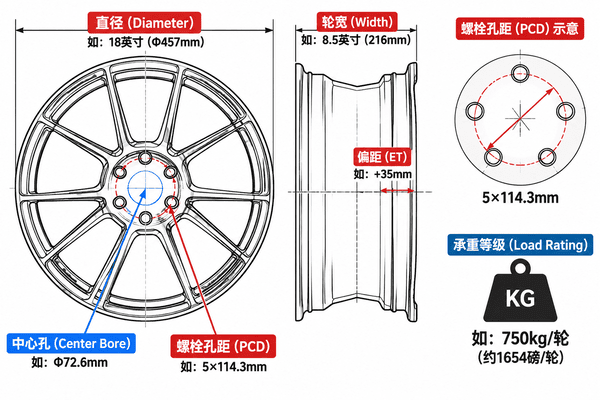
Aftermarket forged wheels are manufactured to specification. Fitment is determined by bolt pattern, center bore, offset, diameter, width, and load rating — not by whether your car is a Porsche or a Subaru.
What Actually Determines Fitment
The five parameters that define whether a forged wheel fits your vehicle:
- Bolt pattern (PCD) — The number of bolts and the diameter of the circle they sit on. A WRX STI uses a 5×114.3 pattern. A Ferrari 488 uses 5×114.3 as well. Same bolt pattern, very different badge.
- Center bore — The diameter of the center hole must match or be adaptable to your hub. A hub-centric fit is always preferable for high-speed stability.2
- Offset (ET) — Measured in millimeters, this determines how far the wheel sits inside or outside the wheel arch. Wrong offset causes clearance issues with brakes, suspension, and bodywork.
- Diameter and width — Must accommodate your brake caliper size and fit inside your wheel arch without rubbing.
- Load rating — The wheel must be rated to handle your vehicle’s weight per corner. This is non-negotiable for safety and should be verified by a qualified professional for your specific application.
The Cast vs. Forged Misconception
One of the most common decision-blockers I encounter is this reasoning: "My stock wheels are cast, so forged must be overkill for my car."
This logic doesn’t hold up. Stock cast wheels are not a signal of what the vehicle can handle — they’re a signal of what the manufacturer chose at a given price point for a mass-production run.3 Aftermarket forged wheels exist precisely because the upgrade is worthwhile across a broad range of platforms.
The relevant question is not what your stock wheels are made of. The relevant question is what you’re asking your wheels to do.
What use cases justify upgrading to forged wheels?
This is where the real decision lives. I’ve worked with customers across modification shops in the US, Australia, and the Middle East, and the inquiry pattern is consistent: buyers who’ve done their research already know forged is stronger and lighter. What they want to know is whether their situation is the right fit.
The answer comes down to three variables: use case, build goals, and budget tolerance.
Use Cases Where Forged Wheels Are a Well-Justified Upgrade
Track and performance driving
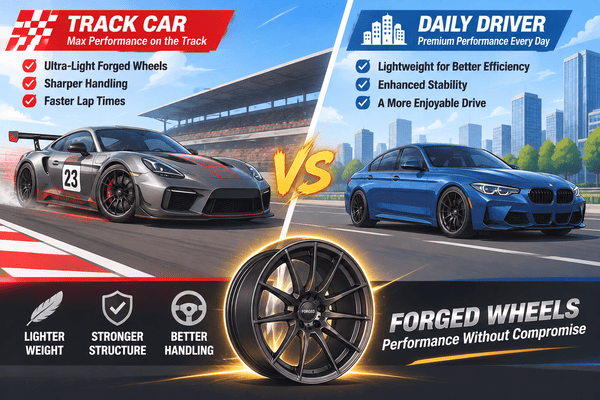
Unsprung weight — the weight of components not supported by the suspension — directly affects handling response, braking distance, and cornering dynamics.4 Forged wheels are consistently lighter than cast equivalents at the same diameter and width. Weight savings of 1–3 kg per wheel are commonly reported across comparable sizes, though exact figures vary by manufacturer design and alloy.5 On a track-day car or autocross build, that reduction is felt in steering response and acceleration.
High-horsepower street builds
Vehicles running significantly more power than stock — whether turbocharged, supercharged, or running larger brake packages — benefit from the structural integrity that forged construction provides. The grain structure of a forged wheel is denser and more continuous than a cast wheel, which matters under the cyclic stress of hard launches, aggressive braking, and cornering loads.6
Appearance-driven custom builds
Forged wheels offer something cast wheels structurally cannot: thinner spokes at equivalent or greater strength.7 This allows for spoke designs that look dramatically more open and aggressive without sacrificing load capacity. For shop customers building show cars, luxury restorations, or client-facing demonstration vehicles, the visual difference is significant and often commercially relevant.
Daily drivers in demanding environments
Not every forged wheel buyer is building a race car. A significant portion of our inquiries come from owners of luxury SUVs and sports sedans who drive on roads with poor surface quality — common in parts of the Middle East and Australia — and want the additional impact resistance that forged construction provides compared to cast.
Use Cases Where the Value Proposition Is More Nuanced
| Scenario | Consideration |
|---|---|
| Stock daily driver, no performance goals | Cast aftermarket may be sufficient; forged is an upgrade but not a necessity |
| Budget-constrained build | Flow-formed cast wheels can close some of the gap at lower cost |
| Infrequent recreational driving | Benefit realized less often; ROI depends on how much the driver values the improvement |
How do mid-range performance vehicles fit into the forged wheel conversation?
Some of the most common inquiries I receive come from owners of vehicles that don’t appear on OEM forged wheel lists — Toyota GR Supra owners, Honda Civic Type R drivers, Subaru WRX STI enthusiasts, and Ford Mustang GT buyers. These are not niche edge cases. They represent a mainstream segment of the modification market.
Forged wheels are not a luxury-exclusive product category. They’re an engineering choice that delivers documented benefits — lighter weight, greater structural integrity, better design flexibility — that are relevant to any performance or enthusiast-oriented platform.

Why the Mid-Range Performance Segment Actively Benefits
These platforms are frequently modified. WRX STI, Supra, Type R, and GT owners are among the highest-rate modification buyers in the market. They’re adding power, upgrading brakes, installing coilovers. A forged wheel upgrade is entirely consistent with the direction these builds are already going.
Fitment compatibility is well-established. These vehicles use common bolt patterns (5×114.3 is particularly prevalent across Japanese performance platforms8) that are widely supported by aftermarket forged wheel manufacturers. Offset and diameter ranges are well-documented in the modification community.
The weight benefit matters more on lighter cars. A 2 kg reduction per corner on a 1,400 kg sports car is proportionally more impactful than the same reduction on a 2,200 kg luxury SUV.9 Mid-range sports platforms arguably benefit more from forged wheel weight savings than heavier luxury vehicles.
Buyers in this segment are informed. They’ve already done research. They know what they want and why. The remaining hesitation is usually about whether a supplier can actually deliver consistent quality, correct fitment, and reliable lead times — not about whether forged is "right for their car."
Frequently Asked Questions
Are forged wheels only for luxury or exotic cars?
No. Forged wheels are used on luxury and exotic cars from the factory, but aftermarket forged wheels are available for a wide range of performance and enthusiast vehicles. Fitment is determined by bolt pattern, offset, center bore, and load rating — not by the vehicle’s price tier or brand prestige.
How do I know if aftermarket forged wheels will fit my car?
You need to confirm five specifications: bolt pattern (PCD), center bore diameter, offset (ET value), wheel diameter, and width. Load rating should also be verified for your specific vehicle weight and use case. A qualified wheel supplier or fitment specialist can cross-reference these against available forged wheel specifications.
Are forged wheels stronger than cast wheels?
Forged wheels are generally regarded as having greater structural integrity than cast wheels of equivalent size, based on the manufacturing process. Forging aligns the grain structure of the aluminum alloy under high pressure, producing a denser and more continuous material.10 Performance claims should be evaluated against specific manufacturer specs, as construction quality varies across products.
What is the typical lead time for custom forged wheels?
Lead times vary by construction type. One-piece forged wheels generally take 15–20 days from confirmed order. Two-piece builds typically require 20–25 days, and three-piece configurations run 30–35 days.11 These figures assume finalized specifications and artwork approval at the time of order.
Do aftermarket forged wheels come with certifications?
Reputable forged wheel manufacturers hold certifications such as ISO 9001, DOT, TÜV, and IATF 16949.12 Buyers should request certification documentation directly from the supplier and verify its current validity. Certifications indicate quality management standards and compliance with relevant market regulations, but buyers should confirm which certifications are required for their specific market and application.
Conclusion
The question of which vehicle brands use forged wheels has a useful but incomplete answer: brands like Porsche, BMW M-series, Ferrari, Lamborghini, Corvette, and Shelby GT500 use forged wheels at the OEM level. But treating that list as a compatibility guide leads buyers in the wrong direction. Forged wheels are an engineering upgrade available to a far broader range of platforms than factory fitment patterns suggest.
The right framework is simpler: identify your use case, confirm your fitment specifications, and evaluate whether the weight, strength, and design advantages of forged construction justify the investment for your build. Whether you’re running a track-prepared WRX STI, a modified Supra, or a daily-driven luxury SUV, those questions matter more than your badge.
If you’re evaluating forged wheels for your vehicle or for your shop’s clients, reach out to the Tree Wheels team. We work directly with modification shops, custom builders, and individual enthusiasts across the US, Canada, Australia, and the Middle East — and we’re happy to help you work through fitment specs and lead times before you commit to an order.
-
"Honda Civic Type R", https://en.wikipedia.org/wiki/Honda_Civic_Type_R. Honda manufacturer specifications and regional press materials for the Civic Type R have documented differences in standard equipment, including wheel specifications, across markets; buyers should verify wheel construction against the build sheet for their specific regional variant. Evidence role: case_reference; source type: other. Supports: That the Honda Civic Type R has been offered with different wheel construction specifications depending on the regional market. Scope note: Regional specification differences may change across model year updates; this claim requires verification against current Honda documentation for the specific model year in question. ↩
-
"What Offset Do Ford Falcon XA Coupe Wheels Need?", https://treewheels.com/what-offset-do-ford-falcon-xa-coupe-wheels-need/. Automotive engineering references explain that hub-centric fitment locates the wheel concentrically on the hub flange, minimizing rotational imbalance and vibration at speed; lug-centric fitment relies on the lug nuts for centering, which can introduce minor eccentricity and associated vibration, particularly at higher velocities. Evidence role: mechanism; source type: research. Supports: That hub-centric wheel fitment, where the wheel center bore matches the hub diameter, reduces vibration and improves stability at high speeds compared to lug-centric fitment. Scope note: In practice, properly torqued lug-centric fitment with hub-centric rings can approximate hub-centric performance; the significance of the difference varies with wheel design and vehicle speed. ↩
-
"What Testing Standards Do Quality Forged Wheels Meet?", https://treewheels.com/what-testing-standards-do-quality-forged-wheels-meet/. Automotive industry analyses of OEM component specification processes document that cost-per-unit, supplier scalability, and production volume are primary drivers of material selection for standard-trim components including wheels, with performance-oriented materials such as forged aluminum typically reserved for higher-margin trim levels. Evidence role: general_support; source type: research. Supports: That OEM wheel material and construction choices in mass-market vehicles are substantially influenced by manufacturing cost and production volume considerations rather than solely by vehicle performance requirements. Scope note: This characterization is broadly supported by industry practice but is difficult to source to a single authoritative reference; specific OEM procurement decisions are not publicly disclosed. ↩
-
"Signature redacted", https://dspace.mit.edu/bitstream/handle/1721.1/116487/14051765-MIT.pdf?sequence=1&isAllowed=y. Vehicle dynamics literature establishes that unsprung mass — components not isolated by the suspension — directly influences wheel contact force variation, steering response, and braking performance; reductions in unsprung mass are associated with improved road-holding and dynamic response. Evidence role: mechanism; source type: research. Supports: That reducing unsprung mass improves vehicle handling response, braking, and cornering dynamics. Scope note: Most foundational treatments appear in automotive engineering textbooks and SAE technical papers rather than freely accessible web sources; specific quantitative thresholds vary by vehicle platform and suspension geometry. ↩
-
"Casting Wheels vs. Forged Wheels: Which Offers Better …", https://treewheels.com/casting-wheels-vs-forged-wheels-which-offers-better-performance-for-your-vehicle/. Comparative analyses of forged and cast aluminum wheel manufacturing report weight differentials attributable to the higher material density achievable through forging, which permits thinner cross-sections at equivalent structural ratings; reported savings vary by design and alloy specification. Evidence role: statistic; source type: research. Supports: That forged aluminum wheels are measurably lighter than cast aluminum wheels of equivalent dimensions. Scope note: Published weight comparisons are often manufacturer-specific and may not generalize across all wheel sizes and designs; independent third-party benchmarking data is limited in the open literature. ↩
-
"Review of the Effects of Micro structure on Fatigue in Aluminum Alloys", https://ntrs.nasa.gov/api/citations/19840014667/downloads/19840014667.pdf. Metallurgical studies of aluminum alloy processing document that hot forging induces grain refinement and directional grain flow, resulting in improved tensile strength, fatigue life, and resistance to crack propagation relative to gravity or low-pressure cast equivalents of the same alloy. Evidence role: mechanism; source type: research. Supports: That the forging process aligns aluminum grain structure, producing denser and more continuous material with superior fatigue and cyclic stress resistance compared to casting. Scope note: Mechanical property improvements are alloy- and process-specific; comparisons between forged and cast wheels must account for differences in alloy grade, heat treatment, and design geometry. ↩
-
"Why Does Grain Structure Matter in Forged Wheel Strength?", https://treewheels.com/why-does-grain-structure-matter-in-forged-wheel-strength/. The higher yield strength and fatigue resistance of forged aluminum alloys relative to cast equivalents permit reduced material cross-sections in structural members such as wheel spokes while meeting equivalent load rating requirements, enabling more open spoke geometries. Evidence role: mechanism; source type: research. Supports: That the superior mechanical properties of forged aluminum allow wheel designers to reduce spoke cross-section while maintaining equivalent or greater structural load capacity compared to cast designs. Scope note: This relationship depends on specific alloy grades, heat treatment, and design validation testing; it is not a universal guarantee across all forged wheel products. ↩
-
"What cars are 5×114.3 bolt pattern? Easy Wheel Guide", https://www.performanceplustire.com/Blog/what-cars-are-5×114-3-bolt-pattern-easy-wheel-guide. Automotive fitment references and manufacturer specification sheets confirm that the 5×114.3 mm pitch circle diameter is a common standard across numerous Japanese performance platforms, including the Toyota GR Supra, Honda Civic Type R, Subaru WRX STI, and Nissan 370Z, facilitating broad aftermarket wheel compatibility. Evidence role: general_support; source type: other. Supports: That the 5×114.3 PCD bolt pattern is widely shared across Japanese performance vehicles including models from Toyota, Honda, Subaru, and Nissan. Scope note: Bolt pattern data should be verified against model-year-specific manufacturer specifications, as some platforms have changed PCD across generations. ↩
-
"Unsprung mass", https://en.wikipedia.org/wiki/Unsprung_mass. Vehicle dynamics engineering literature indicates that the ratio of unsprung to sprung mass is a key parameter in suspension performance; a given reduction in unsprung mass represents a larger proportional change on lighter vehicles, amplifying the dynamic benefit relative to heavier platforms. Evidence role: mechanism; source type: research. Supports: That the ratio of unsprung mass to total vehicle mass influences the magnitude of handling and dynamics benefits from unsprung weight reduction. Scope note: The practical significance of this proportionality depends on suspension design, tire characteristics, and driving conditions; the claim is directionally supported but not quantified in the article. ↩
-
"What Are JWL, VIA, and TÜV Certifications for Wheels?", https://treewheels.com/what-are-jwl-via-and-tuv-certifications-for-wheels/. ASM International and standard materials engineering references describe forging as a deformation process that refines and aligns the crystalline grain structure of aluminum alloys, producing mechanical property improvements — including higher yield strength and fatigue resistance — compared to cast counterparts. Evidence role: definition; source type: encyclopedia. Supports: That forging mechanically works aluminum under pressure to align grain structure, distinguishing it from casting in terms of material continuity and mechanical properties. Scope note: General metallurgical descriptions may not capture the specific alloy grades and forging parameters used by individual wheel manufacturers. ↩
-
"How Long Does It Take to Manufacture Custom Forged …", https://treewheels.com/how-long-does-it-take-to-manufacture-custom-forged-wheels/. Forged wheel manufacturers and industry trade sources indicate that production lead times increase with construction complexity; one-piece forged wheels involve fewer assembly steps than two- or three-piece designs, which require additional machining, barrel fabrication, and assembly operations that extend total production time. Evidence role: general_support; source type: other. Supports: That forged wheel manufacturing lead times vary by construction complexity, with multi-piece configurations requiring longer production periods than one-piece designs. Scope note: The specific day ranges cited in the article reflect one supplier’s stated production schedule and should not be treated as universal industry benchmarks; lead times vary significantly by manufacturer capacity, order volume, and specification complexity. ↩
-
"Universal Electronic Records Management (ERM) …", https://www.archives.gov/records-mgmt/policy/universalermrequirements. ISO 9001 specifies requirements for quality management systems applicable across industries; IATF 16949 extends these requirements specifically to automotive production and service part organizations; DOT compliance denotes conformance with U.S. Federal Motor Vehicle Safety Standards; TÜV certification indicates independent technical safety assessment by German inspection bodies. Evidence role: definition; source type: institution. Supports: That ISO 9001, IATF 16949, DOT, and TÜV represent recognized quality management and safety compliance standards applicable to automotive wheel manufacturing. Scope note: Holding a certification indicates conformance with a quality management process, not a direct guarantee of product performance; buyers should confirm which certifications are legally required in their specific market. ↩