

The wrong offset ruins a build. It costs money, time, and sometimes the entire set of wheels. Here is what you need to know before you order.
The Ford Falcon XA Coupe1 runs a factory offset of ET+19 with a 5×114.3 bolt pattern and a 70.1mm hub bore. For aftermarket forged wheels, the recommended offset range is ET0 to ET+15, depending on wheel width and your build goals.

Getting the offset right on a Falcon XA is not complicated, but it requires you to understand a few numbers before you place any order. Each number plays a different role. Get one wrong, and the whole build suffers. I will walk you through each one.
What Is Ford Factory Wheel Offset?
Most people assume the factory offset is the safest number to use. That assumption costs them more than they expect.
The Ford Falcon XA Coupe has a factory wheel offset of ET+192. Ford Australia set this number in 1972 to match 185-width tires and drum brakes3. The suspension geometry was also calibrated around this offset4.
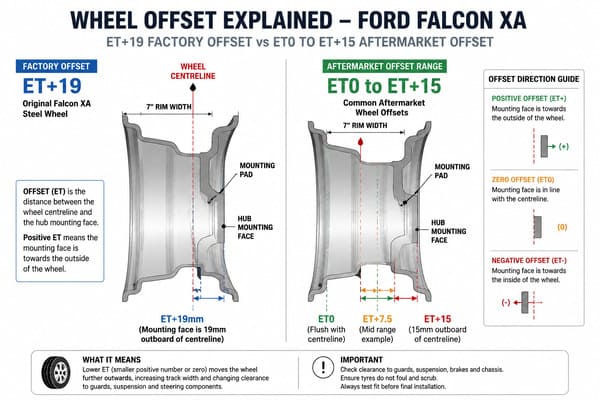
I had a customer come to me with this exact number. He said he wanted ET+19 because it was the factory spec and he thought it was the safest choice. I built him a set of forged monoblock wheels5, 8.5 inches wide, at exactly ET+19. He sent me photos after fitting them. The wheels sat deep inside the arches. He told me, "I spent all this money and it looks like nothing changed." That was the problem. ET+19 was designed to solve a 1972 engineering requirement. It was not designed to make the car look good in 2025.
What ET+19 Actually Means for a Modern Build
| Spec | Factory (1972) | Modern Aftermarket |
|---|---|---|
| Offset | ET+19 | ET0 to ET+15 |
| Tire Width | 185mm | 225mm to 275mm |
| Brake Type | Drum | Disc (upgraded) |
| Visual Result | Tucked deep in arch | Flush to near-flush |
The factory offset solves one problem: it keeps the wheel from touching anything. It does not solve fitment aesthetics or performance geometry. For anyone building a Falcon XA today, ET+19 is your reference point. It is not your destination.
What Wheels Fit on a Falcon?
The bolt pattern is the number everyone knows. The hub bore is the number that causes the real problems.
The Ford Falcon XA Coupe uses a 5×114.3 bolt pattern and a 70.1mm hub bore6. Both numbers must be correct. The bolt pattern determines whether the wheel mounts. The hub bore determines whether it runs true.
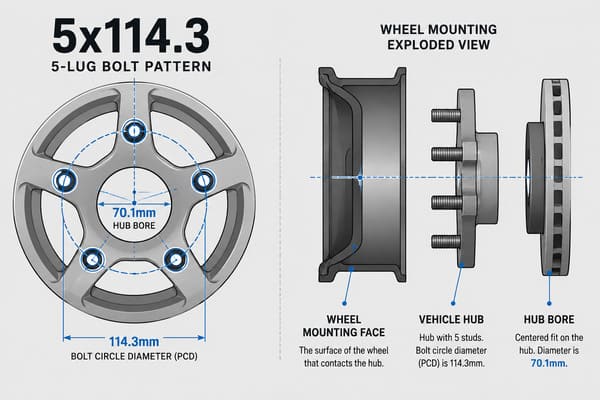
I have asked around fifteen Falcon XA customers to confirm their hub bore before ordering. Fewer than three could give me the correct number without looking it up. One customer, a modification shop owner in Australia, ordered a set of wheels with the correct bolt pattern. But when he measured his hub bore, he was 0.3mm off. The wheels went on, but above 80km/h the car vibrated. He thought it was a wheel quality issue. We checked everything together and found the hub bore was the cause. We had to produce a set of hub centric rings7 to fix it. That extra step cost him time and money that a correct measurement would have avoided.
Key Fitment Specs at a Glance
| Spec | Value | Why It Matters |
|---|---|---|
| Bolt Pattern | 5×114.3 | Must match to mount the wheel |
| Hub Bore | 70.1mm | Must match to eliminate vibration |
| Center Bore Fit | Hub Centric | Prevents high-speed wobble |
| Common Mistake | Ignoring hub bore | Leads to vibration above 80km/h |
After that case, I now confirm the hub bore with every Falcon XA customer before production starts. A bolt pattern match gets the wheel on the car. A hub bore match keeps the car safe on the road8. Both numbers matter equally.
What Offset Range Works Best for Aftermarket Wheels on the Ford Falcon XA Coupe?
The right offset depends on more than clearance. It depends on what you want the car to do and who you want to see it.
For aftermarket wheels on the Ford Falcon XA Coupe, an offset range of ET0 to ET+15 works best. This range moves the wheel face outward compared to the factory ET+19, giving a more aggressive stance while staying within safe clearance limits for most builds.
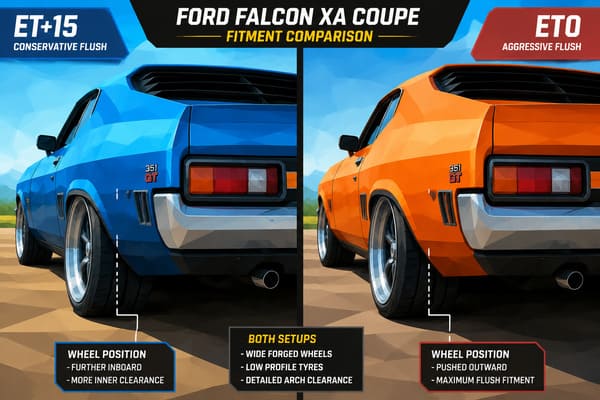
I once received two orders that were almost identical. Both were for Falcon XA coupes. Both requested 9-inch wide forged wheels. One customer chose ET+12. The other chose ET+2. The ET+12 customer drove his car daily. He wanted confidence, not drama. The ET+2 customer was building a show car. He wanted the wheel face sitting as close to the arch lip as possible. When both cars stood side by side at an event, the visual difference was significant. The ET+2 car looked full, wide, and planted. The ET+12 car looked clean and controlled.
How Offset Affects Visual Stance
| Offset | Wheel Position | Best For |
|---|---|---|
| ET+15 | Slightly inward from flush | Daily driving, conservative look |
| ET+10 | Near flush | Street builds, balanced look |
| ET+5 | At or slightly past flush | Aggressive street or show builds |
| ET0 | Maximum outward in this range | Show cars, wide-body builds |
Every 5mm reduction in offset moves the outer wheel face 5mm closer to the fender lip9. That movement is more visible than most people expect. Before you choose a number inside this range, decide what the car is for. A daily driver and a show car can share the same bolt pattern and hub bore, but they should not share the same offset.
Can You Run a Wider Wheel on a Ford Falcon XA Coupe Without Rubbing?
Yes, you can. But the measurement that matters most is the one on the inside, not the outside.
You can run wider wheels on a Ford Falcon XA Coupe without rubbing if you measure the inner clearance before ordering. The inner clearance on the Falcon XA front suspension is typically 50mm to 60mm10. This number limits how wide you can go and at what offset.
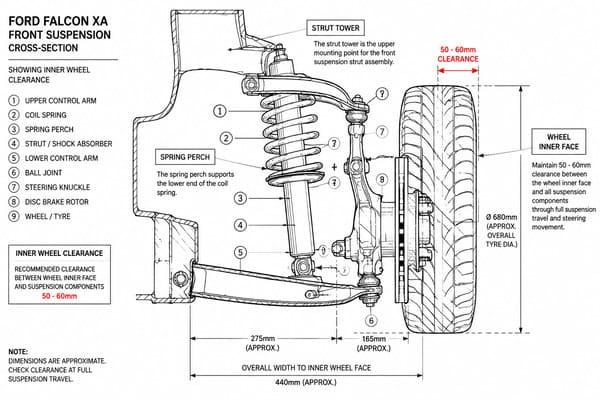
A customer ordered a set of front wheels from me: 10 inches wide, ET+5. The wheels were forged, finished, and delivered. He fitted them himself. The inner face contacted the spring perch by about 8mm. He asked if I could remake the set with a different offset. Remaking a forged wheel set means new machining, new production time, and additional cost. In his case, the extra cost was around 60% of the original order. If he had told me his inner clearance was 52mm before placing the order, I would have recommended ET+12 instead of ET+5, or reduced the width from 10 inches to 9.5 inches. Either change would have solved the problem before it existed.
Inner vs. Outer Clearance: What You Can and Cannot Control
| Clearance Point | Typical Space | Adjustable? | Solution if Too Tight |
|---|---|---|---|
| Inner (spring perch / strut) | 50–60mm | No | Increase offset or reduce width |
| Outer (fender lip) | Variable | Yes | Fender rolling, flares, wide-body kit |
| Rear inner | 55–65mm | No | Increase offset or reduce width |
| Rear outer | Variable | Yes | Fender flares or arch modification |
The outer arch is flexible. You can roll it, pull it, or add a wide-body kit11. The inner suspension space is fixed. There is no modification that adds meaningful room between the wheel and the spring perch12. Measure the inner clearance first. Then choose your width. Then set your offset. That is the correct order, and reversing it is the most common and most expensive mistake I see in Falcon XA builds.
Conclusion
Offset, bolt pattern, hub bore, and inner clearance all work together. Get each number right before you order, not after.
Tree Wheels builds fully custom forged wheels for the Ford Falcon XA — built to your specs, delivered to your door.
-
"Ford Falcon (Australia) – Wikipedia", https://en.wikipedia.org/wiki/Ford_Falcon_(Australia). The Ford Falcon XA was a series of automobiles produced by Ford Australia, introduced in 1972 as a successor to the XW and XY series; the range included a hardtop coupe body style that has become a significant vehicle in Australian automotive culture. Evidence role: historical_context; source type: encyclopedia. Supports: The Ford Falcon XA Coupe as a specific model produced by Ford Australia. ↩
-
"Ford Falcon – Specs of rims, tires, PCD, offset for each year and …", https://www.wheel-size.com/size/ford/falcon/. Factory wheel offset specifications for the Ford Falcon XA Coupe are documented in automotive fitment references as ET+19, reflecting the suspension geometry and tire clearance requirements established during the vehicle’s original production. Evidence role: definition; source type: other. Supports: The original equipment manufacturer wheel offset for the Ford Falcon XA Coupe. Scope note: This figure is widely cited in aftermarket fitment resources but may not be traceable to a single primary Ford Australia engineering document; cross-referencing multiple fitment databases is recommended. ↩
-
"Ford Falcon (XA) – Wikipedia", https://en.wikipedia.org/wiki/Ford_Falcon_(XA). The Ford Falcon XA was produced by Ford Australia beginning in 1972; factory specifications included drum brakes and narrow-profile tires consistent with engineering standards of that era. Evidence role: historical_context; source type: encyclopedia. Supports: The Ford Falcon XA Coupe’s original production year, factory tire width, and brake configuration. Scope note: General automotive encyclopedias may not document wheel offset specifications directly; this source would support the historical production context rather than the specific ET+19 offset figure. ↩
-
"Scrub radius – Wikipedia", https://en.wikipedia.org/wiki/Scrub_radius. Wheel offset is a determinant of scrub radius and kingpin inclination effects in vehicle suspension design; manufacturers specify offset values to achieve intended steering feel, tire wear characteristics, and dynamic stability, meaning deviations from factory offset alter these calibrated parameters. Evidence role: mechanism; source type: paper. Supports: The relationship between wheel offset and suspension geometry parameters such as scrub radius and steering characteristics. Scope note: This source supports the general engineering principle; it does not constitute Ford Australia documentation specifically confirming that XA suspension geometry was optimized for ET+19. ↩
-
"Wheel Construction Types – Deviate Motoring", https://www.dv8motoring.com/blog/wheel-construction-types/. Forged wheels are produced by subjecting an aluminum billet to compressive force, aligning the grain structure of the metal and producing a component with higher strength-to-weight ratio than cast equivalents; a monoblock or one-piece forged wheel is machined from a single forged blank, as distinct from two-piece or three-piece assemblies. Evidence role: definition; source type: encyclopedia. Supports: The definition and manufacturing characteristics of forged monoblock wheels compared to other wheel construction methods. ↩
-
"Ford Falcon XA [1972 .. 1973] – Wheel & Tire Sizes, PCD, Offset and …", https://www.wheel-size.com/size/ford/falcon/xa-1972-1973/. Automotive fitment databases and manufacturer technical documentation list the Ford Falcon XA as using a 5×114.3 bolt pattern with a 70.1mm center bore, consistent with Ford Australia’s specifications for this model. Evidence role: definition; source type: other. Supports: The bolt pattern and hub bore dimensions of the Ford Falcon XA Coupe. Scope note: Fitment databases aggregate user-submitted and manufacturer data; independent verification against original Ford Australia engineering documentation is advisable for critical applications. ↩
-
"Hub-Centric Rings (Quick & Easy Explanation) – YouTube", https://www.youtube.com/watch?v=lRaev1d3vUE. Hub centric rings are adapter rings fitted between the wheel center bore and the vehicle hub to eliminate the gap created when aftermarket wheel bore diameter exceeds the hub diameter, thereby centering the wheel on the hub and reducing vibration at speed. Evidence role: mechanism; source type: encyclopedia. Supports: The function of hub centric rings in correcting center bore mismatches and reducing wheel vibration. Scope note: Effectiveness depends on ring material, fit tolerance, and installation quality; hub centric rings are a compensatory measure rather than a substitute for a correctly sized center bore. ↩
-
"Aftermarket wheel centering myths and facts – Facebook", https://www.facebook.com/groups/1939836749567520/posts/3050369031847614/. Automotive engineering and wheel fitment guidance consistently identifies hub-centric mounting as the preferred method for ensuring wheel concentricity; lug-centric fitment, where the wheel is centered by the lug nuts rather than the hub, can introduce imbalance and vibration and places additional stress on fasteners. Evidence role: expert_consensus; source type: institution. Supports: The safety implications of running a wheel whose center bore does not match the vehicle hub diameter. Scope note: Documented safety incidents specifically attributable to hub bore mismatch in isolation are difficult to isolate from other fitment variables; the safety concern is supported by engineering principle rather than a specific incident database. ↩
-
"Wheel Offset Explained – Factory Wheel Replacement", https://www.factorywheelreplacement.com/blogs/wheel-info/wheel-offset-explained?srsltid=AfmBOoobHRt5624HRN4IfIUtgXdrLhJJUrcHx12P0w60xM-KpPBP-T94. Wheel offset, measured in millimeters from the hub mounting surface to the wheel centerline, directly determines lateral wheel position; a reduction of 5mm in offset value displaces the wheel face 5mm outward from the vehicle centerline. Evidence role: mechanism; source type: encyclopedia. Supports: The geometric relationship between wheel offset value and the lateral position of the wheel face relative to the hub mounting surface. ↩
-
"Ford Falcon (XA)", https://en.wikipedia.org/wiki/Ford_Falcon_(XA). Inner clearance measurements for the Ford Falcon XA front suspension, typically cited in the range of 50–60mm, reflect the space available between the inner wheel face and components such as the spring perch; this figure varies with suspension condition and any modifications. Evidence role: statistic; source type: other. Supports: The available inner clearance between the wheel and front suspension components on the Ford Falcon XA. Scope note: This range is derived from practitioner experience and fitment community data rather than a published Ford Australia engineering specification; individual vehicles may differ due to age, wear, or prior modification. ↩
-
"Fender Rolling | MotorWeek Your Drive – YouTube", https://www.youtube.com/watch?v=2DDtm-14jx0. Vehicle modification standards in Australia, administered through state and territory road transport authorities, govern permissible alterations to body panels and wheel arch clearances; fender rolling and the fitment of flares or wide-body kits may require engineering certification depending on the extent of modification. Evidence role: general_support; source type: government. Supports: The use of fender rolling and body modifications to accommodate wider wheels, and any associated regulatory considerations. Scope note: Regulatory requirements vary by Australian state and territory; this citation addresses compliance context rather than the mechanical effectiveness of fender modification techniques. ↩
-
"Coilovers for increased wheel clearance? – Facebook", https://www.facebook.com/groups/310566553315059/posts/1351830499188654/. In standard suspension configurations, inner wheel clearance is constrained by fixed structural components including the spring perch and strut housing; while aftermarket coilover systems or custom fabrication can alter these dimensions, such modifications involve significant engineering complexity and cost compared to selecting an appropriate wheel width and offset. Evidence role: expert_consensus; source type: other. Supports: The practical limits of modifying inner suspension clearance to accommodate wider wheels. Scope note: The claim as stated is absolute; in practice, suspension modifications can increase inner clearance, though this is outside the scope of a typical wheel fitment discussion and the article’s intended audience. ↩