
White Chevrolet Suburbans are one of the most common vehicles I see in modification orders. Stock wheels make a $70,000+ truck look completely ordinary. That needs to change.
The best wheel options for a white Chevrolet Suburban include sizes from 22" to 24", finishes like gloss black, brushed silver, or polished chrome, and forged construction for durability and weight savings. These choices transform the truck’s appearance and performance without sacrificing drivability.
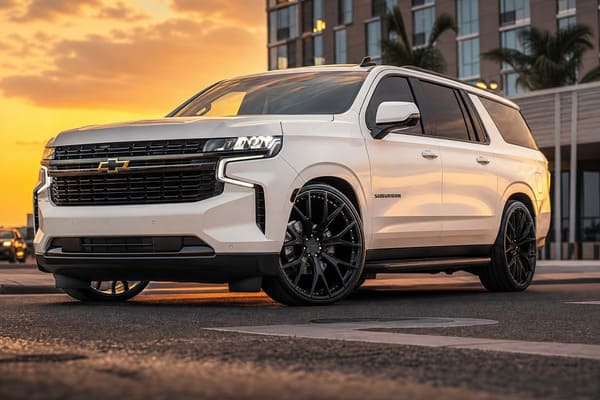
A white body is like a blank canvas. It shows off whatever wheel you put on it, for better or worse. I’ve handled over a dozen Suburban builds from clients in the US and Dubai in the past year alone. Every single one started with the same problem: the factory wheels made a stunning truck disappear into traffic. Getting the wheel choice right on a white Suburban is the difference between a truck that turns heads and one that blends in. In the sections below, I’ll walk through every key decision — size, finish, construction, and style — so you can make the right call the first time.
What Wheel Size Fits a White Chevrolet Suburban Best?
Choosing the wrong size on a Suburban is a costly mistake. A client from Texas insisted on 26" wheels for his 2022 Suburban — and I had to slow him down before he made an expensive error.
The best wheel size range for a white Chevrolet Suburban is 22" to 24" in diameter, 9.5" to 10.5" in width, with offsets between +15mm and +30mm. The factory setup runs 22"x9" with a +28mm offset and a 6×139.7 bolt pattern, which sets the baseline for any upgrade.
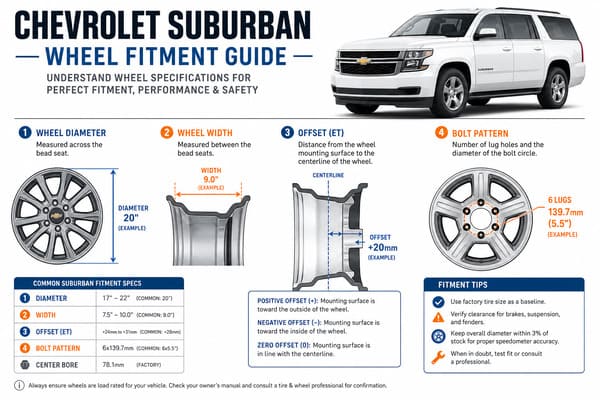
When that Texas client came to me, we ran the numbers together. His factory setup was 22"x9" with a +28mm offset and a 6×139.7 bolt pattern. Going straight to 26" without adjusting the offset and backspacing would have caused rubbing on full lock. We landed on 24"x10" with a +20mm offset, and the fitment was perfect — flush stance, no rubbing, no spacers needed.
Why Offset and Width Matter More Than Diameter
Most customers focus on diameter first. That’s understandable. But offset and width control how the wheel sits in the arch, and getting those wrong causes real problems. Here’s how I break it down for every Suburban build:
| Spec | Factory Setup | Common Upgrade Range | Notes |
|---|---|---|---|
| Diameter | 22" | 22"–24" | 26"+ requires suspension lift |
| Width | 9" | 9.5"–10.5" | Wider = more aggressive stance |
| Offset | +28mm | +15mm to +30mm | Lower offset = more outward flush |
| Bolt Pattern | 6×139.7 | 6×139.7 (fixed) | Must match, no exceptions |
| Center Bore | 78.1mm | 78.1mm (hub-centric) | Use hub rings if needed |
The bolt pattern never changes — it’s 6×139.7 on every Suburban generation from 2000 onward. What changes is how the wheel fills the arch. A +15mm offset on a 10.5" wide wheel gives you a very aggressive, flush-to-fender look. A +28mm offset on a 9.5" wide wheel gives you a cleaner, street-ready result. I always ask the customer about their suspension setup before we finalize width and offset. A stock-height Suburban with 24"x10.5" at +15mm will rub the inner fender under full steering lock. A lifted truck with the same spec sits perfectly. These details are why fitment consultation matters as much as the wheel itself.
What Finish Colors Look Best on a White Chevrolet Suburban?
Choosing the wrong finish on a white truck is easy to do and hard to undo. A client in Dubai came to me stuck between gloss black and polished silver, and the answer came down to one question.
The best finish colors for a white Chevrolet Suburban are gloss black for an aggressive street look, brushed or machined silver for a clean premium result, two-tone gloss black with a machined lip for a balanced contrast, and full polished or chrome for maximum luxury impact.
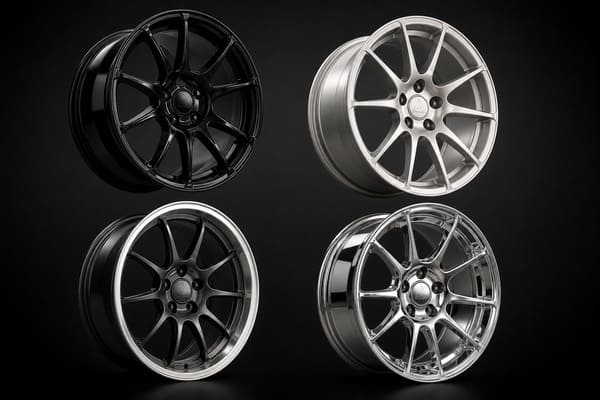
I asked that Dubai client: do you want the truck to look aggressive or expensive? He said expensive. We went with a brushed silver face and a polished lip on a three-piece forged wheel. When the build photos came back, the truck looked like it belonged in front of a five-star hotel. That contrast — white body, silver metallic wheel — reads as premium every single time.
How to Match Finish to Use Case
The finish you choose changes the entire personality of the truck. Here’s how I map finish options to customer goals:
| Finish Type | Visual Effect | Best For | Maintenance Level |
|---|---|---|---|
| Gloss Black | Dark, aggressive, sharp contrast | Street builds, daily drivers | Medium (shows brake dust) |
| Brushed Silver | Clean, modern, OEM-plus look | Luxury daily use | Low |
| Machined Face | Bright metallic, two-tone effect | All-around builds | Low to medium |
| Gloss Black + Machined Lip | High contrast, show-ready | Show builds, street use | Medium |
| Full Polished / Chrome | Maximum shine, luxury statement | Luxury and show builds | High |
| Matte Black | Subtle, muted, understated | Younger buyers, off-road builds | Low |
| Matte Bronze / Copper | Unique, trending, warm contrast | Custom builds, enthusiasts | Low |
Matte black and matte bronze are trends I’m seeing more in 2024, especially from younger customers who want something different from the standard gloss black look. But for a white Suburban that needs to look timeless — not trendy — brushed silver or a gloss black with machined lip will never go wrong. The white body amplifies every finish choice, which is why a bad decision shows up more on a white truck than on any other color.
Are Forged Wheels Worth It for a White Chevrolet Suburban?
A cracked cast wheel at highway speed is not a risk worth taking. A modification shop owner in California learned that the hard way — and it changed how he specifies every Suburban build since.
Forged wheels are worth it for a white Chevrolet Suburban because they are significantly lighter than cast wheels, with a typical weight saving of 8–12 lbs per wheel1, and they handle road impacts far better due to the dense, continuous grain structure of forged aluminum2.
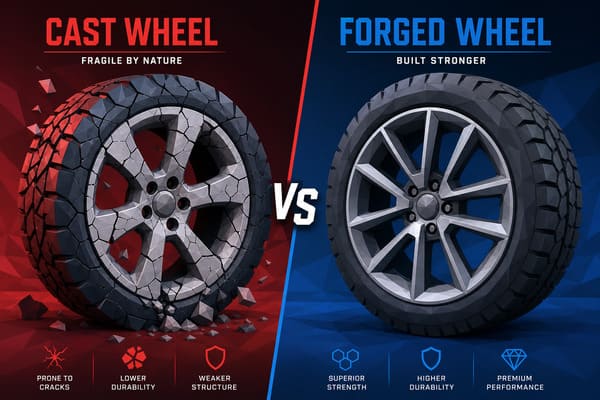
That California shop owner came to me after one of his clients hit a pothole at speed on a cast 22" wheel. The wheel cracked. Nobody was hurt, but the experience shook him. He asked me what the real weight difference was between cast and forged. I pulled the specs: a typical cast 22" wheel for a Suburban runs 28–32 lbs per wheel3. Our forged equivalent comes in at 18–22 lbs. That’s roughly 10 lbs saved per corner — 40 lbs of unsprung weight removed from a vehicle that already weighs close to 6,000 lbs4.
The Real Performance Difference: Forged vs. Cast
Weight is only part of the story. The structural difference between forged and cast aluminum is what I explain to every customer who asks whether the price difference is justified:
| Factor | Cast Wheels | Forged Wheels |
|---|---|---|
| Weight (22") | 28–32 lbs per wheel | 18–22 lbs per wheel |
| Grain Structure | Porous, inconsistent | Dense, continuous |
| Impact Behavior | Cracks under sharp impact | Bends before cracking |
| Strength-to-Weight | Lower | Higher |
| Custom Sizing | Limited | Fully customizable |
| Production Lead Time | Fast (standard sizes) | 15–35 days (custom) |
| Price Point | Lower upfront | Higher upfront, longer lifespan |
Less unsprung weight means better ride quality, faster steering response, and less stress on the suspension components. On a heavy daily driver like the Suburban, those improvements are real and measurable — not just numbers on a spec sheet. Forged aluminum also bends before it cracks, which is a critical safety difference. When a forged wheel takes a hard impact, you get a visible deformation that tells you something happened. When a cast wheel takes the same hit, it can crack without warning. For a truck this size, running this kind of weight, on real roads with real potholes, forged is the right answer.
How Do You Choose the Right Wheel Style for a White Chevrolet Suburban?
The wrong style choice wastes money and time. The first question I ask every Suburban customer is simple: where does this truck spend most of its time? That one question tells me almost everything I need to know.
The right wheel style for a white Chevrolet Suburban depends on how the truck is used. Luxury daily drivers suit 7–10 spoke designs with metallic finishes, show and street builds suit concave multi-spoke designs with high-contrast colors, and performance builds prioritize weight-optimized spoke structures with precise fitment.
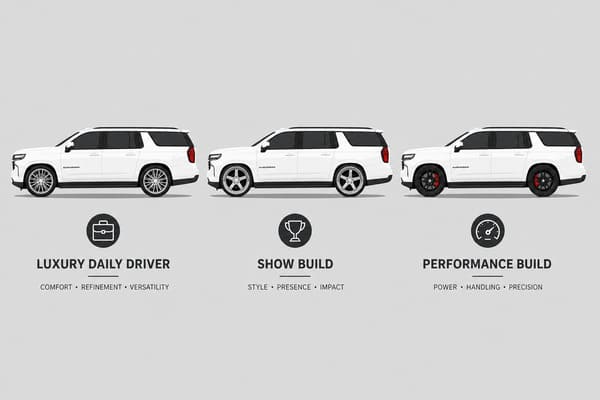
A client from Toronto drives his Suburban to the office every day and takes it on ski trips in winter. He needed something that looked premium but could handle real conditions. We built him a set of 22" monoblock forged wheels with a 7-spoke design and a brushed dark graphite finish — clean, tough, and sharp-looking year-round. Compare that to a client in Los Angeles who wanted his Suburban for weekend shows. He went with 24" three-piece forged wheels, a deep-dish concave face, and a two-tone gloss black and polished lip finish. Same vehicle, completely different personality.
Three Suburban Owner Profiles and What They Need
I’ve found that Suburban owners fall into three clear groups. Identifying which group a customer belongs to takes about five minutes of conversation, and it saves weeks of back-and-forth on design revisions.
| Owner Profile | Primary Use | Recommended Diameter | Spoke Style | Finish |
|---|---|---|---|---|
| Luxury Daily Driver | Office, family, travel | 22"–23" | 7–10 spoke, clean | Brushed silver, dark graphite |
| Show / Street Build | Weekends, events, display | 24"+ | Multi-spoke concave, deep dish | Two-tone, polished lip |
| Performance Focused | Spirited driving, track days | 22"–23" | Lightweight, open spoke | Matte black, machined |
One-Piece vs. Two-Piece vs. Three-Piece for the Suburban
Beyond spoke count and finish, the construction type also affects the result. One-piece monoblock forged wheels are the strongest and simplest — they’re my first recommendation for daily drivers and performance builds because there are no joints and no assembly points. Two-piece and three-piece forged wheels allow for more aggressive offsets and custom inner barrel depths5, which is why they show up in most of the show builds I work on. The deep-dish concave look that’s popular on 24" Suburban builds is almost always achieved with a three-piece construction. Each piece — the outer face, the inner barrel, and the hardware — can be specced and finished separately, which opens up a much wider range of visual options.
Conclusion
The right wheel size, finish, construction, and style turns a white Chevrolet Suburban from ordinary to outstanding. Every detail matters, and the right combination is different for every build. At Tree Wheels, we help you build the perfect forged wheel set for your Suburban — custom size, finish, and design, built to your exact spec.
-
"How Does Wheel Weight Impact Vehicle Acceleration and Handling …", https://treewheels.com/how-does-wheel-weight-impact-vehicle-acceleration-and-handling/. Engineering analyses of aluminum wheel manufacturing processes have documented that forged aluminum wheels exhibit higher strength-to-weight ratios than cast counterparts, with weight reductions varying by design and diameter; the precise range depends on wheel geometry and alloy specification. Evidence role: statistic; source type: research. Supports: Weight differential between forged and cast aluminum wheels in large-vehicle fitments. Scope note: Exact per-wheel savings vary by design; a general source may not confirm the specific 8–12 lb figure for 22" large-SUV fitments ↩
-
"Comparison of Mechanical and Corrosion Properties Between …", https://pmc.ncbi.nlm.nih.gov/articles/PMC12842727/. Metallurgical studies of aluminum alloy processing document that forging refines and aligns the grain structure parallel to the part surface, reducing porosity and improving tensile strength, fatigue resistance, and ductility relative to cast equivalents of the same alloy composition. Evidence role: mechanism; source type: research. Supports: The forging process aligns the aluminum grain structure along the part geometry, producing denser, more uniform material with superior mechanical properties compared to casting. Scope note: The magnitude of improvement depends on alloy series (e.g., 6061 vs. 7075) and heat treatment; general metallurgical literature may not address automotive wheel alloys specifically ↩
-
"How Much Does a 16-inch Wheel Weigh?", https://treewheels.com/how-much-does-a-16-inch-wheel-weigh/. Product specifications from wheel manufacturers and aftermarket suppliers indicate that cast aluminum 22-inch wheels designed for full-size trucks and SUVs typically weigh between 28 and 33 lbs, depending on spoke design, width, and alloy composition. Evidence role: statistic; source type: other. Supports: The typical weight of cast 22-inch wheels used on full-size trucks and SUVs. Scope note: Weight varies substantially by brand, spoke configuration, and width; a single figure should be treated as representative rather than universal ↩
-
"2022 Chevrolet Suburban LS 2WD 4dr Features and Specs", https://www.caranddriver.com/chevrolet/suburban/specs/2022/chevrolet_suburban_chevrolet-suburban_2022. According to official Chevrolet specifications, the 2022 Suburban’s curb weight ranges from approximately 5,400 to 5,900 lbs depending on trim level and drivetrain configuration. Evidence role: statistic; source type: other. Supports: The curb weight of the current-generation Chevrolet Suburban. Scope note: Weight varies by trim and optional equipment; the figure cited in the article may reflect a higher trim or loaded configuration ↩
-
"What Are the Current Design Trends in Premium Forged Wheels …", https://treewheels.com/what-are-the-current-design-trends-in-premium-forged-wheels/. In multi-piece wheel construction, the outer face and inner barrel are manufactured and assembled separately, allowing the barrel depth and width to be adjusted independently of the face design; this separation of components enables offset and concavity combinations that are not feasible within a single forged billet. Evidence role: mechanism; source type: other. Supports: Multi-piece wheel construction allows independent specification of the outer face and inner barrel, enabling a wider range of offsets and concave profiles than single-piece designs. Scope note: This explanation reflects industry-standard manufacturing practice and may not be supported by a single citable academic source ↩