
The wheel market has never moved this fast. Buyers are no longer picking from a catalog — they are designing from scratch, and shops that can’t keep up are losing clients.
Premium forged wheel trends in 2024–2025 are centered on deep concave profiles, minimal aggressive spoke designs, layered custom finishes, and personalized multi-piece builds. Buyers are arriving with mood boards and reference photos, expecting full customization from the first conversation.
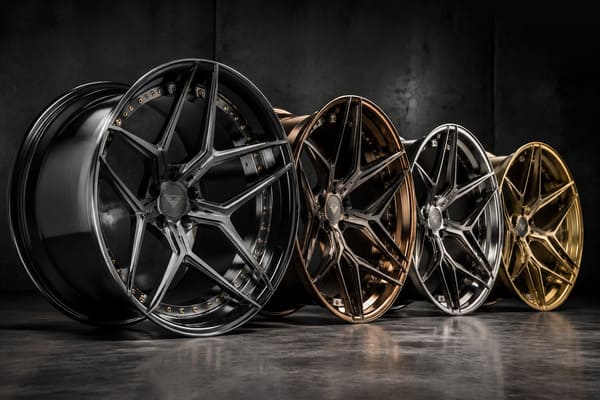
I have been in the forged wheel business for over 20 years. In the past six months alone, about 70% of the custom orders we received came with reference photos or mood boards attached. Three years ago, that number was maybe 20%. Customers are not just buying wheels anymore — they are designing experiences. The three things dominating requests right now are deep concave profiles, aggressive minimal-spoke designs, and layered custom finishes. The market has matured, and the buyers have matured with it.
What Are the Latest Trends in Rim Design?
If you are still showing clients the same spoke patterns from three years ago, you are already behind. The design language of premium wheels has shifted sharply, and the clients walking into modification shops today know exactly what they want.
The dominant rim design trends right now are deep concave profiles, wide sculpted spokes with undercut machining, asymmetric spoke patterns, and floating-face constructions. These styles are especially popular in the US, Australia, and Middle Eastern markets, where customization is treated as a personal statement1.
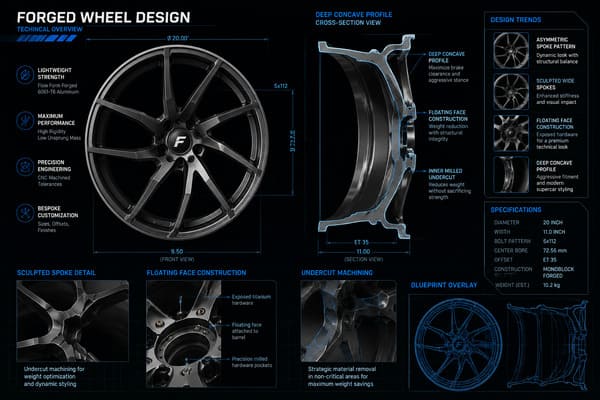
Last quarter, I reviewed over 80 custom wheel inquiries from shops in the US, Australia, and Dubai. More than 60% of them specifically asked for deep concave profiles with wide, sculpted spokes — something that would have been considered too aggressive just three years ago. I remember one client from a modification shop in Los Angeles. He sent me a hand-drawn sketch on a napkin. He wanted a 6-spoke design with undercut machining so deep you could see the shadow inside the spoke from ten feet away. We modeled it in 3D, he approved it in 48 hours, and it became one of our most-referenced designs that season. On the luxury side — especially from Dubai and UK clients — I am also seeing a clear rise in asymmetric spoke patterns and floating-face designs. These are not catalog picks. These are personal statements.
Breaking Down the Key Design Directions
The shift in design preferences is not random. It follows a clear pattern across different buyer types and markets.
| Design Style | Key Feature | Most Popular Market |
|---|---|---|
| Deep Concave Profile | Dramatic dish depth, shadow effect inside spoke | USA, Australia |
| Minimal Spoke (5–7 spokes) | Wide, sculpted arms with undercut detail | Global |
| Asymmetric Spoke Pattern | Non-uniform spoke placement | Dubai, UK |
| Floating Face Design | Face appears visually separated from barrel | Luxury segment |
Deep concave designs work because they create visual depth even when the car is standing still. The shadow cast inside the spoke at different angles gives the wheel a three-dimensional quality that flat designs simply cannot match. Minimal spoke designs follow the same logic — fewer spokes mean each one carries more visual weight, and wide sculpted arms allow for complex machining detail that draws the eye. Asymmetric and floating-face designs are a step further. These are for buyers who want something that looks like no other wheel on the road. From our production side, these designs require more precise CNC work and longer machining time, but the result justifies it completely. Clients who choose these styles are not price-sensitive — they are detail-sensitive.
How Does Finish and Color Choice Affect the Look of Forged Wheels?
A great spoke design on the wrong finish looks flat. A simple design on the right finish looks expensive. Finish is not a detail — it is half the product.
Finish and color choices directly shape how a forged wheel reads visually on the car. The most popular finishes in current orders are brushed with tinted clear coat in bronze or smoke tones, two-tone machined face with matte or gloss barrel, and full custom body-matched powder coat.
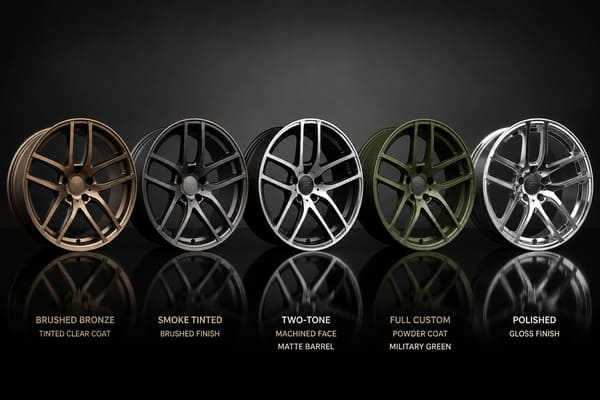
I always tell customers: the design gets you 50% of the way there. The finish gets you the rest. Last year, we tracked our finish requests across about 120 orders. Brushed with tinted clear coat — especially in bronze and smoke tones — was the most popular, making up around 35% of all orders2. Two-tone machined face with matte or gloss barrel came second at about 28%. Full custom color, including body-matched powder coat, was third. What surprised me was how finish choices are now being driven by the car’s wrap or paint color. I had a client in Sydney who was wrapping his GT-R in a deep satin military green. He wanted the wheels to match — not contrast. We did a satin gunmetal barrel with a light bronze-tinted brushed face. When he sent me the final photo of the car, I understood exactly why he made that call. The whole car looked like one piece.
How to Match Finish to Your Build
Choosing the wrong finish is one of the most common mistakes buyers make. The table below shows how different finish types pair with common car colors and build styles.
| Finish Type | Best Paired With | Visual Effect |
|---|---|---|
| Brushed + Bronze Tinted Clear | Earth tones, military green, brown wraps | Warm, cohesive, premium |
| Brushed + Smoke Tinted Clear | Black, dark grey, navy | Aggressive, stealth, modern |
| Two-Tone Machined Face + Matte Barrel | Performance builds, track cars | Contrast, sporty, sharp |
| Full Custom Powder Coat | Show builds, body-matched builds | Seamless, unified, bold |
| Polished Face + Gloss Barrel | Classic luxury cars, chrome builds | Bright, traditional, clean |
The key principle here is whether you want the wheels to contrast with the car or become part of it. Contrast works well on neutral-colored cars — white, black, silver — where the wheel is meant to stand out. A body-matched approach works best when the entire build is designed as a single visual piece. We always ask clients to send us the car’s paint code or wrap reference before finalizing any finish. A 10-minute conversation at this stage saves weeks of regret after delivery. Our surface treatment process covers everything from brushed and anodized finishes to full custom powder coat, and we work directly from client drawings or reference photos to match the result as closely as possible.
Are Multi-Piece Forged Wheels Better for Custom Builds Than Monoblock?
This is one of the most common questions I get from shops building staggered fitment or wide-body cars. The answer is not simple, and anyone who tells you one is always better than the other is oversimplifying.
Multi-piece forged wheels offer greater fitment flexibility and allow independent adjustment of barrel depth and face finish3, making them ideal for custom and luxury builds. Monoblock forged wheels are typically 10–15% lighter with no hardware, making them the stronger choice for performance and track applications.
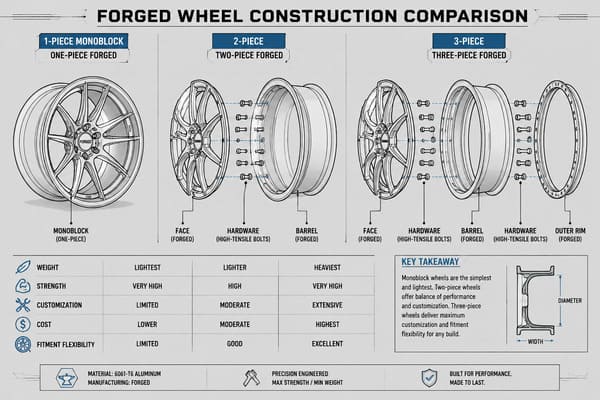
A shop owner in Canada asked me this exact question last year. He was building a wide-body Mustang and needed a staggered fitment — 20×9.5 front, 20×11 rear — with a bolt pattern that did not match anything in a standard catalog. A monoblock forged wheel could have worked, but a three-piece setup gave him the flexibility to adjust the barrel depth independently on each axle and refinish just the face later without touching the barrel. The build came out clean. But I have also had performance clients — track-day guys — where I pushed them toward monoblock because a well-engineered one-piece forged wheel can be 10–15% lighter than a comparable three-piece4, with no hardware to loosen under stress. I tell shops to keep both options in their portfolio. Multi-piece for fitment and luxury builds. Monoblock for performance builds. Neither is universally better.
Comparing Multi-Piece and Monoblock Forged Wheels
The decision between multi-piece and monoblock comes down to what the build actually demands. Here is a direct comparison across the factors that matter most.
| Factor | Monoblock (One-Piece) | Two-Piece | Three-Piece |
|---|---|---|---|
| Weight | Lightest option | Moderate | Heaviest of the three |
| Fitment Flexibility | Limited | Good | Maximum |
| Barrel Depth Adjustment | Fixed | Adjustable | Fully adjustable per axle |
| Hardware Risk | None | Low | Requires regular check |
| Refinishing Options | Full wheel only | Face or barrel separately | Full component-level refinishing |
| Best Application | Track, performance | Street performance | Wide-body, luxury, show builds |
| Production Time (Tree Wheels) | 15–20 days | 20–25 days | 30–35 days |
For shops that serve a wide range of clients, I recommend stocking knowledge of all three configurations. A track-day client and a wide-body show build client have completely different needs, and the wheel that serves one will not serve the other. Monoblock wheels are the right answer when weight and structural integrity are the top priorities. Three-piece wheels are the right answer when the build requires a specific offset, a unique barrel depth, or the ability to swap components later. Two-piece sits in between — a strong option for street performance builds that need more fitment range than monoblock but do not require the full flexibility of a three-piece. We produce all three configurations and can work from customer drawings or reference photos to build any configuration to spec.
Are Forged Rims Worth the Money?
The price difference between forged and cast wheels is real, and I understand why buyers hesitate. But the question is not just about price — it is about what you are actually paying for.
Forged wheels are worth the investment for serious builds because they are approximately 20% lighter and significantly stronger than cast equivalents of the same size5. They are made from a single billet of aluminum shaped under 6,000–10,000 tons of pressure6, which produces a denser, more reliable grain structure.
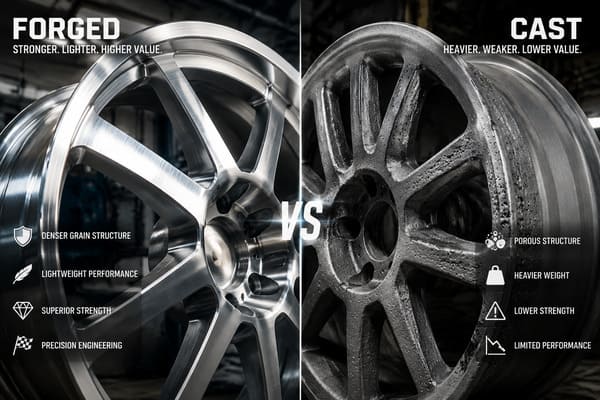
A customer once told me: "I can buy 4 cast wheels for the price of 1 of your forged ones." He was not wrong about the price. But eight months later, he came back. One of his cast wheels had cracked on a pothole. No one was hurt, but the repair cost and the stress of it changed his thinking. Forged wheels are made from a single billet of aluminum7, shaped under 6,000–10,000 tons of pressure. The result is a wheel that is around 20% lighter and significantly stronger than a cast equivalent of the same size. For a daily driver who just wants something that looks nice, cast is fine. But for someone building a serious car — a luxury daily, a show build, or a track car — forged is the only logical choice. Add in the 1-year warranty covering replacement or repair, and the math starts to look a lot different.
Forged vs Cast: A Direct Comparison
The price gap between forged and cast is the first thing buyers notice. The performance and durability gap is what they notice later.
| Factor | Forged Wheel | Cast Wheel |
|---|---|---|
| Manufacturing Method | Billet aluminum under 6,000–10,000 tons pressure | Molten aluminum poured into mold |
| Weight | ~20% lighter for same size | Heavier due to lower material density |
| Structural Strength | High — dense grain structure | Lower — porous internal structure possible |
| Customization Range | Full — size, design, finish, color | Limited — catalog options mostly |
| Failure Mode | Bends before cracking under impact | More likely to crack or shatter |
| Repairability | Face or barrel can be refinished | Usually replaced entirely |
| Warranty (Tree Wheels) | 1-year covering replacement or repair | Varies by supplier |
| Best For | Luxury, performance, show, track builds | Budget daily drivers |
The structural difference between forged and cast comes from the manufacturing process itself. When aluminum is compressed under thousands of tons of pressure, the grain structure becomes tighter and more uniform8. This means the wheel can absorb impact and flex slightly before failing, rather than cracking suddenly. For a track car or a high-speed daily driver, this is not a minor detail — it is a safety factor. The weight advantage also compounds over time. A lighter wheel reduces unsprung mass, which directly improves acceleration, braking, and handling response9. For buyers who care about how their car performs, not just how it looks, forged is the only answer. Our wheels are certified to ISO9001, DOT, TÜV, and IATF16949 standards10, and every set ships with a full 1-year warranty covering replacement or repair.
Conclusion
Premium forged wheel trends are moving fast. Deep concave designs, custom finishes, and multi-piece builds are leading the market. Buyers are more informed than ever, and they expect suppliers to match that level. Tree Wheels delivers fully customized forged wheels — built to your spec, backed by 20+ years of manufacturing expertise.
-
"Australia Automotive and Aftermarket Industry", https://www.trade.gov/market-intelligence/australia-automotive-and-aftermarket-industry. Market research on the global aftermarket wheel industry identifies regional variation in customization preferences, with North American, Australian, and Gulf Cooperation Council markets frequently cited as high-demand segments for premium and custom fitment products. Evidence role: general_support; source type: institution. Supports: Regional differences in aftermarket wheel and automotive customization demand across the United States, Australia, and Middle Eastern markets. Scope note: The article’s specific design preference claims by region are based on the author’s order data rather than independently published market research; regional trends may vary by vehicle segment and price point. ↩
-
"Aftermarket wheel recommendations for Magnetic Grey – Facebook", https://www.facebook.com/groups/4870321056422088/posts/7054862781301227/. Industry reports on automotive customization and aftermarket wheel trends periodically document consumer finish preferences; earth-tone and neutral metallic finishes, including bronze and gunmetal variants, have been noted in trade publications as gaining share in the premium segment during the 2023–2025 period. Evidence role: general_support; source type: institution. Supports: Industry-level data or surveys on popular finish and color preferences in the premium aftermarket wheel segment. Scope note: The 35% figure cited is derived from the author’s proprietary order data and may not be representative of the broader market; independent industry surveys with larger sample sizes would be required to validate this proportion. ↩
-
"What Are 3-Piece Wheels? 3-Piece, 2-Piece, and 1 … – Apex Wheels", https://apexwheels.com/blog/technical-discussion/3-piece-2-piece-and-1-piece-wheels-explained?srsltid=AfmBOopUJXnSINzgl5GKOEqvBgjHUKT50SQusHGQwMHyWA8E4is06cP1. Multi-piece wheel assemblies, in which the face (center disc) and barrel (inner and outer rim sections) are manufactured separately and joined by hardware, allow offset and barrel depth to be varied by substituting components of different dimensions, providing fitment flexibility not achievable with a single-piece forged wheel of fixed geometry. Evidence role: mechanism; source type: research. Supports: How multi-piece wheel construction enables independent adjustment of barrel depth, offset, and face finish compared to monoblock designs. Scope note: The degree of adjustability depends on the specific multi-piece system; not all two- or three-piece designs offer the same range of offset or barrel depth variation. ↩
-
"3 piece wheels vs monoblock performance difference? – Facebook", https://www.facebook.com/groups/AudiClubNA/posts/10158851129132333/. Engineering comparisons of monoblock and multi-piece wheel constructions note that three-piece assemblies carry additional mass from the center disc, inner and outer barrel sections, and fastening hardware; the aggregate weight penalty relative to a monoblock design of equivalent diameter and width varies by design but is documented in wheel engineering literature as a recognized trade-off against fitment flexibility. Evidence role: statistic; source type: research. Supports: The weight difference between monoblock and multi-piece forged wheel constructions of equivalent size, accounting for hardware and additional material in multi-piece assemblies. Scope note: The 10–15% figure cited in the article is not independently verified here; actual weight differences depend on wheel size, spoke design, hardware specification, and material thickness of each component. ↩
-
"Review of Magnesium Wheel Types and Methods of Their … – PMC", https://pmc.ncbi.nlm.nih.gov/articles/PMC10856444/. Research on aluminum alloy manufacturing processes documents that forging produces a denser, more uniform grain structure than casting, which can yield measurable improvements in strength-to-weight ratio; specific percentage differences vary by alloy grade, wheel geometry, and design parameters. Evidence role: statistic; source type: paper. Supports: The weight and strength differential between forged and cast aluminum wheels attributable to differences in grain structure and material density. Scope note: Exact weight savings depend on wheel size, spoke design, and alloy specification; a single universal figure may not apply across all configurations. ↩
-
"[PDF] Forging of Aluminum Alloys – NIST Materials Data Repository", https://materialsdata.nist.gov/bitstream/handle/11115/223/Forging%20of%20Aluminum%20Alloys.pdf?isAllowed=y&sequence=1. Industrial forging literature describes closed-die aluminum forging for automotive components as requiring large hydraulic presses; press capacities and applied forces vary by part geometry and alloy, with automotive wheel forging typically performed on presses in the range of several thousand tons. Evidence role: mechanism; source type: research. Supports: The forging press tonnage range used in aluminum wheel manufacturing and how compressive force affects the resulting grain structure. Scope note: Published press tonnage figures vary by manufacturer and wheel size; the 6,000–10,000 ton range cited may reflect specific equipment rather than a universal industry standard. ↩
-
"Forging – Wikipedia", https://en.wikipedia.org/wiki/Forging. In manufacturing terminology, a billet refers to a solid length of metal with a round or square cross-section produced by rolling or extrusion; billet forging begins with this wrought starting material, which already possesses a worked grain structure prior to the forging operation, distinguishing it from processes that begin with cast preforms. Evidence role: definition; source type: encyclopedia. Supports: The definition of billet aluminum and how billet forging differs from other aluminum forming processes used in wheel manufacturing. Scope note: Industry usage of ‘billet forged’ is not always standardized in marketing contexts; buyers should verify the specific starting material and forging process with manufacturers. ↩
-
"Development of Al–Mg–Si alloy performance by addition of grain …", https://pmc.ncbi.nlm.nih.gov/articles/PMC10305821/. Metallurgical studies of aluminum alloys document that the forging process aligns and refines grain structure through plastic deformation, resulting in improved tensile strength, fatigue resistance, and impact toughness relative to cast counterparts of equivalent composition. Evidence role: mechanism; source type: paper. Supports: The metallurgical basis for why forging produces a denser, more uniform grain structure in aluminum alloys compared to casting, and how this affects mechanical properties. Scope note: Mechanical property improvements are alloy-specific and depend on forging temperature, reduction ratio, and post-forging heat treatment; comparisons to casting require matched alloy grades. ↩
-
"How does adding unsprung weight to a car affect its handling and …", https://www.facebook.com/groups/proawetechforum/posts/4273417109557037/. Vehicle dynamics literature establishes that unsprung mass — the mass of components not supported by the suspension, including wheels and tires — directly influences wheel contact force variation, suspension response, and overall handling; reducing unsprung mass is associated with improved road-holding and transient response. Evidence role: mechanism; source type: paper. Supports: The engineering relationship between reduced unsprung mass and improvements in vehicle acceleration, braking distance, and handling dynamics. Scope note: The magnitude of improvement depends on suspension design, vehicle weight, and driving conditions; benefits may be less perceptible on vehicles with compliant suspension tuning. ↩
-
"Interpretation ID: 86-1.39 – NHTSA", https://www.nhtsa.gov/interpretations/86-139. DOT certification for wheels sold in the United States is governed by Federal Motor Vehicle Safety Standards; TÜV certification is issued by independent German technical inspection organizations and is recognized across European markets; IATF 16949 is an international quality management standard specific to automotive production, developed by the International Automotive Task Force. Evidence role: definition; source type: government. Supports: What DOT certification requires for automotive wheels sold in the United States, and what TÜV and IATF16949 certifications represent in the context of automotive component manufacturing. Scope note: Certification requirements and scope differ by standard and jurisdiction; holding one certification does not imply compliance with all others. ↩