
When I first entered the forged wheel industry, I thought the supply chain was simple. I was wrong. The real chain has at least five to seven steps, and not every step adds real value.
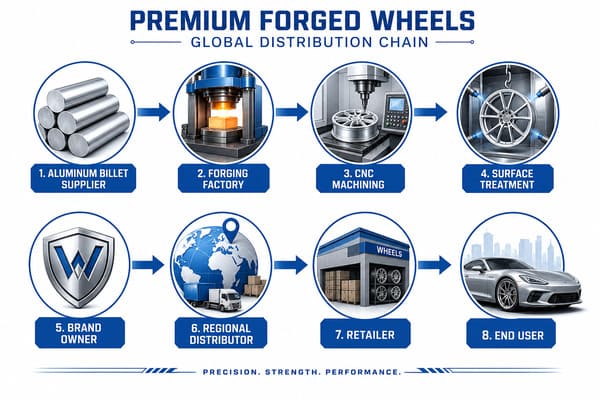
The global distribution chain for premium forged wheels runs from aluminum billet suppliers through forging factories, CNC machining, surface treatment, branding, regional distributors, and finally to retailers or end users. Each layer adds cost, but only the manufacturing layers add true product value.
I have been working in this industry long enough to see the full picture. What surprised me most is that many wheels sold under European or American brand names are actually made in China. The chain starts in a factory in Ningbo, Suzhou, or Dongguan. Understanding this chain helps buyers make smarter decisions and helps shop owners save real money.
Are Forged Wheels Made in China?
A Canadian customer once asked me if our wheels could compete with a well-known European brand. I did not answer directly. I asked him where that brand actually made their wheels.
Yes, forged wheels are widely made in China. China produces over 60% of the world’s forged aluminum wheels1. Zhejiang and Guangdong are the two largest production regions2. Many globally recognized brands use Chinese factories for OEM production3, operating under the same certification systems, including ISO9001, IATF16949, TÜV, and DOT4.
The customer went away and did his own research. He came back and told me he had found out that the European brand he trusted was also manufactured in China, using the same certification framework we use at Tree Wheels. That moment changed how he thought about the phrase "Made in China."
The factory we work with has over 20 years of forged wheel production experience. They have fulfilled OEM orders for well-known brands in the US and European markets. The equipment, the processes, and the quality control systems are not different from what those brands use. What is different is the price you pay when a brand logo is added on top.
Here is a quick comparison to show what "Made in China" actually means in this segment:
| Factor | Common Assumption | Reality in Forged Wheels |
|---|---|---|
| Quality Level | Low-end, basic | High-end, OEM-grade |
| Certifications | Few or none | ISO9001, IATF16949, TÜV, DOT |
| OEM Experience | Unlikely | Serving global brands for 20+ years |
| Production Scale | Small workshops | Heavy-asset forging facilities |
| Market Share | Minor | 60%+ of global forged aluminum wheel output |
China’s dominance in this space is not about cutting corners. It is about decades of investment in specialized equipment, skilled labor, and manufacturing systems that meet the strictest global standards. "Made in China" in the forged wheel segment stopped meaning low quality a long time ago.
How Are Forged Wheels Manufactured and Distributed Globally?
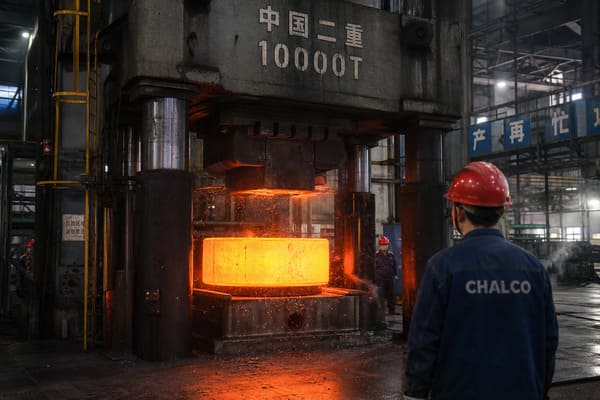
The first time I walked through our partner factory’s forging workshop, I watched a 6061-T6 aluminum billet get pressed into the rough shape of a wheel under 10,000 tons of pressure5. It took less than ten seconds.
Forged wheels are manufactured through a multi-stage process: heating the aluminum billet, forging under high pressure, CNC precision machining, heat treatment, surface finishing (such as painting, brushing, polishing, or PVD), dynamic balance testing6, and final quality inspection. One-piece forged wheels take 15–20 days from raw material to finished product.
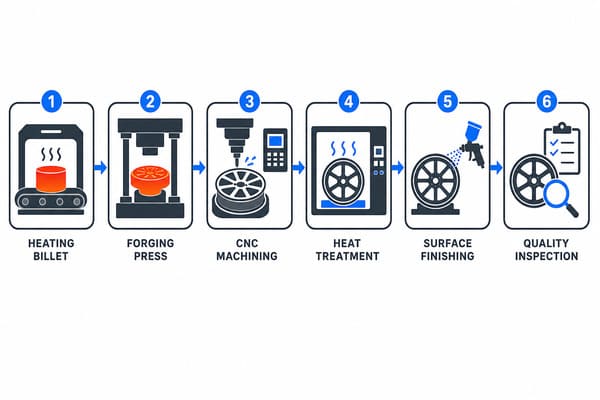
Those ten seconds of forging are just the most dramatic moment in a much longer process. Before the press comes down, the billet has already been heated to a precise temperature, positioned carefully, and aligned with a custom die. After the press, the wheel goes through CNC machining to achieve the exact dimensions and design details. Then comes heat treatment to strengthen the structure7, followed by surface finishing. After that, every wheel goes through dynamic balance testing and a final inspection before it is cleared for shipment.
The timeline for different wheel types reflects how complex each one is to build:
| Wheel Type | Production Time |
|---|---|
| One-Piece (Monoblock) Forged | 15–20 days8 |
| Two-Piece Forged | 20–25 days |
| Three-Piece Forged | 30–35 days9 |
On the distribution side, the traditional global path looks like this: factory → brand owner → regional distributor → modification shop → car owner. Each time the wheel passes through one of these layers, the price goes up by 15% to 30%10. By the time the wheel reaches the shop floor, it may have passed through four or five pricing layers.
At Tree Wheels, we cut out those middle layers. We ship directly from the factory to the modification shop or individual buyer. We offer door-to-door delivery, a minimum order of just four wheels, and full customization on size, color, and surface finish. The result is a shorter lead time, a lower price, and a product built exactly to the buyer’s specification.
Who Are the Key Players in the Forged Wheel Supply Chain?
Many buyers assume that a well-known wheel brand means there is a factory, a technical team, and a research department behind it. That assumption is often not correct.
The key players in the forged wheel supply chain are: aluminum billet suppliers, specialized forging factories, CNC machining and surface treatment facilities, brand owners or trading companies, regional distributors, and end-user retailers such as modification shops. Each layer carries a profit margin of 15% to 40%, with higher margins closer to the end user.
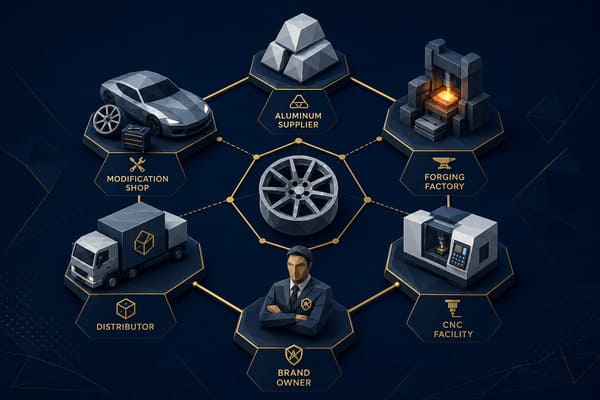
I have met many so-called "wheel brands" that own no production equipment at all. They have a design team and a sales team. The wheels are fully outsourced to Chinese factories, then shipped out under their own logo at three to five times the factory price. This is a legal and common business model, but buyers should understand what they are actually paying for.
Here is a breakdown of each key player and what they contribute:
| Supply Chain Layer | Main Role | Value Added | Typical Margin |
|---|---|---|---|
| Aluminum Billet Supplier | Raw material supply | Material quality | 5–15% |
| Forging Factory | Core manufacturing | Product strength and structure | 15–25% |
| CNC & Surface Treatment | Precision and finish | Accuracy and appearance | 10–20% |
| Brand Owner / Trader | Branding and sales | Market access, design | 30–50% |
| Regional Distributor | Local stocking and service | Availability and credit terms | 15–30% |
| Modification Shop / Retailer | End-user sales | Installation and local support | 20–40% |
The forging factory is the heaviest investment point in the entire chain. Our manufacturing partner has put tens of millions of RMB into forging equipment alone11. That kind of capital commitment is what creates the technical barrier that separates real forging operations from lighter assembly or casting operations. When you buy directly from a source like Tree Wheels, you are buying from a team connected directly to that manufacturing foundation, not from someone who is simply adding a label.
What Role Do Distributors and Wholesalers Play in the Forged Wheel Market?
I have a client who runs a modification shop in Australia. He used to order wheels through a local distributor, wait six to eight weeks, and choose only from whatever the distributor had in stock.
Distributors and wholesalers in the forged wheel market serve three main functions: local inventory storage, local service and returns handling, and credit term support for buyers. These functions remain valuable in markets like the Middle East and Southeast Asia. However, in markets like the US, Canada, and Australia, direct factory sourcing is becoming more common due to lower MOQs and faster logistics12.
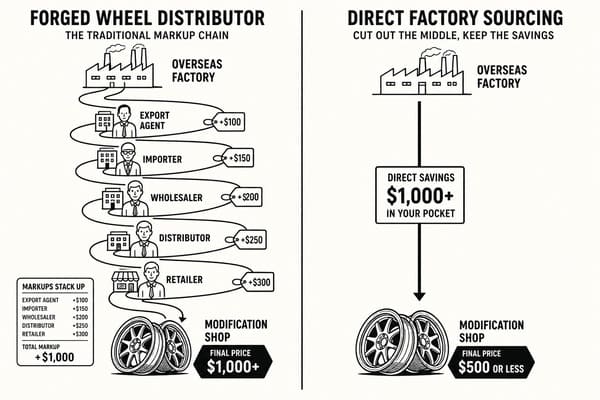
After that Australian shop owner found Tree Wheels, everything changed for him. We gave him 3D design renderings based on his style preferences. He approved the design. We produced his one-piece forged wheels and shipped them door-to-door from Ningbo to his shop in under 20 days. His price was 20% to 30% lower than what he had been paying through the local distributor. And the wheels were fully custom — his size, his color, his surface finish.
So what is the actual value of a distributor? It is real, but it is specific:
| Distributor Value | When It Matters |
|---|---|
| Local inventory (fast delivery) | When buyers cannot wait 15–35 days |
| Local service and returns | When buyers lack import experience |
| Credit terms (buy now, pay later) | When buyers need cash flow flexibility |
| Market knowledge | When buyers are new to wheel sourcing |
These strengths matter most in markets where logistics infrastructure is slower or where buyers do not have direct communication lines with overseas factories. In those cases, a distributor genuinely earns their margin.
But in the US, Canada, Australia, and the UK, the situation is shifting. Logistics from China is reliable and trackable. Communication with factories is fast and can happen entirely online. With a minimum order of just four wheels and door-to-door shipping, there is no longer a strong reason for most shop owners to pay an extra 20% to 30% for a layer of distribution they do not need. The buyers who figure this out are the ones who get the best margins and the most flexibility.
Conclusion
The forged wheel supply chain is longer and more layered than most people expect. Knowing where value is created — and where it is just marked up — is the key to sourcing smarter.
Tree Wheels connects you directly to 20+ years of forged wheel manufacturing expertise, with full customization, a 4-wheel MOQ, and door-to-door global delivery.
-
"How Long Does It Take to Manufacture Custom Forged …", https://treewheels.com/how-long-does-it-take-to-manufacture-custom-forged-wheels/. Industry analyses of the global forged aluminum wheel market should confirm the approximate proportion attributable to Chinese manufacturers, typically drawing on trade data from customs records or sector-specific market research. Evidence role: statistic; source type: research. Supports: China’s percentage share of global forged aluminum wheel manufacturing output. Scope note: Market share figures vary by report methodology and year; the 60% figure should be verified against a specific publication date and product category definition. ↩
-
"Zhejiang Hongxin Technology Co., Ltd.: Forged Alloy Wheel Manufacturer …", https://zjhxwheel.en.made-in-china.com/. Chinese government industrial statistics or provincial economic reports may document the concentration of automotive components manufacturing, including forged wheels, in Zhejiang and Guangdong. Evidence role: statistic; source type: government. Supports: Geographic concentration of China’s automotive wheel manufacturing in Zhejiang and Guangdong provinces. Scope note: Provincial-level breakdowns specific to forged wheels as a subcategory may not be separately enumerated in publicly available government statistics. ↩
-
"KP | Monoblock Forged Wheels", https://treewheels.com/monoblock-forged-wheels/. Trade and industry analyses of the automotive aftermarket sector have documented the widespread practice of Western brands outsourcing component manufacturing to Chinese OEM facilities, a pattern consistent with broader contract manufacturing trends in automotive parts. Evidence role: general_support; source type: research. Supports: The practice of globally recognized wheel brands contracting Chinese factories for OEM manufacturing. Scope note: Specific brand-factory relationships in the wheel segment are rarely disclosed publicly; general OEM outsourcing documentation may not constitute direct confirmation for named brands. ↩
-
"Interpretation ID: 86-1.39", https://www.nhtsa.gov/interpretations/86-139. IATF 16949 is the international quality management standard specific to automotive production and service parts organizations, developed by the International Automotive Task Force; DOT certification denotes compliance with United States Federal Motor Vehicle Safety Standards administered by the National Highway Traffic Safety Administration. Evidence role: definition; source type: institution. Supports: What IATF 16949 and DOT certification standards require of automotive component manufacturers. Scope note: Certification scope and enforcement vary; holding a certification does not in itself guarantee any particular product outcome beyond conformance to the standard’s procedural requirements. ↩
-
"6061 aluminium alloy", https://en.wikipedia.org/wiki/6061_aluminium_alloy. 6061-T6 aluminum is a precipitation-hardened alloy widely documented in materials engineering literature for its high strength-to-weight ratio and corrosion resistance, properties that make it suitable for structural automotive components such as forged wheels. Evidence role: mechanism; source type: education. Supports: Use of 6061-T6 aluminum alloy and high-pressure forging in wheel manufacturing. Scope note: Press tonnage requirements vary by wheel diameter and design complexity; 10,000 tons is cited as a representative figure for this facility and may not apply universally across forging operations. ↩
-
"What Testing Standards Do Quality Forged Wheels Meet?", https://treewheels.com/what-testing-standards-do-quality-forged-wheels-meet/. Dynamic balance testing of wheels is required under various automotive industry quality frameworks to ensure that mass distribution around the wheel’s rotational axis meets tolerances that prevent vibration-related handling and safety issues at driving speeds. Evidence role: definition; source type: institution. Supports: The purpose and automotive industry standards governing dynamic balance testing for wheels. Scope note: Specific balance tolerance thresholds differ by vehicle class and wheel size; a general reference to the practice does not confirm the particular specification used by any individual manufacturer. ↩
-
"How Does Heat Treatment Enhance Aluminum Wheel Properties?", https://treewheels.com/how-does-heat-treatment-enhance-aluminum-wheel-properties/. Heat treatment processes such as solution heat treatment and artificial aging (T6 temper) are well-established in metallurgical literature as methods for increasing tensile strength and hardness in aluminum alloys through controlled precipitation of strengthening phases. Evidence role: mechanism; source type: education. Supports: The metallurgical role of heat treatment in improving the mechanical properties of forged aluminum components. Scope note: The specific heat treatment parameters applied to wheels vary by alloy and manufacturer; general metallurgical descriptions may not reflect proprietary process details. ↩
-
"Review of Magnesium Wheel Types and Methods of Their Manufacture", https://pmc.ncbi.nlm.nih.gov/articles/PMC10856444/. Manufacturing process analyses for forged aluminum automotive wheels indicate that the full production sequence — encompassing billet preparation, forging, CNC machining, heat treatment, surface finishing, and quality inspection — spans multiple working days, with the precise duration depending on order volume, facility capacity, and design complexity. Evidence role: general_support; source type: research. Supports: Typical production cycle time for one-piece forged aluminum wheels from billet to finished product. Scope note: The 15–20 day figure reflects conditions at a specific facility; actual lead times vary across manufacturers and are affected by queue depth and production scheduling. ↩
-
"How Long Does It Take to Manufacture Custom Forged …", https://treewheels.com/how-long-does-it-take-to-manufacture-custom-forged-wheels/. Technical descriptions of multi-piece wheel manufacturing indicate that two- and three-piece designs require additional production stages beyond those of monoblock wheels, including separate fabrication of barrel and face components, precision machining of mating surfaces, and assembly processes such as bolting or welding, each of which extends the overall production cycle. Evidence role: mechanism; source type: research. Supports: Why three-piece forged wheels require longer production cycles than one-piece wheels. Scope note: Specific day-count timelines depend on facility workflow and order size; the 30–35 day figure represents one manufacturer’s estimate rather than a published industry standard. ↩
-
"Operating and Net Margins", https://pages.stern.nyu.edu/~adamodar/New_Home_Page/datafile/margin.html. Research on automotive aftermarket supply chains documents that each intermediary layer — including distributors and retailers — typically applies a markup to the transfer price received, with ranges that vary by product category, market, and competitive dynamics. Evidence role: statistic; source type: research. Supports: Typical per-layer price markup percentages in automotive aftermarket parts distribution chains. Scope note: Published margin data for the premium forged wheel segment specifically is scarce; figures cited may reflect general automotive aftermarket patterns rather than segment-specific benchmarks. ↩
-
"U.S. FORGING INDUSTRY", https://science.osti.gov/-/media/sbir/pdf/Market-Research/AMO—Forging-Industry-August-2022-Public.pdf. Industrial economics literature on manufacturing sectors characterizes high capital expenditure requirements for specialized equipment — such as large-tonnage forging presses — as a structural barrier to entry that limits the number of viable competitors and differentiates capital-intensive producers from lighter assembly or trading operations. Evidence role: general_support; source type: research. Supports: The high capital investment required for industrial forging equipment and its role as a barrier to entry in the forged wheel manufacturing sector. Scope note: Specific investment figures for forging facilities are proprietary; published data on forging press costs provides general context rather than direct verification of any individual facility’s expenditure. ↩
-
"Automotive Trade Data", https://www.trade.gov/automotive-trade-data. Studies of cross-border B2B e-commerce and direct sourcing trends indicate that improved international logistics infrastructure and digital communication tools have reduced the practical barriers to direct factory procurement for small and medium-sized businesses in Western markets. Evidence role: general_support; source type: research. Supports: The growth trend of direct factory sourcing from China in automotive aftermarket channels in Western markets. Scope note: Available research may address cross-border sourcing broadly rather than the forged wheel segment specifically, and trend data may not disaggregate by product category. ↩