

Buying a forged wheel without understanding heat treatment is like buying a house without checking the foundation. Most buyers focus on finish and design, but the real strength is invisible.
Heat treatment enhances aluminum wheel properties by reorganizing the alloy’s internal structure at the microscopic level. Processes like solution treatment and artificial aging create precipitation hardening, which can more than double tensile strength without adding any weight. This makes heat-treated wheels significantly stronger, more consistent, and more durable than untreated ones.

I have worked with forged wheels long enough to know that most buyers ask about finish, spoke design, and sizing. Very few ask about heat treatment. That is a problem, because heat treatment is what separates a wheel that lasts from one that fails under stress. In the sections below, I will walk through each stage of the heat treatment process, explain what actually happens inside the metal, and tell you why it matters for your specific use case.
What Is the Result in Aluminum Alloys After Solution Heat Treatment?
Most articles will tell you the result is simple: alloying elements dissolve into the matrix and form a supersaturated solid solution. That is technically correct, but it misses the most important point.
After solution heat treatment, the aluminum alloy is actually in its softest, most ductile state. The alloying elements are dissolved and held in suspension, which resets the microstructure and prepares it for the next strengthening stage. Without this reset, aging treatment cannot work properly.
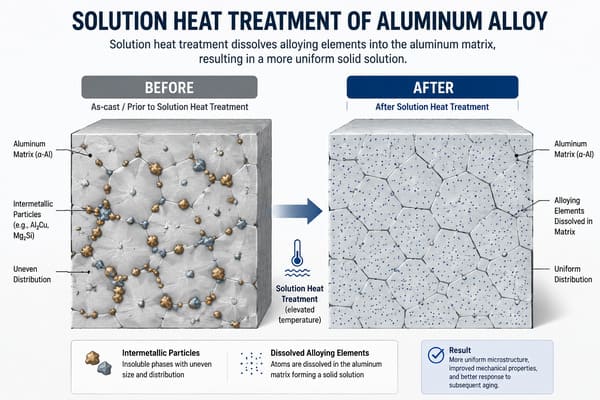
Solution heat treatment is not the finish line. It is the starting point of the entire heat treatment chain. Think of it this way: before you can rebuild something stronger, you need to clear the existing structure first. That is exactly what solution treatment does to the alloy’s microstructure.
Why the "Soft Stage" Matters More Than People Think
If a wheel were installed on a car immediately after solution treatment, it would not perform safely. The alloy at this stage has high ductility but low strength. It cannot handle the loads that road driving or track use demands.
The real value of solution treatment is what it makes possible afterward. By dissolving the alloying elements uniformly into the aluminum matrix, it creates the conditions for aging treatment to work at full effect. Without this step, the precipitation hardening in the next stage would be uneven, incomplete, or entirely ineffective.
| Stage | Alloy State | Strength Level | Purpose |
|---|---|---|---|
| Before Solution Treatment | Uneven microstructure | Low and unpredictable | — |
| After Solution Treatment | Supersaturated solid solution | Very low, highly ductile | Reset structure for aging |
| After Aging Treatment | Fine precipitates distributed | High and controlled | Final performance state |
The table above shows why solution treatment cannot be skipped or rushed. It is the foundation. Every performance gain that comes later depends on how well this step was executed. At Tree Wheels, we treat this stage with the same level of attention as the final aging step, because a poor solution treatment will ruin everything that follows.
What Is the Main Difference Between Heat Treated and Non-Heat Treated Aluminum Alloys?
People usually say heat-treated aluminum is "stronger." That is true, but it is not the most important difference. The real gap is much more significant for anyone making safety-critical components.
The key difference is predictability. Heat-treated aluminum alloys like 6061-T6 have controlled, repeatable mechanical properties. Non-heat-treated alloys depend heavily on cold working during manufacturing, which means strength varies between batches, positions, and production runs. For wheels, consistency matters as much as peak strength.
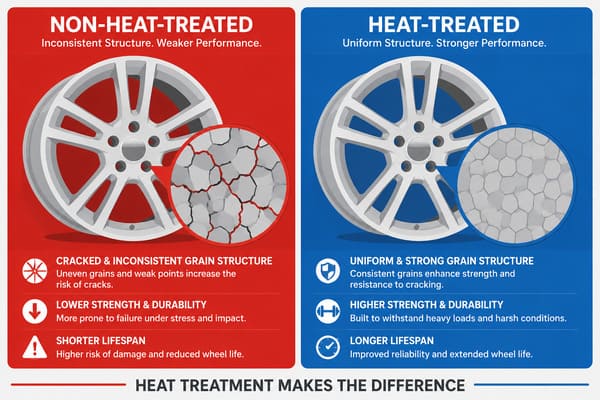
I have seen this issue cause real problems. A wheel that tests well in one batch but underperforms in the next is not a wheel you can trust. Non-heat-treated aluminum alloys carry that risk by design.
Controlled Strength vs. Random Strength
Non-heat-treated aluminum alloys gain their mechanical properties primarily through cold deformation during processing. The more the metal is worked, the stronger it gets in that area. But this also means different sections of the same wheel can have meaningfully different strength levels.
Heat-treated alloys follow a standardized thermal process. The parameters — temperature, hold time, quench rate, and aging duration — are controlled precisely. This produces predictable tensile strength, yield strength, and elongation values that you can verify and rely on.
| Property | Non-Heat-Treated Alloy | Heat-Treated Alloy (e.g., T6) |
|---|---|---|
| Strength Source | Cold deformation | Precipitation hardening |
| Batch Consistency | Variable | Highly consistent |
| Predictability | Low | High |
| Suitability for Safety Parts | Limited | Strong |
| Quality Verification | Difficult | Straightforward |
For a wheel, which is a safety-critical component, "occasionally performs well" is not acceptable. You need every single unit to meet the same standard. That is why all forged wheels we produce at Tree Wheels go through a standardized heat treatment process. The goal is not just strength — it is strength you can count on every time.
Which Heat Treatment Process Is Best for Forged Aluminum Wheels?
Most people will tell you T6 is the answer. It is the most common answer, and it is often correct. But it is not always the right choice, and recommending it without context is an oversimplification.
The best heat treatment process for forged aluminum wheels depends on how the wheel will be used. T6 delivers maximum strength and hardness for street and performance applications. T73 and over-aging treatments sacrifice some strength in exchange for better toughness and stress corrosion resistance, which suits high-impact or track environments.
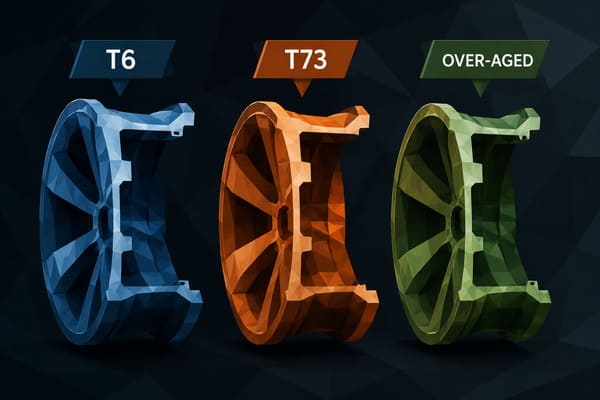
When a customer asks me which heat treatment we recommend, my first question back is always: what is this wheel going to do? The answer changes everything.
Matching the Process to the Application
The heat treatment decision is a trade-off between three properties: strength, toughness, and corrosion resistance. No single process maximizes all three. The right choice depends on which properties matter most for the specific use case.
| Treatment | Strength | Toughness | Corrosion Resistance | Best For |
|---|---|---|---|---|
| T6 | Very High | Moderate | Moderate | Street, performance, daily driving |
| T73 | Moderate | High | High | Track use, repeated impact loads |
| T7 (Over-aged) | High | Moderate-High | High | Harsh environments, corrosion-prone conditions |
| No Treatment | Low | High | Low | Not suitable for performance wheels |
T6 is the right choice for the vast majority of forged wheel applications. It delivers the highest tensile and yield strength, and it is well-suited for road use where static and dynamic loads are the primary concern. However, T6 aluminum is harder and less forgiving under repeated impact. On a track, where a wheel may hit curbs, absorb sudden lateral forces, or experience fatigue from repeated high-stress cycles, T6’s hardness can become a liability. In those cases, T73 or a controlled over-aging treatment can provide better real-world performance even though the numbers on a strength test look lower.
At Tree Wheels, we do not apply T6 by default to every order. We discuss the vehicle type, intended use, and the customer’s priorities before deciding on a heat treatment specification. That conversation is part of what we offer, not an extra service.
How Does T6 Heat Treatment Improve Wheel Strength and Durability?
The textbook answer is precipitation hardening: fine precipitates like Mg₂Si form within the aluminum matrix and block dislocation movement, which raises strength. That is accurate, but there is a more useful way to understand what T6 actually does.
T6 heat treatment builds an internal microscopic framework inside the aluminum alloy by redistributing existing alloying elements — not by adding new material. For 6061 aluminum, this process raises tensile strength from approximately 125 MPa in the untreated state to over 310 MPa after T6, more than doubling strength with zero increase in weight.
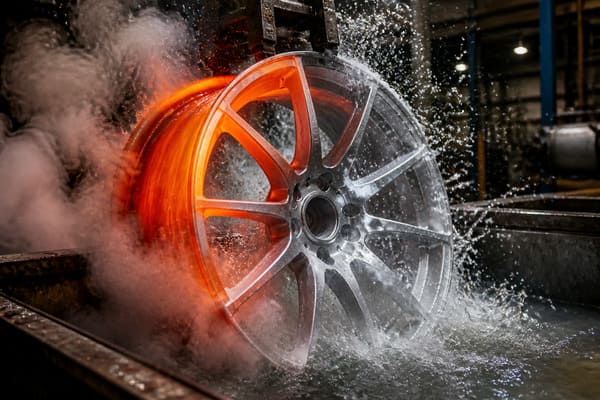
That last point is worth sitting with. The same material. The same weight. More than twice the strength. This is why forging combined with T6 heat treatment is the standard for high-performance wheels.
The T6 Process and What It Produces
T6 is not a single step. It is a two-stage sequence: solution heat treatment followed by artificial aging. Each stage plays a specific role in building the final mechanical properties.
Stage 1 — Solution Treatment: The wheel is heated to a high temperature (typically 520–540°C for 6061 aluminum) and held there until the alloying elements dissolve uniformly into the aluminum matrix. It is then rapidly quenched, usually in water, to lock the elements in place before they can form large, uncontrolled precipitates.
Stage 2 — Artificial Aging: The wheel is reheated to a lower temperature (typically 160–180°C) and held for several hours. During this time, very fine, evenly distributed precipitate particles form throughout the matrix. These particles are the "microscopic framework" I mentioned earlier. They physically block the movement of dislocations inside the crystal structure, which is the mechanism that raises strength.
| Property | 6061 Untreated | 6061-T6 | Improvement |
|---|---|---|---|
| Tensile Strength | ~125 MPa | ~310 MPa | +148% |
| Yield Strength | ~55 MPa | ~276 MPa | +402% |
| Hardness (Brinell) | ~30 HB | ~95 HB | +217% |
| Weight Change | — | None | 0% |
The combination of forging and T6 treatment is what makes a lightweight wheel genuinely strong. Forging aligns the grain structure of the aluminum for maximum directional strength. T6 then maximizes the strength of that already-optimized structure. Cast wheels cannot match this combination because casting does not produce the same grain alignment, and the alloys used in casting are not always suited to the same heat treatment response. For any customer who wants a wheel that is both light and structurally capable, forged plus T6 is the answer.
Conclusion
Heat treatment is not a finishing step. It is the process that determines whether a forged aluminum wheel is truly strong, consistent, and safe to use.
Tree Wheels produces fully customized forged wheels with certified heat treatment processes — built for performance, backed by 20+ years of manufacturing experience.