

Flow forged wheels appear everywhere in product listings today — and buyers in the US, Australia, and the Middle East consistently ask me whether they are the same as forged wheels. They are not. Conflating the two leads to mispriced orders, mismatched specifications, and real performance consequences you only discover after the wheels are mounted.
Flow forged wheels — also marketed as "flow formed" wheels — are not forged wheels. They begin as cast aluminum blanks. Rollers then apply heat and pressure to stretch and densify the barrel section only. The hub face remains cast. True forged wheels press a solid aluminum billet under high tonnage to form the entire wheel. The grain structure, weight distribution, and structural profile of each process are fundamentally different.
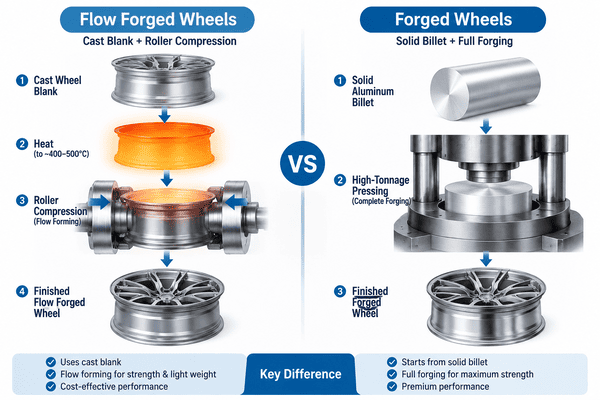
Understanding that distinction is step one. The more useful question is: what does that difference mean for your specific buying decision? The sections below break down both processes at the manufacturing level and give you a practical framework for choosing correctly.
How are flow forged wheels actually made?
Many buyers encounter "flow forged" on a product page and assume the word "forged" confirms the manufacturing method. That assumption is the most common source of confusion I see in buyer inquiries across global markets.
Flow forming starts with a low-pressure cast aluminum blank — essentially a rough wheel casting. The barrel of that casting is then heated and pressed against a mandrel while rollers apply radial force, stretching and compressing the metal outward. The result is a barrel with tighter grain structure than a standard cast barrel.
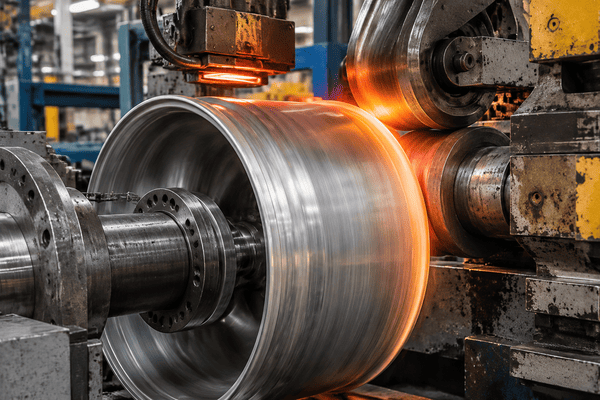
What the process actually changes — and what it does not
Flow forming improves the barrel in measurable ways:
- Barrel wall thickness decreases as metal is densified outward, reducing overall wheel weight
- Grain structure in the barrel tightens, improving barrel strength compared to a standard cast wheel
- The hub face and spoke area remain cast — they are not mechanically worked during the flow forming stage
This last point matters more than most product descriptions let on. In a true forged wheel, the entire structure — hub face, spokes, and barrel — is formed from a compressed billet under high pressure. The grain flow follows the geometry of the wheel continuously. Flow forming densifies one region of an otherwise cast component.
The practical implication for buyers
If you are evaluating a flow formed wheel, you are evaluating a cast wheel with an enhanced barrel. That is a legitimate product category. It is not a forged wheel. Pricing, load ratings, and application recommendations should reflect that reality.
Buyer check: If a product listing uses "flow forged" prominently but the spec sheet says "cast + flow formed" or "spun rim technology," the hub face is cast. Ask the supplier directly: "Is the hub face forged or cast?"
How is a true forged wheel made differently?
True forging is a fundamentally different starting point. The raw material is a solid aluminum billet — a dense, homogeneous cylinder of aluminum alloy with no porosity. High-tonnage presses then compress and shape that billet into the near-net form of a wheel.
In our manufacturing facility — which has produced forged wheels for over 20 years — this pressing process is what defines the product. The compression forces the grain structure to align continuously through the hub face, spokes, and barrel as a single, uninterrupted structure.1
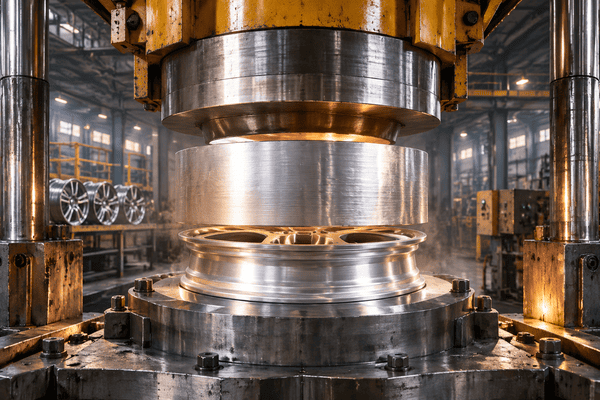
Why grain structure matters at the process level
Aluminum’s mechanical behavior depends heavily on how its grain structure is oriented.2 In a cast part, grains solidify randomly from molten metal. In a forged part, grains are mechanically aligned under pressure during forming.3
The practical consequences:
| Property | Cast Wheel | Flow Formed Wheel | Forged Wheel |
|---|---|---|---|
| Hub face grain structure | Random (cast) | Random (cast) | Aligned (forged) |
| Barrel grain structure | Random (cast) | Densified (worked) | Aligned (forged) |
| Overall porosity risk | Higher | Moderate | Lower |
| Weight reduction potential | Baseline | Moderate | High |
| Structural consistency | Variable | Partial | Full |
This table reflects general manufacturing principles, not certified test data from a specific product. Buyers evaluating load ratings and structural claims should request certified documentation from their supplier.
The buyer implication
For street use on a standard passenger vehicle, the difference in grain structure may never express itself in a failure mode. For track use, repeated high-load cornering, or vehicles with higher unsprung weight sensitivity, the structural consistency of a fully forged wheel becomes a relevant specification4 — not a marketing claim.
Is flow formed a fraud or a legitimate product?
This is the question I want to address directly, because I see two opposite overclaims in the market — and both of them mislead buyers.
Overclaim one: "Flow forged is basically forged." It is not. The hub face is cast. The forming process is different. The structural profile is different. Calling it "basically forged" sets an expectation the product cannot fully meet.
Overclaim two: "Flow formed is basically just cast — it’s cheap junk." That is also wrong. Flow forming is a real manufacturing improvement over standard casting. Barrel strength and weight are genuinely better. For many street and light performance applications, a well-made flow formed wheel is an appropriate, honest choice.
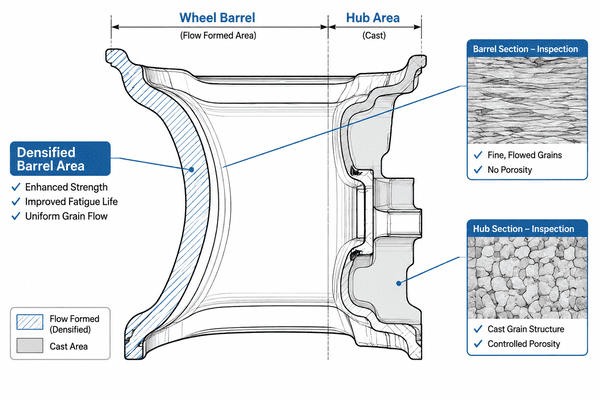
Where flow formed wheels fit honestly
Flow formed wheels occupy a legitimate mid-tier position:
- Better than standard cast in barrel strength and weight reduction
- Not equivalent to forged in whole-wheel structural consistency or weight reduction ceiling
- Appropriate for: Daily drivers, street builds, moderate performance applications, buyers with a mid-range budget who want weight savings over standard cast
- Not the first choice for: High-load track applications, vehicles where minimum unsprung weight is a design requirement, or buyers who have specified forged for structural reasons
How pricing misleads buyers
Premium pricing and luxury branding do not confirm the forming method. I see flow formed wheels priced near entry-level forged wheels regularly. I also see cast wheels sold at high margins because of brand positioning.
Price is not a proxy for process. If you want to confirm what you are buying:
- Ask the supplier: "Is this flow formed or forged from billet?"
- Request the spec sheet — look for explicit language like "cast + flow formed barrel" versus "forged from 6061-T6 billet"
- Check the manufacturer’s own product description, not the reseller’s listing copy
If a supplier cannot answer question one directly, treat that as a red flag.
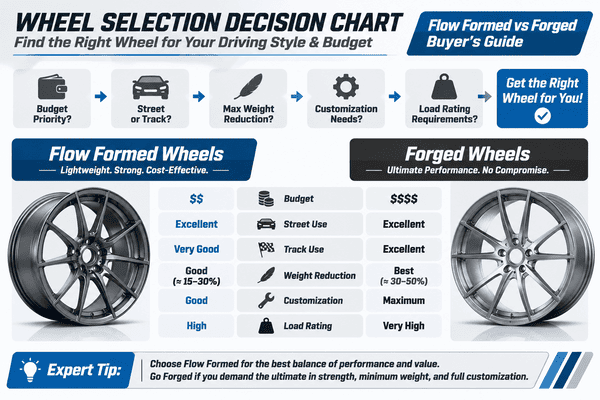
How do you choose between flow formed and forged wheels?
The wrong anchor for this decision is brand prestige or surface finish. Both flow formed and forged wheels can be finished to an identical visual standard. You cannot tell the difference by looking at a polished face.
The right anchor is your use case, target weight, budget, and load requirements.
A practical self-check before contacting a supplier
Before you inquire with any wheel supplier, answer these three questions:
1. What is the primary use case?
- Street / daily driver → flow formed is a reasonable option
- Track days, spirited driving, or repeated high-load use → forged is worth the price difference
2. How important is minimum weight?
- Weight savings matter but budget is constrained → flow formed delivers meaningful reduction over cast at lower cost
- Minimum unsprung weight is a performance requirement → only full forging delivers the full weight reduction profile
3. What is your vehicle’s load rating and wheel fitment specification?
- Standard passenger vehicle → either option can be spec’d correctly
- Modified vehicle, widened track, or non-standard offset → the structural consistency of forged becomes more relevant; get a qualified fitment evaluation
Comparing the two options by decision factor
| Decision Factor | Flow Formed | Forged |
|---|---|---|
| Budget | Lower | Higher |
| Street performance | Suitable | Suitable + margin |
| Track / high-load use | Evaluate carefully | Recommended starting point |
| Weight reduction | Moderate | High |
| Lead time (from Tree Wheels) | — | 15–35 days depending on type |
| MOQ (from Tree Wheels) | — | 4 wheels |
| Customization depth | Limited | Full (size, design, color, finish) |
Tree Wheels produces one-piece, two-piece, and three-piece forged wheels only. We do not produce flow formed wheels. I include flow formed in this comparison because buyers deserve an honest framework, not a sales pitch that pretends the mid-tier category does not exist.
Frequently Asked Questions
Are flow forged wheels safe?
A well-manufactured flow formed wheel from a reputable supplier is safe for its intended application. Safety depends on the manufacturer’s quality controls, the wheel’s load rating relative to your vehicle, and correct fitment. Certifications such as DOT and TÜV are documents worth verifying — ask your supplier for copies before purchasing.5
How can I tell if a wheel is truly forged or just flow formed?
Ask the supplier directly whether the wheel is forged from a solid billet or cast and flow formed. Request the spec sheet and look for explicit process language. If the description says "spun rim," "flow formed barrel," or "cast + flow forming," the hub face is not forged. If a supplier cannot clarify this in writing, consider that a procurement risk.
Does the finish or appearance tell you whether a wheel is forged?
No. Surface finish — polish, paint, powder coat, brushed — is applied after the structural process is complete. A flow formed wheel and a forged wheel can be finished identically. Visual appearance tells you nothing about the forming method.
Is a forged wheel always worth the higher price?
Not always. For a daily driver on standard road surfaces, a quality flow formed wheel may meet your actual performance requirements at lower cost. The forged price premium is most justified for track applications, high-load fitments, and builds where minimum unsprung weight is a genuine engineering requirement.
What certifications should I look for when buying forged wheels?
Relevant certifications include ISO 9001 (quality management systems), IATF 16949 (automotive-specific quality)6, DOT (US market compliance), and TÜV (European/German technical testing). Tree Wheels carries all four. Treat certifications as documents to verify, not claims to accept at face value — ask your supplier for copies.
Conclusion
Flow forged wheels and forged wheels are not the same product. Flow forming densifies the barrel of a cast blank — it does not forge the entire wheel from billet. True forged wheels form the complete structure under high pressure, producing continuous grain alignment across the hub face, spokes, and barrel. For street applications and moderate performance builds, flow formed wheels are a legitimate mid-tier choice. For track use, high-load fitments, and builds where structural consistency matters, forged wheels are the specification to start with.
Before you inquire with any supplier, answer the three self-check questions in this article: use case, weight priority, and load requirements. If you are evaluating forged wheels specifically — one-piece, two-piece, or three-piece, fully customized — Tree Wheels is ready to answer your questions directly. Contact us to discuss your fitment requirements and get a quote.
-
"Comparison of Mechanical and Corrosion Properties Between …", https://pmc.ncbi.nlm.nih.gov/articles/PMC12842727/. Metallurgical analyses of closed-die forged aluminum components show that plastic deformation during forging causes grain flow to follow the part geometry continuously, in contrast to cast microstructures where grain orientation is determined by solidification conditions rather than part shape; this continuous grain alignment is associated with improved fatigue resistance and directional strength. Evidence role: mechanism; source type: research. Supports: Closed-die forging of aluminum alloys produces continuous grain flow that follows the contours of the die geometry, resulting in aligned grain structure throughout complex shapes including hub faces and spoke profiles.. Scope note: Studies on grain flow continuity in forged aluminum wheels specifically are limited in open literature; the principle is well established for forged aluminum components generally and is extrapolated to wheel geometry. ↩
-
"How Are Maximum Load Ratings Determined Through Scientific …", https://treewheels.com/how-are-maximum-load-ratings-determined-through-scientific-testing/. Materials science literature establishes that aluminum alloys exhibit mechanical anisotropy related to crystallographic texture and grain orientation; components with aligned grain structures produced by deformation processes such as forging or rolling typically demonstrate superior fatigue resistance and tensile strength in the direction of grain alignment compared to components with randomly oriented grains produced by casting. Evidence role: expert_consensus; source type: research. Supports: The mechanical properties of aluminum alloys, including tensile strength, fatigue resistance, and ductility, are influenced by grain structure orientation due to the anisotropic nature of aluminum’s crystal structure.. ↩
-
"A Review on Porosity Formation in Aluminum-Based Alloys", https://pmc.ncbi.nlm.nih.gov/articles/PMC10004325/. Standard metallurgical references describe casting as producing equiaxed or columnar grain structures dependent on solidification conditions, while forging induces grain flow aligned with the deformation direction, typically improving tensile strength, fatigue life, and impact resistance relative to cast equivalents of the same alloy. Evidence role: mechanism; source type: encyclopedia. Supports: Casting produces randomly oriented grain structures as metal solidifies from a liquid state, whereas forging mechanically deforms solid metal to align grain flow with the part geometry, generally improving directional mechanical properties.. ↩
-
"Signature redacted", https://dspace.mit.edu/bitstream/handle/1721.1/116487/14051765-MIT.pdf?sequence=1&isAllowed=y. Vehicle dynamics research establishes that unsprung mass — the mass of components not supported by the suspension, including wheels and tires — directly affects suspension response frequency and road-holding capability; reductions in unsprung mass have been associated with improved ride quality and handling, providing an engineering basis for specifying lightweight wheels in performance applications. Evidence role: mechanism; source type: research. Supports: Reducing unsprung mass, including wheel weight, improves suspension response and handling dynamics, making wheel structural properties and weight relevant specifications for performance applications.. Scope note: The magnitude of handling improvement attributable specifically to wheel weight reduction versus other unsprung components varies by vehicle platform and driving condition; general dynamics principles apply but specific performance gains depend on system-level factors. ↩
-
"Interpretation ID: 86-1.39", https://www.nhtsa.gov/interpretations/86-139. In the United States, wheel compliance is governed by Federal Motor Vehicle Safety Standards administered by the National Highway Traffic Safety Administration (NHTSA); TÜV certification refers to testing conducted by Technischer Überwachungsverein (Technical Inspection Association) organizations against applicable European automotive standards, with both serving as third-party verification of structural and safety performance. Evidence role: definition; source type: government. Supports: DOT certification for wheels relates to US Federal Motor Vehicle Safety Standards compliance, while TÜV certification refers to testing by German technical inspection authorities against European standards.. Scope note: Specific FMVSS provisions applicable to aftermarket wheels and the precise TÜV test protocols for wheel certification may require reference to the relevant regulatory texts for full accuracy. ↩
-
"IATF 16949", https://en.wikipedia.org/wiki/IATF_16949. ISO 9001 specifies requirements for a quality management system applicable across industries, while IATF 16949, published by the International Automotive Task Force, defines quality management system requirements specific to automotive production and service part organizations, building on ISO 9001 with additional automotive-sector requirements. Evidence role: definition; source type: institution. Supports: ISO 9001 is an internationally recognized quality management system standard, and IATF 16949 is a sector-specific quality management standard for automotive production and relevant service part organizations.. ↩