
Ordering a custom set of forged wheels is exciting — until they arrive and sit two inches too deep inside the fender well, or worse, rub against your brake calipers on every turn. A wheel offset calculator exists precisely to prevent that outcome. Most buyers skip it, copy a number from a forum, and hope for the best.
A wheel offset calculator is a tool that helps you determine whether a specific wheel offset value will place your wheel and tire in a safe position relative to your fender, suspension components, and brake hardware. You input your wheel width, backspacing, and hub centerline data, and the calculator converts those measurements into an ET (offset) value — or tells you how a proposed ET value changes the wheel’s position compared to your current setup.

Understanding the output of that calculator, however, is the part most guides skip. The number it gives you is a starting point for evaluation — not a green light to place your order. Let me explain why, and what you actually need to know before you confirm your wheel specs.
What Does Wheel Offset Actually Mean — and Why Does the Number Feel Backwards?
Most buyers assume a higher offset number means the wheel sticks out more. It doesn’t. This counterintuitive relationship causes real problems in the ordering process.
Wheel offset (measured in millimeters, expressed as ET) is the distance between the wheel’s mounting face and its true centerline. A positive ET value means the mounting face sits toward the street side of the wheel, pushing the wheel inward. A negative ET value means the mounting face sits toward the brake side, pushing the wheel outward.1 Zero offset means the mounting face aligns exactly with the wheel’s centerline.

In our inquiry process at Tree Wheels, this is one of the most frequent points of confusion we clarify before production begins. A customer building a wide-body kit will often specify the same ET value as a customer on a completely stock suspension — without realizing those two applications require fundamentally different offsets.
The Spatial Logic, Explained with Two Real Scenarios
Consider two customers ordering the same 9-inch-wide wheel in ET25 and ET-10 respectively:
- ET25 (positive offset): The mounting face sits 25mm toward the outer edge of the wheel. The wheel tucks inward. This is typical for factory fitments where the suspension and brake hardware sit close to the inner barrel.
- ET-10 (negative offset): The mounting face sits 10mm inward from center. The wheel pushes outward. This is common in wide-body builds where fender flares create clearance, but the stock inner suspension geometry does not.
Neither value is universally "correct." What matters is how that position intersects with your specific vehicle’s:
- Brake caliper clearance — positive offset can cause the inner barrel to contact the caliper
- Suspension control arm travel — at full droop, the wheel moves relative to the arch
- Fender lip and liner position — negative offset pushes the tire outward and can cause rubbing under load or during turns
- Strut housing clearance — often the first casualty of a wide wheel with too-positive an offset
The calculator shows you the number. Whether that number works is a judgment call based on these variables.
How Does a Wheel Offset Calculator Actually Work?
The math behind offset calculators is straightforward. What makes them useful — or misleading — is whether you feed them accurate inputs.
A wheel offset calculator uses the relationship between wheel width and backspacing to derive or verify an offset value. The core formula is: Offset (mm) = Backspacing − (Wheel Width ÷ 2)2. If you input your wheel width and backspacing accurately, the calculator tells you the ET value of that wheel. Alternatively, input your current ET and a new proposed ET to see how many millimeters the wheel will move inward or outward.

The formula itself is reliable. The inputs, however, are where most orders go wrong. Here is a breakdown of each input and where buyers most commonly make mistakes.
Input 1: Wheel Width
This is the inner bead-to-inner bead measurement, not the overall width of the wheel including the lips. A wheel listed as 9 inches wide may have an overall width closer to 10.5 inches once you account for the outer lip profile.3 When you input the wrong width, every downstream calculation shifts.
Input 2: Backspacing
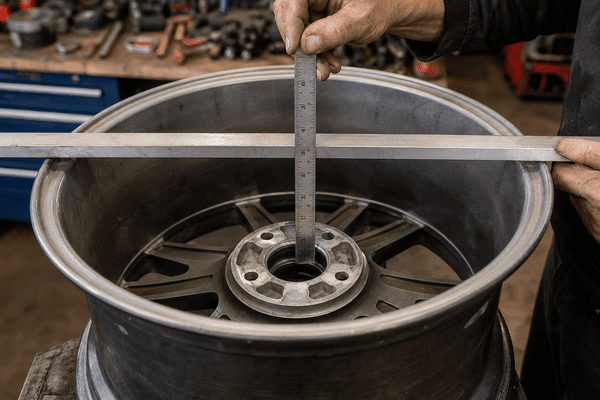
Backspacing is the distance from the wheel’s mounting face to the back edge of the rim4. This is the measurement most buyers either don’t know or confuse with offset. You can measure it directly on your current wheels using a straightedge and a ruler. Place the straightedge across the back of the wheel, then measure down to the mounting pad.
In orders we’ve processed, customers sometimes submit a backspacing figure taken from a product listing that measured to the outer lip edge — not the mounting face. That produces an offset calculation that is meaningless.
Input 3: The Offset Comparison Delta
Many offset calculators also let you compare your current ET against a proposed ET. The output is a simple millimeter shift:
| Current ET | Proposed ET | Shift Direction | Shift Amount |
|---|---|---|---|
| ET35 | ET25 | Outward (toward fender) | 10mm |
| ET35 | ET45 | Inward (toward brake) | 10mm |
| ET20 | ET-5 | Outward | 25mm |
| ET15 | ET30 | Inward | 15mm |
Each 10mm shift outward increases your risk of fender contact. Each 10mm shift inward increases your risk of brake caliper contact. The calculator shows you the magnitude. Whether that magnitude is acceptable depends entirely on your clearance margins — which the calculator cannot measure for you.
What the Calculator Cannot Account For
This is the part that matters most for a buyer considering custom forged wheels:
- Suspension droop and compression travel — your wheel position at ride height is not your worst-case position
- Tire width and stretch — a wider tire on the same wheel pushes the contact patch outward regardless of offset
- Body kit variations — if you’ve added flares or lip kits, your clearance envelope has changed from factory spec
- Camber adjustment — negative camber moves the top of the tire inward but the bottom outward; offset interacts with camber in ways a static calculator doesn’t model5
- Brake upgrade packages — aftermarket big-brake kits dramatically reduce inner barrel clearance6
I always recommend that buyers get a professional fitment check — ideally from their modification shop — before confirming custom wheel specs. No calculator replaces physical measurement on the actual vehicle.
How Do You Find the Right Inputs for Your Vehicle?
This is where most self-research stalls. Buyers know they need offset and backspacing data, but don’t know where to find reliable figures for their specific car.
To find the correct inputs for a wheel offset calculator, check your vehicle’s owner manual for OEM wheel specs, measure your existing wheels directly for backspacing, and verify your hub bore and bolt pattern against a fitment database. Never rely solely on forum-sourced offset recommendations without confirming the reference vehicle had the same trim level, suspension setup, and tire size as yours.
Where to Find Each Data Point
From your OEM wheel or owner’s manual:
- Bolt pattern (e.g., 5×114.3)7
- Hub bore diameter
- Factory offset (ET value)
- Factory wheel width
From direct measurement of your existing wheel:
- Actual backspacing (straightedge method described above)
- Actual wheel width (bead seat to bead seat)
From fitment databases (use as a cross-reference only):
- Sites like WheelSize.com aggregate OEM and aftermarket fitment data by make, model, year, and trim8
- Treat these as a starting range, not a confirmed fit — trims vary significantly
The Forum Problem We See Constantly
In our pre-sale inquiries, we regularly see customers submit offset values copied from forum posts — without checking whether the reference car had the same wheel width, trim level, or brake configuration. A post from a 2018 Mustang GT owner running ET20 on a 10-inch wheel does not apply to a 2021 Mustang GT500 with Brembo brakes.9 The offset value may be identical in both posts, but the fitment context is entirely different.
This is a common point of confusion we clarify before finalizing production specs. A few targeted questions about the customer’s actual vehicle configuration — not the forum reference — often reveals a 10–15mm discrepancy that would have caused fitment problems on delivery.
Frequently Asked Questions
Is a wheel offset calculator accurate enough to confirm a custom wheel order?
A calculator gives you a precise mathematical output based on your inputs. It is accurate as a calculation tool. However, it cannot account for suspension travel, tire width, body kit modifications, or brake upgrade clearances. Use it as a pre-screening filter, then confirm final specs with a professional fitment check on your actual vehicle.
What happens if I order wheels with the wrong offset?
The consequences depend on the direction and magnitude of the error. Too-positive an offset risks brake caliper contact or inner suspension rubbing. Too-negative an offset risks fender scrubbing, especially during turns or under load.10 In severe cases, the wheels are unusable without adding spacers or modifying the vehicle — neither of which is ideal for a custom forged wheel order.
What is the difference between offset and backspacing?
Offset (ET) is the distance from the mounting face to the wheel’s centerline, expressed in millimeters. Backspacing is the distance from the mounting face to the back edge of the rim, expressed in inches or millimeters. Both describe wheel position, but backspacing is a physical measurement while offset is a derived value. Knowing both gives you the most complete picture of fitment.
Can I use the same offset on a wider aftermarket wheel as my factory wheel?
Not necessarily. If you increase wheel width without adjusting offset, the wheel will move outward by half the added width — because the centerline shifts. For example, going from an 8-inch wheel at ET35 to a 10-inch wheel at ET35 moves the outer face of the wheel outward by approximately 25mm11. This often causes fender rubbing, especially with a wider tire.
Where can I find a reliable wheel offset calculator?
Several reputable tools are available online, including calculators from Tire Rack, Wheel-Size.com, and dedicated offset comparison tools from larger wheel retailers. Any calculator that accepts wheel width and backspacing as inputs will give you a mathematically valid result — but always pair the output with physical vehicle measurements.
Conclusion
A wheel offset calculator is a genuinely useful tool for anyone evaluating custom wheel fitment. It converts physical measurements — wheel width, backspacing, mounting face position — into a clear millimeter value that tells you how a wheel will sit relative to your vehicle’s centerline. Used correctly, it filters out incompatible options before you commit to a production order. But a wheel offset calculator works only as well as the inputs you give it, and it cannot replace on-vehicle clearance verification for suspension travel, brake hardware, or body modifications.
At Tree Wheels, we work through offset specifications with every customer before production begins — because a beautifully manufactured forged wheel that doesn’t fit is a problem neither of us wants. If you’re planning a custom forged wheel order and want to walk through your offset requirements with someone who has seen these fitment challenges firsthand, reach out to our team before you finalize your specs.
-
"Wheel sizing", https://en.wikipedia.org/wiki/Wheel_sizing. Wheel offset, expressed as ET (from the German Einpresstiefe, meaning ‘insertion depth’), is defined as the distance in millimeters from the wheel’s hub mounting face to the centerline of the wheel; positive values indicate the mounting face is displaced toward the outer (street) side, while negative values indicate displacement toward the inner (brake) side. Evidence role: definition; source type: encyclopedia. Supports: The directional convention for positive and negative ET offset values relative to the wheel mounting face and centerline.. Scope note: General encyclopedic sources may describe the convention without citing a specific ISO or SAE standard, making this definitional rather than normatively authoritative. ↩
-
"Wheel Offset and backspacing calculator", https://www.1010tires.com/Tools/Wheel-Offset-Calculator?srsltid=AYCX9vKaK1ncND7fxIDH8sN5hR9lsR9mR030YnED9oV6Arc88iVbpp7r. The relationship between backspacing and offset is expressed as: Offset (mm) = Backspacing − (Wheel Width ÷ 2), where all measurements must be in consistent units; this formula is widely cited in automotive fitment literature and wheel manufacturer technical documentation. Evidence role: mechanism; source type: institution. Supports: The standard arithmetic relationship between wheel backspacing, wheel width, and ET offset value.. Scope note: This formula assumes bead-seat-to-bead-seat width as the wheel width input; sources that use overall width will produce different results, so the specific measurement convention should be confirmed. ↩
-
"European Tyre and Rim Technical Organisation", https://en.wikipedia.org/wiki/European_Tyre_and_Rim_Technical_Organisation. Industry standards bodies such as the Tire and Rim Association (TRA) and the European Tyre and Rim Technical Organisation (ETRTO) define wheel width as the distance between inner bead seats, which is consistently narrower than the overall rim width measured across the outer lips. Evidence role: definition; source type: institution. Supports: That the industry-standard wheel width measurement is taken between inner bead seats and differs from the overall rim width including lips.. Scope note: The specific 1.5-inch example given in the article is illustrative; actual lip-to-lip overhang varies by wheel design and manufacturer, and no universal figure applies across all rim profiles. ↩
-
"How to Match Wheel Rim and Tire Sizes?", https://treewheels.com/how-to-match-wheel-rim-and-tire-sizes/. Wheel backspacing is defined as the distance from the hub mounting face to the back (inboard) edge of the rim, typically measured in inches in North American practice; it is a direct physical measurement, in contrast to offset, which is a derived value representing the mounting face’s displacement from the wheel’s centerline. Evidence role: definition; source type: encyclopedia. Supports: That wheel backspacing is the linear distance measured from the hub mounting face to the innermost (brake-side) edge of the rim.. Scope note: Some sources measure backspacing to the inner lip rather than the inner bead seat edge; the article does not specify which reference point is used, which can introduce small measurement discrepancies. ↩
-
"Camber angle", https://en.wikipedia.org/wiki/Camber_angle. In suspension geometry, negative camber tilts the wheel such that the top leans inward toward the vehicle; as a consequence, the lower contact patch moves outward, an effect that compounds with wheel offset to determine actual fender and suspension clearance and is not represented in static offset calculations. Evidence role: mechanism; source type: education. Supports: That negative camber angles cause the lower portion of the tire to move outward relative to the vehicle centerline, affecting effective clearance independently of static offset measurements.. Scope note: The magnitude of this effect depends on camber angle, tire sidewall height, and wheel diameter; the article does not quantify the interaction, and sources may address camber effects on handling rather than fitment clearance specifically. ↩
-
"How Do You Ensure Proper Brake Caliper Clearance When …", https://treewheels.com/how-do-you-ensure-proper-brake-caliper-clearance-when-upgrading-wheels/. Aftermarket performance brake systems typically employ larger-diameter rotors and multi-piston calipers that extend further inward than OEM brake hardware, reducing the clearance envelope available to the wheel’s inner barrel and necessitating offset adjustments or wheel designs with greater inner clearance. Evidence role: general_support; source type: institution. Supports: That aftermarket big-brake kits use larger calipers than OEM units, reducing the available inner barrel clearance and requiring wheel offset recalculation.. Scope note: The degree of clearance reduction varies substantially by brake kit manufacturer and vehicle platform; the article’s use of ‘dramatically’ is qualitative and not supported by specific dimensional data. ↩
-
"Bolt circle", https://en.wikipedia.org/wiki/Bolt_circle. Wheel bolt patterns are specified by the number of lug bolts and the pitch circle diameter (PCD) — the diameter of the circle on which the bolt centers lie — expressed in millimeters; 5×114.3 denotes five bolts on a 114.3mm PCD and is among the most common specifications used by Japanese and American manufacturers. Evidence role: definition; source type: encyclopedia. Supports: That wheel bolt patterns are expressed as the number of bolts multiplied by the pitch circle diameter in millimeters, and that 5×114.3 is a widely used specification.. Scope note: Fitment databases list vehicles by bolt pattern but OEM specifications should be verified against manufacturer documentation, as some vehicles use multiple bolt patterns across trim levels. ↩
-
"Wheel sizing", https://en.wikipedia.org/wiki/Wheel_sizing. Online wheel fitment databases compile OEM and aftermarket specifications by vehicle make, model, year, and trim; however, because brake packages, suspension configurations, and wheel arch dimensions can vary between trim levels of the same model year, database entries may not reflect all vehicle variants accurately. Evidence role: general_support; source type: other. Supports: That online wheel fitment databases organize specifications by vehicle trim level and that trim-level variation is a known limitation of such resources.. Scope note: The accuracy of any specific database depends on its data sourcing methodology, which is not always publicly documented; the article appropriately recommends treating these as a starting range rather than a confirmed fit. ↩
-
"Ford Mustang GT PP 6-Piston Brembo Front Brake Caliper", https://www.steeda.com/ford-oe-fr3z-2b120-e-s550-black-brembo-brake-caliper?srsltid=AYCX9vJ_DVe5Xvq5MHznDHjsWFxUuB11ETitXp4fG4bCtY04Yc9cIo7M. The 2021 Ford Mustang Shelby GT500 is factory-equipped with Brembo six-piston front brake calipers, which are substantially larger than the single-piston sliding calipers used on the base Mustang GT; this dimensional difference means that wheel offset values suitable for the GT may result in caliper contact when applied to the GT500. Evidence role: case_reference; source type: other. Supports: That the 2021 Ford Mustang Shelby GT500 is equipped with Brembo brake calipers that are dimensionally larger than those on the standard Mustang GT, making offset recommendations non-transferable between these trims.. Scope note: Exact caliper-to-barrel clearance figures for these specific vehicles are not publicly standardized; the example illustrates a general principle about trim-level variation rather than providing a precisely measured clearance comparison. ↩
-
"Can 18×9 Wheels Fit on a Subaru WRX STI GD Without Fender …", https://treewheels.com/can-18×9-wheels-fit-on-a-subaru-wrx-sti-gd-without-fender-work/. Wheel fitment guidelines consistently identify two primary failure modes associated with incorrect offset: excessive positive offset reduces inner barrel clearance to brake calipers and suspension arms, risking contact under load; excessive negative offset moves the tire outward toward the fender lip, with contact most likely during cornering when body roll and steering input combine to reduce available clearance. Evidence role: general_support; source type: institution. Supports: That excessive positive offset can cause the inner wheel barrel to contact brake calipers or suspension components, and that excessive negative offset can cause the tire or wheel to contact the fender, particularly under dynamic loading conditions.. Scope note: The threshold at which these failure modes occur is vehicle-specific and depends on OEM clearance margins, suspension design, and tire width; no universal offset tolerance applies across all vehicles. ↩
-
"Is +35mm Offset Too Much for a Toyota Supra MK4?", https://treewheels.com/is-35mm-offset-too-much-for-a-toyota-supra-mk4/. When wheel width increases while ET offset remains constant, the mounting face position is unchanged but the centerline moves outward by half the added width; a 2-inch (approximately 50.8mm) width increase therefore shifts the outer face outward by approximately 25mm, a relationship derivable directly from the offset formula. Evidence role: mechanism; source type: institution. Supports: That increasing wheel width by 2 inches while maintaining the same ET offset displaces the outer wheel face outward by approximately 25mm due to the shift in the wheel’s centerline.. Scope note: This is a geometric consequence of the offset formula rather than an empirically measured value; the article’s figure of 25mm is consistent with the formula but is presented without showing the derivation. ↩