
Shops sourcing forged wheels today face a quiet but costly problem: the word "forged" has been stretched so far from its original meaning that it no longer reliably describes a manufacturing process. Buyers pay forged prices, receive a product labeled forged, and have no simple way to know what they actually bought.
True forged wheels never disappeared. They were buried under an industry-wide labeling problem. "Forged" became a marketing word that suppliers apply to flow-formed, semi-forged, and even cast-then-machined products. The manufacturing process — closed-die forging under high tonnage pressure, using a billet of specific alloy — is the only thing that makes a wheel genuinely forged. The label on the box does not confirm that process happened.
This distinction matters most to modification shops. When a shop specs a wheel for a performance build or a luxury fitment and the wheel underperforms, bends, or fails inspection, the label "forged" offers no protection. Understanding what questions to ask — before the purchase order goes out — is the only reliable defense.
How did "forged" become a meaningless label?
The word carries enormous commercial weight in the wheel industry. Every buyer in a modification shop has heard that forged wheels are lighter, stronger, and more precise than cast alternatives1. That reputation is real — but it was earned by a specific manufacturing process, not by a category of marketing claims.
"Forged" became detached from process because there is no universal retail enforcement mechanism preventing a supplier from using the term loosely. Flow-formed wheels, semi-forged wheels, and rotary-forged wheels are regularly marketed under variations of the forged label. Unless a buyer asks direct process questions, the label itself provides no useful information.
The practical consequence is that shops are making purchasing decisions based on a word that has been commercially diluted. I hear this directly in conversations with shop owners sourcing wheels for customer builds. A recurring pattern: a shop comes in having already purchased wheels from another supplier, labeled forged, priced accordingly, and they want confirmation that the product is what they paid for. In multiple cases, the wheels were flow-formed or used a cast core with a forged-style finish — not the same product, not the same structural outcome.
What actually defines true forged construction?
From what our manufacturing partner — a facility with over 20 years of forged wheel production — documents in their process, a genuinely forged wheel requires:
- A billet starting material — a solid slug of aluminum alloy (commonly 6061-T6 or 70752), not molten poured metal
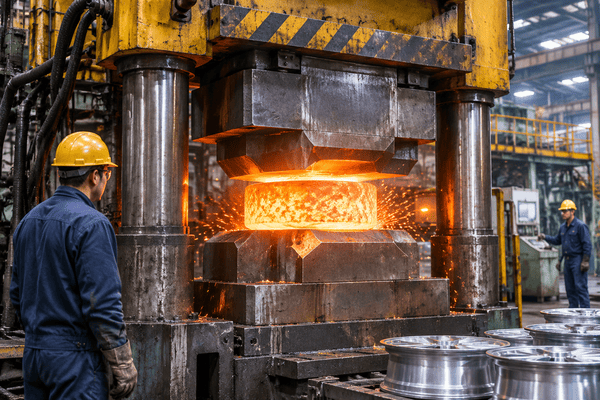
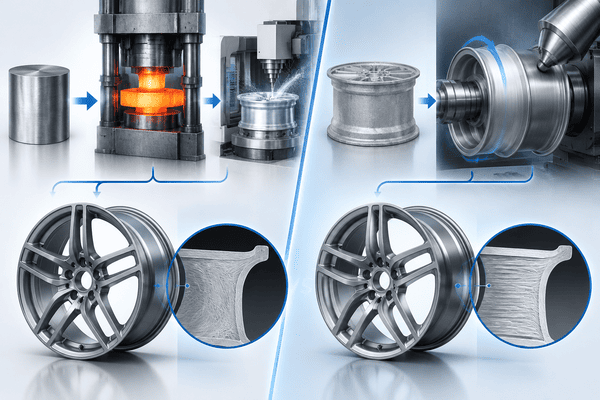
- High-tonnage press forging — the billet is compressed under thousands of tons of pressure inside a closed die, aligning the grain structure of the metal along the wheel’s stress lines3
- Post-forge heat treatment — tempering to achieve the intended mechanical properties of the alloy
- CNC machining from the forged blank — material is removed to achieve final geometry, tolerances, and surface finish
Each step has a cost. Tooling dies are expensive to produce and maintain. Press time is capacity-constrained. Material loss from machining a billet down to a finished wheel is significant. None of that cost disappears just because a competitor chose a cheaper process and called it forged.
Why do alternative processes get called "forged"?
Flow-forming, for example, is a legitimate and capable manufacturing method. A flow-formed wheel starts with a cast blank that is then spun and rolled under pressure to elongate and thin the barrel.4 This process does improve the material properties of the barrel section. It is not forging. The confusion enters when manufacturers market these wheels with phrases like "forged technology" or "forging-inspired process."
The same pattern appears with terms like:
| Term Used in Marketing | Actual Process | Key Distinction |
|---|---|---|
| Forged | True closed-die billet forging | Full grain alignment, full billet origin |
| Flow-forged / Rotary-forged | Cast center + flow-formed barrel | Cast core, not billet-forged throughout |
| Semi-forged | Varies — often cast with forged finish | No standardized definition |
| Monoblock forged | Can be true forged or misleadingly named | Requires process verification |
A shop relying on marketing terminology alone will not be able to reliably distinguish between these categories.
Does certification tell you whether a wheel is truly forged?
Many shops treat certifications — DOT, TÜV, ISO9001, IATF16949 — as a quality shortcut. If the wheel has the stamp, the reasoning goes, it must be what it claims to be.
Certifications confirm safety thresholds and quality management systems — they do not certify manufacturing method. A DOT-compliant wheel has passed impact and fatigue load tests. TÜV certification confirms the wheel meets European structural and dimensional standards. Neither document states whether the wheel was produced from a forged billet or a cast blank with secondary processing.
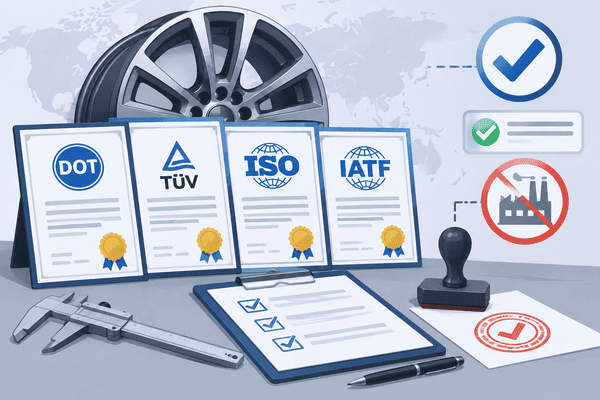
I want to be direct about this because I see shops treat certifications as a complete vetting checklist. They are not. Certifications are necessary — I would not source from a supplier without them — but they answer a different question than "is this wheel truly forged?"
What certifications actually tell you
Here is a clear breakdown of what each common certification covers:
- DOT (Department of Transportation): Required for road use in the US. Confirms the wheel passed specific load, impact, and fatigue tests. Does not address manufacturing process.
- TÜV (Technischer Überwachungsverein): German certification covering structural and dimensional performance. Widely respected globally. Tests the finished product, not the production method.
- ISO 9001: A quality management system standard. Confirms the factory has documented processes and consistent quality control. Does not specify what those processes are.
- IATF 16949: Automotive-specific quality management, stricter than ISO 9001. Confirms supply chain controls and production discipline. Again, process-neutral.
A genuinely certified supplier should be able to produce these documents and have them verified. But a shop that stops at certification has only confirmed the wheel meets minimum structural performance benchmarks. The process — and the structural properties that come from true forging — requires a separate line of inquiry.
What questions should a modification shop actually ask?
The most effective way to protect a shop from purchasing misrepresented forged wheels is to ask specific, process-level questions that a supplier selling a non-forged product cannot answer accurately without contradicting themselves.
A shop can expose a misrepresented "forged" wheel by asking: What is the starting billet material and weight? What press tonnage is used for forging? Does your facility have forging dies on-site, or is forging contracted out? These questions separate suppliers who control a true forged process from those who buy pre-shaped blanks and apply finishing.
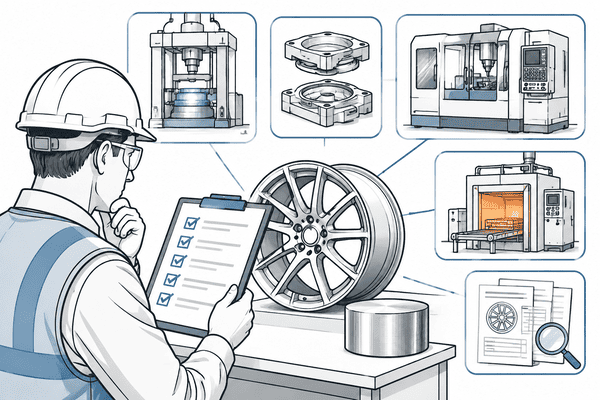
Based on what I have observed through our manufacturing partner’s process and through direct conversations with shop owners who have had bad sourcing experiences, here is the checklist that consistently separates real suppliers from label-only sellers:
The supplier qualification checklist
1. Starting material
- What alloy is the billet? (6061-T6 and 7075 are standard for performance forged wheels)
- What is the billet weight before forging and the finished wheel weight? (A high material-loss ratio indicates genuine billet machining5)
2. Forging process
- What press tonnage is used? (True forging of a full-size wheel requires substantial press capacity — a supplier who cannot name a specific tonnage is a red flag)
- Is forging done in one heat or multiple? (Multi-heat forging is common for complex geometries; the supplier should be able to explain their sequence)
- Is this closed-die forging? (Open-die or impression-die forging produces different structural results)
3. On-site capability
- Does the facility own and operate the forging press and dies, or is forging contracted to a third party?
- Can you visit or receive documentation of the forging line?
4. Post-forge treatment
- What heat treatment process follows forging? (T6 temper, for example, involves solution heat treatment and artificial aging6 — a supplier should be able to name the treatment)
- What are the CNC tolerancing specs for the finished bore and mounting face?
5. Sample and documentation
- Can the supplier provide a 3D model and sample before full production?
- Is there traceable documentation connecting a finished wheel to its billet batch?
A supplier operating a legitimate forged production line will answer these questions without hesitation. In my experience, suppliers who cannot — or who redirect to marketing language and certifications — are not producing true forged wheels, regardless of what the label says.
Frequently Asked Questions
Is there a price point below which a wheel cannot be truly forged?
Yes, in practice. True forged production carries structural cost: tooling dies, press capacity, billet material, post-forge machining, and heat treatment. A wheel priced significantly below the market rate for verified forged product from a reputable source warrants direct process questions. The cost difference is structural, not just brand markup.
Can a flow-formed wheel perform as well as a forged wheel?
For many street applications, a quality flow-formed wheel performs adequately. The distinction matters most in high-load applications — performance builds, track use, heavy vehicles, or luxury fitments where dimensional tolerance and weight are critical specifications.7 A modification shop should match the manufacturing process to the application, not the label to the budget.
Do two-piece and three-piece wheels follow the same forging rules?
The forging question applies to each individual component. A two-piece or three-piece wheel may have a forged center with a spun or rolled barrel, which is a legitimate construction — but it should be described accurately. Each piece should be evaluated for its own manufacturing process.
Why doesn’t the wheel industry standardize the use of the term "forged"?
There is no governing body with enforcement authority over how wheel manufacturers use manufacturing terminology in marketing materials.8 Industry associations publish standards for performance and safety — not for labeling accuracy. The burden of verification sits with the buyer.
How do I verify a supplier’s forging capability before placing an order?
Request documentation of the forging process, including press specifications and die photographs. Ask for a sample with traceable material documentation. For larger orders, a facility audit or third-party inspection is appropriate. A supplier with nothing to hide will support this process.
Conclusion
True forged wheels still exist, and they are still worth the investment for the applications that demand them. The problem is not the product — it is the label. "Forged" has been commercially diluted to the point where it no longer reliably indicates manufacturing method. Shops sourcing forged wheels today need to ask process-level questions: billet origin, press tonnage, on-site die capability, heat treatment sequence. Certifications confirm safety performance, not process type. Price gaps between forged wheel suppliers are structural, not cosmetic. The checklist in this article gives modification shops a starting point to evaluate suppliers honestly.
At Tree Wheels, our manufacturing partner has over 20 years of forged wheel production experience and the documentation to support it. If you are sourcing one-piece, two-piece, or three-piece forged wheels for your shop’s builds and want direct answers to the questions above, reach out. We work with modification shops, custom car builders, and luxury service centers across the US, Canada, Australia, and the Middle East — and we start every conversation the same way: with the process, not the label.
-
"Comparison of Mechanical and Corrosion Properties Between …", https://pmc.ncbi.nlm.nih.gov/articles/PMC12842727/. Research on aluminum alloy manufacturing processes consistently documents that closed-die forging produces denser grain structures and higher fatigue strength than gravity or low-pressure casting, contributing to improved strength-to-weight ratios in structural components. Evidence role: general_support; source type: research. Supports: That forged aluminum components exhibit superior strength-to-weight ratios and fatigue resistance compared to cast aluminum components due to grain structure alignment. Scope note: Most published comparisons address aluminum alloy components broadly; direct wheel-specific mechanical testing data is less commonly available in open literature. ↩
-
"How Are Weight Reduction Pockets Created Without …", https://treewheels.com/how-are-weight-reduction-pockets-created-without-compromising-strength-of-forged-wheels/. Aluminum alloy 6061-T6 and 7075 series alloys are widely documented in materials engineering literature as suitable for structural forging applications; 6061-T6 offers good corrosion resistance and weldability, while 7075 provides higher tensile strength, making both relevant to performance wheel manufacturing. Evidence role: general_support; source type: research. Supports: That 6061-T6 and 7075 aluminum alloys are commonly used in forged wheel production due to their mechanical properties, forgeability, and strength-to-weight characteristics. Scope note: Alloy selection in wheel manufacturing is proprietary to individual manufacturers; published literature confirms the general suitability of these alloys for forging but does not establish industry-wide standardization of their use specifically in wheels. ↩
-
"Influence of the Grain-Flow Orientation after Hot Forging …", https://preserve.lehigh.edu/lehigh-scholarship/faculty-and-staff-publications/faculty-publications/influence-grain-flow. Materials science literature describes how compressive deformation during closed-die forging causes plastic flow that aligns polycrystalline grain boundaries along the geometry of the forged part, enhancing fatigue resistance in the primary stress directions. Evidence role: mechanism; source type: education. Supports: That closed-die forging reorients the grain flow of aluminum alloys to follow the contours of the die, improving directional mechanical properties relative to cast or machined-from-plate alternatives. Scope note: The degree of grain alignment and its effect on fatigue life varies by alloy composition, forging temperature, and die geometry; general metallurgical principles apply but wheel-specific data requires manufacturer testing. ↩
-
"What Is the Difference Between Flow-Formed and Fully Forged …", https://treewheels.com/what-is-the-difference-between-flow-formed-and-fully-forged-wheels/. Technical descriptions of the flow-forming process confirm that rotational pressure applied to a cast preform induces plastic deformation in the barrel section, improving tensile strength and reducing wall thickness relative to the as-cast condition, though the wheel center retains cast microstructure. Evidence role: mechanism; source type: research. Supports: That flow-forming applies compressive and shear forces to a cast preform by spinning it against a mandrel, thinning and elongating the barrel while improving local tensile strength and reducing porosity in that region. Scope note: Published process comparisons often originate from manufacturers or trade publications; independent academic studies specifically on wheel flow-forming are limited. ↩
-
"How Long Does It Take to Manufacture Custom Forged …", https://treewheels.com/how-long-does-it-take-to-manufacture-custom-forged-wheels/. Manufacturing engineering literature on forged aluminum components documents that CNC machining from a forged blank involves substantial material removal to achieve final tolerances, resulting in a buy-to-fly ratio that is characteristically higher than for cast or flow-formed near-net-shape processes. Evidence role: mechanism; source type: research. Supports: That forged-and-machined aluminum components typically exhibit a high buy-to-fly ratio, meaning significant material is removed from the forged blank to achieve final geometry, which distinguishes the process from near-net-shape casting. Scope note: Specific buy-to-fly ratios for forged wheels are not standardized in public literature; the ratio varies by wheel design complexity and alloy, and cannot alone confirm forged origin without corroborating process documentation. ↩
-
"What Documentation Should Come with Premium Forged Wheels?", https://treewheels.com/what-documentation-should-come-with-premium-forged-wheels/. The T6 temper designation, as defined in aluminum alloy temper classification systems, denotes solution heat treatment followed by artificial aging; this process dissolves soluble phases, quenches the alloy to retain a supersaturated solid solution, and then ages it at elevated temperature to precipitate strengthening phases. Evidence role: definition; source type: encyclopedia. Supports: That the T6 temper designation for aluminum alloys denotes a two-stage heat treatment consisting of solution heat treatment followed by artificial aging to achieve peak strength. Scope note: Specific time and temperature parameters for T6 treatment vary by alloy; the general definition is standardized but application details are alloy-dependent. ↩
-
"Forged vs Flow-Formed Wheels for Track Use", https://8twelvewheels.com/guides/forged-vs-flow-formed-wheels-track-use?srsltid=AYCX9vLEQxRPmW1GVtqJAJLshvUvqaHH4fhD1ooUheeDqiPaQixEwwry. Fatigue testing of aluminum alloy components demonstrates that forged microstructures exhibit higher resistance to crack initiation and propagation under cyclic loading compared to cast microstructures, a difference that becomes more consequential as load magnitude and cycle frequency increase. Evidence role: general_support; source type: research. Supports: That the superior fatigue resistance and structural consistency of forged aluminum wheels relative to cast or flow-formed alternatives becomes most significant under high cyclic loading conditions typical of track, performance, or heavy-duty applications. Scope note: Direct comparative fatigue testing of production wheels across manufacturing methods is rarely published in open literature; available data on aluminum alloy fatigue behavior provides general support but does not constitute wheel-specific proof. ↩
-
"Complying with the Made in USA Standard", https://www.ftc.gov/business-guidance/resources/complying-made-usa-standard. While general consumer protection frameworks such as FTC guidelines on deceptive advertising apply broadly to product claims, no sector-specific regulatory standard governs the use of manufacturing process terminology in automotive wheel marketing, placing the burden of verification on purchasers. Evidence role: general_support; source type: government. Supports: That no specific regulatory body enforces the accurate use of manufacturing process terminology such as ‘forged’ in automotive wheel marketing, leaving buyers without a formal verification mechanism. Scope note: General false advertising law could theoretically apply to materially misleading manufacturing claims, but enforcement actions specifically targeting wheel labeling terminology are not documented in publicly available sources. ↩