
Most buyers searching for cheap forged wheels assume they’re chasing a contradiction. Forged wheels carry a premium reputation, and that reputation drives many buyers — especially first-timers — toward cast alternatives before they’ve done the real math. But the forged wheel category has a much wider price range than most people realize, and the cheapest entry point is closer than you’d expect.
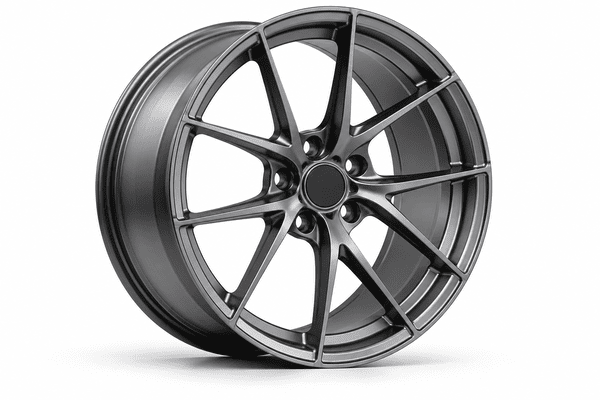
The cheapest forged wheels are one-piece monoblock forged wheels, ordered at low minimum quantities from a certified manufacturer. Because monoblock wheels involve a single forged blank, fewer production steps, and shorter lead times (typically 15–20 days), they represent the lowest structural cost within the forged wheel category. Customization in size, color, and finish does not automatically push buyers into a premium tier — especially when MOQs start as low as 4 wheels.
Understanding why monoblock wheels cost less requires understanding how wheel structure, spec configuration, and buyer assumptions each affect price differently. The cheapest wheel isn’t just about finding the lowest number — it’s about matching the right structure to your actual use case. Get that wrong, and a "cheap" wheel becomes an expensive mistake.
Does wheel structure determine the price of forged wheels?
Many buyers compare forged wheel prices without realizing they’re comparing structurally different products. A three-piece forged wheel and a one-piece forged wheel can look similar in a product photo — but they involve completely different manufacturing processes, component counts, and labor requirements. Comparing their prices without knowing this is like comparing the cost of a prefabricated door to a custom-joinery one and wondering why the numbers don’t line up.
Yes — wheel structure is the single largest driver of price within the forged wheel category. One-piece (monoblock) forged wheels cost the least because they are machined from a single forged blank with no assembly. Two-piece wheels add a fabricated outer rim joined to the center. Three-piece wheels involve a forged center, two rim halves, and hardware assembly — making them the most labor-intensive and expensive structure.
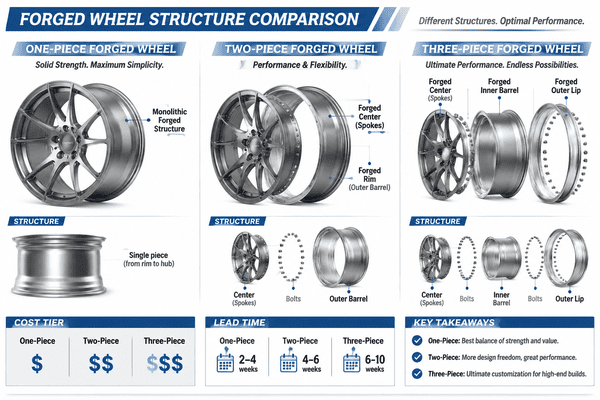
How the three structures compare in practice
In conversations with customers — particularly modification shop owners evaluating their first forged order — the structure question is almost always the missing piece. Here’s how the three structures break down:
| Structure | Components | Lead Time | Typical Use Case | Relative Price |
|---|---|---|---|---|
| One-piece (monoblock) | Single forged blank | 15–20 days | Daily drivers, track use, most passenger vehicles | Lowest |
| Two-piece | Forged center + fabricated rim | 20–25 days | Performance builds, wide-body fitments | Mid-range |
| Three-piece | Forged center + 2 rim halves + hardware | 30–35 days | Show cars, extreme custom fitments | Highest |
The price gap between monoblock and three-piece wheels isn’t marginal. The three-piece process requires:
- More raw material — three separate components instead of one
- More machining passes — each component is finished independently
- Assembly labor — hardware installation, sealing, and alignment
- Longer production time — nearly double the lead time of a monoblock wheel
For a buyer who doesn’t need extreme custom-width fitment or a show-car aesthetic, choosing a three-piece wheel is paying for capability they won’t use. The monoblock format handles the vast majority of daily driving, performance street, and even track applications without compromise.
What monoblock forged wheels give up — and what they don’t
Monoblock wheels are sometimes dismissed as the "entry-level" forged option. That framing isn’t entirely wrong, but it overstates the trade-off. What monoblock wheels give up:
- Width adjustability — you can’t change the rim width after production, unlike a three-piece where the outer sections can be swapped
- Extreme offset flexibility — very aggressive fitments are harder to achieve in a single-piece design
What they don’t give up:
- Structural strength — a properly forged monoblock wheel carries the same metallurgical benefits as more expensive structures: higher strength-to-weight ratio compared to cast, better fatigue resistance, and consistent grain structure1
- Certification eligibility — monoblock wheels can carry the same ISO9001, DOT, TÜV, and IATF16949 certifications as higher-tier structures
- Customization — size, bolt pattern, finish, and color are all adjustable at the order stage
For most buyers reading this article, a monoblock forged wheel covers the full use case at the lowest price point in the forged category.
Is "forged equals expensive" actually true?
This is the assumption that stops more buyers from exploring forged wheels than any other single factor. When I talk to customers who’ve defaulted to cast wheels, the reasoning is almost always the same: "I figured forged was out of my budget." They never ran the actual numbers — they just accepted the category-level myth and moved on.
"Forged equals expensive" is a generalization, not a fact. The forged wheel category spans a wide price range. Entry-level monoblock forged wheels from certified Chinese manufacturers can cost substantially less than European or American-branded equivalents — without sacrificing the certification standards that matter for compliance and safety. Country of origin is not a reliable proxy for quality tier.
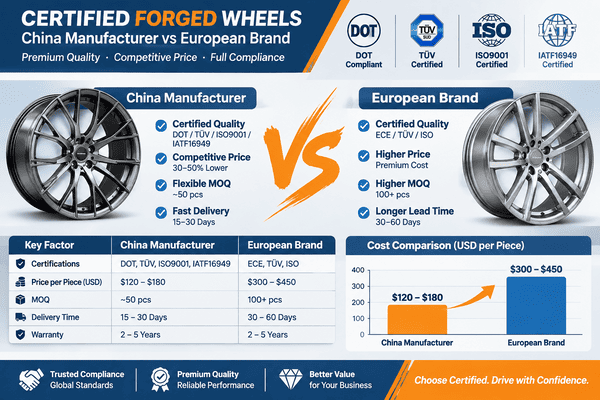
When forged wheels carry a high price tag, it’s usually driven by one or more of these factors:
- Brand premium — established European or American wheel brands carry a licensing and marketing cost built into the price
- Retail markup — wheels sold through distributors, dealers, or specialty retailers carry layered margins
- Structure complexity — three-piece and high-finish two-piece wheels involve more production cost, as covered above
- Niche sizing — wheels in uncommon diameters or bolt patterns with low production runs cost more per unit
None of these factors are inherently tied to forged construction itself. A monoblock forged wheel produced in a certified Chinese facility — one with ISO9001, DOT, TÜV, and IATF16949 certifications — meets the same documented compliance standards as a more expensive branded alternative.
Why buyers should verify certifications independently
I want to be careful here: certifications are documents, and buyers should verify them directly rather than taking any supplier’s word for it. The relevant certifications for international wheel sales include:
- DOT — required for street use on US roads
- TÜV — German technical inspection standard, widely recognized for structural testing
- ISO9001 — quality management system certification
- IATF16949 — automotive-specific quality management, stricter than ISO9001
A certified monoblock wheel from a reputable manufacturer is not a compromise product. It’s a differently positioned product within a category that buyers have been taught to treat as monolithic.
Does ordering custom forged wheels cost more than buying standard sizes?
This is one of the most common misconceptions I encounter with first-time forged wheel buyers. The assumption is: standard = affordable, custom = premium. In cast wheel purchasing from catalog distributors, that logic often holds. In forged wheel manufacturing, the relationship between customization and cost is more nuanced.
Custom forged wheels do not automatically cost more than standard sizes. Because forged wheels are typically produced-to-order rather than from inventory, the cost difference between a "standard" spec and a custom spec depends on machining complexity, not on whether the buyer calls it "custom." MOQs as low as 4 wheels make small custom orders viable without the premium most buyers expect.
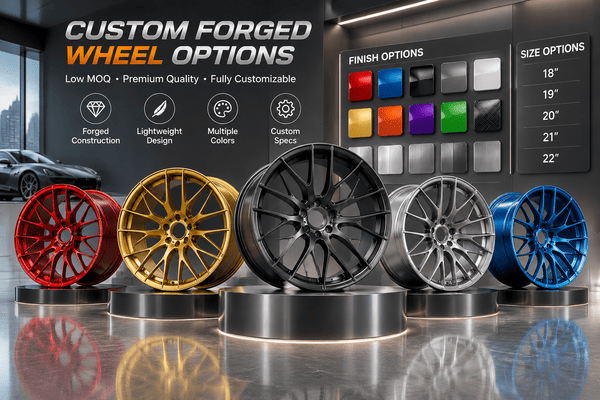
What actually drives cost in a custom order
When a buyer specifies a custom forged wheel, the cost variables are:
Size and diameter:
Larger diameter wheels require more raw material. A 22-inch wheel forging uses significantly more aluminum billet than an 18-inch equivalent2. This is a real cost driver.
Offset and width:
Unusual offsets or very wide widths can require additional machining passes or tooling adjustments. Standard fitment ranges generally don’t carry this cost.
Finish and color:
- Machined or brushed finishes are lower cost than multi-step painted or polished finishes
- Custom color matching (RAL codes, reference samples) may add a small per-unit cost at low quantities
- Anodized and PVD finishes carry higher processing costs than powder coat
Design complexity:
Spoke designs with complex undercuts or very thin spoke profiles require longer CNC machining time. Simple spoke patterns cost less to produce than intricate multi-spoke designs.
The MOQ reality check
Most buyers assume custom forged wheels require orders of 20, 50, or 100+ sets. That assumption is based on cast wheel economics, not forged wheel reality. At Tree Wheels, for example, our minimum order is 4 wheels — enough to equip a single vehicle. That structure makes forged accessible to individual enthusiasts and small modification shops who previously assumed they were priced out.
The practical implication: a single-car owner who wants a specific color and size doesn’t need to order a container to access custom forged pricing. That changes the cost calculation entirely.
Price comparison between wheel options rarely accounts for fitment errors, spec mismatches, or application misalignment. In my experience handling orders across markets — from individual enthusiasts in the US to modification shops in Dubai — the buyers who end up overpaying are usually not the ones who ordered expensive wheels. They’re the ones who ordered the wrong wheel for the job.
The hidden cost of forged wheels comes from spec mismatches: ordering a three-piece wheel for a daily driver, selecting a size that requires expensive custom machining, or choosing a finish that doesn’t suit the operating environment. A correctly spec’d monoblock forged wheel at the entry price point will almost always cost less — and perform better — than an incorrectly spec’d premium option.
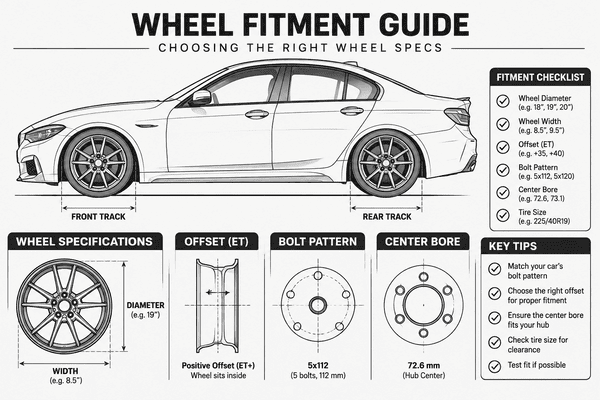
Common spec mistakes that inflate real cost
Choosing three-piece when monoblock fits the use case:
Three-piece wheels are designed for show cars, extreme custom fitments, and builds where post-production width adjustment is genuinely needed. Using them on a daily driver adds [needs verification] to the per-wheel cost with no functional return.
Ordering a size that triggers extra machining:
Wheels at the upper end of diameter ranges (e.g., 24-inch and above for most passenger vehicles) require more billet material and more machining time. If the fitment doesn’t require that diameter, the cost difference is pure waste.
Mismatching bolt pattern or offset:
An incorrect bolt pattern or offset doesn’t just cause a fitment problem — it may require spacers, which introduce additional unsprung weight3 and a separate cost. Getting the spec right at the order stage is always cheaper than correcting it after delivery.
Underestimating finish durability requirements:
A polished or bare-machined finish looks excellent but requires more maintenance in high-humidity or salt-road environments. Choosing a finish appropriate for the operating environment avoids premature corrosion and avoidable refinishing costs4.
The spec-matching checklist buyers should use
Before comparing any forged wheel prices, buyers should confirm:
- Vehicle fitment data: bolt pattern, center bore, offset range, and clearance requirements
- Load rating requirement: based on vehicle weight and intended use (street, track, mixed)
- Diameter and width constraints: what the vehicle’s suspension and bodywork actually accommodate
- Finish suitability: matched to climate, use frequency, and maintenance commitment
- Structure requirement: whether standard width monoblock fits, or whether custom width (two/three-piece) is genuinely needed
A buyer who works through this checklist before requesting a quote will almost always find that the most cost-effective option is a monoblock forged wheel in a mid-range diameter and finish. That’s not a sales conclusion — it’s what the spec data consistently points to for most passenger vehicle applications.
Frequently Asked Questions
Are forged wheels always more expensive than cast wheels?
Not necessarily. Entry-level monoblock forged wheels can be price-competitive with premium cast or flow-formed wheels, especially when ordered directly from a certified manufacturer. The key variables are structure, order quantity, and finish. Buyers who compare total cost — including weight savings, durability, and fitment accuracy — often find forged more cost-effective over time5.
What is the difference between cast, flow-formed, and forged wheels?
Cast wheels are made by pouring molten aluminum into a mold — the most affordable process but typically heavier and less strong6. Flow-formed wheels start as a cast center and have their barrel spun and stretched under heat, improving strength in the rim section7. Forged wheels are pressed from a solid aluminum billet under high pressure, producing the highest strength-to-weight ratio8. These are distinct manufacturing processes, not interchangeable quality tiers.
Can I order a single set of custom forged wheels, or do I need a large minimum order?
Minimum order quantities vary by manufacturer. At Tree Wheels, the MOQ is 4 wheels — enough for a single vehicle. This makes custom forged wheels accessible to individual enthusiasts and small modification shops without requiring bulk purchasing. Buyers should confirm MOQ directly with their supplier before assuming large minimum quantities are required.
How long does it take to produce affordable monoblock forged wheels?
One-piece monoblock forged wheels typically have the shortest lead time in the forged category: 15–20 days from order confirmation. Two-piece wheels take 20–25 days, and three-piece wheels take 30–35 days. Lead time is one reason monoblock wheels cost less — less production time means lower per-unit labor cost.
Do cheaper forged wheels still meet safety certifications?
Price tier does not determine certification status — manufacturing process and quality management do. Monoblock forged wheels from certified facilities can carry DOT, TÜV, ISO9001, and IATF16949 certifications at lower price points than premium branded alternatives. Buyers should always request and verify certification documentation directly from the supplier, regardless of price level.
Conclusion
Cheap forged wheels are a real category — but only for buyers who understand what determines forged wheel pricing. Forged wheel structure is the primary cost driver: monoblock one-piece wheels cost the least, while three-piece assemblies carry the highest price due to components, assembly, and lead time. The "forged equals expensive" assumption is a generalization that doesn’t survive contact with actual supplier quotes. Certified monoblock forged wheels, ordered at low MOQs, are accessible to individual enthusiasts and small shops alike. The real risk isn’t overpaying for forged — it’s choosing the wrong spec and paying more than necessary for a wheel that doesn’t fit the job.
If you’re evaluating forged wheels for the first time and want to match the right structure and spec to your actual application, contact the Tree Wheels team. We’ll walk through the fitment data with you and give you an honest starting point — no oversized order requirements, no unnecessary upsells.
-
"Shape optimisation of rim structure of aluminium alloy car wheels based …", https://pmc.ncbi.nlm.nih.gov/articles/PMC12241507/. The forging process aligns the grain flow of aluminum alloys along the contours of the part, resulting in improved tensile strength and fatigue resistance compared to cast equivalents, which may contain porosity and interrupted grain boundaries. Evidence role: mechanism; source type: research. Supports: That the forging process produces a refined, continuous grain structure in aluminum alloys that improves tensile strength and fatigue resistance relative to cast aluminum. Scope note: General metallurgical literature on forged versus cast aluminum applies broadly; wheel-specific fatigue performance data may vary by alloy grade and design geometry. ↩
-
"Alloy wheel", https://en.wikipedia.org/wiki/Alloy_wheel. The mass of aluminum billet required for a forged wheel blank increases with wheel diameter and section width; because aluminum is priced by weight, larger diameter forgings carry proportionally higher raw material costs independent of design complexity. Evidence role: mechanism; source type: research. Supports: That the volume of aluminum billet required for a forged wheel blank scales with wheel diameter and width, directly increasing raw material cost for larger diameter wheels. Scope note: Actual billet consumption depends on spoke design, final machined weight, and material recovery rate; the relationship is not strictly linear across all diameter ranges. ↩
-
"Unsprung mass", https://en.wikipedia.org/wiki/Unsprung_mass. Unsprung mass refers to the combined mass of vehicle components not isolated from road inputs by the suspension system, including wheels, tires, hubs, and brake assemblies; vehicle dynamics literature consistently identifies reductions in unsprung mass as beneficial to wheel contact patch control, ride quality, and transient handling response. Evidence role: definition; source type: education. Supports: That unsprung mass — the mass of vehicle components not supported by the suspension, including wheels, tires, and brake components — affects ride quality and handling response, and that reducing it is a recognized performance objective. Scope note: The magnitude of handling improvement from small changes in unsprung mass varies with vehicle type, suspension design, and operating conditions; the effect of spacer mass specifically is rarely isolated in published studies. ↩
-
"What Makes Chrome Finishing Different from Polished Aluminum …", https://treewheels.com/what-makes-chrome-finishing-different-from-polished-aluminum-wheels/. Corrosion studies of aluminum alloy surfaces demonstrate that intact polymer coatings such as powder coat provide a barrier against chloride ion ingress, substantially reducing pitting corrosion rates compared to bare or mechanically polished aluminum surfaces exposed to salt-laden environments. Evidence role: mechanism; source type: research. Supports: That the surface finish applied to aluminum wheels significantly affects their resistance to corrosion in chloride-rich environments, with sealed coatings such as powder coat providing greater protection than bare machined or polished surfaces. Scope note: Corrosion performance depends on coating thickness, adhesion quality, and the presence of surface defects; laboratory salt-spray results may not directly predict field performance across all climatic conditions. ↩
-
"Wheel Failure Investigation Program: Phase I", https://railroads.dot.gov/sites/fra.dot.gov/files/2021-02/Wheel%20Failure%20Investigation%20Program%20Phase%20I.pdf. Fatigue testing of aluminum wheels under simulated road load conditions has generally shown that forged wheels sustain higher cycle counts before crack initiation than gravity cast equivalents of similar design, suggesting longer service life under equivalent operating conditions. Evidence role: general_support; source type: research. Supports: That forged aluminum wheels exhibit superior fatigue life and impact resistance compared to cast equivalents, which may reduce replacement frequency and support a lower total cost of ownership over the service life of the wheel. Scope note: Published lifecycle cost comparisons between forged and cast wheels for passenger vehicle applications are limited; total cost of ownership conclusions depend heavily on use case, maintenance practices, and replacement pricing in specific markets. ↩
-
"Characterization and Analysis of Porosities in High Pressure …", https://pmc.ncbi.nlm.nih.gov/articles/PMC7412358/. Cast aluminum components produced by gravity or low-pressure die casting typically exhibit lower tensile strength than forged equivalents due to microporosity and non-directional grain structure; achieving equivalent load ratings in cast designs generally requires additional material, increasing wheel mass. Evidence role: mechanism; source type: research. Supports: That gravity or low-pressure cast aluminum wheels typically exhibit lower tensile strength and higher weight than forged aluminum wheels of equivalent dimensions due to microstructural differences including porosity. Scope note: Advances in low-pressure casting and flow-forming have narrowed the performance gap for specific wheel geometries; direct comparisons depend on alloy grade, design, and manufacturing process variant. ↩
-
"What Is Plus-Sizing and How Does It Affect Vehicle Performance?", https://treewheels.com/what-is-plus-sizing-and-how-does-it-affect-vehicle-performance/. Flow-forming (also termed rim rolling or rotary forging of the barrel) applies roller pressure to a cast aluminum wheel blank, thinning the barrel wall while inducing work hardening and grain alignment that increase tensile strength in the rim section relative to the as-cast condition. Evidence role: mechanism; source type: research. Supports: That the flow-forming process applies compressive force to the barrel of a cast aluminum wheel blank, reducing wall thickness while increasing tensile strength through work hardening and grain refinement in the rim section. Scope note: Strength improvements from flow-forming are localized to the barrel; the cast center retains the microstructural characteristics of the original casting process. ↩
-
"Enhancement of Aluminum Alloy Forgings through Rapid …", https://digital.library.unt.edu/ark:/67531/metadc892267/m2/1/high_res_d/886705.pdf. Closed-die forging of aluminum alloys under high compressive loads eliminates casting porosity and develops a refined, directional grain structure, yielding higher specific strength (strength per unit mass) than gravity cast or low-pressure cast equivalents; this property is widely cited in aerospace and automotive engineering literature as the primary advantage of forged aluminum components. Evidence role: expert_consensus; source type: research. Supports: That closed-die forging of aluminum billet under high compressive force produces components with superior strength-to-weight ratios compared to casting processes, due to elimination of porosity and development of a refined, directional grain structure. Scope note: Strength-to-weight comparisons are alloy- and geometry-dependent; some advanced casting alloys and processes can approach forged performance in specific applications. ↩