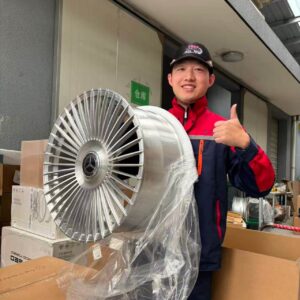

Most buyers see a shiny wheel and assume it’s chrome. That assumption costs them money. The real difference isn’t appearance — it’s process, and process determines how long your wheels last.
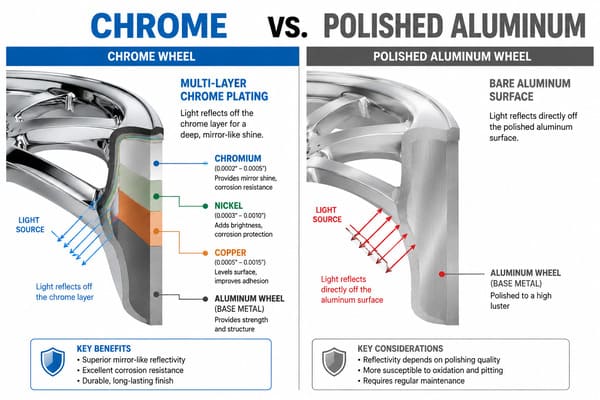
Chrome finishing adds layers on top of the wheel — copper, then nickel, then chromium1 — at a total thickness of 0.0001 to 0.0003 inches2. Polished aluminum does the opposite. No material is added. Abrasives and CNC machines remove surface imperfections until the aluminum itself reflects light like a mirror.3
I had a customer once who asked me: "Can you make my wheels look like chrome?" I said yes. He assumed I meant electroplating. I showed him our mirror-polished forged aluminum samples instead. He held one up and said, "I can see my face in it." That moment made something clear to me — most people want the look of chrome, not chrome itself. And that distinction matters more than most buyers realize. We produce forged aluminum wheels in-house. Polishing is part of our own process — we control it, we refine it, we inspect it ourselves. Chrome plating requires sending wheels to a separate electroplating facility. That hand-off means less quality control, more steps, more variables, and more risk. With polished aluminum, the finish and the wheel are made by the same hands.
Is Polished Aluminum Better Than Chrome?
Most people compare these two finishes on looks alone. That is the wrong comparison. The better question is: which one holds up after two years of real driving?
Polished aluminum outperforms chrome in long-term durability. Chrome plating is thinnest at edges, lug holes, and tight curves4 — exactly where heat and stress concentrate. Once the coating fails at one point, moisture gets in and the damage spreads fast.5 Polished aluminum has no coating to peel.
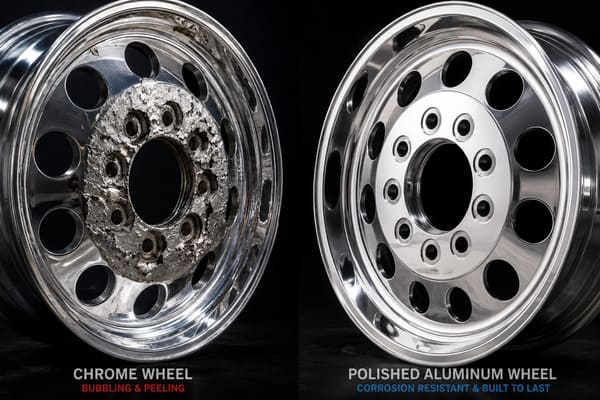
A shop owner in California once sent me photos of a customer’s chrome wheels — only 18 months old, bought from a local shop. The plating around the lug holes had started bubbling. The inner barrel showed rust-colored pitting. The customer was furious. The shop owner asked me: "Why does this happen?" I told him: chrome plating fails wherever the coating is thinnest, and brake heat accelerates that failure. This is not a rare case. It is a predictable outcome.
How the Numbers Compare
Here is a direct comparison of the two finishes across the factors that matter most to buyers:
| Factor | Chrome Plating | Polished Aluminum |
|---|---|---|
| Coating thickness | 0.0001–0.0003 inches | No coating — solid aluminum |
| Re-finish cost (4 wheels) | $600–$1,600 | $150–$400 (or DIY for ~$30) |
| Failure mode | Bubbling, peeling, delamination | Gradual haze, no structural damage |
| Repair difficulty | Requires professional re-plating | Most enthusiasts do it at home |
| Heat resistance near brakes | Low — thin coating cracks under thermal stress | High — no coating to crack |
Polished forged aluminum is not just better-looking in the long run. It is cheaper to maintain and easier to repair. That is a practical argument, not just an aesthetic one. When I recommend polished aluminum to a shop owner, I am not selling a preference — I am giving them a solution that reduces callbacks and customer complaints.
Can You Make Aluminum Wheels Shine Like Chrome?
Yes — and the secret is in the material, not the process. Not all aluminum polishes the same way. The grain structure of the metal determines how close you can get to chrome-level reflectivity.
Forged aluminum has a compressed, tight grain structure.6 CNC diamond-cut polishing can bring its surface roughness below Ra ≤ 0.2 microns7 — visually indistinguishable from chrome to most eyes. Cast aluminum, with its porous grain structure8, can only reach roughly 80–85% of chrome’s reflectivity at best9.
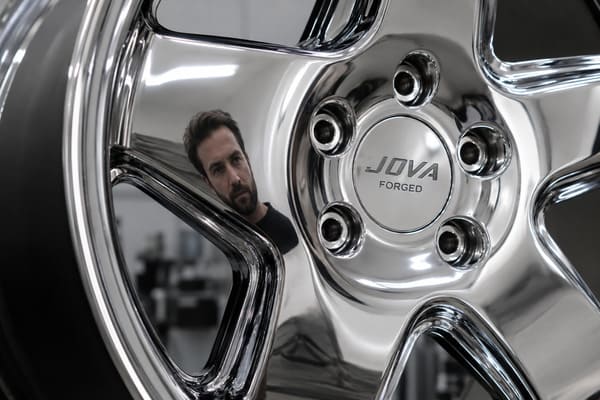
One of our longtime B2B clients runs a luxury car modification shop in Dubai. He used to order chrome-plated wheels from another supplier. After switching to our mirror-polished forged aluminum wheels, he told me his end customers stopped asking for chrome altogether. "They see the polished wheels on the shelf and they just want those," he said. He has not ordered chrome since. That shift happened because the product spoke for itself.
Why Forged Aluminum Polishes Better
The material you start with determines the ceiling of your finish quality. Here is why forged aluminum sits at the top:
| Property | Cast Aluminum | Forged Aluminum |
|---|---|---|
| Grain structure | Porous, irregular | Compressed, uniform |
| Max reflectivity after polish | ~80–85% of chrome | ~95%+ of chrome |
| Surface roughness achievable | Ra ≥ 0.5μm typical | Ra ≤ 0.2μm with CNC diamond cut |
| Polish consistency across surface | Uneven — pores cause variation | Even — tight grain holds uniform finish |
There is also a middle-ground option worth knowing about: PVD Chrome (Physical Vapor Deposition). PVD deposits a thin metallic layer in a vacuum chamber10 — no toxic hexavalent chromium involved11. It looks like chrome, bonds better to aluminum, and resists peeling more effectively than traditional electroplating. In markets like California and Germany, where traditional chrome plating faces environmental restrictions, PVD is becoming the standard alternative. We can discuss this option with clients who specifically want that chrome-mirror look without the drawbacks of conventional plating.
Which Finish Lasts Longer: Chrome or Polished Aluminum?
Polished aluminum lasts longer — but the more important story is how each finish fails, and which failure is easier to recover from.
Chrome fails structurally — it bubbles, cracks, and peels, often spreading from a single weak point within months. Polished aluminum oxidizes slowly and evenly, forming a thin aluminum oxide layer that dulls the surface but never delaminates. One failure destroys the wheel’s appearance. The other just needs a polish.
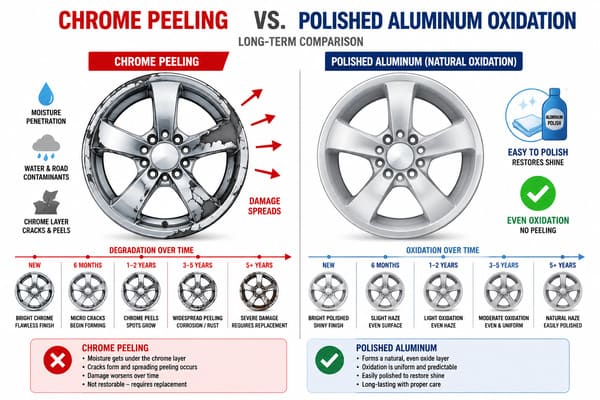
I keep a test piece in my office. Half of it is chrome-plated, half is mirror-polished aluminum. It has been sitting near a window for about two years — exposed to sunlight and humidity. The chrome side has a small bubble forming near one edge. The polished side has lost maybe 10% of its original brightness — a slight haze. One side is failing structurally. The other just needs a polish. That test piece tells the story better than any specification sheet.
How Each Finish Degrades Over Time
Understanding the failure pattern helps buyers make a smarter purchase decision:
| Condition | Chrome Plating | Polished Aluminum |
|---|---|---|
| First sign of wear | Micro-pitting or bubbling at edges | Slight surface haze |
| How it spreads | Moisture enters crack → spreads rapidly | Oxidizes slowly and evenly across surface |
| Salt-road climates (Canada, UK, northern US) | Visible degradation at 2–3 years | Maintains 85%+ finish quality at 7–10 years with annual re-seal |
| Structural damage risk | High — delamination can spread to full surface | None — oxidation is cosmetic only |
| Recovery | Requires professional re-plating | DIY polish kit, ~$30 |
Our warranty covers one year — but we have had customers using our polished forged wheels for five or more years with zero structural finish issues. The warranty reflects our confidence in the product, not the limit of its lifespan.
What Are the Disadvantages of Chrome Wheels?
I am not here to sell against chrome. But buyers spending $1,500 to $4,000 or more on a set of wheels deserve honest information before they decide.
Chrome wheels carry five real disadvantages: peeling risk near heat zones, high repair costs, environmental restrictions on the plating process, high sensitivity to brake dust and water spots, and poor performance on complex forged designs where plating thickness is uneven.
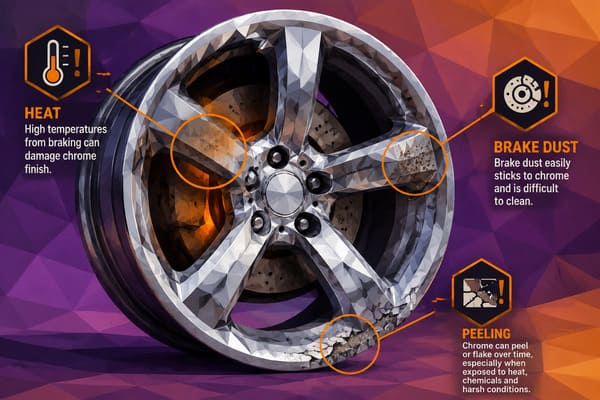
A customer came to me after a bad experience. He had paid $2,200 for a set of chrome-plated aftermarket wheels. Two winters later — he lives in Toronto — the plating was peeling on all four wheels. His local shop quoted him $1,100 to re-chrome them. He asked me: "If I had bought forged polished aluminum from you instead, would this have happened?" I told him honestly: oxidation would happen, but it would not peel, and he could fix it himself for under $50.
The 5 Real Disadvantages of Chrome Wheels
Each disadvantage below is worth understanding before a purchase decision:
1. Peeling Risk Near Heat Zones
Brake rotor heat reaches 300–600°C under hard use. Chrome plating near the hub area takes repeated thermal stress. Micro-cracks form. Moisture enters. Peeling begins. This is not a defect — it is a physical limitation of the process.
2. High Repair Cost
Re-chroming in North America costs $150–$400 per wheel. For a set of four large-diameter wheels (22 inches or larger), expect $800–$1,600 total. Not every shop offers the service, and quality varies significantly between facilities.
3. Environmental Restrictions
Hexavalent chromium (Cr VI), used in traditional bright chrome plating, is classified as a carcinogen.12 It is restricted under EPA regulations in the US and REACH in the EU. Some plating shops have switched to trivalent chrome (Cr III), which is safer but produces a slightly less brilliant finish. Buyers should ask which process their supplier uses.
4. High Maintenance Demand
Chrome is unforgiving. Every water drop leaves a mark. Brake dust stains are visible within days. Maintaining chrome wheels requires cleaning every one to two weeks. For daily drivers, that is a significant commitment.
5. Poor Fit for Complex Forged Designs
Deep concave profiles, intricate spoke geometries, and narrow inner barrels are difficult to plate evenly. The plating is thinnest at recessed areas — which is exactly where failure starts first. This is why our most premium three-piece forged designs are never recommended for traditional chrome plating. The geometry that makes the wheel beautiful is the same geometry that makes chrome impractical.
Conclusion
Chrome covers the wheel. Polish reveals it. For durability, cost, and long-term quality, polished forged aluminum is the smarter choice for serious buyers. Tree Wheels builds every forged wheel from solid aluminum billet — finished with the same hands that shaped it.
-
"[PDF] 12.20 Electroplating – EPA", https://gaftp.epa.gov/ap42/ch12/s20/final/c12s20_jul1996.pdf. A technical reference on decorative chromium electroplating should support that bright chrome finishes are typically multilayer systems in which copper and nickel underlayers are applied before a thin chromium top layer. Evidence role: definition; source type: institution. Supports: Chrome finishing adds copper, nickel, and chromium layers on top of the wheel.. Scope note: The source may describe decorative chrome plating generally rather than wheel-specific production. ↩
-
"Chrome plating – Wikipedia", https://en.wikipedia.org/wiki/Chrome_plating. A plating handbook, standards document, or technical paper should substantiate typical decorative chromium coating thickness ranges and clarify whether the cited range refers to the chromium layer alone or the total plated system. Evidence role: statistic; source type: paper. Supports: Chrome finishing on wheels has a total thickness of 0.0001 to 0.0003 inches.. Scope note: Thickness ranges vary by specification, substrate, and whether copper/nickel underlayers are included. ↩
-
"The Science of Metal Polishing: Why a Perfect Finish Is Physically …", https://exquisitemad.com/exquisitemad-technical-journal/the-science-of-metal-polishing-why-a-perfect-finish-is-physically-impossible/. A manufacturing or surface-finishing source should support that mechanical polishing and precision machining reduce surface roughness, increasing specular reflection from aluminum surfaces. Evidence role: mechanism; source type: education. Supports: Polished aluminum is made reflective by removing surface imperfections rather than adding a coating.. Scope note: The source will likely explain the surface-roughness mechanism generally rather than evaluate the specific wheels in the article. ↩
-
"Modeling and simulation of electrodeposition: effect of electrolyte …", https://www.academia.edu/121723287/Modeling_and_simulation_of_electrodeposition_effect_of_electrolyte_current_density_and_conductivity_on_electroplating_thickness. A source on electroplating current distribution and throwing power should support that coating thickness can vary significantly on complex geometries, especially in recesses and holes where current density is lower. Evidence role: mechanism; source type: education. Supports: Chrome plating thickness can be uneven on wheel features such as lug holes and tight curves.. Scope note: Electroplating may be thicker on exposed edges and thinner in recesses; the source may not support every listed location exactly as phrased. ↩
-
"Investigating Different Local Polyurethane Coatings Degradation …", https://pmc.ncbi.nlm.nih.gov/articles/PMC9964212/. A corrosion-engineering source should support that defects in protective coatings permit electrolyte ingress and can initiate underfilm corrosion, which may propagate beneath the coating. Evidence role: mechanism; source type: paper. Supports: A breached chrome coating can allow moisture ingress and underfilm corrosion to spread from the defect.. Scope note: Propagation rate depends on coating quality, substrate, salts, humidity, and service conditions; the source may not quantify how fast damage spreads on wheels. ↩
-
"A Review on Porosity Formation in Aluminum-Based Alloys – PMC", https://pmc.ncbi.nlm.nih.gov/articles/PMC10004325/. A metallurgy textbook or university source should support that forging plastically deforms aluminum, refines or elongates the grain structure, and can reduce casting-type porosity compared with cast material. Evidence role: mechanism; source type: education. Supports: Forged aluminum has a denser, more uniform grain structure than cast aluminum.. Scope note: The exact grain morphology depends on alloy, forging temperature, deformation ratio, and heat treatment. ↩
-
"Investigation of Diamond Turning -of Rapidly Solidified Aluminum …", https://www.academia.edu/9115014/Investigation_of_Diamond_Turning_of_Rapidly_Solidified_Aluminum_Alloys. A precision-machining study should support that diamond turning or diamond cutting of aluminum alloys can achieve submicron surface roughness values, including Ra values around or below 0.2 micrometers under suitable conditions. Evidence role: statistic; source type: paper. Supports: CNC diamond-cut polishing can achieve Ra ≤ 0.2 micrometers on aluminum surfaces.. Scope note: Achievable roughness depends on alloy, tooling, machine rigidity, feed rate, and post-polishing steps; evidence may not be wheel-specific. ↩
-
"A Review on Porosity Formation in Aluminum-Based Alloys – PMC", https://pmc.ncbi.nlm.nih.gov/articles/PMC10004325/. A materials-science source should support that cast aluminum alloys can contain porosity and microstructural heterogeneity arising from solidification and gas shrinkage effects. Evidence role: mechanism; source type: education. Supports: Cast aluminum can have a more porous and irregular structure than forged aluminum.. Scope note: Porosity varies widely with alloy, casting method, process control, and subsequent treatment. ↩
-
"Metal surface roughness and optical reflectance – NASA ADS", https://ui.adsabs.harvard.edu/abs/1990OptLT..22..127P/abstract. A surface metrology or optical reflectance source would be needed to support any quantitative comparison between polished cast aluminum and chrome reflectivity, ideally with measured reflectance values under defined wavelengths and surface roughness conditions. Evidence role: statistic; source type: paper. Supports: Polished cast aluminum reaches only about 80–85% of chrome’s reflectivity.. Scope note: This exact 80–85% figure may be difficult to verify because reflectivity depends on alloy composition, roughness, oxide layer, measurement angle, and polishing method. ↩
-
"Physical vapor deposition – Wikipedia", https://en.wikipedia.org/wiki/Physical_vapor_deposition. An encyclopedia or technical source on physical vapor deposition should support that PVD is a vacuum-based process in which material is vaporized and deposited as a thin film on a substrate. Evidence role: definition; source type: encyclopedia. Supports: PVD deposits a thin metallic layer in a vacuum chamber.. Scope note: General PVD descriptions do not necessarily address wheel-finishing performance. ↩
-
"[PDF] Replacement of Toxic Hexavalent Chromium in the Plating Process", https://www.epa.gov/sites/default/files/2015-06/documents/replacement.pdf. A regulatory or occupational-health source should support that conventional hexavalent chromium compounds are toxic and carcinogenic, while PVD processes are dry vacuum deposition processes that do not require hexavalent chromium plating baths. Evidence role: general_support; source type: government. Supports: PVD Chrome avoids the use of toxic hexavalent chromium involved in traditional chrome plating baths.. Scope note: Some PVD coatings may still involve chromium metal or chromium compounds; the claim should be limited to avoiding hexavalent chromium plating chemistry. ↩
-
"Hexavalent Chromium – Health Effects | Occupational Safety and …", http://www.osha.gov/hexavalent-chromium/health-effects. An occupational-health or regulatory source should support that hexavalent chromium compounds used in chromium electroplating are recognized human carcinogens. Evidence role: expert_consensus; source type: government. Supports: Hexavalent chromium used in traditional bright chrome plating is classified as a carcinogen.. Scope note: Carcinogenic classification concerns exposure to hexavalent chromium compounds, especially occupational inhalation exposure, rather than finished chrome-plated consumer products under normal use. ↩