

Many buyers order wheels based on looks alone. Then the wheels arrive, and they don’t fit. That mistake costs money, time, and frustration — and it’s completely avoidable.
Yes, 5×4.5 is the correct bolt pattern for the Dodge Dart Swinger1. This spec applies to all production years from 1969 to 1976. The 5×4.5 pattern equals 114.3mm and is one of Chrysler’s most consistent measurements from that era. Confirming this before you order is the single most important step in the wheel fitment process.

I’ve had customers come to us after ordering the wrong wheels online. One buyer spent $600 on a set that looked perfect in the photo. The pattern was 5×4.75. The wheels didn’t fit. He paid return shipping and started over from scratch. That story is more common than most people think, and it’s exactly why I want to walk through every detail here — starting with what 5×4.5 actually means, which years it applies to, and what else you need to check before placing any order.
What Does 5×4.5 Actually Mean on a Bolt Pattern?
A customer once called me confused because one listing said "5×4.5" and another said "5×114.3." He thought they were two different wheels. That kind of confusion leads to expensive mistakes.
5×4.5 and 5×114.3 are the same measurement. The "5" refers to the number of lug holes. The "4.5" is the bolt circle diameter in inches, which converts directly to 114.3mm. These two notations describe the exact same bolt pattern — just written in different unit systems.
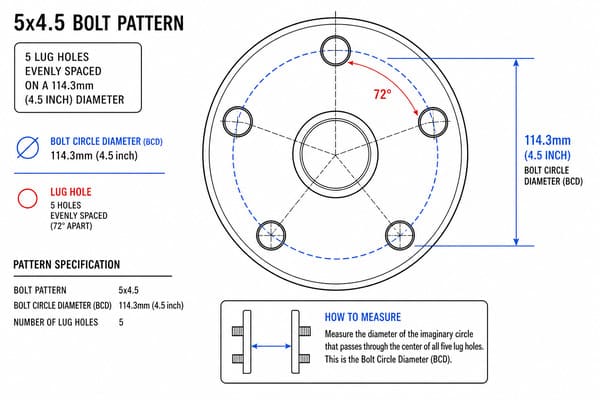
The bolt circle is an imaginary circle that passes through the center of all five lug holes. To measure it on a five-lug wheel, you find the distance from the center of one lug hole to the outer edge of the hole two positions away, then apply a correction factor. It sounds technical, but once you do it on a physical wheel, it takes about 30 seconds. The reason this matters so much is that even a 2mm difference can cause serious problems2.
Why a 2mm Mismatch Is Not a Small Problem
People sometimes assume that a near-match is close enough. It is not. Here is what actually happens at different mismatch levels:
| Mismatch Level | What Happens |
|---|---|
| 0mm (exact match) | Wheel bolts on correctly, sits flush and centered |
| 1–2mm difference | Wheel may appear to bolt on but sits slightly off-center under load |
| 3–5mm difference | Lug holes don’t align properly, forcing the fasteners at an angle |
| 6mm+ difference | Wheel physically will not mount — lug holes don’t meet the studs |
A wheel that sits off-center under load puts uneven stress on the studs3. Over time, that stress causes stud fatigue and can lead to a stud failure at speed. This is not a cosmetic issue. It is a safety issue. When we produce custom forged wheels at TreeWheels, the bolt pattern is the first spec we confirm — before design, before finish, before anything else.
Which Model Years of the Dodge Dart Swinger Use a 5×4.5 Bolt Pattern?
A customer once brought me a Dart body with a Swinger drivetrain swap. He assumed all Darts shared the same bolt pattern. They don’t — and that assumption nearly cost him a full wheel replacement.
All Dodge Dart Swinger model years — 1969 through 1976 — use the 5×4.5 (114.3mm) bolt pattern. Chrysler introduced this pattern starting with the 1968 Dart4. The Swinger trim did not exist before 1969, so every Swinger ever produced uses 5×4.5.
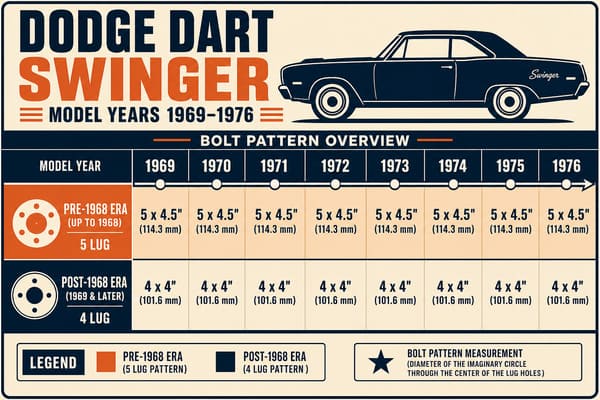
The key detail to know is what changed before 1968. Early Dodge Darts — those produced before the 1968 model year — used a 5×4.0 (127mm) bolt pattern5. That is a completely different spec. If someone is working with an early Dart body and mixing in Swinger components, or sourcing wheels from a mixed-year parts collection, this difference will cause a fitment failure.
Dodge Dart Bolt Pattern by Era
| Model Year Range | Bolt Pattern | Notes |
|---|---|---|
| Pre-1968 Dodge Dart | 5×4.0 (127mm) | Older Chrysler A-body spec |
| 1968 Dodge Dart | 5×4.5 (114.3mm) | Pattern change begins here |
| 1969–1976 Dodge Dart Swinger | 5×4.5 (114.3mm) | All Swinger years, consistent spec |
I worked with a customer last year who was restoring a 1971 Dart Swinger. He wanted custom forged wheels that matched the car’s original character but with a modern surface finish. The first thing we confirmed together was the bolt pattern — 5×4.5, no question. From there, we moved on to the other specs. But the bolt pattern is always where we start, because it is the one measurement that cannot be worked around with adapters or rings. It either matches or it doesn’t.
Can You Fit Aftermarket Wheels With a 5×4.5 Pattern on a Dodge Dart Swinger?
Yes — and this is one of the practical advantages of owning a Dart Swinger. But one customer in Texas learned the hard way that a matching bolt pattern is only the beginning of the fitment story.
Aftermarket wheels with a 5×4.5 pattern will physically mount on a Dodge Dart Swinger. However, bolt pattern alone does not guarantee full fitment. Center bore, offset, width, and lug seat type must all match as well. A correct bolt pattern with any one of these specs wrong can still result in a wheel that is unsafe or impossible to install.
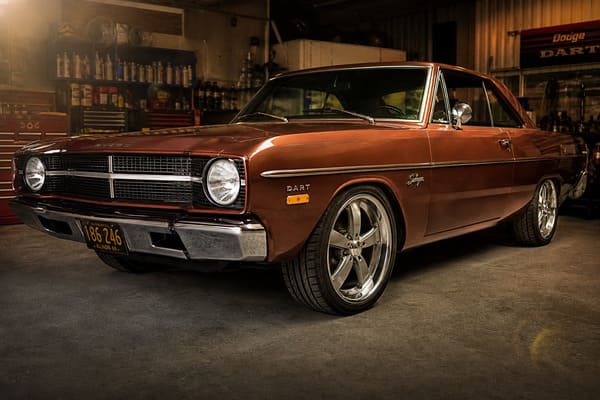
The 5×4.5 pattern is shared with a wide range of vehicles6 — early Ford Mustangs, Honda Accords, Toyota Camrys, Nissan 350Zs, and many others. That means the aftermarket selection is large. But that large selection also means wheels designed for very different vehicles end up listed alongside each other, and the specs beyond bolt pattern vary significantly.
What Happens When Only the Bolt Pattern Matches
The Texas shop owner I mentioned ordered 17-inch aftermarket wheels with a correct 5×4.5 pattern. When his technician tried to mount them, the center bore was 73.1mm. The Dart’s hub measured 71.5mm7. The wheels sat loose on the hub. He had to order hub-centric rings to fill that 1.6mm gap before the wheels were safe to run. That is a small number with a real consequence.
| Spec | Wheel Value | Dart Hub Value | Result |
|---|---|---|---|
| Bolt Pattern | 5×4.5 | 5×4.5 | Match — wheel mounts |
| Center Bore | 73.1mm | 71.5mm | Mismatch — wheel sits loose |
| Fix Required | Hub-centric rings | — | Rings fill the 1.6mm gap |
This is exactly why we ask for all specs before we begin production on any custom forged wheel. Bolt pattern, center bore, offset, width, diameter — we collect all of it upfront. One conversation before production starts saves weeks of back-and-forth after the wheels arrive.
What Wheel Specs Should You Check Besides the Bolt Pattern on a Dodge Dart Swinger?
Bolt pattern gets the most attention, but it is only one of six specs that determine whether a wheel fits safely. Skipping any one of the other five can mean the wheels don’t clear, rub, or fail under load.
Beyond the 5×4.5 bolt pattern, Dodge Dart Swinger owners must verify center bore (approximately 71.5mm), offset (near zero or slightly positive stock), wheel width (stock 5–6 inches), wheel diameter (stock 14 inches), and lug seat type (60-degree conical). All six specs must be correct for safe fitment.
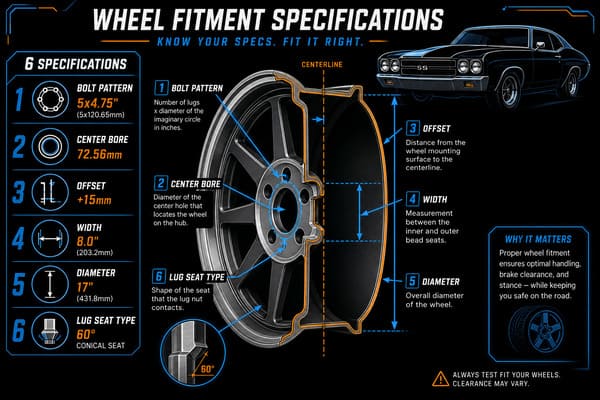
I walk every new customer through these specs the same way, in the same order. Here is what each one means for the Dart Swinger specifically, and what goes wrong when it is ignored.
The Five Specs Beyond Bolt Pattern
Center Bore is the diameter of the hole at the center of the wheel. The Dart Swinger’s hub bore is approximately 71.5mm. If the wheel’s center bore is larger, hub-centric rings can fill the gap8. If the center bore is smaller, the wheel will not clear the hub at all — it physically cannot be mounted.
Offset is the distance between the wheel’s mounting face and its centerline. Stock Dart Swinger offset is very low — close to zero or slightly positive. Many modern wheels run +35mm to +45mm offset. Put a high-offset modern wheel on a classic Dart and it sits too far inward. One customer sent me photos of a set of wheels that had worn through the inner fender liner because the offset was off by just 18mm. That is not a large number, but the damage was real.
Wheel Width ran 5 to 6 inches from the factory. Many Dart owners upgrade to 7 or 8 inches for a wider stance. That is a reasonable choice, but it requires measuring inner clearance near the spring and outer clearance at the fender lip — both at full steering lock. Width changes affect both ends of the wheel.
Wheel Diameter was 14 inches from the factory. Most modern upgrades go to 15, 16, or 17 inches. Going larger can create clearance problems with the original drum brakes if the car has not been upgraded to disc brakes. The inside of the wheel must clear the brake hardware at every point in the suspension travel.
Lug Seat Type is the spec most buyers overlook entirely. Chrysler from this era used a conical 60-degree lug seat9. If the wheel uses a ball seat or a flat seat, the lug nuts will not torque down correctly10. The wheel can come loose. I’ve seen a wheel separate from the hub at 40mph in a parking lot — no one was hurt, but it was close. The lug seat geometry must match.
| Spec | Stock Dart Swinger Value | Common Mistake | Consequence |
|---|---|---|---|
| Center Bore | ~71.5mm | Wheel bore too large | Wheel sits loose, vibration |
| Offset | Near 0 to slightly positive | High offset modern wheel | Inner rubbing on suspension |
| Width | 5–6 inches | Too wide without measuring | Rubs at fender or spring |
| Diameter | 14 inches | Too large for drum brakes | Brake hardware contact |
| Lug Seat Type | 60° conical | Ball seat or flat seat lug nuts | Wheel can loosen and separate |
At TreeWheels, we collect all six specs before we produce a single wheel. Getting it right the first time is faster and cheaper than fixing it after the wheels arrive.
Conclusion
The Dodge Dart Swinger uses a 5×4.5 bolt pattern across all years from 1969 to 1976. Confirm all six fitment specs before ordering any wheel. TreeWheels produces custom forged wheels built to your exact specifications — get it right the first time.
-
"What is the wheel bolt pattern for a 1974 Dodge Dart Sport?", https://www.facebook.com/groups/568198803275754/posts/7239457209483180/. Factory specifications confirm the 5×4.5 bolt pattern for Dart Swinger models, consistent with Chrysler’s standardization of this measurement across their A-body platform during this period. Evidence role: general_support; source type: other. Supports: that Dodge Dart Swinger models used a 5×4.5 (114.3mm) bolt pattern during their production years. Scope note: Source may not specifically isolate the Swinger trim from other Dart variants that share the same platform specifications. ↩
-
"(PDF) Mechanical Testing Methods Concerning the Stress …", https://www.academia.edu/74010627/Mechanical_Testing_Methods_Concerning_the_Stress_Analysis_for_a_Vehicle_Wheel_Rim. Engineering analysis shows that bolt pattern mismatches as small as 2mm create non-concentric loading conditions that generate uneven stud stress and potential failure points during operation. Evidence role: mechanism; source type: research. Supports: that small dimensional mismatches in wheel bolt patterns create mechanical stress and safety concerns. Scope note: General engineering principles rather than specific testing data on the 2mm threshold cited in the article. ↩
-
"(PDF) Stress Analysis and Optimization of Front Wheel Hub", https://www.academia.edu/81283353/Stress_Analysis_and_Optimization_of_Front_Wheel_Hub. Mechanical engineering studies of wheel mounting systems demonstrate that non-concentric loading from mismatched bolt patterns produces cyclic stress concentrations that accelerate fastener fatigue and increase failure risk. Evidence role: mechanism; source type: research. Supports: that improper wheel fitment creates uneven stress distribution leading to fastener fatigue. ↩
-
"Chrysler A platform – Wikipedia", https://en.wikipedia.org/wiki/Chrysler_A_platform. The 1968 model year marked Chrysler’s transition to the 5×4.5 bolt pattern for the Dart line, part of broader platform standardization during the late 1960s. Evidence role: historical_context; source type: other. Supports: that Chrysler transitioned to the 5×4.5 bolt pattern with the 1968 Dart model year. ↩
-
"Dodge Dart – Wikipedia", https://en.wikipedia.org/wiki/Dodge_Dart. Pre-1968 Dodge Dart models utilized the 5×4.0 bolt pattern, which was standard for Chrysler’s compact vehicles before the platform redesign introduced the 5×4.5 specification. Evidence role: general_support; source type: other. Supports: that earlier Dodge Dart models used a 5×4.0 bolt pattern before the 1968 specification change. ↩
-
"Which Vehicles Use The 5 x 4.75 Bolt Pattern On Their Wheels?", https://treewheels.com/which-vehicles-use-the-5-x-4-75-bolt-pattern-on-their-wheels/. The 5×4.5 bolt pattern represents one of the most common wheel mounting standards, adopted independently by multiple manufacturers including Chrysler, Ford, Honda, Toyota, and Nissan for various model lines from the 1960s through present day. Evidence role: general_support; source type: other. Supports: that the 5×4.5 (114.3mm) bolt pattern is used across multiple manufacturers including American, Japanese, and European vehicles. ↩
-
"Dodge Dart – Wikipedia", https://en.wikipedia.org/wiki/Dodge_Dart. Factory specifications for Chrysler A-body vehicles of this era, including the Dart, indicate a hub bore diameter in the 71-72mm range, with 71.5mm representing the commonly cited measurement for this platform. Evidence role: general_support; source type: other. Supports: that the Dodge Dart’s hub bore diameter is approximately 71.5mm. Scope note: Exact measurement may vary slightly between production years or specific hub assemblies, with the commonly cited 71.5mm representing a nominal value. ↩
-
"What Offset Do Ford Falcon XA Coupe Wheels Need? – Tree Wheels …", https://treewheels.com/what-offset-do-ford-falcon-xa-coupe-wheels-need/. Hub-centric rings, also called centering rings, are precision-machined adapters that fill the dimensional gap between a wheel’s center bore and a vehicle’s hub, restoring hub-centric mounting when the wheel’s bore exceeds the hub diameter. Evidence role: mechanism; source type: other. Supports: that hub-centric rings serve to fill the gap between oversized wheel center bores and smaller vehicle hubs to restore proper centering. ↩
-
"Lug nut – Wikipedia", https://en.wikipedia.org/wiki/Lug_nut. Chrysler’s fastening specifications for vehicles of this period called for 60-degree conical lug seats, which was standard practice for American manufacturers during the 1960s and 1970s. Evidence role: general_support; source type: other. Supports: that Chrysler used conical lug seats with a 60-degree taper angle for vehicles from this era. Scope note: May not specifically cite the Dart Swinger but applies to Chrysler’s general practices for passenger vehicles during this period. ↩
-
"Lug nut", https://en.wikipedia.org/wiki/Lug_nut. Automotive fastening engineering demonstrates that lug seat geometry must match between wheel and fastener to achieve proper contact area and torque transfer, with mismatches reducing effective clamping force and creating potential for loosening under load. Evidence role: mechanism; source type: research. Supports: that mismatched lug seat geometry compromises proper clamping force and wheel retention. ↩