

The most common question buyers ask before placing a forged wheel order is some version of this: "Which is better — 1-piece or 2-piece?" It sounds simple. But framing it as a quality ranking is the first mistake, and it leads buyers toward the wrong purchase more often than any other decision point in the forged wheel buying process.
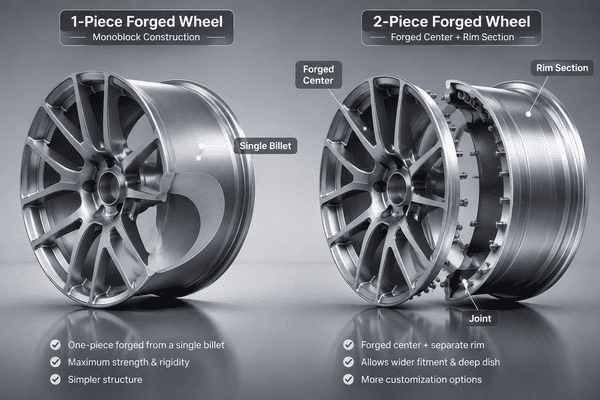
The honest answer is that neither 1-piece forged nor 2-piece forged wheels is inherently better than the other. They solve different problems. A 1-piece forged wheel is milled from a single aluminum billet — simpler, lighter in many configurations, and faster to produce1. A 2-piece forged wheel pairs a forged center with a separate rim section, unlocking fitment and aesthetic flexibility that a monoblock design cannot easily match. The right choice depends on your vehicle specs, use case, and what you actually need from the wheel.
Understanding why these two constructions exist — and what problem each one was designed to solve — is what separates a confident buyer from one who orders twice. The sections below break down the structural difference, the real-world trade-offs, and a concrete framework for making the right call.
What is the structural difference between 1-piece and 2-piece forged wheels?
Most buyers assume the difference is cosmetic — a seam here, a bolt pattern there. But the structural distinction runs deeper than appearance, and it drives every downstream difference in weight, fitment range, and production time.
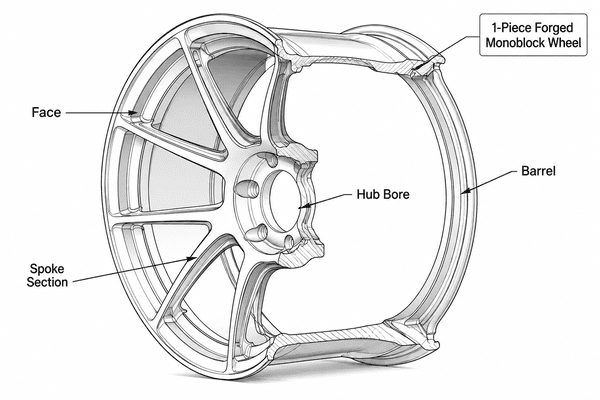
A 1-piece forged wheel (also called a monoblock) is machined from a single forged aluminum billet. The barrel and the face are one continuous piece of material. There are no joints, no hardware connections, and no interfaces between components. What you see is what was forged.
A 2-piece forged wheel combines a forged center — the face and inner barrel — with a separate outer rim section. The two pieces are joined, typically by bolting, to form the finished wheel. This joint is the defining structural feature of the design.
Why the joint matters
The joint in a 2-piece wheel is not a weakness — it is a design decision. It exists because manufacturing a single billet wide enough and deep enough to accommodate extreme offsets or non-standard barrel depths is either technically limiting or economically impractical at scale2.
By separating the center from the rim, manufacturers can:
- Mix offset depths without retooling an entire forging die
- Adjust barrel width independently of the center design
- Scale customization across a wider range of vehicle fitments from a smaller die library
For a 1-piece wheel, the entire geometry — face, spoke depth, offset, barrel width — is determined in the forging and machining process. That means more precision in the final product, but less flexibility to accommodate unusual specifications without a custom die.
How the manufacturing process differs
| Feature | 1-Piece Forged | 2-Piece Forged |
|---|---|---|
| Construction | Single aluminum billet | Forged center + separate rim |
| Joints or connections | None | Bolted or welded joint |
| Offset flexibility | Moderate | High |
| Size range | Standard to custom | Wider, especially for extreme offsets |
| Structural failure points | Fewer | More (joint is a potential point) |
| Production time (typical) | 15–20 days | 20–25 days |
| Weight profile | Lighter in many configs | Varies by barrel depth and hardware |
Based on what our manufacturing partners have confirmed across production runs, the single-piece construction consistently requires fewer assembly steps and less post-production inspection of joint integrity. That contributes directly to the shorter lead time.
Which use cases favor 1-piece forged wheels?
Buyers often assume 2-piece construction means "more premium" because it involves more components and looks more complex. That framing inverts the logic. More components means more assembly, not more quality.
For a wide range of builds, 1-piece forged is the stronger practical choice — specifically because of what it eliminates.
A 1-piece forged wheel has no hardware to loosen, no joint to inspect, and no interface where dissimilar machining tolerances can create micro-movement over time. For performance applications, that simplicity is a feature, not a limitation.

When 1-piece forged wheels make more sense
Performance and track-oriented builds:
On a vehicle where unsprung weight reduction is a priority3 and the wheel dimensions fit within standard forging ranges, 1-piece construction is the default recommendation across the performance wheel segment. Fewer components means fewer variables.
Daily-driven enthusiast vehicles:
For a buyer who wants high-quality forged wheels on a street car without unusual fitment requirements, 1-piece delivers the core value — strength, weight, finish — at a faster lead time and without the assembly complexity of a multi-piece design.
Buyers with standard or near-standard offsets:
If your vehicle’s required offset falls within the range that 1-piece tooling can accommodate cleanly, there is no functional reason to pay for 2-piece fitment flexibility you won’t use.
Buyers on a tighter timeline:
When lead time matters — a build deadline, a show date, an event — the 15–20 day production window for 1-piece versus 20–25 days for 2-piece is a real variable. That difference compounds when you factor in shipping.
Buyer decision signal: If your vehicle has a standard fitment and you are optimizing for performance, weight, or lead time — 1-piece forged is likely the right call.
Which use cases favor 2-piece forged wheels?
The 2-piece forged wheel exists to solve a specific problem: fitment and aesthetic scenarios that push beyond what a monoblock design can deliver efficiently. When that problem is real for your build, the 2-piece construction earns its place.
The joint in a 2-piece wheel is not a liability when the wheel is engineered correctly and assembled to spec. What it delivers in return — flexibility in offset, barrel depth, and face-to-rim proportion — is genuinely difficult to replicate in a single-piece design without significant retooling costs.
When 2-piece forged wheels make more sense
Wide-body builds and aggressive fitment:
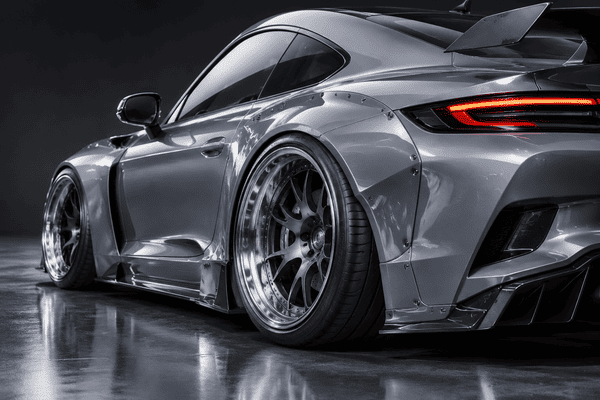
If your vehicle runs a wide-body kit or requires a deep-dish profile with an extreme offset, 2-piece construction is usually the more practical path. The barrel depth can be adjusted independently of the center design, which gives the manufacturer more room to hit your exact spec.
Show cars with strong visual design requirements:
The 2-piece construction allows a wider range of face-to-barrel proportions and dish depths. For a show car where the visual profile of the wheel is a primary design element, that flexibility is worth the additional production time and cost.
Unusual or non-standard offsets:
Based on what we see across customer inquiries at Tree Wheels, buyers running modified suspension, air bags, or aftermarket hubs often arrive with offset requirements that fall outside standard 1-piece tooling ranges. For those buyers, 2-piece is frequently the more direct solution.
Buyers who want interchangeable or repairable components:
In some configurations, a damaged rim section on a 2-piece wheel can be replaced without discarding the center4. This is build-specific and depends on the assembly method, but it is a real consideration for buyers who put high miles on expensive custom wheels.
Trade-offs to weigh honestly
- 2-piece wheels require more inspection at the joint, particularly after high-load use or any impact event.
- Production time is longer — 20–25 days versus 15–20 days for 1-piece. That is not a minor detail for buyers with a deadline.
- Cost is typically higher due to additional components, assembly steps, and quality checks at the joint.
- Weight can go either way. A 2-piece wheel with a deep barrel and hardware may weigh more than a comparable 1-piece monoblock. Never assume 2-piece is lighter.
Buyer decision signal: If your build requires unusual offsets, wide fitment, or a specific visual depth that standard 1-piece tooling cannot accommodate — 2-piece forged is worth the additional lead time and cost.
How should buyers evaluate quality within each construction type?
Once a buyer decides which construction fits their use case, the next question is how to evaluate quality within that category. This is where certifications and manufacturing standards become relevant — not as proof that one construction type outperforms another, but as baseline indicators that a supplier operates within documented quality systems.
When evaluating any forged wheel supplier, buyers should look for:
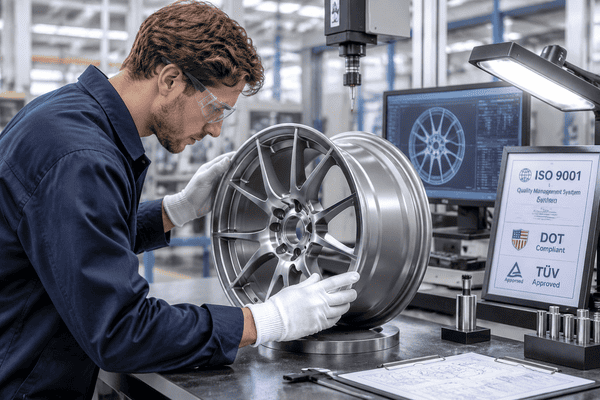
- ISO 9001 certification — indicates a documented quality management system
- DOT certification — required for road use in the United States; buyers should verify this applies to the specific wheel being ordered
- TÜV certification — a European standard that tests structural integrity under load; relevant for buyers in markets that recognize TÜV testing
- IATF 16949 — automotive-specific quality management, more common among Tier 1 suppliers but increasingly used by aftermarket manufacturers
Important: Treat these certifications as documents to verify, not marketing claims to accept at face value. Ask the supplier to provide current, product-specific certification documentation before placing an order.
Questions to ask a supplier before ordering
A well-run supplier should be able to answer the following without hesitation:
- What forging process is used — closed-die or open-die5?
- What aluminum alloy grade is used, and what is the temper specification6?
- How is the joint assembled on 2-piece wheels — bolted, welded, or bonded?
- What non-destructive testing is performed on finished wheels7?
- Can you provide a sample or 3D model before full production begins?
If a supplier cannot answer these questions clearly, that is a stronger signal than any certification logo on their website.
Frequently Asked Questions
Is a 1-piece forged wheel always lighter than a 2-piece forged wheel?
Not necessarily. Weight depends on the specific design, alloy, and barrel dimensions of each wheel. A deep-dish 1-piece wheel can weigh more than a compact 2-piece design. Never assume construction type equals weight outcome — ask the supplier for the actual weight spec of the wheel you are ordering.
Can a 2-piece forged wheel fail at the joint under normal driving conditions?
A properly engineered and assembled 2-piece wheel should not fail at the joint under normal use. Joint failure risk increases with improper installation, impact damage, or wheels that were not engineered for the load rating of the vehicle. Always verify the wheel’s load rating against your vehicle’s requirements before purchasing.
Does the type of forging (1-piece vs. 2-piece) affect the warranty?
Warranty coverage varies by manufacturer, not by construction type. At Tree Wheels, we offer a 1-year warranty covering replacement or repair for both 1-piece and 2-piece forged wheels. Buyers should confirm warranty scope in writing before placing any order, regardless of supplier.
Is a 2-piece forged wheel the same as a split-rim wheel?
No. A 2-piece forged wheel refers to the construction of the wheel structure itself — a forged center joined to a rim section. A split-rim (or multi-piece rim) is a different concept related to tire mounting. These are not interchangeable terms, and confusing them can lead to incorrect fitment decisions.
How do I know which offset I need for my specific vehicle?
Offset is determined by your vehicle’s hub face position relative to the wheel centerline8. The correct offset depends on your vehicle make and model, any suspension modifications, brake clearance requirements, and whether you are running a wide-body kit. For application-specific fitment decisions, consult a qualified wheel fitment specialist or your vehicle manufacturer’s specifications.
Conclusion
The question "Is 1-piece forged better than 2-piece forged?" has a direct answer: neither is universally better. 1-piece forged wheels offer a cleaner structure, fewer failure points, and a faster production timeline — the right choice for performance builds and standard fitment applications. 2-piece forged wheels deliver greater offset flexibility and visual range — the right choice for wide-body kits, show cars, and unusual fitment requirements. The real risk is not choosing the wrong construction type — it is choosing based on prestige language instead of your actual vehicle specs and use case.
If you are actively evaluating forged wheels and want to work through the right fitment and construction choice for your build, Tree Wheels offers design sketches, 3D models, and sample production with an MOQ of just 4 wheels. Our team is available to walk through your specifications directly. Get in touch to start your project.
-
"Review of Magnesium Wheel Types and Methods of Their …", https://pmc.ncbi.nlm.nih.gov/articles/PMC10856444/. Engineering analyses of aluminum wheel construction indicate that monoblock designs eliminate the mass contribution of fasteners and flanged joint interfaces, which can result in lower total wheel weight in equivalent-size comparisons, though final weight depends heavily on spoke geometry and barrel depth. Evidence role: general_support; source type: research. Supports: That monoblock wheel construction can yield lower total mass compared to multi-piece designs in equivalent diameter and width configurations due to the absence of joining hardware and overlapping material at the joint.. Scope note: Direct mass comparisons are highly design-specific; general construction-type weight claims require qualification by wheel dimensions and alloy grade. ↩
-
"How Much Weight Can Forged Wheels Save?", https://treewheels.com/how-much-weight-can-forged-wheels-save/. Closed-die forging operations are constrained by press tonnage, die cavity depth, and material flow characteristics; producing components with deep recesses or large aspect ratios in a single forging operation requires proportionally larger dies and higher press forces, increasing tooling investment and per-part cost, which provides a manufacturing rationale for separating center and rim production in multi-piece wheel designs. Evidence role: mechanism; source type: research. Supports: That forging die geometry and press capacity impose practical constraints on the range of wheel profiles achievable in a single-piece forging operation, particularly for deep-barrel or extreme-offset configurations.. Scope note: The specific threshold at which monoblock forging becomes impractical versus multi-piece construction depends on press capacity, alloy, and manufacturer-specific tooling investments, and is not universally defined in published standards. ↩
-
"Unsprung mass", https://en.wikipedia.org/wiki/Unsprung_mass. Vehicle dynamics literature establishes that unsprung mass — the mass of components not supported by the suspension spring, including wheels and tires — directly affects the natural frequency of wheel hop and the ability of the suspension to maintain tire contact with the road surface, with reductions in unsprung mass generally improving dynamic response. Evidence role: mechanism; source type: research. Supports: That reducing unsprung mass improves vehicle dynamic response, including wheel tracking, suspension compliance, and transient handling behavior.. Scope note: The magnitude of handling improvement from wheel-specific mass reduction varies with suspension design, spring rate, and vehicle class, and may be imperceptible in low-performance street applications. ↩
-
"1910.177 – Servicing multi-piece and single piece rim …", http://www.osha.gov/laws-regs/regulations/standardnumber/1910/1910.177. Multi-piece wheel designs that use bolted rim-to-center joints allow replacement of individual components following damage; however, structural integrity of the reassembled wheel is contingent on the use of manufacturer-specified hardware, correct torque values, and inspection of mating surfaces, as joint integrity is a load-bearing element of the overall wheel structure. Evidence role: general_support; source type: institution. Supports: That multi-piece wheel designs allow component-level replacement, and that structural integrity of the reassembled wheel depends on adherence to manufacturer specifications for fastener torque and joint assembly.. Scope note: Repairability in practice depends on whether replacement components are available from the original manufacturer and whether the assembly method permits disassembly without compromising joint surfaces; welded 2-piece designs do not offer the same repairability as bolted configurations. ↩
-
"Open-Die vs. Closed-Die Forging: What Forging Process is …", https://www.scotforge.com/post/open-die-vs-closed-die-forging-what-forging-process-is-right-for-your-application. In metalworking, closed-die forging (also termed impression-die forging) confines the workpiece within a shaped die cavity to produce near-net-shape parts with tighter dimensional tolerances, whereas open-die forging deforms the workpiece between flat or simple-contour dies without full enclosure, typically used for larger or simpler geometries. Evidence role: definition; source type: encyclopedia. Supports: The technical distinction between closed-die and open-die forging processes as applied to aluminum component manufacturing.. Scope note: General forging process definitions may not capture wheel-industry-specific variants such as flow-forming or rotary forging, which are sometimes used in aftermarket wheel production. ↩
-
"6061 aluminium alloy", https://en.wikipedia.org/wiki/6061_aluminium_alloy. The mechanical properties of forged aluminum components are substantially determined by alloy composition and temper condition; for example, 6061-T6 aluminum achieves tensile strength of approximately 310 MPa and yield strength of approximately 276 MPa through solution heat treatment and artificial aging, compared to significantly lower values in annealed or naturally aged conditions, making alloy and temper specification critical parameters for structural performance evaluation. Evidence role: mechanism; source type: research. Supports: That aluminum alloy grade and temper designation significantly affect the mechanical properties — including tensile strength, yield strength, and fatigue resistance — of forged aluminum components such as wheels.. Scope note: Specific property values vary by forging process, billet quality, and post-forging heat treatment; published alloy data represents typical values rather than guaranteed minimums for any specific manufacturer’s product. ↩
-
"KP | Monoblock Forged Wheels", https://treewheels.com/monoblock-forged-wheels/. Non-destructive testing (NDT) methods applicable to forged aluminum wheel production include dye penetrant inspection for surface-breaking defects, ultrasonic testing for subsurface discontinuities, and X-ray or computed tomography for internal porosity and inclusion detection; these methods allow identification of manufacturing defects that could compromise structural performance under cyclic loading without requiring destructive sectioning of the component. Evidence role: mechanism; source type: research. Supports: That non-destructive testing methods applied to forged aluminum wheels can detect internal and surface defects — including porosity, cracks, and inclusions — without compromising the component.. Scope note: The NDT methods employed and their detection thresholds vary by manufacturer; the presence of an NDT step in production does not guarantee detection of all defect types, and buyers should ask specifically which methods are applied and to what percentage of production units. ↩
-
"How Do Fitment Requirements Differ Between European, …", https://treewheels.com/how-do-fitment-requirements-differ-between-european-japanese-and-american-vehicles/. Wheel offset, commonly expressed in millimeters and denoted ‘ET’ (from the German Einpresstiefe, meaning insertion depth), is defined as the distance between the hub mounting face of the wheel and the geometric centerline of the wheel assembly; positive offset indicates the mounting face is toward the outboard side of the centerline, negative offset toward the inboard side, and zero offset places the mounting face at the centerline. Evidence role: definition; source type: institution. Supports: The technical definition of wheel offset as the measured distance between the wheel’s hub mounting face and its geometric centerline, expressed in millimeters.. Scope note: Offset specifications interact with wheel width, suspension geometry, and brake caliper clearance; the offset value alone is insufficient to confirm fitment without reference to vehicle-specific dimensional data. ↩