
Fitting new wheels sounds exciting — until they rub against the brake caliper. This is one of the most common and costly mistakes in wheel customization.
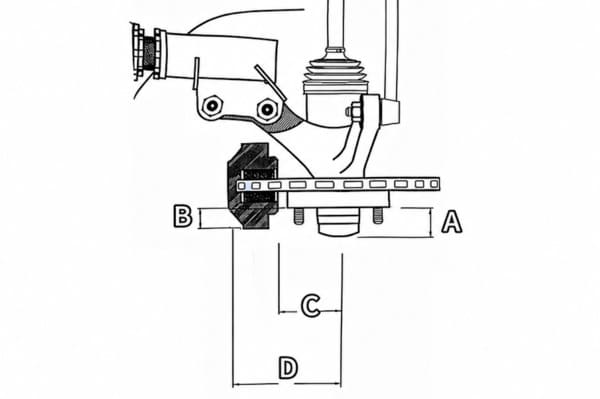
Brake caliper clearance is the gap between your wheel’s inner barrel and the brake caliper. To ensure safe fitment, you need to measure four key dimensions: hub height (A), caliper height from mounting surface (B), distance from hub center to the inner edge of the caliper (C), and distance from hub center to the outer edge of the caliper (D).
Not every wheel fits every car. Even if the bolt pattern matches and the size looks right, the inner barrel of the wheel can still make contact with the brake caliper. This contact causes serious problems — from vibration and noise to complete brake failure1. Before you order any custom or aftermarket wheel, you need to verify clearance. Measuring it is straightforward if you know the right dimensions to check.
What Is Brake Caliper Clearance and Why Does It Matter?
Most people focus on bolt pattern and offset when shopping for wheels. But ignoring caliper clearance is a mistake that can cost you far more than the wheels themselves.
Brake caliper clearance is the physical space between the inside of a wheel and the brake caliper mounted on your vehicle. If this space is too small, the wheel will contact the caliper during installation or while driving. This can damage both the wheel and the braking system, and creates a serious safety risk.
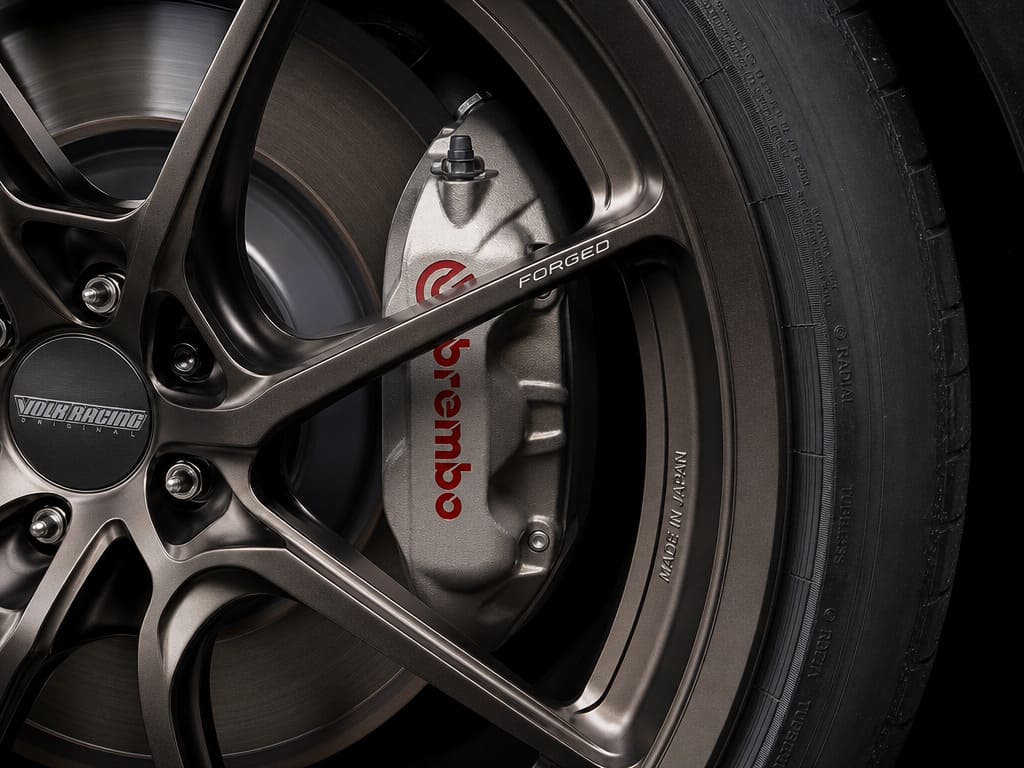
Many buyers assume that if a wheel fits the hub and matches the bolt pattern, it will clear everything else. This is not always true. Caliper clearance is easy to overlook for several reasons. First, most fitment guides focus on bolt pattern, offset, and diameter — not inner clearance. Second, if you have upgraded to larger aftermarket brakes2, your calipers are bigger than stock. Third, some spoke designs push material closer to the caliper area. Fourth, caliper size and position vary widely between vehicle makes and models3. The result is that two wheels with identical specs can fit very differently on the same car. One clears the caliper with room to spare. The other does not fit at all. If contact does happen, the consequences are serious — from a rubbing noise at low speed, to deep gouging of both the wheel and caliper at highway speed, to a caliper piston seizing under heavy braking4. This is why measuring before ordering is not optional. At Tree Wheels, we ask every customer to provide caliper measurements before we begin designing or producing any custom wheel. This step protects your investment and keeps you safe on the road.
What Are the 4 Key Dimensions You Need to Measure?
You already know clearance is important. But what exactly should you be measuring? Most guides give vague advice. We use a specific four-point system on every order.
To check brake caliper clearance properly, you need four measurements: (A) hub height, (B) distance from the highest point of the brake caliper to the mounting surface, (C) distance from the hub center to the inner edge of the caliper, and (D) distance from the hub center to the outer edge of the caliper.
These four measurements come directly from the Brake Caliper Measurement Guide we send to our customers at Tree Wheels. Each dimension serves a specific purpose in the wheel design process. Dimension A tells us how far the wheel sits from the mounting surface. Dimension B is the most critical number — it tells us how tall the caliper is at its highest point, which is where contact is most likely to happen. Dimension C defines the inner boundary of the caliper footprint, and dimension D defines the outer boundary. Together, these four numbers give our design team a complete picture of the caliper’s position and size relative to the hub.
| Code | Measurement | Why It Matters |
|---|---|---|
| A | Hub height | Determines how far the wheel sits from the mounting surface |
| B | Highest point of caliper to mounting surface | Most critical clearance point — defines caliper height |
| C | Hub center to inner edge of caliper | Defines the inner boundary of the caliper footprint |
| D | Hub center to outer edge of caliper | Defines the outer boundary of the caliper footprint |
With this data, we design the inner barrel, spoke geometry, and dish depth of the wheel so that it clears the caliper with a safe margin on all sides. Without these measurements, any custom wheel order is a guess. Even experienced technicians have made costly fitment errors by skipping this step.
How to Measure Each Dimension Correctly?
Knowing what to measure is only half the job. You also need to measure accurately. One millimeter of error can mean the difference between a clean fit and a dangerous contact point5.
Use a digital caliper or a steel ruler with millimeter markings6 for all measurements. Work with the vehicle on a flat surface and the wheel removed. Measure from fixed reference points — the hub mounting surface and the hub center — to get consistent and repeatable results.
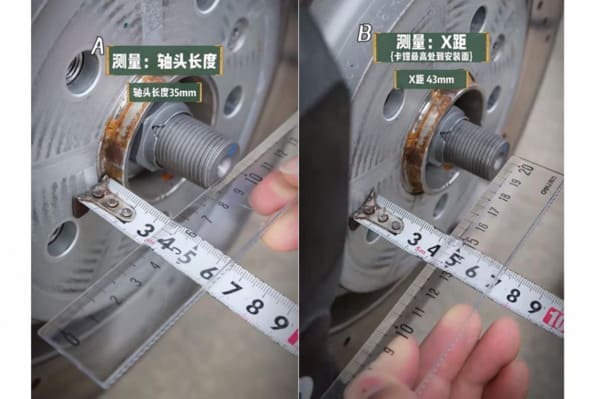
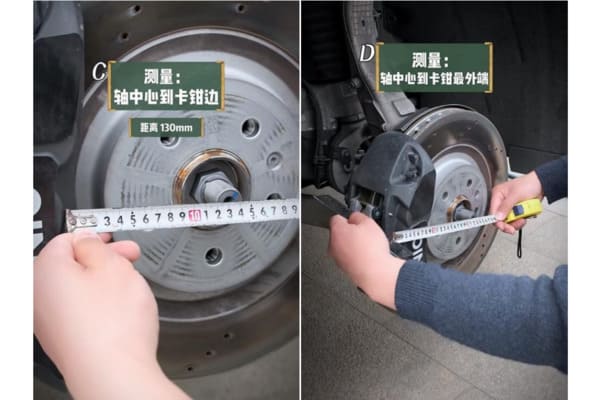
Follow these steps carefully. All measurements should be recorded in millimeters (mm). Start by lifting the vehicle safely and removing the wheel on the side you are measuring. Make sure the vehicle is stable before you begin. For dimension A, measure the distance from the face of the hub mounting surface to the tip of the hub center bore. For dimension B, find the highest point of the brake caliper body and measure the vertical distance from that point down to the wheel mounting surface. This is your most important number. For dimension C, place your measuring tool at the exact center of the hub and measure horizontally to the inner edge of the caliper body. For dimension D, measure from the same hub center point to the outer edge of the caliper body. Once you have all four numbers, take each measurement a second time to confirm. If your two readings differ by more than 0.5mm, measure again.
| Step | Dimension | Action | Tool |
|---|---|---|---|
| 1 | — | Remove wheel, stabilize vehicle | Jack, jack stands |
| 2 | A | Measure hub height from mounting surface | Digital caliper |
| 3 | B | Measure caliper height from mounting surface | Digital caliper |
| 4 | C | Measure hub center to inner caliper edge | Steel ruler |
| 5 | D | Measure hub center to outer caliper edge | Steel ruler |
| 6 | — | Record all values and verify each one twice | Measurement form |
Once you have confirmed all four values, send them to your wheel supplier. At Tree Wheels, we use these exact dimensions to verify that our wheel design will clear your brake caliper before a single piece of material is cut. We will not begin production until this check is complete.
How Do Forged Wheels Help With Brake Caliper Clearance?
You might be wondering whether the type of wheel affects caliper clearance. It does — more than most people realize.
Forged wheels offer better brake caliper clearance compatibility than cast wheels because they are manufactured with tighter dimensional tolerances. The forging process7 also allows for more precise spoke geometry and inner barrel shaping, which gives designers more flexibility to clear large or upgraded brake calipers.
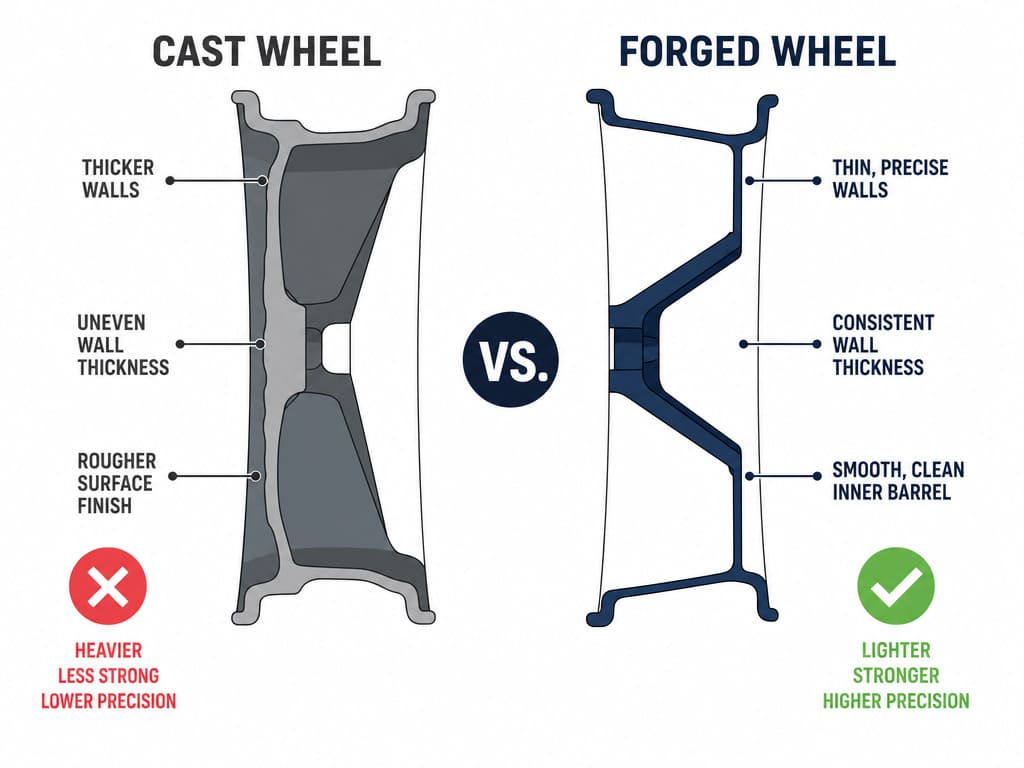
This is not just a marketing claim. The manufacturing process itself creates real, measurable differences in how well a wheel can be designed around a specific caliper. A cast wheel requires thicker walls for structural strength8, which leaves less room to work with near the caliper area. A forged wheel is denser and stronger by nature9, so material can be placed exactly where it is needed and removed where it is not. This gives us much more control over the inner barrel shape. When a customer sends us dimensions A, B, C, and D, our team uses those numbers to design the inner barrel with CNC precision10. We shape the spoke roots, adjust the inner lip depth, and control every dimension that affects clearance.
| Factor | Cast Wheels | Forged Wheels |
|---|---|---|
| Dimensional tolerance | ±1.5mm or more11 | ±0.5mm or less12 |
| Wall thickness control | Limited — thicker walls needed for strength | Precise — material placed exactly where needed |
| Inner barrel design flexibility | Low — constrained by casting mold | High — CNC machining allows custom shaping |
| Custom fitment capability | Difficult to modify per vehicle | Fully customizable to your specific measurements |
| Clearance reliability | Less predictable | Consistent and verifiable |
At Tree Wheels, we have over 20 years of forged wheel manufacturing experience behind every design decision. When we say a wheel will clear your caliper, we have the engineering precision to back that up. If you have upgraded brakes, a modified suspension, or a vehicle with unusually large stock calipers, a custom forged wheel built around your exact measurements is the only reliable solution.
Conclusion
Brake caliper clearance comes down to four measurements. Get them right before you order, and your wheels will fit safely and precisely every time.
At Tree Wheels, we build every custom forged wheel around your exact caliper dimensions — send us your measurements and we’ll take care of the rest.
-
"Brake Testing Methodology Study – Driver Effects Testing", https://www.nhtsa.gov/sites/nhtsa.gov/files/braketst.pdf. Automotive safety authorities document that physical interference between wheels and brake components can compromise braking performance through heat buildup, component damage, and in severe cases, loss of braking function. Evidence role: mechanism; source type: government. Supports: The mechanical consequences of wheel-to-caliper contact on brake system function. Scope note: Most sources discuss general wheel fitment issues rather than specifically documenting complete brake failure from caliper contact ↩
-
"ARE BIGGER BRAKES WORTH IT? Standard vs. Aftermarket brake test", https://www.youtube.com/watch?v=vJ7Meb7tYmU. Automotive aftermarket sources document that performance brake upgrades commonly feature larger caliper bodies and increased piston counts to accommodate bigger rotors, resulting in calipers that extend further toward the wheel mounting area than original equipment components. Evidence role: general_support; source type: other. Supports: The dimensional characteristics of aftermarket performance brake systems. ↩
-
"[PDF] Cal Poly BSAE Brake Caliper", https://digitalcommons.calpoly.edu/cgi/viewcontent.cgi?filename=1&article=1899&context=mesp&type=additional. Automotive engineering references confirm that brake caliper dimensions, mounting positions, and designs vary substantially across manufacturers and vehicle platforms, with no universal standardization beyond basic mounting interface specifications. Evidence role: general_support; source type: institution. Supports: The diversity of brake caliper designs across the automotive industry. ↩
-
"Is 57.1mm the Correct Hub Bore for a BMW E30?", https://treewheels.com/is-57-1mm-the-correct-hub-bore-for-a-bmw-e30/. Automotive engineering sources describe how wheel-to-caliper interference creates escalating damage: initial contact produces noise and surface wear, continued operation causes material removal and heat generation, and sustained interference can damage caliper seals, restrict piston movement, and compromise brake function. Evidence role: mechanism; source type: institution. Supports: The mechanical failure progression when wheels contact brake calipers. Scope note: Most documentation addresses general mechanical interference rather than providing detailed failure analysis specific to wheel-caliper contact ↩
-
"How Do You Ensure Proper Brake Caliper Clearance When …", https://treewheels.com/how-do-you-ensure-proper-brake-caliper-clearance-when-upgrading-wheels/. Automotive engineering guidelines emphasize that wheel-to-brake clearances operate within tight tolerances, where small measurement errors or dimensional variations can eliminate necessary safety margins and result in component interference. Evidence role: general_support; source type: institution. Supports: The critical nature of precise measurements in wheel-to-caliper clearance. Scope note: Most sources provide general guidance rather than specifying exact minimum clearance values, which vary by application ↩
-
"Calipers – Wikipedia", https://en.wikipedia.org/wiki/Calipers. Measurement standards confirm that quality digital calipers typically provide accuracy within 0.02-0.03mm and steel rulers with fine graduations offer sufficient precision for most automotive fitment measurements where tolerances are in the sub-millimeter to millimeter range. Evidence role: general_support; source type: education. Supports: The suitability of digital calipers and precision rulers for automotive dimensional measurements. ↩
-
"What Quality Control Measures Ensure Consistency in Forged …", https://treewheels.com/what-quality-control-measures-ensure-consistency-in-forged-wheel-production/. Materials engineering sources explain that forging compresses and aligns the grain structure of aluminum alloys, resulting in higher material density, improved strength-to-weight ratios, and more uniform mechanical properties compared to casting processes. Evidence role: mechanism; source type: education. Supports: How the forging manufacturing process affects material density and structural properties in aluminum wheels. ↩
-
"055000", https://online2.ogs.ny.gov/dnc/masterspec24/docs/Division05Metals/055000.0MetalFabrications.docx. Engineering analyses of wheel design demonstrate that cast aluminum wheels require greater wall thickness and material volume to achieve equivalent strength and safety factors compared to forged wheels, due to the lower material density and strength properties inherent in casting processes. Evidence role: mechanism; source type: research. Supports: The relationship between manufacturing method and required wall thickness in aluminum wheels. ↩
-
"Comparison of Mechanical and Corrosion Properties Between …", https://pmc.ncbi.nlm.nih.gov/articles/PMC12842727/. Metallurgical studies show that forged aluminum alloys exhibit refined grain structures and reduced porosity compared to cast alloys, resulting in higher material density, superior tensile strength, and improved fatigue resistance. Evidence role: mechanism; source type: education. Supports: The material property differences between forged and cast aluminum alloys. ↩
-
"Computer numerical control", https://en.wikipedia.org/wiki/Computer_numerical_control. Manufacturing engineering references establish that modern CNC machining centers can maintain positional accuracy within 0.005-0.025mm and repeatability within 0.002-0.010mm, enabling precise dimensional control in wheel manufacturing applications. Evidence role: mechanism; source type: education. Supports: The dimensional accuracy capabilities of CNC machining technology. ↩
-
"Dimensional accuracy of castings produced with ringless …", https://pubmed.ncbi.nlm.nih.gov/10898838/. Industry manufacturing standards indicate that gravity cast and low-pressure cast aluminum wheels typically maintain dimensional tolerances in the range of 1.0-2.0mm depending on the specific dimension and casting method used. Evidence role: statistic; source type: institution. Supports: Typical dimensional tolerances in cast wheel manufacturing. Scope note: Exact tolerance values vary by manufacturer, casting method, and specific dimension being measured ↩
-
"What Is the Complete Manufacturing Process for a Premium …", https://treewheels.com/what-is-the-complete-manufacturing-process-for-a-premium-forged-wheel/. Manufacturing engineering literature documents that forged aluminum wheels finished with CNC machining can consistently achieve dimensional tolerances of 0.5mm or tighter on critical dimensions, significantly exceeding the precision of cast manufacturing methods. Evidence role: statistic; source type: research. Supports: Achievable dimensional tolerances in forged and CNC-machined wheel manufacturing. ↩