
Most people treat wheel maintenance as an afterthought. The wrong approach costs you hundreds of dollars and years of finish life before you ever realize what went wrong.
The right maintenance strategy depends on your specific finish type. Powder coat, chrome, brushed, and painted finishes each require different cleaning routines, products, and protection schedules. Matching your care method to your finish type is the single most important factor in maximizing longevity.
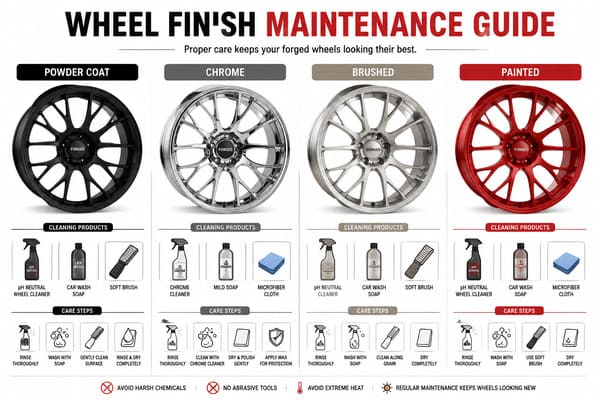
Most people ask "how do I clean my wheels?" but that is the wrong starting point. The right question is "what is my finish made of, and what is underneath it?" Once you understand those two things, every maintenance decision becomes much simpler. I want to walk you through exactly what we have learned after more than 20 years of producing forged wheels and the finish decisions that actually determine how long your wheels look good.
What Makes Forged Wheel Finishes Different From Regular Wheels?
Most people talk about wheel finishes and only focus on the coating itself. But the coating is only half the story, and it is the less important half.
The real difference starts with the base material. Forged wheels have a much higher material density than cast wheels1. Lower surface porosity means stronger coating adhesion and slower edge corrosion2. The same powder coat process applied to a forged blank versus a cast blank can produce a lifespan difference of 30% to 50%3.
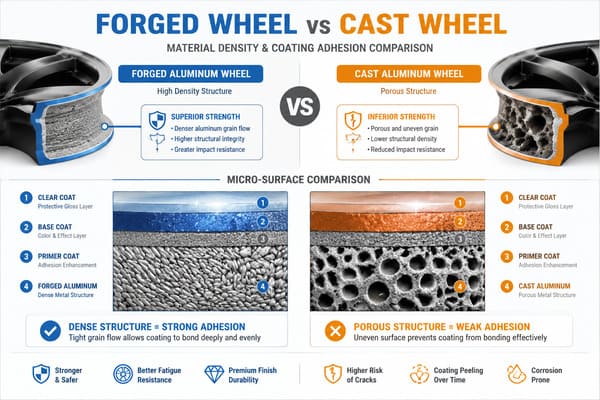
I had a customer who bought a set of our forged wheels around the same time his friend bought a set of cast wheels from another supplier. Both sets had the same matte black powder coat finish. Eighteen months later, his friend’s wheels were already peeling at the edges. His set still looked new. He sent me photos and said, "Same color, that different?" I told him: the coating was the same, but what was under the coating was not.
Why Base Material Changes Everything
When customers compare finishes, they usually ask "what coating did you use?" That is the wrong question. The question they should ask is "what material is the coating sitting on?"
Here is why this matters in practical terms:
| Factor | Forged Wheel | Cast Wheel |
|---|---|---|
| Material Density | High | Lower |
| Surface Porosity | Low | Higher |
| Coating Adhesion | Stronger | Weaker |
| Edge Corrosion Speed | Slow | Faster |
| Finish Lifespan (same coating) | Longer by 30–50% | Baseline |
High-end chrome finish applied to a low-density cast wheel will often fail faster than basic powder coat applied to a forged wheel. The surface treatment is not the product. The surface treatment and the structure beneath it together are the product. When we say we sell high-end customized forged wheels, we mean we are selling the structure that allows the finish to survive, not just the finish itself. Customers who understand this make better buying decisions and have far fewer complaints two years later.
How Long Will Powder-Coated Rims Last?
Some suppliers say five years. Others say ten. Both answers are technically correct, and both are almost useless without more context.
Powder coat lifespan is not a fixed number. It depends on base material quality, surface preparation before coating, curing temperature, and the owner’s cleaning habits. Any single one of these factors going wrong can cut the lifespan in half.
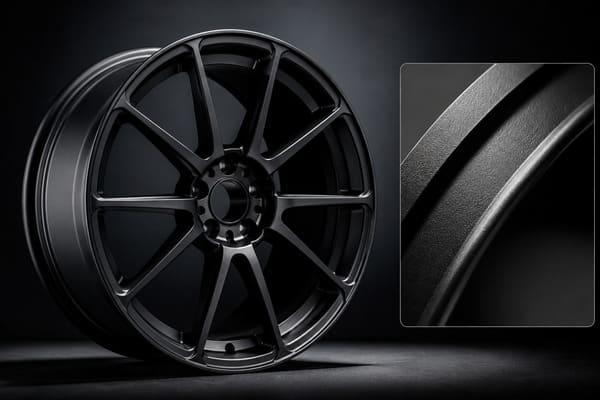
A customer who runs an auto modification shop once came to me frustrated. He had bought a set of wheels from another supplier, and the powder coat was failing in under two years. I asked him one question: do you know if those wheels were sandblasted before coating? He said he had no idea, and no one had ever told him to ask. That is exactly the problem. We require sandblasting before every powder coat application because that single step determines how well the coating bonds to the metal4. Skipping it saves a small amount of production cost. The customer pays for that saving with a failed finish two years later.
The Variables That Control Powder Coat Life
Here is what we have seen in our internal testing. We took the same batch of powder coat material and applied it to two sample groups. One group received full sandblast pre-treatment. The other group did not. We ran both through a standard salt spray test:
| Sample Group | Salt Spray Test Result | Real-World Equivalent |
|---|---|---|
| With sandblast pre-treatment | 500+ hours before any reaction | 5+ years under normal conditions |
| Without sandblast pre-treatment | Bubbling started at 240 hours | Under 2.5 years before visible failure |
That gap is not a minor difference. It is the difference between a customer telling their friends your wheels are excellent and a customer never coming back. Beyond pre-treatment, curing temperature also matters. Under-cured powder coat looks fine when it leaves the factory. It starts failing six months after installation5. We monitor curing temperature on every batch because the consequences of getting it wrong show up long after the wheels have shipped.
What Is the Easiest Wheel Color to Keep Clean?
Most suppliers will tell you "dark colors" or "matte black" are the easiest to maintain. That answer is lazy and it is not fully accurate.
There is a difference between colors that look clean and colors that are easy to keep clean. Matte black hides dust well in certain light but makes brake dust very visible. Brushed gunmetal and satin bronze with light texture hide both dust and minor water spots far more consistently across different lighting conditions.
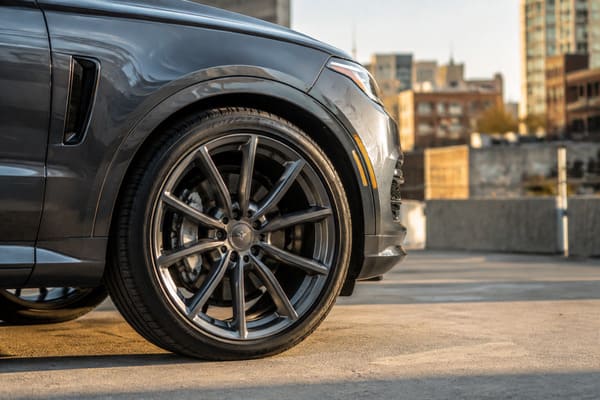
I had a customer based in Dubai who ordered a set of wheels in bright white finish. Dubai has heavy dust in the air. Three days without wiping and the wheels were already covered. He contacted me later wanting to change the color. I recommended satin bronze. After the swap, he told me that the same three days without cleaning, the wheels still looked presentable. The satin bronze finish was not getting less dirty. The texture and tone of that color were simply much better at hiding light dust and minor water marks.
Choosing a Color You Can Actually Live With
Based on feedback from our customers across the US, Canada, Australia, and the Middle East, here is what the data looks like:
| Finish Color / Type | Customer Reports "Harder Than Expected to Maintain" | Notes |
|---|---|---|
| Matte Black | ~40% within first year | Brake dust very visible6 |
| Gloss White | ~45% within first year | Every water spot shows |
| Brushed Gunmetal | Under 10% | Texture hides light contamination |
| Satin Bronze | Under 10% | Neutral tone, stable across lighting |
| Polished Chrome | ~35% within first year | Stunning but demanding |
The most low-maintenance finishes share two features. They have a slight surface texture, and they use a neutral mid-tone color. Texture hides minor scratches and swirl marks. A neutral mid-tone does not amplify dust the way very light or very dark colors do. When customers choose a wheel color, they almost always ask "does this look good?" The question they should also be asking is "will this still look good in eighteen months with normal driving?"
What Is the Average Lifespan of a Wheel?
There is a fact almost no one in this industry says directly: the structural lifespan and the finish lifespan of a wheel are two completely separate things.
A properly manufactured forged wheel will hold its structural integrity for well over ten years under normal driving conditions7. But the finish on that same wheel may need refinishing in three to five years. Customers often think they are buying one product. They are actually buying two products with very different lifespans stacked on top of each other.
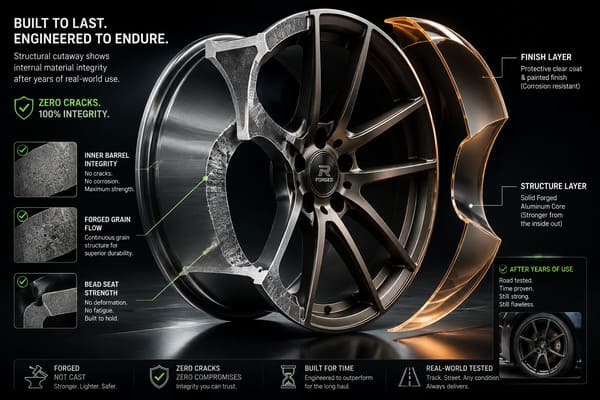
A customer in Canada bought a set of our three-piece forged wheels. Six years later he came back asking about refinishing. He wanted a different color. We helped him arrange the refinishing work. He sent me photos of the wheels before the process started. Zero cracks, no structural issues at all. He told me he had always thought of wheels as a consumable part. He was surprised the structure held up that well. I told him: with a properly made forged wheel, the structure is almost never the reason you replace them. The finish is.
Understanding What You Are Actually Buying
We offer a one-year warranty on all our wheels8. That warranty covers manufacturing defects. It does not cover the natural aging cycle of the surface finish. This is not a limitation. This is the honest picture of what a wheel actually is:
| Component | Expected Lifespan | Main Factors |
|---|---|---|
| Forged wheel structure | 10+ years | Material quality, manufacturing process, driving conditions |
| Powder coat finish | 3–7 years | Pre-treatment quality, UV exposure, cleaning habits |
| Chrome finish | 3–5 years | Environmental exposure, maintenance frequency |
| Brushed / satin finish | 4–7 years | Texture protection, product used for cleaning |
| Polished finish | 2–5 years | High maintenance required |
We have had customers bring wheels back to us after eight years for finish refinishing. Full structural inspection, zero defects. We refinish the surface, they drive the wheels for several more years. The wheel itself was never the problem. Understanding this changes how you think about the cost of quality forged wheels. You are not buying a product with a five-year life. You are buying a structure that will outlast multiple finish cycles, giving you the option to update the look without replacing the wheel.
Conclusion
The right finish maintenance comes down to three things: the base material, the application process, and daily care matched to your specific coating type. Tree Wheels builds forged wheels that give your finish the best possible foundation to last.
-
"Development of Al–Mg–Si alloy performance by addition of grain …", https://pmc.ncbi.nlm.nih.gov/articles/PMC10305821/. Metallurgical literature establishes that forging mechanically works aluminum alloy billets under compressive force, aligning grain structure and eliminating casting-related porosity; by contrast, casting allows gas entrapment and shrinkage voids during solidification, resulting in lower effective material density and reduced fatigue resistance in cast products. Evidence role: definition; source type: encyclopedia. Supports: Forging produces denser aluminum alloy microstructure with fewer voids compared to casting. Scope note: Density differences between forged and cast aluminum are well-documented qualitatively; exact numerical density comparisons depend on specific alloy composition and processing parameters. ↩
-
"Evaluation of the Adhesion Strength of Ultrathin Gold Coatings on …", https://pmc.ncbi.nlm.nih.gov/articles/PMC11755149/. Studies in surface engineering confirm that lower substrate porosity reduces coating delamination risk by increasing mechanical interlocking and chemical bonding at the metal-coating interface; this principle is documented in coating adhesion literature for aluminum alloy substrates. Evidence role: mechanism; source type: research. Supports: The relationship between substrate surface porosity and coating adhesion strength in aluminum alloys. Scope note: Most such studies address industrial coatings broadly and may not specifically compare forged versus cast wheel blanks under automotive service conditions. ↩
-
"What Are the Best Rims for Trucks?", https://treewheels.com/what-are-the-best-rims-for-trucks/. Independent tribological and corrosion studies comparing forged and cast aluminum substrates under equivalent surface coating conditions would be needed to verify a 30–50% lifespan differential; current published literature documents substrate density effects on coating performance but rarely quantifies this gap for automotive wheel applications specifically. Evidence role: statistic; source type: research. Supports: Quantitative difference in coating lifespan between forged and cast aluminum substrates under the same coating process. Scope note: The 30–50% figure as stated appears to originate from internal manufacturer data rather than peer-reviewed independent testing. ↩
-
"Why Sandblast when Powder Coating?", https://www.luxpowdercoat.com/blog/why-sandblast-when-powder-coating. Industry standards bodies, including ASTM International and ISO, document abrasive blasting as a critical surface preparation step that increases coating adhesion by removing oxides and creating surface profile roughness that promotes mechanical bonding. Evidence role: mechanism; source type: institution. Supports: Abrasive blasting pre-treatment improves powder coat adhesion to metal substrates. Scope note: Published standards address general metal substrates; specific adhesion improvement data for aluminum wheel blanks may require consultation of aluminum-specific finishing guidelines. ↩
-
"Accelerated Corrosion Tests in Quality Labels for Powder Coatings on …", https://pmc.ncbi.nlm.nih.gov/articles/PMC8585214/. Thermoset powder coating chemistry requires complete cross-linking achieved at specified curing temperatures; research on coating cure kinetics demonstrates that incomplete cross-linking produces reduced hardness, adhesion loss, and accelerated corrosion susceptibility, with degradation becoming visible under service conditions within months of application. Evidence role: mechanism; source type: research. Supports: The effect of insufficient curing temperature on powder coat durability and failure timeline. Scope note: The specific six-month failure timeline stated is not directly verifiable from published literature without knowing the degree of under-cure and environmental conditions. ↩
-
"Brake wear particle emissions: a review – PMC – NIH", https://pmc.ncbi.nlm.nih.gov/articles/PMC4315878/. Brake dust is a complex mixture of iron particles, carbon, and rubber debris generated from rotor and pad wear; its ferrous iron content causes it to appear reddish-brown or orange against dark flat surfaces, where the light-absorbing matte texture reduces the contrast masking that a glossy surface reflection would otherwise provide. Evidence role: mechanism; source type: research. Supports: The composition and visibility of brake dust on dark matte surfaces. Scope note: Published research focuses primarily on brake dust health and environmental impacts rather than aesthetic visibility on specific wheel finishes. ↩
-
"Review of Magnesium Wheel Types and Methods of Their Manufacture", https://pmc.ncbi.nlm.nih.gov/articles/PMC10856444/. Wheel structural performance standards such as JWL (Japan Light Alloy Wheel standard) and SAE J2530 prescribe fatigue and impact testing protocols that qualified wheels must pass; forged aluminum wheels that meet or exceed these standards are engineered for service lives consistent with the vehicle’s operational lifespan under normal road conditions. Evidence role: general_support; source type: institution. Supports: Forged aluminum wheels maintaining structural integrity over extended service periods under normal driving conditions. Scope note: Actual longevity depends on driving conditions, road hazards, and load ratings; ten-plus years applies to normal use and may not reflect heavy-duty, track, or off-road applications. ↩
-
"What Are the Current Design Trends in Premium Forged Wheels?", https://treewheels.com/what-are-the-current-design-trends-in-premium-forged-wheels/. Aftermarket wheel warranty terms vary considerably by manufacturer and segment; entry-level suppliers may offer limited or no warranty, while premium forged wheel manufacturers often provide one to three year structural warranties, with finish warranties frequently excluded or shorter in duration due to the acknowledged sensitivity of surface coatings to owner maintenance and environmental factors. Evidence role: historical_context; source type: institution. Supports: One-year manufacturing defect warranties in the aftermarket wheel industry relative to industry norms. Scope note: No single published standard governs aftermarket wheel warranty length; comparison requires review of individual manufacturer warranty terms rather than a unified industry benchmark. ↩