
The wrong wheel choice costs you money, performance, and customers. Most buyers never realize they are comparing two completely different manufacturing philosophies.
OEM wheels are built to pass safety standards at the lowest cost. Aftermarket forged wheels are built to maximize performance and customization. The difference shows up in weight, strength, design freedom, and long-term value for both shop owners and individual buyers.
I have spent over 20 years manufacturing forged wheels, and I have worked with auto modification shops, luxury car service centers, and individual enthusiasts across the US, Australia, Canada, the UK, and the Middle East. The question I get asked most often is simple: should I go OEM or aftermarket forged? The answer is almost never simple, so let me break it down properly.
What Is the Difference Between OEM and Aftermarket Forged Wheels?
Most buyers assume all wheels from major brands are built to a high standard. That assumption costs them weight, performance, and money they never get back.
OEM wheels are designed around one goal: pass safety standards at the lowest production cost1. Aftermarket forged wheels are designed around a different goal entirely — maximum performance and personalization. This single difference drives every design, material, and weight decision that follows.
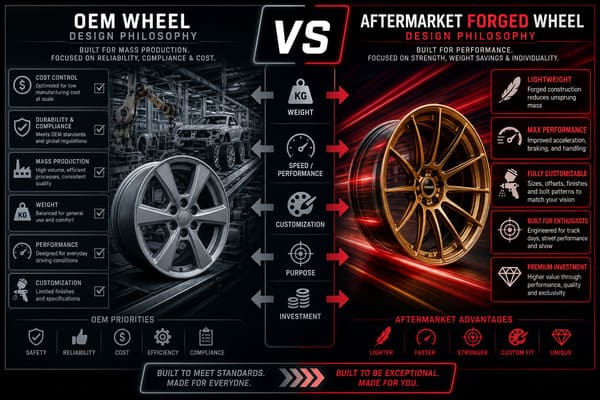
I have been involved in supply chain projects for automotive brands, and I can tell you directly: the OEM wheel development budget puts cost control first. Aesthetics and weight reduction are not priorities in that system. The goal is to meet the minimum required standard at the lowest possible price per unit.
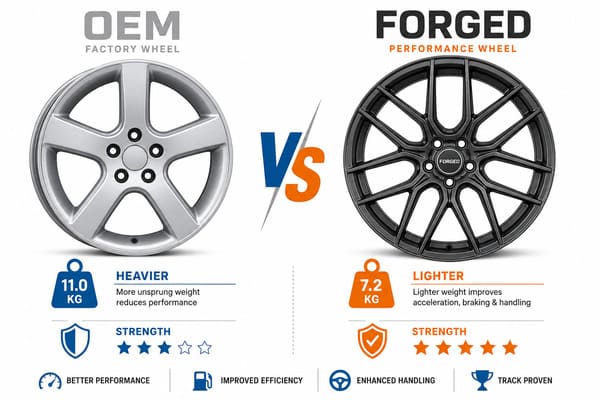
Aftermarket forged wheels operate under a completely different set of rules. When a customer spends money on a custom forged wheel, they are paying for performance and individuality. That means we have real room to push the design and material to their limits. Here is what that difference looks like in actual numbers:
| Specification | OEM Cast Wheel | Aftermarket Forged Wheel |
|---|---|---|
| Typical Weight (per wheel) | 10–12 kg | 7–9 kg |
| Weight Reduction | — | 20%–30% lighter |
| Internal Structure | Porous (cast) | Dense (forged under pressure) |
| Design Flexibility | Fixed by OEM spec | Fully customizable |
| Customization Options | None | Size, design, color, finish |
A 20%–30% weight reduction per wheel2 is not a small improvement. That number changes how a car accelerates, how it handles corners, and how it responds to braking. Every rotating component that loses weight gives back energy to the driver3. OEM wheels are built to satisfy a procurement checklist. Aftermarket forged wheels are built to satisfy a driver.
Are Aftermarket Forged Wheels Better Than OEM Wheels?
Many car owners stay loyal to OEM wheels simply because they came with the car. They mistake familiarity for quality, and that assumption holds them back.
Aftermarket forged wheels outperform OEM wheels in weight, strength, and customization. For drivers who care about handling, braking, and appearance, a properly made forged aftermarket wheel delivers a measurable improvement over the standard OEM option in nearly every category.
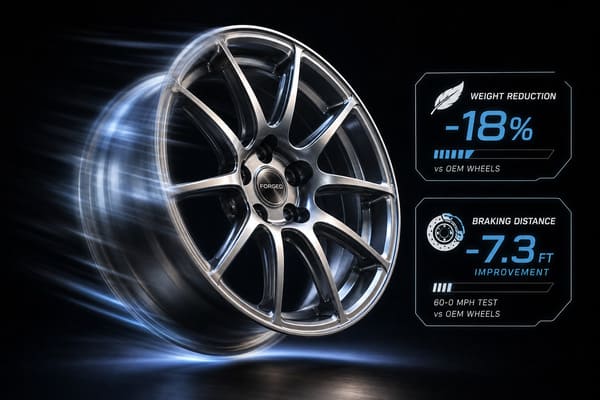
I had a client in Australia who runs a modification shop. He sent me a photo of a factory wheel from a popular European sedan and asked if I could build something that looked better and weighed less. My answer was not just "yes" — it was "significantly better."
We built him a set of 19-inch one-piece forged wheels. The original OEM wheels weighed 11.2 kg each. Our forged version came in at 8.1 kg. That is a 27% weight reduction per wheel.
He called me after his customer picked up the car. The driver felt the difference on the first lap out of the shop — lighter steering, shorter braking distance, better road response4. These were not numbers on a spec sheet. These were things the driver felt immediately.
| Category | OEM Wheel | Aftermarket Forged Wheel |
|---|---|---|
| Steering Feel | Standard | Noticeably lighter |
| Braking Response | Standard | Shorter stopping distance |
| Handling | Baseline | Improved cornering response |
| Visual Customization | None | Full custom design available |
| Weight Example (19") | 11.2 kg | 8.1 kg (−27%) |
The performance gap between OEM and aftermarket forged wheels is real. It is not marketing language. It is physics. Less rotating mass means the engine works less, the brakes work less, and the driver gets more control. If your customers are serious about their cars, OEM is not the ceiling — it is the floor.
How Do OEM and Aftermarket Forged Wheels Compare in Quality?
A common belief in the market is that OEM means high quality because a major car brand put their name on it. This belief is wrong in a very specific and important way.
Most OEM wheels — including those fitted to luxury vehicles — are cast, not forged. Cast wheels have internal porosity that limits their strength ceiling. Forged wheels are compressed under high pressure, producing a denser internal structure that is 20%–30% stronger at the same weight.
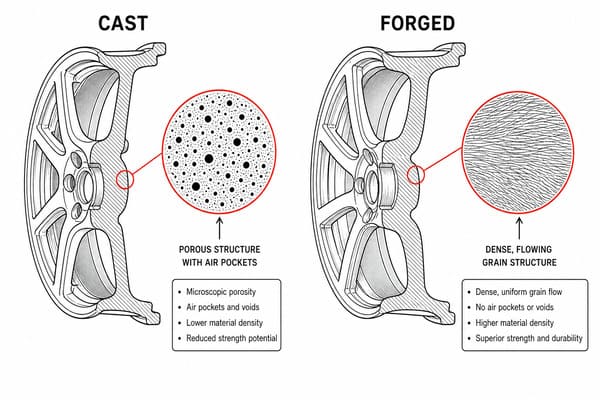
I have been making forged wheels for over 20 years. I want to say this clearly: the OEM badge does not guarantee forged construction. The majority of OEM wheels, including those on premium and luxury car brands, are produced using casting. Casting pours molten aluminum into a mold and lets it cool. The result has microscopic air pockets inside the material.5 Those pockets create a hard limit on how strong and how light the wheel can be.
Forging is a different process. We compress aluminum alloy under extreme pressure. The molecules align tightly. The internal structure becomes dense.6 That density is where the strength comes from.
| Quality Metric | Cast OEM Wheel | Forged Aftermarket Wheel |
|---|---|---|
| Internal Structure | Porous | Dense and compact |
| Relative Strength | Baseline | ~20%–30% stronger7 |
| Weight at Same Strength | Heavier | Lighter |
| Manufacturing Process | Cast (poured into mold) | Forged (pressed under pressure) |
| Certifications (Tree Wheels) | Varies by OEM supplier | ISO9001, DOT, TÜV, IATF16949 |
At Tree Wheels, every wheel we produce is certified under ISO9001, DOT, TÜV, and IATF169498. That certification stack is stricter than the standards applied to many OEM supply chain manufacturers. Quality is not determined by which car brand orders the wheel. It is determined by the process used to make it and the standards it is held to. Forging wins on both counts.
Which Is More Cost-Effective: OEM or Aftermarket Forged Wheels?
OEM wheels appear to be free because they come with the car. That appearance disappears the moment you need a replacement or want to upgrade.
Aftermarket forged wheels offer better long-term value than OEM wheels for both individual buyers and shop owners. Lower replacement costs, higher retail margins, greater durability, and full customization make forged aftermarket wheels the stronger financial choice across all buying scenarios.
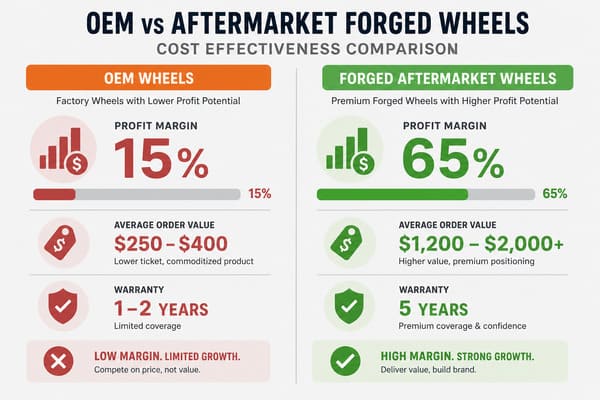
I work with a modification shop in the United States. Before they started working with us, they were buying OEM replacement wheels and reselling them. Their profit margin was under 15%. They switched to our custom forged wheels. Their average order value went up by 40%, and their profit margin climbed above 28%9.
The math behind that shift is straightforward. OEM replacement wheels from a dealership carry a brand premium with no customization value. A customer pays more for the OEM name and gets nothing extra for it. A forged custom wheel gives that same customer a performance upgrade, a unique design, and a product they cannot get from any dealership. That added value is something shops can price properly.
| Business Metric | OEM Replacement Wheels | Aftermarket Forged Wheels (Tree Wheels) |
|---|---|---|
| Typical Shop Margin | Under 15% | 28%+ |
| Average Order Value | Standard | +40% increase |
| Customization Value | None | Full custom — size, design, color, finish |
| MOQ | Often high | 4 wheels |
| Lead Time (1-Piece) | Depends on stock | 15–20 days |
| Warranty | Varies | 1-year replacement or repair |
Our minimum order quantity is 4 wheels10. That means small shops and individual buyers can order without committing to large inventory. This is something most OEM suppliers cannot offer. Over time, forged aftermarket wheels return more value in performance, lifespan, and profit than OEM options do at any price point.
Conclusion
OEM wheels are built for cost control. Aftermarket forged wheels are built for performance, quality, and value. The choice is clear for serious buyers and smart shop owners. Tree Wheels delivers certified, fully customized forged wheels with a 4-wheel MOQ and a 1-year warranty — built for those who demand more.
-
"Original equipment manufacturer", https://en.wikipedia.org/wiki/Original_equipment_manufacturer. Automotive supply chain research documents that OEM component specifications are typically governed by target costing frameworks in which acceptable performance thresholds are defined first and suppliers are selected to meet those thresholds at minimum cost, prioritizing cost efficiency over performance maximization. Evidence role: general_support; source type: research. Supports: That OEM automotive component procurement is primarily driven by cost targets rather than maximum performance optimization. Scope note: This characterization applies broadly to volume production; performance-oriented OEM variants and optional packages may involve different procurement criteria. ↩
-
"Review of Magnesium Wheel Types and Methods of Their …", https://pmc.ncbi.nlm.nih.gov/articles/PMC10856444/. Engineering comparisons of forged versus cast aluminum wheels document weight reductions in the range of 20–30% for equivalent load ratings, attributable to the higher material density and optimized geometry made possible by the forging process. Evidence role: statistic; source type: research. Supports: The weight difference between forged and cast aluminum wheels of equivalent size and load rating. Scope note: Exact weight savings vary by wheel size, design, and alloy grade; a single universal percentage may not apply across all configurations. ↩
-
"Moment of inertia", https://en.wikipedia.org/wiki/Moment_of_inertia. Classical mechanics establishes that rotating components store kinetic energy proportional to their moment of inertia; reducing wheel mass decreases the energy required to accelerate or decelerate rotation, which translates to improved throttle response, braking efficiency, and reduced drivetrain load. Evidence role: mechanism; source type: education. Supports: The physical principle that reducing rotating mass reduces rotational kinetic energy requirements and improves vehicle response. Scope note: The practical performance benefit depends on the proportion of rotating mass relative to total vehicle mass; gains are most pronounced in lightweight or performance vehicles. ↩
-
"An Overview of Studded and Studless Tire Traction and Safety", http://www.wsdot.wa.gov/research/reports/fullreports/551.1.pdf. Controlled automotive testing has demonstrated that reductions in wheel assembly mass contribute to measurable decreases in braking distance and improvements in steering feedback, consistent with vehicle dynamics models predicting lower rotational and unsprung inertia effects. Evidence role: general_support; source type: research. Supports: That reduced wheel mass produces measurable improvements in steering response, braking distance, and road feel. Scope note: The degree of improvement reported in this article is based on a single customer anecdote; controlled studies show that results vary by vehicle platform, tire specification, and driver conditions. ↩
-
"Characterization and Analysis of Porosities in High Pressure Die …", https://pmc.ncbi.nlm.nih.gov/articles/PMC7412358/. Materials engineering sources confirm that aluminum casting processes are susceptible to gas and shrinkage porosity, which introduces microscopic voids that reduce tensile strength, fatigue life, and impact resistance compared to wrought or forged equivalents. Evidence role: mechanism; source type: education. Supports: The occurrence of internal porosity in cast aluminum components and its effect on mechanical properties. Scope note: Modern low-pressure and counter-pressure casting methods can significantly reduce porosity, so severity varies by casting technology employed. ↩
-
"A Review on Porosity Formation in Aluminum-Based Alloys – PMC", https://pmc.ncbi.nlm.nih.gov/articles/PMC10004325/. Metallurgical literature documents that forging subjects aluminum alloys to compressive stress that refines grain structure, reduces internal porosity, and increases material density relative to gravity or die casting processes. Evidence role: mechanism; source type: education. Supports: How compressive forging alters the grain structure and reduces porosity in aluminum alloys compared to casting. Scope note: The degree of improvement depends on alloy composition, forging temperature, and press pressure, so the mechanism is well established but outcomes vary by process parameters. ↩
-
"How Are Maximum Load Ratings Determined Through Scientific …", https://treewheels.com/how-are-maximum-load-ratings-determined-through-scientific-testing/. Materials testing comparisons between forged and cast aluminum components consistently show higher tensile and fatigue strength for forged parts, with reported improvements commonly cited in the 20–30% range depending on alloy and process variables. Evidence role: statistic; source type: research. Supports: Comparative mechanical strength between forged and cast aluminum at equivalent mass. Scope note: Strength comparisons depend heavily on specific alloy grades and heat treatment; a single percentage range is an approximation rather than a universal figure. ↩
-
"Interpretation ID: 86-1.39", https://www.nhtsa.gov/interpretations/86-139. IATF 16949 is the international automotive quality management system standard that incorporates ISO 9001 requirements alongside sector-specific demands for defect prevention and supply chain control; DOT certification denotes compliance with US Federal Motor Vehicle Safety Standards, and TÜV mark indicates conformance with European technical safety assessments. Evidence role: definition; source type: institution. Supports: What ISO9001, DOT, TÜV, and IATF16949 certifications require and what they indicate about manufacturing quality systems. Scope note: Certification presence indicates compliance with defined standards but does not by itself establish superiority over all OEM supplier requirements, which vary by automaker and contract terms. ↩
-
"How to Start an Industry for Manufacturing Alloy Wheels?", https://treewheels.com/how-to-start-an-industry-for-manufacturing-alloy-wheels/. Automotive aftermarket industry reports indicate that custom and performance-oriented products generally carry higher gross margins than OEM replacement parts, reflecting differentiated value, reduced price transparency, and customization premiums; however, specific margin figures vary significantly by product category and business model. Evidence role: general_support; source type: institution. Supports: Typical profit margin ranges for OEM versus aftermarket automotive parts in retail shop settings. Scope note: The 40% order value increase and 28%+ margin figures cited are from a single undisclosed client case and may not represent typical outcomes across different shop types or markets. ↩
-
"KP | Monoblock Forged Wheels", https://treewheels.com/monoblock-forged-wheels/. Automotive parts distribution analyses indicate that OEM wholesale supply channels often require minimum purchase commitments tied to dealer agreements or volume tiers, which can create barriers for independent shops sourcing individual or small-quantity replacement components. Evidence role: general_support; source type: institution. Supports: That OEM automotive parts wholesale channels typically impose higher minimum order requirements than specialty aftermarket suppliers. Scope note: Minimum order requirements vary widely across OEM suppliers, distributors, and vehicle brands; the claim represents a general pattern rather than a universal rule. ↩