
The wrong supplier cost one of my clients over $2,000. He bought "forged" wheels that cracked within three months. You don’t have to make the same mistake.
You can verify a forged wheel by checking four things: visual surface details, actual weight, certifications with traceable numbers, and laser-engraved serial numbers matched to production records. Each method works on its own, but using all four gives you near-certain confidence.
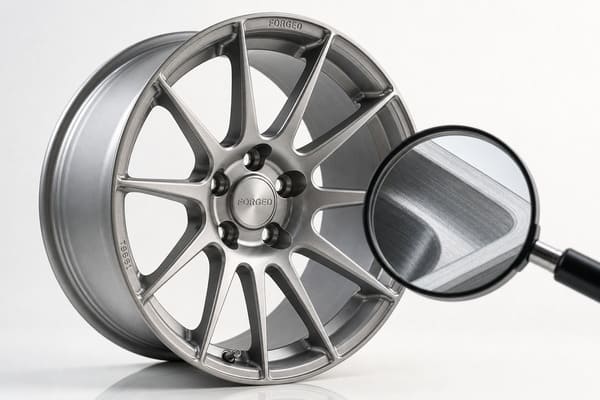
The word "forged" is one of the most misused terms in the wheel market. Suppliers coat cast wheels in matte finishes, shoot a few clean product photos, and list them as forged. A buyer looking at images alone has almost no way to tell the difference. But once you know what to look for, verification becomes straightforward. The four methods below are what I use and what I recommend to every buyer before they commit to a purchase.
What Are the Key Visual Differences Between Forged and Cast Wheels?
Most buyers focus on the design and finish. That is exactly what a dishonest supplier wants. The real differences are in the details that most people never check.
Forged wheels go through at least 8 production steps1, including hydraulic pressing at over 3,000 tons of force2 and multiple rounds of CNC machining. This process reorganizes the grain structure of the aluminum, making the surface denser and more consistent3 than a cast wheel can ever be.
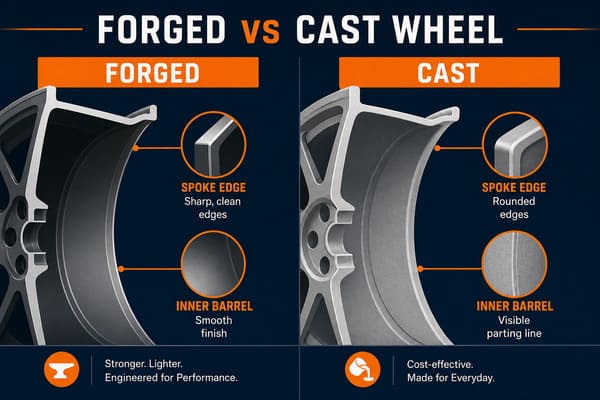
A customer once brought me a wheel he had purchased from another supplier and asked whether it was genuinely forged. The moment I turned it over, I saw a thin parting line running along the back of a spoke. That line is left behind when two halves of a casting mold come together4. It does not exist on a forged wheel, because the forging process uses a solid aluminum billet, not a split mold. Most buyers never flip the wheel over. That one detail told me everything.
Four Visual Points to Check
Here is a breakdown of what to look for and what each detail means:
| Check Point | Forged Wheel | Cast Wheel |
|---|---|---|
| Spoke edges | Sharp, consistent lines from CNC machining | Slightly rounded or mildly uneven |
| Unmachined surface texture | Dense, nearly porosity-free aluminum | Small pits or rough texture visible |
| Inner barrel machining marks | Clear lathe cutting lines | Sand-cast surface or resin-coated finish |
| Parting line | None | Thin line where mold halves met |
The spoke edges are a good starting point because they are easy to see without tools. A genuine forged wheel has edges that look almost machined sharp, because they are. The CNC process cuts clean, precise lines. A cast wheel, even a well-finished one, tends to have softer transitions at the edges because the shape comes out of a mold rather than being cut into shape.
The inner barrel is where suppliers get lazy. A forged wheel’s inner barrel will show clear circular cutting marks from the lathe. If the inner surface looks rough, grainy, or has an uneven texture that resembles sand or coarse resin, that wheel was cast. This is one of the most reliable visual checks because it is the area least likely to receive cosmetic treatment.
How Does Weight Help You Identify a Real Forged Wheel?
Weight is the most accessible test. You do not need any expertise. You just need a luggage scale and a reference number to compare against.
A genuine one-piece forged wheel in a 20-inch size typically weighs between 8.5 kg and 9.5 kg5, depending on the design. A cast wheel in the same size usually weighs between 12 kg and 14 kg, and some exceed 15 kg. That difference is large enough to feel before you even put it on a scale.
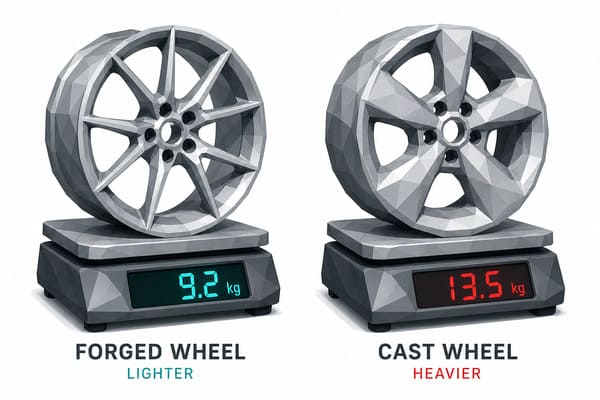
The American shop owner I mentioned at the start of this article discovered the problem with weight before he even set up his scale. He picked up the first wheel and immediately felt it was heavier than expected. When he weighed it, a 20-inch wheel that was listed as forged came in at 13.2 kg. He contacted us that same day.
Understanding Flow-Forming and Why It Confuses Buyers
There is one concept that creates confusion, and some suppliers use that confusion intentionally.
| Wheel Type | Process | Weight Range (20-inch) | Strength Level |
|---|---|---|---|
| Full forged (monoblock) | Solid billet, pressed at 3,000+ tons, fully CNC machined | 8.5 – 9.5 kg | Highest |
| Flow-formed | Cast face, barrel spun under pressure | 10 – 11.5 kg | Medium |
| Cast | Molten aluminum poured into mold | 12 – 15+ kg | Lowest |
Flow-formed wheels are lighter than standard cast wheels6. Some suppliers use this as a selling point and market them as "forged" or "forged-like." They are not forged. The face of a flow-formed wheel is still cast. Only the barrel section is worked under pressure. A truly forged wheel starts as a solid billet and is shaped under thousands of tons of force as one piece. The material density and structural strength are in a completely different category.
The simple rule is this: if a wheel claimed to be forged weighs close to the average of a cast wheel in the same size, it almost certainly is not forged.
What Certifications Should a Genuine Forged Wheel Have?
A certification logo printed on a product photo means nothing. The number attached to that certification is what matters, because it can be checked.
The most important certifications for forged wheels sold in major markets are DOT, TÜV, and IATF 16949. Each of these comes with a traceable number. Any legitimate manufacturer can provide that number, and any buyer can verify it directly with the certifying organization.
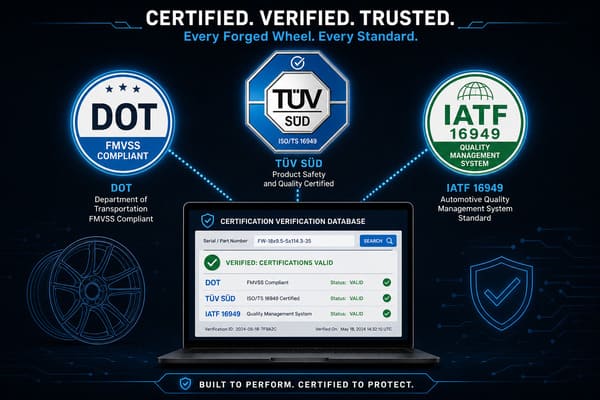
A potential client once sent me a photo of a competitor’s product. In the corner of the image, there were TÜV and DOT logos. He asked whether we could meet the same standard. I said yes, then asked him to send me the competitor’s certification number so I could look it up on the TÜV database. The number did not exist. The logos had been placed on the image with no real certification behind them.
What Each Certification Actually Means
| Certification | Issuing Body | What It Tests | Market Relevance |
|---|---|---|---|
| DOT | U.S. Department of Transportation | Safety compliance for road use | Required by law for the U.S. market7 |
| TÜV | German Technical Inspection Association | Radial fatigue, bending fatigue, impact tests | Recognized globally; one of the strictest standards |
| ISO 9001 | International Organization for Standardization | Factory quality management system | Confirms process discipline, not product quality directly8 |
| IATF 169499 | International Automotive Task Force | Highest-level automotive manufacturing standard | Very few forged wheel factories worldwide hold this |
TÜV testing requires a wheel to survive at least 500,000 simulated load cycles10 across multiple test types. A wheel that passes TÜV has been physically proven under conditions far more demanding than normal road use. Our wheels carry both DOT and TÜV certification, and we also hold IATF 16949, which governs how we run our entire manufacturing operation.
The verification step is simple. Ask the supplier for the certification number, go to the certifying body’s official website, and enter the number. If it does not come up, the certification is not real. Any real manufacturer will hand over this information without hesitation. If a supplier avoids this request or gives vague answers, that tells you what you need to know.
How Can You Use a VIN or Serial Number to Verify Forged Wheels?
A serial number is a wheel’s identity record. It connects that specific wheel to the exact production batch, the materials used, and every quality check it passed before leaving the factory.
Every wheel we ship carries a laser-engraved serial number on the inner barrel. That number maps to a complete internal production record, covering the aluminum billet batch, press date, heat treatment parameters, CNC log, inspection result, and shipping information. If a supplier cannot trace a serial number, that is a serious problem.
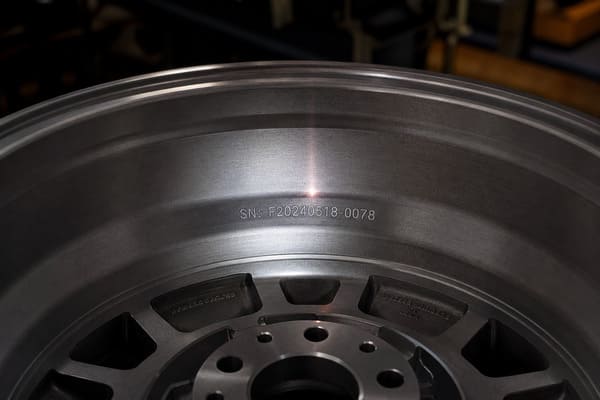
A buyer once contacted us after purchasing what he believed were Tree Wheels through a third-party channel. He wanted to register a warranty claim. We looked up the serial numbers he provided and found none of them in our system. The wheels were counterfeit. He had not yet installed them, so he avoided putting fake wheels on a customer’s vehicle. The serial number check caught the problem before it caused real damage.
How to Run a Serial Number Check
| Step | What to Do | What to Look For |
|---|---|---|
| 1 | Find the engraved number on the inner barrel | Must be laser-engraved, not a sticker or painted text |
| 2 | Contact the manufacturer directly with the number | Request confirmation against their production record |
| 3 | For B2B orders, ask for a Certificate of Conformance | Document should list each serial number, spec, material, and certification status |
| 4 | Cross-check any mismatch immediately | A number not found in the system is a clear red flag |
The engraving method matters as much as the number itself. A laser-engraved number is permanent and precise. A sticker can be moved from one wheel to another11. Painted or stamped numbers can be faked with basic tools. If the number on a wheel is anything other than a clean laser engraving, treat it as unverified.
For B2B buyers placing orders for modification shops or service centers, a Certificate of Conformance is a standard document that every serious manufacturer should provide12. It lists the serial numbers of every wheel in the shipment along with the corresponding specifications, materials, and certification data. If a supplier does not offer this, or has never heard of it, that is enough reason to look for a different supplier.
A wheel with no serial number, or a serial number that cannot be traced back to the manufacturer, should not be trusted. This is not an unreasonable demand. It is the minimum standard for any product going onto a vehicle.
Conclusion
Verifying a forged wheel comes down to four checks: visual details, weight, traceable certifications, and serial numbers. Use all four before you buy. At Tree Wheels, every wheel we produce is fully certified, laser-serialized, and backed by 20+ years of forged wheel manufacturing experience.
-
"What Is the Complete Manufacturing Process for a Premium Forged …", https://treewheels.com/what-is-the-complete-manufacturing-process-for-a-premium-forged-wheel/. The production of forged aluminum wheels from raw billet involves multiple sequential operations including billet cutting, heating, forging, heat treatment, CNC machining, surface finishing, and quality inspection, with the exact number of steps varying by manufacturer process design and wheel specification. Evidence role: mechanism; source type: research. Supports: The multi-stage manufacturing process involved in producing forged aluminum wheels from billet to finished product. Scope note: The claim of ‘at least 8 steps’ is manufacturer-specific; the number of discrete production stages varies across facilities and does not constitute a universal industry standard. ↩
-
"12000 Ton Hydraulic Forging Press Machine For …", https://www.taitianpress.com/product/12000-ton-hydraulic-forging-press-machine-for-aluminum-forged-wheels/. Industrial forging of aluminum alloy wheels typically employs hydraulic presses operating in the range of thousands of tons of force to achieve the required grain refinement and material density in the finished component. Evidence role: mechanism; source type: research. Supports: The hydraulic press forces used in aluminum wheel forging manufacturing processes. Scope note: Exact press tonnage varies by wheel size, alloy, and manufacturer; a general industry range rather than a universal figure should be cited. ↩
-
"Effect of Multidirectional Forging on the Grain Structure and Mechanical …", https://pmc.ncbi.nlm.nih.gov/articles/PMC6266014/. Plastic deformation during forging aligns the grain flow of aluminum alloys along the contours of the part, reducing porosity and improving tensile strength and fatigue resistance relative to cast counterparts. Evidence role: mechanism; source type: paper. Supports: Forging refines and aligns the grain structure of aluminum alloys, resulting in improved density and mechanical properties compared to cast aluminum. Scope note: The degree of improvement depends on alloy composition, forging temperature, and post-process heat treatment, so general statements should not be applied universally. ↩
-
"What Is the Complete Manufacturing Process for a Premium Forged …", https://treewheels.com/what-is-the-complete-manufacturing-process-for-a-premium-forged-wheel/. In metal casting, a parting line is the visible seam on a finished casting that corresponds to the interface between the two halves of the mold; this feature is inherent to the casting process and does not occur in forged components, which are shaped from solid billets without a split mold. Evidence role: mechanism; source type: education. Supports: Parting lines are a characteristic artifact of the casting process resulting from the junction of mold halves, and are not present on forged components. ↩
-
"How Do Designers Balance Weight Reduction and … – Tree Wheels", https://treewheels.com/how-do-designers-balance-weight-reduction-and-structural-strength-for-wheels/. Industry specifications and product data from wheel manufacturers and automotive engineering references indicate that forged monoblock aluminum wheels are substantially lighter than cast equivalents of the same diameter, owing to higher material density and reduced section thickness requirements. Evidence role: statistic; source type: institution. Supports: Typical weight ranges for forged versus cast aluminum wheels in equivalent sizes. Scope note: Weight varies significantly with spoke design, width, and offset; the ranges cited are approximate and design-dependent rather than fixed standards. ↩
-
"What Is the Complete Manufacturing Process for a … – Tree Wheels", https://treewheels.com/what-is-the-complete-manufacturing-process-for-a-premium-forged-wheel/. Flow-forming, also termed spin-forming or rim-rolling, applies localized pressure to the barrel of a cast wheel blank to reduce wall thickness and improve material properties in that region, while the wheel face retains its cast microstructure. Evidence role: definition; source type: research. Supports: Flow-forming is a distinct manufacturing process in which the barrel of a cast wheel is spun and thinned under pressure, differing fundamentally from full billet forging. Scope note: The process and its resulting properties vary by manufacturer; the characterization as ‘medium strength’ is a generalization that may not apply to all flow-formed products. ↩
-
"Interpretation ID: 86-1.39", https://www.nhtsa.gov/interpretations/86-139. The U.S. Department of Transportation, through the National Highway Traffic Safety Administration (NHTSA), establishes Federal Motor Vehicle Safety Standards (FMVSS) that govern the safety performance of vehicle components including wheels sold for road use in the United States. Evidence role: general_support; source type: government. Supports: U.S. federal regulations governing safety compliance requirements for wheels sold in the American market. Scope note: DOT marking requirements and their applicability to aftermarket wheels involve specific regulatory nuances; the article’s characterization as a blanket legal requirement may oversimplify the regulatory framework. ↩
-
"What Are JWL, VIA, and TÜV Certifications for Wheels? – Tree …", https://treewheels.com/what-are-jwl-via-and-tuv-certifications-for-wheels/. ISO 9001, published by the International Organization for Standardization, specifies requirements for a quality management system that an organization must demonstrate to consistently provide products and services meeting customer and regulatory requirements, but does not itself certify the performance characteristics of specific products. Evidence role: definition; source type: institution. Supports: ISO 9001 certifies an organization’s quality management system processes rather than guaranteeing the quality of individual products. ↩
-
"IATF 16949", https://en.wikipedia.org/wiki/IATF_16949. IATF 16949 is an international quality management system standard developed by the International Automotive Task Force, specifying requirements for automotive production and relevant service part organizations, and is widely recognized as a benchmark for supplier quality in the automotive industry. Evidence role: definition; source type: institution. Supports: The scope and significance of IATF 16949 as an automotive quality management system standard. Scope note: The claim that ‘very few’ wheel factories hold this certification is not independently verified; the standard’s prevalence among wheel manufacturers specifically is not documented in this citation. ↩
-
"(PDF) Radial Fatigue Analysis of Automotive Wheel Rim(ISO 3006)", https://www.academia.edu/90209625/Radial_Fatigue_Analysis_of_Automotive_Wheel_Rim_ISO_3006_. TÜV certification for automotive wheels involves standardized fatigue testing protocols, including radial load fatigue and cornering fatigue tests, with cycle requirements specified in the relevant test standards to simulate extended road use conditions. Evidence role: statistic; source type: institution. Supports: The number of simulated load cycles required for TÜV wheel certification testing. Scope note: The exact cycle count depends on the specific TÜV test standard version and wheel category; the 500,000-cycle figure cited in the article should be verified against the current applicable standard. ↩
-
"Process Specification for Laser Marking & Laser Engraving", https://www.nasa.gov/wp-content/uploads/2023/03/prc-9003-current.pdf. Laser marking creates permanent, high-contrast identifiers directly in the substrate material without consumables, making it resistant to removal, transfer, or falsification compared to adhesive labels or surface-applied coatings, and is widely used for part traceability in automotive manufacturing. Evidence role: general_support; source type: research. Supports: Laser engraving provides a permanent, tamper-resistant identification method superior to adhesive labels or painted markings for component traceability. Scope note: While laser engraving is more difficult to falsify than stickers, sophisticated counterfeiting operations can replicate laser markings; it is most reliable when combined with manufacturer database verification. ↩
-
"General Certificate of Conformity | CPSC.gov", https://www.cpsc.gov/Business–Manufacturing/Testing-Certification/General-Certificate-of-Conformity. A Certificate of Conformance (CoC) is a supplier-issued quality document affirming that delivered products conform to specified requirements, typically including part identification, applicable standards, and traceability information, and is a standard element of quality management systems in automotive and industrial supply chains. Evidence role: definition; source type: institution. Supports: A Certificate of Conformance is a recognized quality document in manufacturing supply chains attesting that products meet specified requirements. Scope note: The specific content requirements for a CoC are not universally standardized and may vary by industry, customer specification, or applicable quality standard. ↩