
Wheels don’t fit by accident. Yet thousands of custom wheel orders go wrong every year because of one misunderstood relationship — backspacing and offset.
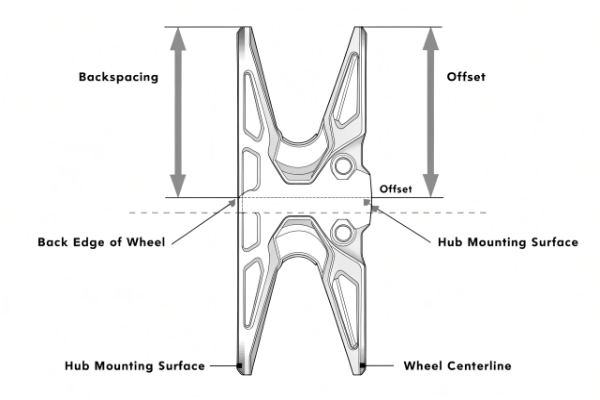
Backspacing and offset describe the same physical point on a wheel, but from different starting lines. Backspacing measures from the back edge of the wheel to the hub mounting surface. Offset measures from the wheel’s centerline to the same surface. Converting between them requires only the wheel width — nothing more.
I’ve been working in the forged wheel industry long enough to know that most fitment problems are not caused by bad manufacturing. They’re caused by miscommunication at the spec stage. A customer says one number. A supplier hears a different number. The wheel gets made. The wheel doesn’t fit. Everyone loses. Understanding how backspacing and offset connect is the first step to preventing that from happening.
What Is 4 Inch Backspacing in Offset?
A customer sends you a spec. It says "4 inch backspacing." You need an offset number to proceed. Do you know how to make that conversion without guessing?
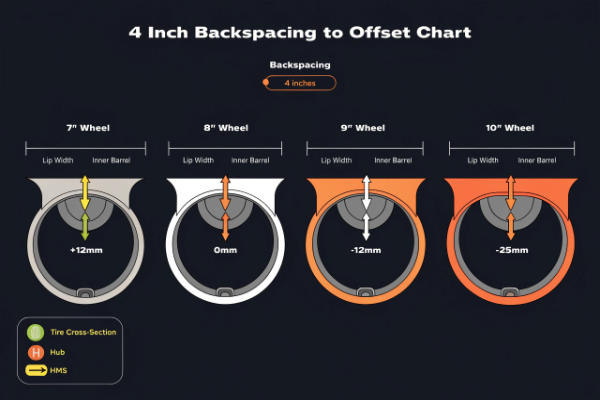
To convert 4 inch backspacing to offset, you need the wheel width. The formula is: Offset = Backspacing − (Wheel Width + Flange Thickness) ÷ 2. For a typical 8-inch wide wheel with roughly 0.5 inch of flange, 4 inch backspacing equals approximately −0.25 mm to +5 mm offset depending on exact width.
The reason this question comes up so often is that 4 inch backspacing is a common spec in the American truck and SUV market. Customers in the US are used to giving backspacing numbers. But when those customers order forged wheels from a global supplier, the factory is often working in offset. That gap in language is where mistakes happen.
Here is how 4 inch backspacing converts across common wheel widths:
| Wheel Width (inches) | 4" Backspacing in Offset (mm) |
|---|---|
| 7 inches | approx. +12 mm |
| 8 inches | approx. 0 mm (zero offset) |
| 9 inches | approx. −12 mm |
| 10 inches | approx. −25 mm |
A few things stand out from this table. First, the same backspacing number means something completely different depending on wheel width. Second, 4 inch backspacing on a wide wheel produces a negative offset — meaning the wheel face sits outside the centerline of the wheel. This pushes the wheel outward toward the fender. On a truck, this creates an aggressive stance. On a passenger car, it may cause rubbing immediately. This is why I always ask for wheel width before I confirm any backspacing spec. The number alone tells me nothing useful.
Does Wheel Offset Affect Backspacing?
This question gets asked in reverse all the time. A customer changes their offset spec and then wonders why the fitment feels different. Of course it does — but can you explain exactly why?
Yes, wheel offset directly affects backspacing. If offset increases (becomes more positive), the hub mounting surface moves closer to the outer face of the wheel, which means backspacing increases. If offset decreases (becomes more negative), backspacing decreases. The two measurements move together because they describe the same point.
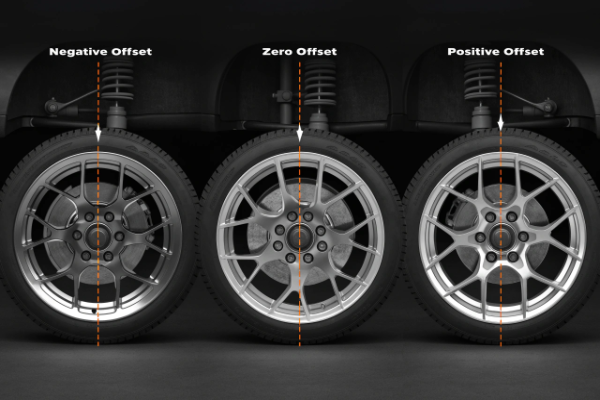
This relationship matters most when a customer is making changes to their fitment setup. Let’s say a shop owner in Texas is upgrading from a stock wheel with +20 mm offset to a custom forged wheel with −10 mm offset. That is a 30 mm shift in the hub mounting surface position. On the outside of the vehicle, the wheel face moves outward. On the inside, the barrel moves inward toward the suspension components. Both sides of the wheel are affected.
Why This Matters for Suspension Clearance
| Change in Offset | Effect on Outer Clearance | Effect on Inner Clearance |
|---|---|---|
| More positive offset | More clearance inside (fender) | Less clearance outside (suspension) |
| More negative offset | Less clearance inside (fender) | More clearance outside (suspension) |
| Zero offset | Wheel centered over hub | Equal clearance on both sides |
When we receive a custom order, we do not just check the offset number in isolation. We ask the customer about their suspension setup, any lift or lowering kit installed, and the tire size they are running. A wheel spec does not exist by itself. It exists inside a system. Changing offset without checking both inner and outer clearance is one of the most common reasons custom forged wheels get returned. With forged wheels specifically, there is no flexibility in the metal. If the spec is off by even a few millimeters on a high-offset application, the wheel will rub. The customer will be frustrated. The relationship is damaged. Getting this right from the start is not just good manufacturing — it is good business.
What Offset Is 7.5 Backspacing?
"I need 7.5 backspacing." I hear this from customers building wide-body trucks and off-road rigs. It is a big number. And like all backspacing numbers, it means very different things depending on what wheel you are putting it on.
7.5 inch backspacing converts to different offset values depending on wheel width. On a 10-inch wide wheel, 7.5 inch backspacing equals approximately +25 mm offset. On a 12-inch wide wheel, it equals approximately +12 mm. The wider the wheel, the lower the offset for the same backspacing measurement.
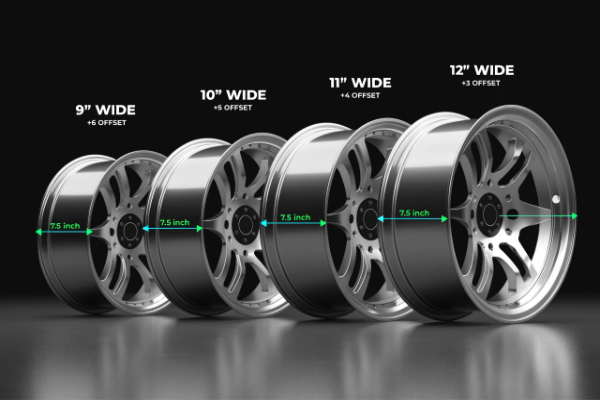
7.5 inch backspacing is most common on wide truck wheels — widths of 9, 10, and 12 inches. In these applications, the wheel is large and heavy, and the position of the hub mounting surface has a significant effect on both stance and load on the wheel bearings.
7.5 Backspacing Conversion Table
| Wheel Width (inches) | 7.5" Backspacing in Offset (mm) |
|---|---|
| 9 inches | approx. +50 mm |
| 10 inches | approx. +38 mm |
| 11 inches | approx. +25 mm |
| 12 inches | approx. +12 mm |
When a customer tells me they want 7.5 backspacing, the first thing I do is ask what width they are running. That answer changes everything. A 7.5 inch backspacing on a 9-inch wide wheel means the wheel sits deeply inside the fender — tucked in, close to the suspension. That setup is common on trucks that need inner clearance for large tires or long-travel suspension. On a 12-inch wide wheel, the same backspacing puts the face much closer to the fender lip, giving a far more aggressive outward stance. I have seen customers order the wrong combination simply because they gave a backspacing number without a width. We always confirm both before we start production. That five-minute conversation has saved us — and our clients — from costly remakes more times than I can count.
What Does 5 Inch Backspacing Mean?
Five inches sounds like a straightforward number. And on some cars, it is perfectly standard. But on others, it is a major fitment red flag. The number is not the problem. The context is.
5 inch backspacing means the hub mounting surface sits 5 inches from the back edge of the wheel. Whether this is a stock, aggressive, or problematic fitment depends entirely on the wheel width and the vehicle it is going on. On a narrow compact car wheel, 5 inches is deep. On a wide truck wheel, 5 inches may be insufficient.
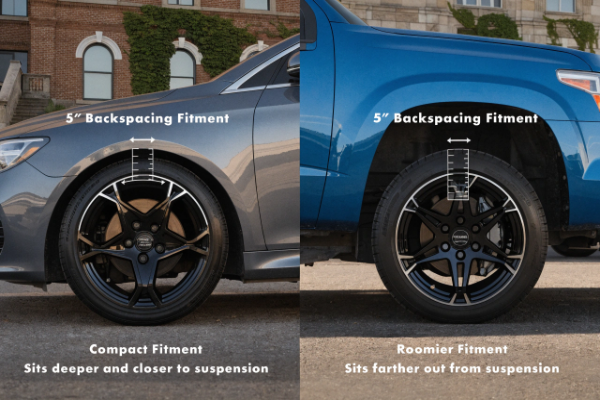
This is the insight that most articles miss. On a compact car with a 7-inch wide wheel, the difference between 4 inch and 5 inch backspacing is noticeable but manageable. It shifts the wheel inward by roughly 25 mm. On a full-size truck with a 10-inch wide wheel, that same one-inch difference translates to a dramatically different stance — and potentially a wheel that sits deep inside the fender or sticks out past it.
5 Inch Backspacing in Context
| Vehicle Type | Typical Wheel Width | 5" Backspacing Offset (approx.) | Fitment Tendency |
|---|---|---|---|
| Compact sedan | 7 inches | +38 mm | Deeply tucked, may rub suspension |
| Mid-size SUV | 8.5 inches | +25 mm | Near stock fitment |
| Full-size truck | 10 inches | +12 mm | Slightly outward stance |
| Wide-body truck | 12 inches | −12 mm | Aggressive outward stance |
The practical lesson here is that you cannot talk about backspacing as an isolated number. Whenever a customer gives me a backspacing spec, I treat it as the starting point of a conversation — not the end of one. I ask about width, vehicle type, tire size, and any suspension modifications. Only after I have that full picture do I feel confident confirming the spec. That is not extra work. That is the job.
Conclusion
Backspacing and offset are two ways of saying the same thing. Understanding both — and knowing when to use which — is what separates a reliable supplier from one that guesses. At Tree Wheels, we speak both languages fluently so your fitment is right the first time.