
You’re shopping for aftermarket wheels and every vendor seems to have a different answer. Some say forged is the only serious choice. Others say cast wheels are fine for your build. Without knowing how alloy wheels are actually made, you can’t tell who’s selling you something — and who’s telling you the truth.
Most alloy wheels on the market are cast, not forged. Gravity casting and low-pressure casting are the dominant production methods across the industry1. Forged wheels represent a premium minority of the market, manufactured under high compressive force from a solid aluminum billet2. Both methods produce road-legal, performance-capable wheels — but they serve different use cases, price points, and customization requirements.
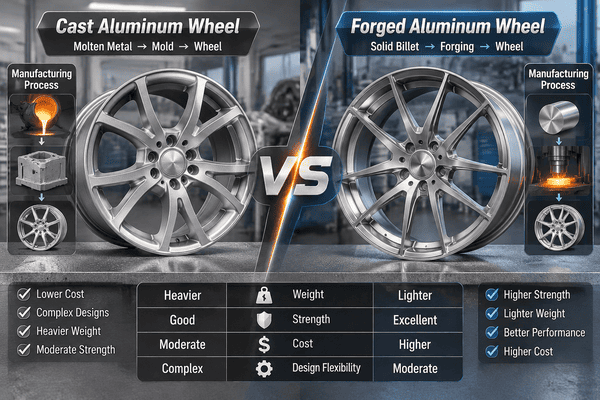
The real question isn’t which method sounds more impressive. It’s which method matches your actual build requirements — and whether the supplier explaining the difference has a financial reason to steer you toward one answer. The sections below break that down honestly.
What does "cast" actually mean for a wheel buyer?
Most buyers encounter the word "cast" without a clear picture of what it means at the factory level. That gap matters because not all cast wheels are equal — and treating casting as a single category leads to bad comparisons.
Cast wheels are produced by pouring molten aluminum alloy into a mold, then allowing it to cool and solidify. The method is cost-efficient, highly scalable, and capable of producing complex spoke geometries that would be difficult or expensive to machine from billet.

There are at least three distinct casting methods buyers will encounter in the market, and they differ meaningfully in terms of material density and structural consistency.
Gravity casting
This is the most basic approach. Molten aluminum flows into a mold under gravity alone. It’s inexpensive and widely used for entry-level OEM and aftermarket fitments. The resulting material tends to have a coarser grain structure and more internal porosity than higher-end processes — which is why gravity-cast wheels are typically heavier for their size3.
Low-pressure casting (LPC)
Low-pressure casting pushes molten aluminum into the mold from below using controlled gas pressure. This produces a denser, more consistent material structure compared to gravity casting4. Most quality OEM wheels and mid-range aftermarket products use this method. From a buyer’s standpoint, LPC is the standard benchmark when someone says "a good cast wheel."
Counter-pressure casting (CPC) and flow-forming
Some manufacturers take cast wheels a step further using counter-pressure casting or flow-forming (also called rotary forging on the barrel). Flow-formed wheels begin as a low-pressure cast blank, then have the barrel section stretched and shaped under rollers while hot. This aligns the grain structure in that section, improving strength and reducing weight compared to a conventional cast wheel.5
Buyer note: A wheel marketed as "flow-formed" or "rotary forged" is not the same as a fully forged wheel. The barrel is improved; the spoke area is still cast. Verify the full manufacturing description before assuming equivalence.
Here’s a quick reference for how casting methods compare:
| Method | Relative Weight | Material Density | Typical Use Case | Relative Cost |
|---|---|---|---|---|
| Gravity Cast | Heaviest | Lower | Budget OEM, entry aftermarket | Lowest |
| Low-Pressure Cast | Moderate | Medium | Mid-range OEM and aftermarket | Moderate |
| Flow-Formed | Lighter | Medium-High | Performance street, modified builds | Moderate-High |
| Fully Forged | Lightest | Highest | Track, high-performance, luxury custom | Highest |
What does "forged" actually mean — and why does it cost more?
Forged wheels carry a premium price in nearly every market segment. Understanding why helps buyers decide whether that premium is justified for their specific application — or whether they’re paying for prestige rather than performance.
A forged wheel starts as a solid cylinder of aluminum billet. That billet is placed under enormous compressive force — typically thousands of tons of press pressure — which shapes and densifies the material simultaneously. The result is a wheel with a tighter, more uniform grain structure than any casting process produces.
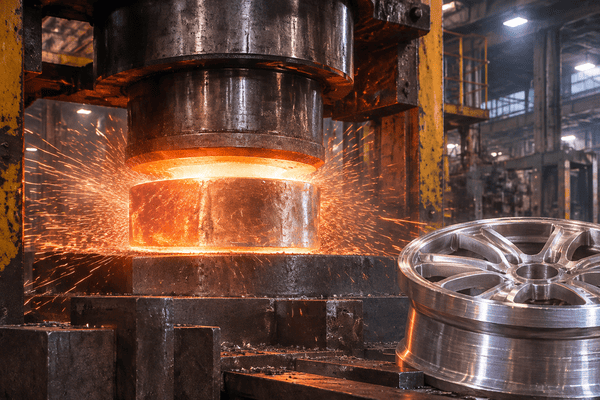
From a sourcing and sales standpoint, the conversations we have with modification shop buyers consistently surface three reasons the forged premium is commercially justified — and two reasons it sometimes isn’t.
Where forging earns its price
Weight reduction at equivalent strength. Because the material is denser and more structurally consistent, a forged wheel can be designed with thinner cross-sections and still meet the same load requirements as a heavier cast equivalent6. In applications where unsprung weight matters — track days, performance tuning, or spirited driving — this is a meaningful functional advantage, not a marketing claim.
Customization depth. Forged wheels are typically produced in lower volumes per SKU, which makes per-order customization commercially viable. Diameter, width, offset, bolt pattern, spoke design, surface treatment, and color can all be specified to exact customer requirements. This is the primary reason modification shops and custom builders work with forged suppliers — not because cast wheels can’t look good, but because the production model supports true per-vehicle fitment.
Structural consistency for high-stress applications. Under track conditions, repeated hard cornering, or heavy-vehicle fitments, the material behavior of a forged wheel is more predictable than a cast equivalent. This isn’t a claim we make based on internal testing — it’s the directional consensus across the aftermarket industry, and it’s why motorsport applications predominantly specify forged7.
For daily commuting, mild street modifications, or builds where budget constrains the full project, a quality low-pressure cast or flow-formed wheel will perform reliably for years. In pre-sales conversations, I’ve had buyers tell me a forged supplier pushed them toward a $3,000+ set for a car they drive to work and occasionally to a car show. That’s not a recommendation — that’s a close.
The benchmark question isn’t "which method is better." It’s: what load, what use, and what budget?
How do you decide between cast and forged for your specific build?
This is where most buying guides fall short. They describe the manufacturing methods in detail, then leave the decision to a vague "it depends." Here is a more structured way to think about it.
The decision comes down to four variables. Evaluate your build honestly against each one before committing to a method.

Variable 1 — Weight sensitivity
- Track or performance driving: Unsprung weight reduction has a real handling effect8. Forged is the directionally correct choice.
- Street and show builds: The weight difference between a good flow-formed wheel and an entry-level forged wheel is often smaller than buyers expect. Evaluate actual product specs, not category assumptions.
- Heavy SUV or truck fitments: The structural load matters more than shaving grams. A properly spec’d LPC wheel may be sufficient — and forged may offer no practical advantage over it.
Variable 2 — Customization requirements
- Need exact fitment, unique sizing, or proprietary design? Forged production models support this economically. Cast tooling for custom designs requires expensive mold investment per design.
- Standard PCD, standard sizing, catalog design? High-quality cast and flow-formed options exist at every aesthetic level. No need to go forged on customization grounds alone.
Variable 3 — Lead time tolerance
Forged wheel production takes longer. Based on our production schedule at Tree Wheels:
| Type | Production Time |
|---|---|
| One-Piece Forged | 15–20 days |
| Two-Piece Forged | 20–25 days |
| Three-Piece Forged | 30–35 days |
If a build deadline is tight, cast wheels from stock or near-stock inventory will be faster. Factor this into your planning — especially for event-driven deadlines.
Variable 4 — Budget reality
Be honest about total project budget. A forged wheel set on a build that compromises suspension, tires, or brakes for budget reasons is a misallocation. The wheel is only one component of the handling and safety system. A well-specified cast wheel with money left over for quality tires may produce a better overall result.
How should buyers evaluate supplier claims about casting or forging?
Supplier transparency on manufacturing method is one of the clearest signals of whether a vendor can be trusted with a serious order. The problem is that claims are easy to make and hard to verify without the right questions.
From a sourcing standpoint, here is what buyers should ask before accepting a supplier’s framing at face value.
Ask for certifications — and understand what they cover
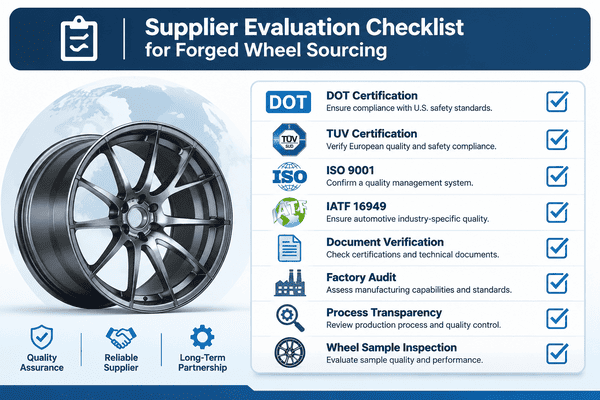
Reputable forged wheel suppliers should carry certifications relevant to your target market. The commonly referenced ones for wheel products include:
- DOT (required for US road-legal fitment)
- TÜV (German technical inspection authority, widely respected for structural testing)
- ISO 9001 (quality management system certification)
- IATF 16949 (automotive-specific quality management, stricter than ISO 9001)
Certifications are documents — buyers should request copies and verify they apply to the specific product being purchased, not just to the company broadly. A facility-level ISO certificate does not guarantee every individual product meets a specific test standard.
Ask how they describe their manufacturing process — not just the output
A supplier who says "our wheels are forged" should be able to explain the billet source, the press tonnage range, and whether post-forging machining and heat treatment are included. Vague answers to specific process questions are a yellow flag.
Be alert to category conflation
"Rotary forged," "flow-forged," and "spin-forged" are marketing terms that describe flow-forming — a process applied to the barrel of a cast wheel blank. These are not fully forged wheels. The terms aren’t deceptive in themselves, but they’re often used in contexts where buyers assume "forged" means billet-forged throughout. Ask directly: is this wheel cast and then flow-formed, or fully forged from billet?
Evaluate minimum order quantities in context
Fully forged custom wheels require per-order production. A supplier offering 4-wheel MOQ with custom sizing and color is operating a genuine low-volume custom production model. A supplier offering "custom forged" at 500-unit minimums is likely offering semi-custom or catalog products with limited variation — which is fine, but buyers should understand what they’re buying.
Frequently Asked Questions
Are OEM factory wheels cast or forged?
The overwhelming majority of OEM wheels fitted at the factory are low-pressure cast9. A small number of performance OEM fitments — typically on high-end sports or luxury vehicles — use forged wheels. If you’re unsure about your vehicle’s stock wheels, the manufacturer’s specification sheet or a wheel data service will confirm the production method.
Is a forged wheel always stronger than a cast wheel?
Directionally, forged wheels have a denser grain structure that supports higher strength-to-weight ratios. However, a heavy-gauge low-pressure cast wheel may carry a higher static load rating than a lightweight forged wheel designed for track use. Strength is a function of design, thickness, and alloy composition — not manufacturing method alone. Always compare rated load capacity for your specific application.
Can cast wheels be repaired after a curb strike or impact?
This depends on the severity of the damage and the casting method. Minor cosmetic damage can sometimes be repaired on both cast and forged wheels. Structural damage — cracks, bent flanges, or deformed spoke roots — typically voids any warranty and should not be repaired for road use regardless of wheel type. Have any impact-damaged wheel inspected by a qualified technician before continued use.
Why do forged wheels cost so much more than cast wheels?
The cost premium reflects material input (solid aluminum billet vs. molten pour), press equipment and operating cost, longer machining time due to harder material, and lower production volume per design. Custom forged wheels also factor in per-order design engineering. For a buyer who needs that product, the cost is the cost. For a buyer whose use case doesn’t require it, that premium doesn’t return performance value.
What is the minimum order for custom forged wheels?
This varies by supplier. At Tree Wheels, our MOQ is 4 wheels — which makes custom forged production accessible to individual owners and small modification shops without requiring large inventory commitments.
Conclusion
The question "are alloy wheels cast or forged?" is really a buyer’s decision disguised as a product question. Most alloy wheels are cast — and many of them perform excellently for the applications they’re designed for. Forged wheels offer genuine advantages in weight, customization depth, and structural consistency under high-stress conditions — but those advantages are meaningful only when the use case demands them. Evaluate your build honestly: weight sensitivity, customization needs, lead time, and budget. Ask suppliers the right questions, verify certifications, and understand exactly what manufacturing process you’re paying for. If you’re working through a wheel decision and want a straight answer rather than a sales pitch, reach out to Tree Wheels — we’ll tell you honestly whether forged is right for your build.
-
"Alloy wheel", https://en.wikipedia.org/wiki/Alloy_wheel. Industry analyses of automotive aluminum wheel manufacturing consistently identify low-pressure die casting as the predominant production method, accounting for the majority of OEM and aftermarket output, with gravity casting used primarily for lower-cost segments. Evidence role: statistic; source type: research. Supports: The proportion of alloy wheels produced via gravity casting and low-pressure casting relative to other methods. Scope note: Precise global market share figures vary by source and year; cited data should be verified against the most recent industry reports. ↩
-
"Forging", https://en.wikipedia.org/wiki/Forging. Forging is defined as a manufacturing process in which compressive forces are applied to shape metal, typically producing a denser grain structure than casting; aluminum forging is widely used in aerospace and automotive applications where high strength-to-weight ratios are required. Evidence role: definition; source type: encyclopedia. Supports: The definition of forging as a metalworking process involving compressive force applied to a solid billet, and its application to aluminum alloy components. Scope note: General definitions of forging may not capture the specific press tonnages or process parameters used by individual wheel manufacturers. ↩
-
"A Review on Porosity Formation in Aluminum-Based Alloys", https://pmc.ncbi.nlm.nih.gov/articles/PMC10004325/. Research on aluminum casting processes demonstrates that gravity casting produces higher levels of porosity and a coarser dendritic grain structure compared to low-pressure casting, which reduces material density and necessitates greater wall thickness to achieve equivalent structural performance. Evidence role: mechanism; source type: research. Supports: That gravity casting produces higher porosity and coarser grain structure in aluminum alloys compared to pressure-assisted casting methods, resulting in lower material density and greater mass for equivalent geometry. Scope note: Specific weight differences depend on alloy composition, mold design, and post-processing; the relationship is directional rather than a fixed quantitative rule. ↩
-
"Multi-Objective Optimization of The Low-Pressure Casting of …", https://pmc.ncbi.nlm.nih.gov/articles/PMC10532954/. Studies on aluminum casting methods indicate that low-pressure casting reduces shrinkage porosity and refines grain structure compared to gravity casting, resulting in improved tensile strength and fatigue resistance in the finished component. Evidence role: mechanism; source type: paper. Supports: That low-pressure casting yields improved material density and microstructural consistency in aluminum alloys relative to gravity casting. Scope note: Quantitative improvements vary with alloy grade, process parameters, and heat treatment; results from laboratory studies may not directly translate to all commercial wheel production environments. ↩
-
"Microstructural Study of Aluminum Alloy for Manufacturing …", https://scholarworks.calstate.edu/concern/projects/h702qg764. Research on flow-forming of aluminum alloys demonstrates that the process induces grain refinement and preferred crystallographic orientation through plastic deformation, increasing tensile and yield strength in the deformed region and enabling material reduction without equivalent loss of structural performance. Evidence role: mechanism; source type: paper. Supports: That flow-forming of aluminum alloy wheel barrels produces grain alignment and work hardening that improve tensile strength and allow reduced wall thickness compared to conventionally cast equivalents. Scope note: These effects are localized to the flow-formed barrel section; the spoke and hub areas of a flow-formed wheel retain the properties of the original cast blank. ↩
-
"Casting Wheels vs. Forged Wheels: Which Offers Better …", https://treewheels.com/casting-wheels-vs-forged-wheels-which-offers-better-performance-for-your-vehicle/. Comparative studies of forged and cast aluminum alloys consistently report higher tensile strength, yield strength, and fatigue resistance in forged specimens, attributable to refined grain structure and reduced porosity, which supports the design of lighter components meeting equivalent structural load criteria. Evidence role: general_support; source type: research. Supports: That forged aluminum components achieve higher strength-to-weight ratios than cast equivalents, permitting thinner sections at equivalent load capacity. Scope note: Actual load ratings depend on specific alloy, heat treatment, and geometric design; the strength advantage of forging does not automatically translate to a lighter wheel without appropriate engineering optimization. ↩
-
"Formula One regulations", https://en.wikipedia.org/wiki/Formula_One_regulations. Technical regulations and supplier documentation from major motorsport series indicate a strong preference for forged aluminum wheels in competitive applications, reflecting the weight and fatigue-resistance advantages relevant to high-load, high-cycle racing environments. Evidence role: general_support; source type: institution. Supports: That forged aluminum wheels are the predominant choice in competitive motorsport applications due to their weight and structural properties. Scope note: Wheel material specifications vary by racing series and class; some categories permit or mandate specific wheel types, and ‘predominant’ use does not imply universal specification across all motorsport disciplines. ↩
-
"Influence of unsprung weight on vehicle ride quality – ADS", https://ui.adsabs.harvard.edu/abs/1988JSV…124..497H/abstract. Vehicle dynamics literature establishes that unsprung mass — the mass of components not supported by the suspension spring, including wheels and tires — affects wheel contact force variation and suspension response frequency; reductions in unsprung mass are associated with improved road-holding and reduced suspension settling time, particularly on uneven surfaces. Evidence role: mechanism; source type: research. Supports: That reducing unsprung mass at the wheel improves vehicle handling by allowing the suspension to respond more quickly to road inputs and reducing inertial forces during cornering and braking. Scope note: The magnitude of the handling benefit depends on suspension geometry, spring and damper tuning, and driving conditions; the effect is most pronounced in performance and track applications and may be imperceptible in normal street driving. ↩
-
"Why Does Suspension Type Affect Wheel Selection?", https://treewheels.com/why-does-suspension-type-affect-wheel-selection/. Automotive industry analyses of aluminum wheel supply chains identify low-pressure casting as the dominant OEM production method, selected for its balance of material quality, dimensional consistency, and production economics at the volumes required by vehicle assembly programs. Evidence role: statistic; source type: research. Supports: That low-pressure casting is the predominant manufacturing method for original equipment aluminum wheels supplied to vehicle manufacturers. Scope note: The precise proportion varies by vehicle segment and region; premium and performance OEM fitments increasingly use flow-formed or forged wheels, and the share of these methods has grown in recent model years. ↩