
Most people who search this question are not engineers planning a foundry. They are shop owners, custom brand founders, or serious enthusiasts who have hit a wall — either a supplier let them down, or they want more control over design and cost. That frustration is real. But the question itself may be pointing you toward the wrong answer.
Searching "how to build a wheel rim forge" almost always signals a buy-vs-build decision in disguise. For the vast majority of buyers — modification shops, custom car builders, and enthusiasts — building in-house forging capability is not viable. The capital requirement runs into the millions, compliance certifications take years to obtain, and specialized sourcing partners can deliver fully customized forged wheels from as few as 4 units with lead times as short as 15 days.
Understanding why self-manufacturing rarely makes sense requires walking through the real costs and timelines. It also requires being honest about the narrow scenario where it could make sense — and helping you figure out which side of that line you are on.
What does "building a wheel rim forge" actually involve?
Many buyers come to this question with a rough mental image: a press, some aluminum, and a skilled machinist. The reality of industrial wheel rim forging is significantly more complex.
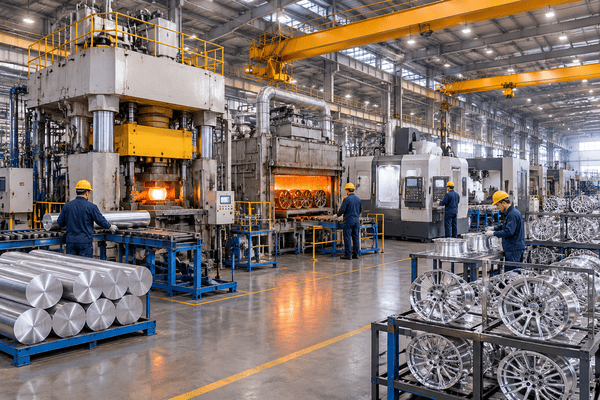
A production-ready forged wheel facility is not a single machine. It is a coordinated system of capital equipment, controlled processes, trained personnel, and regulatory compliance — each layer adding cost, time, and operational risk before a single saleable wheel leaves the floor.
From conversations with buyers and based on what our manufacturing partner — which has operated forged wheel production for over 20 years — has shared with us, the core components of a wheel rim forge include:
The equipment stack
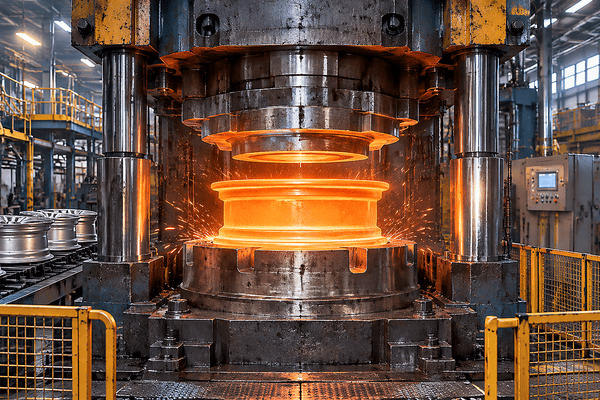
- Forging press: The centerpiece of the operation. Industrial aluminum forging presses used for wheels are high-tonnage hydraulic or mechanical systems1. These are not off-the-shelf items. Lead times for procurement and installation alone can stretch to many months.
- Dies and tooling: Each wheel design requires its own forged die. Dies are precision-machined from tool steel and represent a significant per-design investment. A single die set can cost tens of thousands of dollars2 — verify current pricing with tooling suppliers before budgeting.
- Heat treatment equipment: Aluminum alloy wheels require controlled heat treatment (solution heat treatment and artificial aging) to achieve the mechanical properties that make forged wheels structurally superior to cast alternatives3.
- CNC finishing cells: Raw forgings require extensive CNC machining to achieve final dimensions, spoke profiles, and bolt patterns. Multi-axis CNC equipment is standard in professional facilities4.
- Quality inspection systems: Coordinate measuring machines (CMMs), dynamic balance testing equipment, and fatigue testing rigs are required for compliance verification5, not just quality assurance.
The facility requirements
Beyond equipment, an operational forge needs:
- Adequate floor space (industrial square footage, not a workshop bay)
- Three-phase electrical supply rated for heavy industrial loads
- Material handling systems (overhead cranes, conveyors)
- Environmental and safety compliance (OSHA in the US, local equivalents elsewhere)
- Skilled operators, metallurgists, and quality engineers on staff
The total capital expenditure for a facility capable of producing automotive-grade forged wheels is estimated in the multi-million-dollar range6. I am deliberately not citing a specific figure here because legitimate costs vary significantly by geography, equipment source, production scale, and facility condition. Any number you see online should be verified directly with equipment suppliers and facility consultants before it informs a business decision.
What certifications does a wheel rim forge need?
Certification is where most preliminary business cases for in-house wheel forging collapse — not because certifications are impossible to obtain, but because the timeline and audit burden are rarely factored in at the outset.
Buyers in the US, Australia, and Europe expect wheels to arrive with recognized compliance documentation. Supplying uncertified wheels into these markets creates serious liability exposure for shop owners and brands.
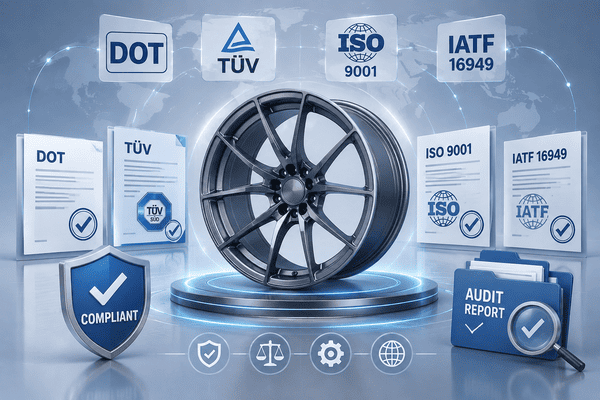
The certifications buyers should verify when evaluating any forged wheel supplier — including a hypothetical in-house facility — include:
| Certification | Scope | Market Relevance |
|---|---|---|
| DOT | US Department of Transportation — safety standard for wheels sold in the US | Required for US market |
| TÜV | German technical inspection association — widely recognized in Europe and globally as a quality benchmark | Strong signal of quality in EU, Australia, Middle East |
| ISO 9001 | Quality management systems standard | Foundational manufacturing quality credential |
| IATF 16949 | Automotive sector quality management — stricter than ISO 9001 | Expected by serious automotive buyers and OEM-adjacent suppliers |
What certification actually requires
Obtaining and maintaining these certifications is not a one-time exercise. It requires:
- Documented quality management systems covering every production process
- Third-party audits conducted by accredited certification bodies
- Ongoing surveillance audits (typically annual) to maintain certification status
- Traceability records for materials, processes, and inspections at the batch level
- Non-conformance management systems with documented corrective actions
For a new facility, achieving the full certification stack above could realistically take two to four years from initial facility setup, depending on audit scheduling, first-pass compliance performance, and the certification body’s workload. That is two to four years before you can credibly sell wheels into regulated markets.
Established suppliers — including Tree Wheels, backed by our manufacturing partner’s 20+ year track record — carry these certifications as existing credentials. For a buyer evaluating sourcing options, that history is a verifiable asset. For someone building from scratch, it is a timeline that must be honestly planned for.
Who should actually consider building in-house forging capability?
This is the question most articles in this space avoid. I will answer it directly, because the honest answer protects buyers from an expensive mistake.
The business case for vertical integration into wheel rim forging exists, but it is narrow. Here is a simple self-assessment framework based on what I see from buyers at different scales.
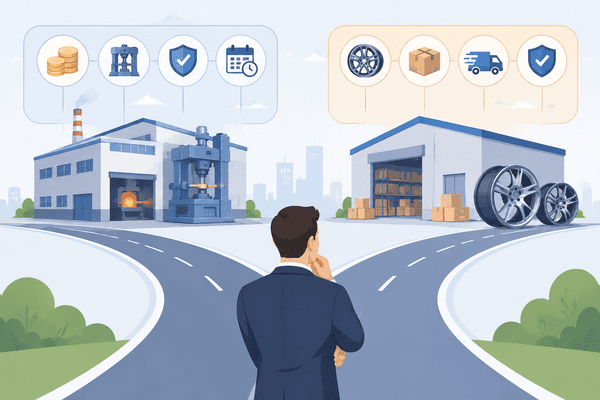
The viable scenario for in-house forging
You may have a legitimate reason to explore building forging capability if all of the following are true:
- Volume: You are producing or selling tens of thousands of wheels per year, with a credible demand forecast to sustain that volume.
- Design IP: You have proprietary wheel designs that represent competitive differentiation you cannot protect through supplier relationships alone.
- Existing infrastructure: You already operate a light manufacturing or precision machining facility with relevant equipment, skilled labor, and quality systems in place.
- Capital: You have access to multi-million-dollar capital (debt or equity) with a payback horizon of five years or more.
- Compliance runway: You have two to four years of operating time before certification is commercially critical, or you are planning an acquisition of an existing certified facility.
If you can check all five boxes, an in-house forging feasibility study is a reasonable next step. I would still recommend engaging a manufacturing consultant with direct forging industry experience before committing capital.
The much more common scenario
For most people reading this article:
- Modification shop owners running custom wheel programs at dozens to low hundreds of units per year
- Custom car brand founders in early growth phase with design concepts but limited manufacturing experience
- Enthusiasts wanting one-off or small-batch custom wheels for personal builds or a small client base
The ROI math does not work. The capital outlay is disproportionate to the volume. The certification timeline delays revenue. And the operational complexity of running a forge is entirely separate from the core skill set of designing, selling, or fitting custom wheels.
The honest conclusion from the buyer conversations I have is that most people searching this question are not in the first group. They are in the second.
What is the realistic alternative to building a wheel rim forge?
If you have worked through the framework above and concluded — as most buyers do — that in-house forging is not viable at your current scale, the question becomes: what does a well-structured sourcing relationship actually look like?
This matters because one of the reasons buyers consider self-manufacturing is a bad prior experience with a supplier: missed lead times, inconsistent quality, inflexible minimums, or no real design support. Those are legitimate frustrations. But the solution is finding the right sourcing partner, not building a forge.
A qualified forged wheel manufacturer should be able to offer:
Customization within confirmed parameters
Customization is real, but it has a scope. From our direct experience working with buyers, the customization options available through a specialized manufacturer include:
- Size: Diameter and width tailored to your vehicle application and specification
- Design: Spoke pattern, face style, and overall aesthetic — supported by design sketches and 3D models in the pre-production phase
- Color: Wide range of color options, from classic silver and gloss black to custom matched finishes
- Surface treatment: Brushed, polished, painted, powder-coated, or anodized finishes based on client drawings or reference samples
What customization does not mean: unlimited design complexity with zero tooling cost, or zero-lead-time prototyping. Die creation for a new design adds time and cost. Good suppliers are transparent about this upfront.
Low minimum order quantities
One of the persistent myths about forged wheels is that you need to buy in large quantities to access quality production. At Tree Wheels, our MOQ is 4 wheels — a full set for a single car. This makes genuine forged wheels accessible to individual enthusiasts and small shops without committing to warehouse inventory.
Realistic lead times
| Product Type | Production Lead Time |
|---|---|
| One-piece (monoblock) forged | 15–20 days |
| Two-piece forged | 20–25 days |
| Three-piece forged | 30–35 days |
These are production timelines from confirmed order to dispatch. Shipping transit time adds to this depending on destination — door-to-door delivery is standard, with packaging designed for international freight (foam protection, corner guards, seven-layer corrugated cartons).
Pre-certified compliance
Sourcing from a manufacturer that already holds DOT, TÜV, ISO 9001, and IATF 16949 certifications means you are not carrying the compliance burden. Buyers should still request and verify current certification documents — certifications expire, and audit status should always be confirmed directly rather than assumed.
Frequently Asked Questions
Is it legal to sell homemade forged wheels in the US or Australia?
Selling wheels for road use without meeting applicable safety standards (DOT in the US, ADR in Australia) creates significant liability7. Homemade or uncertified wheels are not compliant for road use in these markets. Any wheel sold commercially for on-road fitment should meet the applicable standard — verify current requirements with a compliance consultant for your specific market.
How much does a single forged wheel die cost?
Die costs vary significantly based on design complexity, material, and the supplier you use. Rough industry estimates range from several thousand to tens of thousands of dollars per die set, but these figures should be verified with tooling suppliers before making financial decisions. This is one of the significant upfront costs in any in-house or low-volume custom forging scenario.
Can I get one-off custom forged wheels made without building my own forge?
Yes. Specialized manufacturers with low MOQ policies can produce custom forged wheels in quantities as small as a single set (4 wheels). This is the practical route for enthusiasts, one-off builds, and small shops. Lead times and design support vary by manufacturer — confirm both before placing an order.
What is the difference between forged and cast wheels for buyers evaluating suppliers?
Forged wheels are produced by pressing heated aluminum billet under high pressure, aligning the grain structure and producing a denser, stronger, lighter wheel. Cast wheels are made by pouring molten aluminum into molds, which is faster and cheaper but produces a less refined grain structure8. For performance, weight-sensitive, and premium custom applications, forged is the professional standard.
How do I verify a wheel supplier’s certifications?
Ask the supplier to provide current certification documents (not just logos on a website). Check the certification body’s online registry where available — TÜV and ISO 9001 certifications issued by accredited bodies are often verifiable directly. Confirm the certification scope covers the specific products you are buying, not just the company in general.
Conclusion
The question of how to build a wheel rim forge is really a question about control — over design, quality, cost, and lead times. That instinct is understandable. But for the overwhelming majority of buyers in this space, the path to that control runs through a qualified sourcing partner, not a multi-million-dollar capital project with a multi-year compliance runway.
Wheel rim forging at the industrial scale required for road-legal, certified products is a serious manufacturing discipline. It is not inaccessible — but the bar is high enough that only buyers with substantial volume, existing infrastructure, and long capital horizons should seriously evaluate it.
If you are a modification shop, a custom car brand, or an enthusiast who wants access to genuine high-end forged wheels — in your specifications, your design, your finish — without building a forge, that option already exists.
At Tree Wheels, we work with buyers from 4-wheel individual orders up to larger B2B programs across the US, Canada, Australia, and the Middle East. If you want to talk through your wheel specifications or understand what customization is realistic for your application, contact us directly and we will give you a straight answer.
-
"What Are JWL, VIA, and TÜV Certifications for Wheels?", https://treewheels.com/what-are-jwl-via-and-tuv-certifications-for-wheels/. Industrial forging of aluminum alloy automotive wheels typically requires hydraulic presses in the range of several thousand to tens of thousands of tons, with equipment specifications documented in manufacturing engineering literature on closed-die forging processes. Evidence role: mechanism; source type: research. Supports: That aluminum wheel forging requires high-tonnage presses and specialized industrial equipment not available as standard commercial items. Scope note: Specific tonnage figures vary by wheel size, alloy, and die geometry; general forging literature may not address automotive wheel production directly. ↩
-
"Estimation of Forging Die Wear and Cost", https://etd.ohiolink.edu/acprod/odb_etd/ws/send_file/send?accession=osu1277993083&disposition=inline. Closed-die forging tooling costs for automotive components are documented in manufacturing engineering references as ranging from several thousand to over one hundred thousand dollars depending on complexity, material, and tolerances required. Evidence role: statistic; source type: research. Supports: That precision-machined forging dies for automotive components represent significant per-design capital costs, commonly in the tens of thousands of dollars range. Scope note: Published cost figures are often dated or region-specific; current pricing should be verified with tooling suppliers as the article itself advises. ↩
-
"Material testing of aluminum alloy 6061 with heat treatment …", https://ui.adsabs.harvard.edu/abs/2023AIPC.2646e0106R/abstract. The T6 temper process — comprising solution heat treatment and artificial aging — is established in aluminum metallurgy literature as the standard method for maximizing strength in precipitation-hardenable alloys such as 6061 and 6082, which are commonly used in forged automotive wheels. Evidence role: mechanism; source type: research. Supports: That aluminum alloy wheels require solution heat treatment followed by artificial aging to develop the tensile strength and fatigue resistance characteristic of forged aluminum products. Scope note: General aluminum metallurgy sources address alloy behavior broadly; specific process parameters for wheel production may differ by manufacturer and alloy grade. ↩
-
"What Machining Challenges Exist for Ultra-Concave Wheel …", https://treewheels.com/what-machining-challenges-exist-for-ultra-concave-wheel-designs/. Manufacturing process literature on aluminum wheel production documents CNC turning and multi-axis milling as the standard finishing operations applied to forged wheel blanks, enabling the tight dimensional tolerances required for wheel-to-hub fitment and dynamic balance. Evidence role: general_support; source type: research. Supports: That CNC machining — including multi-axis turning and milling centers — is the established method for finishing forged aluminum wheel blanks to final dimensional specifications including spoke profiles, bolt patterns, and center bores. Scope note: The specific number of axes and machine configurations vary by wheel design complexity; simpler designs may be finished on fewer axes than complex multi-spoke or concave-face designs. ↩
-
"Steel Automotive Wheel Rims—Data Fusion for the Precise …", https://pmc.ncbi.nlm.nih.gov/articles/PMC10817687/. Standards governing automotive wheel performance — including SAE J2530, ISO 3006, and the Japanese JWL standard — specify rotary fatigue, radial fatigue, and impact testing requirements; compliance with these standards necessitates dedicated testing equipment including fatigue test rigs and dynamic balancing machines. Evidence role: mechanism; source type: institution. Supports: That automotive wheel compliance verification requires dimensional inspection, dynamic balance testing, and fatigue testing as specified in recognized standards such as SAE J2530, ISO 3006, and JWL. Scope note: The specific equipment required depends on which standards a manufacturer is certifying to; CMMs are standard quality tools but are not always explicitly mandated by wheel standards themselves. ↩
-
"U.S. FORGING INDUSTRY", https://science.osti.gov/-/media/sbir/pdf/Market-Research/AMO—Forging-Industry-August-2022-Public.pdf. Industry analyses of automotive component forging facilities document capital requirements ranging from tens of millions to hundreds of millions of dollars for full-scale greenfield operations, with smaller-scale facilities still requiring multi-million-dollar investment in core equipment and compliance infrastructure. Evidence role: statistic; source type: research. Supports: That establishing a production-capable aluminum forging facility for automotive components requires capital investment in the multi-million-dollar range when accounting for press equipment, tooling, heat treatment, CNC finishing, and quality systems. Scope note: Published capital cost figures are highly variable by geography, production scale, and equipment sourcing strategy; the article appropriately declines to cite a specific figure and advises direct verification with suppliers. ↩
-
"49 CFR Part 571 — Federal Motor Vehicle Safety Standards", https://www.ecfr.gov/current/title-49/subtitle-B/chapter-V/part-571. The U.S. Department of Transportation’s National Highway Traffic Safety Administration (NHTSA) administers Federal Motor Vehicle Safety Standards applicable to wheel and rim components; manufacturers and importers of non-compliant parts are subject to civil penalties and recall obligations under 49 U.S.C. Chapter 301. Evidence role: general_support; source type: government. Supports: That wheels sold for on-road use in the United States must comply with applicable Federal Motor Vehicle Safety Standards administered by the DOT, and that non-compliance exposes sellers to regulatory and civil liability. Scope note: The article’s reference to ADR (Australian Design Rules) compliance is accurate in principle but the specific ADR standard applicable to aftermarket wheels should be verified with the Australian Department of Infrastructure; liability exposure also depends on jurisdiction-specific consumer protection law. ↩
-
"How Does Heat Treatment Enhance Aluminum Wheel Properties?", https://treewheels.com/how-does-heat-treatment-enhance-aluminum-wheel-properties/. Materials science literature consistently documents that hot forging of aluminum alloys produces a refined grain structure with improved mechanical properties — including higher tensile strength and fatigue resistance — relative to gravity or low-pressure die casting of the same alloy. Evidence role: mechanism; source type: research. Supports: That the forging process produces a refined, directional grain structure in aluminum alloys that results in higher fatigue strength and impact resistance compared to cast aluminum of equivalent composition. Scope note: The magnitude of the performance difference depends on alloy, heat treatment, and design geometry; some high-quality cast wheels may approach forged performance in specific metrics. ↩