
Every modification shop gets that call eventually. A client wants their forged wheels looking showroom-perfect again, and the question lands on your desk: "Can you just polish them?" The problem is that "just polish it" is the wrong frame entirely — and recommending the wrong surface treatment on a forged wheel can create a warranty headache, an unhappy client, and a reputation problem you didn’t need.
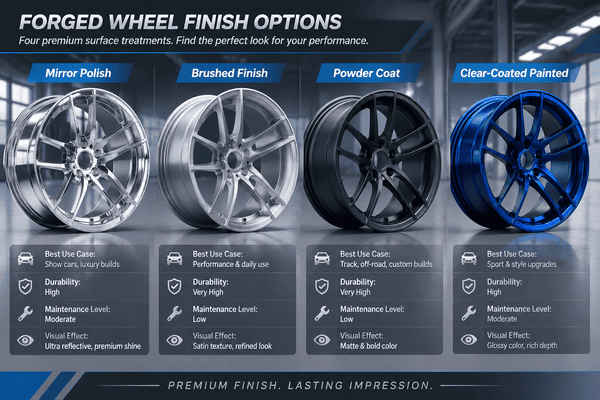
Polishing a forged wheel is not a single procedure — it’s a surface treatment decision. The right answer depends on the wheel’s current finish condition, the car’s use environment, and what the client actually needs the wheel to do. For modification shops advising clients, the diagnostic questions matter more than the polishing technique itself. Mirror polish, brushed finish, powder coat, and ceramic-sealed clear coat each serve a specific scenario, and matching them correctly is what separates a professional recommendation from a guess.
Understanding that distinction is what this article is about. The sections below walk through how to assess a wheel’s condition, which surface treatments actually suit which use cases, what makes forged aluminum different from cast when it comes to polishing, and why your recommendation isn’t complete until you’ve addressed post-polish protection.
Is polishing always the right answer for a forged wheel?
Most technicians know intuitively that a damaged wheel isn’t always salvageable with a polish. But in the context of client consultations, the instinct to say yes — to avoid losing the job — creates a longer-term risk. Recommending polish when the wheel needs a different treatment means the result underperforms, and that conversation comes back around.
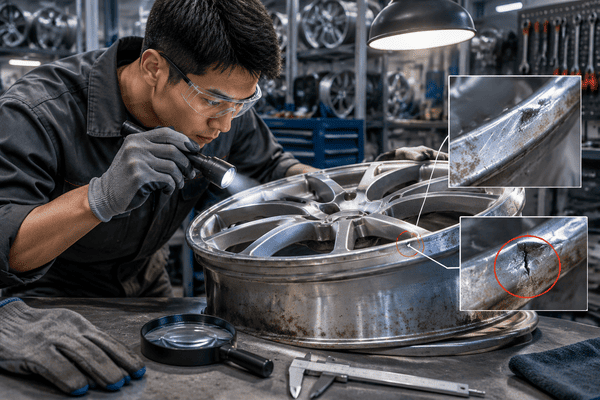
Polishing is the right answer when the damage is purely cosmetic, the wheel’s structural integrity is confirmed, and the client’s use case supports the chosen finish. It is not the right answer for wheels with corrosion penetrating below the surface layer, stress cracks, or impact damage — those cases need professional structural evaluation before any cosmetic work begins1.
Before a surface treatment recommendation, the diagnostic conversation needs to happen first. Skipping it doesn’t save time — it creates callbacks.
The three questions that should come before any polish recommendation
When modification shops reach out to us at Tree Wheels during pre-sales consultations, the most common source of confusion isn’t finish preference — it’s that clients haven’t been asked the right questions yet. Here’s the framework we suggest:
1. What is the wheel’s current finish type?
Factory forged wheels leave the production environment with a controlled surface treatment — whether that’s a machined mirror face, anodizing, powder coat, or a painted and clear-coated finish. Each of those responds differently to field polishing. A mirror-machined finish can be re-polished with the right tooling. A powder-coated wheel that gets polished loses its coating entirely, which is a different job with different material requirements.
In our production process, we typically apply surface treatments in a controlled environment with consistent abrasive progression and finish verification. Field polishing, by contrast, is manual and variable. Understanding what you’re starting from determines whether the goal is achievable and what it will cost the client.
2. What is the damage type and depth?
- Light surface oxidation or water spots — addressable with polish
- Fine swirl marks or light scratches — addressable with controlled abrasive work
- Deep scratches reaching the base aluminum — require re-machining or re-coating, not just polishing
- Corrosion pitting — polishing can clean the surface but will not restore the material; the client needs to understand the limit
- Impact deformation or stress marks — stop here; recommend professional structural inspection before cosmetic work
3. What is the car’s use environment?
This is the question that determines which surface treatment the client should end up with, not just which one they want aesthetically. A show car that drives two weekends a year has completely different finish requirements than a daily driver in a region with road salt, brake dust, and winter precipitation. More on this in the next section.
Which surface treatment is right for which use case?
This is the question modification shops should be answering for their clients, not just "should we polish it." Surface treatment is a menu, not a default. Each option has a functional profile, and matching it to the use case is the professional’s job.
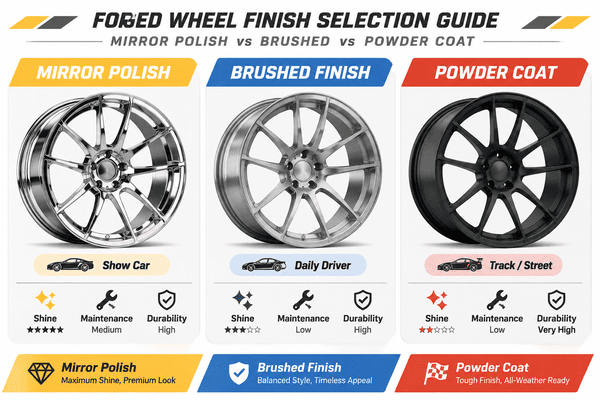
Mirror polish suits low-mileage show cars and display vehicles where aesthetics are the primary goal and exposure to road contaminants is minimal. Brushed finishes offer a more durable visual option for clients who want a premium look with better resistance to fine surface damage2. Powder coat and painted-with-clear-coat finishes serve daily drivers and track applications where protection from brake dust, road debris, and environmental exposure is the priority3.
Here is a direct comparison of the main treatment options and their practical trade-offs:
| Finish Type | Best Use Case | Key Advantage | Key Limitation |
|---|---|---|---|
| Mirror Polish | Show cars, low-mileage vehicles | Maximum visual impact | Requires frequent maintenance; marks easily |
| Brushed Finish | Street builds, daily-use premium vehicles | Hides fine scratches; cleaner to maintain | Less dramatic than mirror; not ideal for show |
| Anodizing | Off-road, functional builds | Hard surface layer; corrosion resistant | Color range limited; re-anodizing is complex |
| Powder Coat | Daily drivers, track use | Durable; resistant to chips and brake dust | Polishing removes it; repair requires re-coating |
| Paint + Clear Coat | Custom color builds, show and street | Widest color range; smooth finish | Clear coat degrades over time with UV/heat4 |
Mirror polish: high reward, high maintenance
For clients with show cars or garage queens, mirror polish delivers the visual result they’re after. The reflective face on a forged wheel — particularly a machined or diamond-cut surface — is genuinely striking.
But this is also where shops create the most warranty friction. For daily drivers, mirror polish without a protective coating is a poor choice. Brake dust bonds chemically to polished aluminum surfaces5. Road debris leaves micro-scratches. And in humid or coastal environments, oxidation on an unprotected polished surface develops faster than most clients expect6.
If a client insists on mirror polish for a daily driver, the professional recommendation is to pair it immediately with a ceramic coating or high-quality sealant — and to be explicit that the maintenance schedule is non-negotiable.
Powder coat and clear coat: the honest answer for working vehicles
Based on customer feedback we receive from modification shops across the US and Australia, the most common regret pattern is this: a shop recommends mirror polish because the client asked for it, the wheels look great for six months, and then the client calls back frustrated because the finish has degraded. The shop did the work correctly — the finish recommendation was wrong for the use case.
For any vehicle that sees regular road use, track days, or harsh climate exposure, powder coat or a quality paint-and-clear-coat system is the honest answer. It’s not as dramatic as a mirror finish, but it holds up. Tree Wheels offers powder coat and custom paint finishes as standard options — not because they’re premium upsells, but because they’re functionally appropriate for most of the vehicles our B2B clients work on.
Why forged aluminum requires a different polishing approach than cast wheels?
This is the technical distinction that most generic DIY polishing guides miss entirely — and it matters for shops advising clients who may have already tried polishing their forged wheels at home with disappointing results.
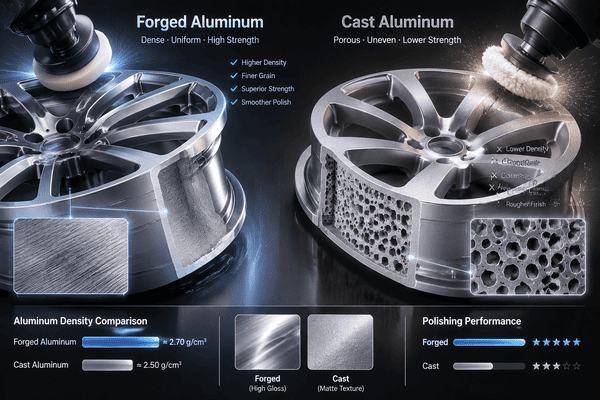
Forged aluminum is significantly denser and harder than cast aluminum7. The grain structure is compressed and refined during the forging process, which is what gives forged wheels their strength advantage8. That same density means standard DIY abrasive compounds and entry-level rotary tools often underperform on forged surfaces — they remove material unevenly, leave swirl marks, or fail to cut through surface oxidation at all.
What this means in a workshop setting
In our manufacturing process, post-forge surface finishing is done with calibrated equipment and consistent abrasive progression — the surface is prepared in a controlled way before any final treatment is applied. That’s not a process that translates simply to field conditions, and it’s worth being honest with clients about that.
For modification shops doing in-house polish work on forged wheels, a few principles apply:
- Start with condition, not product. The abrasive selection should be dictated by what the surface actually needs, not what’s on the shelf. (Specific grit progressions and tool speed parameters should be confirmed with your manufacturing partner or materials specialist before establishing a standard shop procedure.)
- Slower, controlled passes outperform aggressive cutting. Because forged aluminum is harder, aggressive approaches tend to cut unevenly and introduce new surface defects. Patience produces better results.
- Machine polishing on forged surfaces requires consistent pressure control. Variations in pressure across a single pass are visible on the finished surface — more so on forged aluminum than on cast, because the surface responds more consistently and any deviation shows clearly.
- Factory finishes cannot always be fully replicated in the field. This is the honest limit that shops should communicate to clients upfront. A factory-machined mirror face was produced in a controlled environment with precision tooling. Field re-polishing can get close, but it is not the same result9, and framing it otherwise creates client expectation problems.
When to recommend professional re-finishing instead of in-shop polishing
Some finish types are simply not practical to restore in a modification shop environment:
- Anodized finishes — anodizing is an electrochemical process. It cannot be replicated with polish10. A damaged anodized surface needs to be stripped and re-anodized, which requires specialized equipment.
- Factory machined faces with depth damage — if the machining marks or diamond-cut pattern has been scratched or corroded below the surface, re-cutting is the only real fix. Polish will clean the surface but won’t restore the pattern.
- Any finish with structural concerns — always flag these for inspection before cosmetic work. A good cosmetic result on a structurally compromised wheel is the worst outcome.
What happens after polishing — and why shops skip this at their peril?
Post-polish protection is where the work actually gets preserved. A polished forged wheel with no protective layer is a surface that’s actively degrading from the moment the client drives away. Shops that advise on polishing without a protection recommendation get callbacks — and the callbacks always cost more than the original conversation would have.
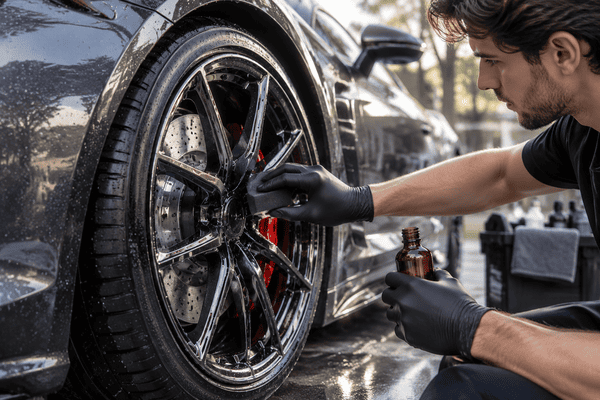
The protection layer applied after polishing determines how long the finish holds. Ceramic coatings provide the strongest and most durable barrier for polished aluminum, repelling brake dust, water, and road contaminants11. High-quality wax or polymer sealants are a lower-cost option that require more frequent reapplication. For any wheel that will see regular road use, post-polish protection is not optional — it’s part of the service.
Matching the protection to the finish and use case
| Finish Type | Recommended Protection | Reapplication Frequency |
|---|---|---|
| Mirror Polish (show car) | Ceramic coating | As needed per use |
| Mirror Polish (daily driver) | Ceramic coating — mandatory | 1–2 years depending on product |
| Brushed Finish | Polymer sealant or ceramic coat | 6–12 months for sealant |
| Paint + Clear Coat | Paint protection film or ceramic coat12 | Per product specification |
| Powder Coat | None typically required; edge sealant optional | Check coating condition annually |
The maintenance conversation as part of the sale
One pattern we hear repeatedly from modification shop clients is that customers come back after six months with degraded polish finish and blame the shop or the wheel. In almost every case, no maintenance conversation happened at point of sale.
Building a basic maintenance protocol into your recommendation — even a single printed sheet explaining what to use and how often — protects your reputation, sets accurate expectations, and positions your shop as the professional resource rather than the business that just did the work and disappeared.
Frequently Asked Questions
Can any forged wheel be polished back to a mirror finish?
Not always. Whether a forged wheel can be restored to mirror finish depends on the original surface treatment, the type and depth of damage, and the specific alloy. Wheels with deep corrosion pitting, anodized finishes, or structural damage are not good candidates. Always assess the wheel’s condition and finish type before promising a mirror result.
How is polishing a forged wheel different from polishing a cast wheel?
Forged aluminum is denser and harder than cast aluminum due to the compression process used in manufacturing. This means standard abrasive compounds work more slowly, tool speed and pressure need more careful control, and uneven technique is more visible in the finished surface. Generic DIY tutorials written for cast wheels often underperform on forged material.
How long does a polished forged wheel finish last?
Finish longevity depends heavily on post-polish protection and the car’s use environment. A mirror-polished wheel with ceramic coating on a show car can hold well for extended periods with minimal maintenance. The same finish on a daily driver without protection can show oxidation and brake dust bonding within months. Protection is not optional — it’s what determines longevity.
Should modification shops always recommend polishing, or are there better options?
Polishing is one option on a menu of surface treatments. For clients with working vehicles, daily drivers, or track use, powder coat or painted-and-clear-coated finishes are often the more durable and honest recommendation. Recommending mirror polish to a client who drives daily without explaining the maintenance requirements is a common source of client dissatisfaction.
Does polishing void a wheel warranty?
This depends on the manufacturer and the specific warranty terms. At Tree Wheels, our 1-year warranty covers manufacturing defects — not cosmetic modifications made after delivery. Any field polishing or surface treatment change after purchase is outside the warranty scope. Shops should verify warranty terms with their wheel supplier before recommending cosmetic modifications on recently purchased wheels.
Conclusion
Polishing a forged wheel is not a single procedure — it’s a surface treatment decision that requires a diagnostic conversation first. The right questions are: What is the current finish? What is the damage type and depth? What is this car actually used for? The answers to those questions determine whether mirror polish, brushed finish, powder coat, or a clear-coat system is the right recommendation. Forged aluminum’s density means field polishing has real limits that factory finishing doesn’t — and communicating those limits honestly is what builds long-term client trust. Post-polish protection is non-negotiable for any working vehicle.
If you’re a modification shop evaluating wheel suppliers and want to understand the surface treatment options Tree Wheels offers — including finish specifications, customization scope, and production lead times — reach out directly. We’re happy to walk through the decision with you before the order, not after a problem shows up.
-
"Wheel Failure Investigation Program: Phase I", https://railroads.dot.gov/sites/fra.dot.gov/files/2021-02/Wheel%20Failure%20Investigation%20Program%20Phase%20I.pdf. Regulatory and standards bodies recognize wheel structural failure as a safety-critical concern; SAE International standards (e.g., SAE J328 for passenger car wheels) and NHTSA guidance on wheel integrity establish that impact damage and cracking require evaluation against load and fatigue criteria before a wheel is returned to service. Evidence role: expert_consensus; source type: government. Supports: That structurally compromised wheels with cracks or impact damage pose safety risks and require inspection before use or cosmetic modification. Scope note: SAE J328 and similar standards address new wheel qualification testing; field inspection protocols for damaged wheels in service are less formally standardized ↩
-
"Which Wheel Designs Look Best on a White Porsche 911?", https://treewheels.com/which-wheel-designs-look-best-on-a-white-porsche-911/. Surface finish texture influences the visual perception of scratches and wear; a directional brushed finish with defined Ra values masks random fine scratches within its texture pattern, whereas a mirror-polished surface (very low Ra) renders any surface discontinuity highly visible due to specular reflection; this principle is discussed in surface metrology literature including Whitehouse, D.J., ‘Handbook of Surface and Nanometrology’ (CRC Press). Evidence role: mechanism; source type: research. Supports: That directional brushed surface textures are less visually susceptible to fine scratches than mirror-polished surfaces because the existing texture pattern masks random surface marks. Scope note: The cited principle is drawn from surface metrology and optical reflection theory; direct empirical studies comparing scratch visibility on brushed versus mirror-polished aluminum wheel surfaces specifically are not widely published ↩
-
"What Types of Finishes Can Be Applied to Forged Wheels?", https://treewheels.com/what-types-of-finishes-can-be-applied-to-forged-wheels/. Powder coating forms a thermoset polymer film that provides documented resistance to corrosion, impact, and chemical exposure; the Powder Coating Institute and ASTM standards (e.g., ASTM D3359 for adhesion, ASTM B117 for salt spray resistance) provide performance benchmarks that support its use in demanding environmental conditions. Evidence role: general_support; source type: institution. Supports: That powder coat finishes provide superior protection against corrosion, abrasion, and chemical exposure compared to uncoated polished aluminum. Scope note: Standardized test data compares coating types under laboratory conditions; real-world wheel performance depends on coating thickness, application quality, and substrate preparation ↩
-
"Photodegradation and photostabilization of polymers …", https://pmc.ncbi.nlm.nih.gov/articles/PMC4320144/. UV-induced photodegradation of acrylic and polyurethane clear coat systems is well documented in polymer science literature; chain scission and photooxidation mechanisms cause progressive loss of gloss and film integrity (see Bauer, D.R., ‘Degradation of organic coatings,’ Progress in Organic Coatings, 1986); thermal cycling from brake heat further accelerates micro-cracking in wheel-applied clear coats. Evidence role: mechanism; source type: research. Supports: That automotive clear coat polymers undergo photodegradation from UV radiation and thermal stress, leading to chalking, cracking, and loss of gloss over time. Scope note: Academic degradation studies are typically conducted under accelerated weathering conditions; actual service life on wheels depends on coating formulation, film thickness, and specific thermal and UV exposure levels ↩
-
"Brake Dust Is 94% Iron — and It’s Rusting Inside Your Wheels", https://www.sacramentomobilecardetailing.com/blog/brake-dust-and-wheel-damage. Brake dust is known to contain iron particles, carbon, and organic residues that can embed in and react with unprotected metal surfaces; studies on brake wear particle composition (e.g., Kukutschová et al., ‘On airborne nano/micro-sized wear particles released from low-metallic automotive brakes,’ Environmental Pollution, 2011) document the reactive ferrous content that facilitates surface bonding. Evidence role: mechanism; source type: research. Supports: That brake dust, which contains ferrous particles and other reactive compounds, can chemically interact with and adhere to aluminum wheel surfaces. Scope note: Most brake dust research focuses on airborne particulate health effects rather than wheel surface adhesion specifically; chemical bonding to polished aluminum is an inference from particle composition data ↩
-
"Research reveals how humidity affects atmospheric corrosion of …", https://www.llnl.gov/article/49876/research-reveals-how-humidity-affects-atmospheric-corrosion-aluminum-metal. Atmospheric corrosion of aluminum alloys is well documented to accelerate in marine and high-humidity environments due to chloride ion attack on the passive oxide layer; see Vargel, C., ‘Corrosion of Aluminium’ (Elsevier, 2004) for a systematic treatment of environmental corrosion rate factors. Evidence role: mechanism; source type: research. Supports: That unprotected polished aluminum oxidizes more rapidly in high-humidity and chloride-rich coastal environments compared to controlled conditions. Scope note: General corrosion literature covers alloy families broadly; specific oxidation rates for wheel-grade alloys under road-use conditions would require targeted testing data ↩
-
"The Effect of the Forging Process on the Microstructure and Mechanical …", https://pmc.ncbi.nlm.nih.gov/articles/PMC10386272/. The mechanical superiority of forged aluminum over cast aluminum is attributable to grain refinement and alignment induced by compressive deformation during forging, which increases tensile strength and hardness; see, e.g., ASM International, ‘Aluminum and Aluminum Alloys’ (ASM Handbook series) for a treatment of forging effects on microstructure. Evidence role: mechanism; source type: research. Supports: That the forging process compresses aluminum grain structure, resulting in higher density and hardness compared to cast aluminum. Scope note: General metallurgical references cover aluminum alloys broadly; wheel-specific comparative data may require manufacturer testing documentation ↩
-
"How Much Can Lightweight Forged Wheels Improve Fuel …", https://treewheels.com/how-much-can-lightweight-forged-wheels-improve-fuel-economy/. Forging improves mechanical properties of aluminum alloys through grain refinement, elimination of porosity, and alignment of grain flow with part geometry; this is documented in standard metallurgical references such as Dieter, G.E., ‘Mechanical Metallurgy’ (McGraw-Hill), and is the basis for forged aluminum’s superior strength-to-weight ratio compared to cast equivalents. Evidence role: mechanism; source type: research. Supports: That the compressive deformation in forging refines and aligns aluminum grain structure, producing higher tensile strength and fatigue resistance than casting. Scope note: The strength advantage magnitude varies by alloy series and forging parameters; generalized claims should be understood as directional rather than quantitatively precise without alloy-specific data ↩
-
"Surface Roughness Explained | Ra Roughness Chart", https://get-it-made.co.uk/resources/surface-roughness-explained. Surface finish quality in machining is quantified by roughness parameters (Ra, Rz) that are tightly controlled in CNC operations through programmed feed rates and tooling; manual polishing introduces operator-dependent variability that typically results in less consistent surface profiles (see Kalpakjian, S. & Schmid, S., ‘Manufacturing Engineering and Technology,’ for a treatment of surface finish in machining versus finishing operations). Evidence role: mechanism; source type: research. Supports: That CNC-machined surfaces achieve controlled surface roughness values that manual field polishing cannot consistently replicate due to variability in pressure, speed, and abrasive progression. Scope note: Manufacturing engineering texts address surface finish in general machining contexts; wheel-specific finish specifications are proprietary to individual manufacturers ↩
-
"How Does Anodizing Change Both the Appearance and …", https://treewheels.com/how-does-anodizing-change-both-the-appearance-and-durability-of-wheels/. Anodizing is an electrolytic passivation process that grows a controlled aluminum oxide layer directly from the substrate metal; because the oxide layer is formed through electrochemical conversion rather than applied as a coating, mechanical polishing removes rather than restores it (see Wikipedia, ‘Anodizing,’ for a general technical overview). Evidence role: definition; source type: encyclopedia. Supports: That anodizing creates an electrochemically grown aluminum oxide layer that is integral to the metal surface and cannot be restored through mechanical polishing. Scope note: Wikipedia provides a general description; specific thickness, hardness, and repair protocol details should be verified against industry standards such as MIL-A-8625 ↩
-
"Development of Car Coating Materials over the Past Decade for Paint …", https://pmc.ncbi.nlm.nih.gov/articles/PMC12694507/. Silica-based ceramic coatings applied to metal surfaces form covalently bonded layers with high hardness and hydrophobicity; research on sol-gel derived SiO₂ coatings (e.g., Metroke et al., ‘Passivation of metal alloys using sol-gel-derived materials,’ Progress in Organic Coatings, 2001) supports their superior barrier properties relative to organic wax films. Evidence role: general_support; source type: research. Supports: That silicon dioxide-based ceramic coatings form a hard, chemically resistant layer on metal surfaces that outperforms wax and polymer sealants in durability and contaminant resistance. Scope note: Academic literature addresses sol-gel coatings in corrosion science contexts; direct comparative consumer product testing for automotive wheel applications is largely proprietary ↩
-
"PROS and CONS of Paint Protection Film", https://www.youtube.com/watch?v=mG3fo-DcpBw. Thermoplastic polyurethane (TPU) paint protection films provide documented resistance to abrasion, stone impact, and chemical exposure through their elastic, self-healing polymer structure; material properties of TPU films relevant to surface protection are described in polymer engineering literature, though wheel-specific PPF performance data is primarily available through manufacturer testing rather than independent academic sources. Evidence role: general_support; source type: research. Supports: That polyurethane-based paint protection film provides a physical barrier against stone chips, abrasion, and contaminants on painted automotive surfaces. Scope note: Independent peer-reviewed studies on PPF performance specifically for wheel applications are limited; most performance data originates from manufacturer specifications and automotive industry testing ↩