
Forged aluminum wheels are a significant investment — and one of the first things owners get wrong is assuming the metal’s strength protects the finish too. It doesn’t. The coating on your forged wheels is vulnerable to the wrong cleaner, the wrong cloth, and the wrong maintenance schedule, regardless of how strong the alloy underneath is.
Forged aluminum wheels stay shiny through a combination of finish-appropriate cleaning, pH-neutral products, regular protection (wax or sealant), and avoiding the harsh acid- or alkali-based wheel cleaners that attack clear coat and anodized surfaces. The specific protocol depends on your finish type — glossy paint, brushed/polished, PVD, or matte powder coat each require a different approach.
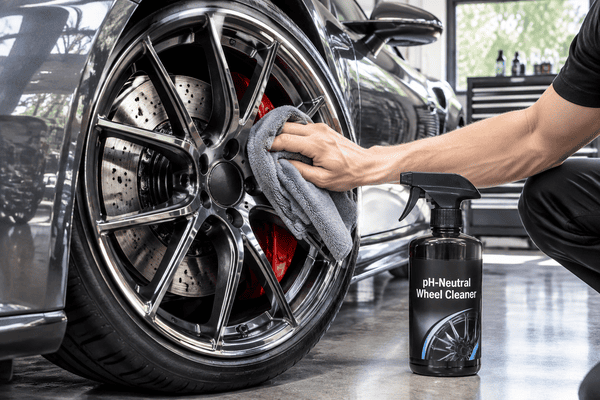
There’s more nuance here than a simple product recommendation can cover. The type of finish on your wheel, where and how you drive, and how often you clean all affect what "keeping them shiny" actually requires. The sections below break each of those factors down — starting with the distinction most owners miss entirely.
Does the forged process make the coating tougher too?
Many buyers assume that because forged aluminum is stronger, the whole wheel — finish included — is more durable. That assumption leads directly to the kind of damage we see reported in after-sales conversations.
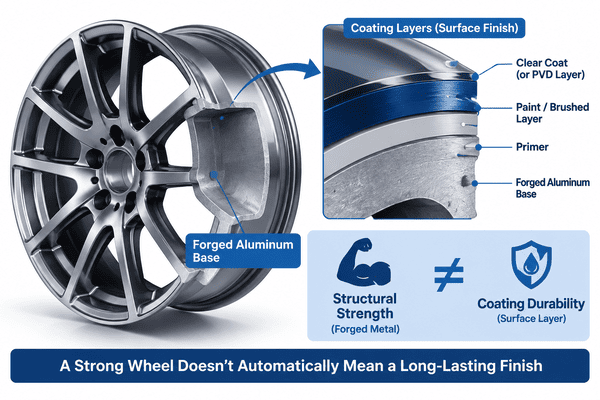
Forged aluminum is structurally superior to cast aluminum. The forging process aligns the grain structure of the metal, producing a wheel that is denser, stronger, and more fatigue-resistant.1 But none of those structural advantages transfer to the surface coating. The coating — whether it’s a painted clear coat, a brushed finish, PVD chrome, or matte powder coat — is applied after the structural work is done. It’s a separate layer, and it has its own vulnerabilities.
Why this distinction matters for maintenance
The core confusion is this: owners treat their forged wheels the way they’d treat bare metal — assuming toughness throughout. In reality, the metal underneath can handle enormous stress loads, but the coating on top can be damaged by something as routine as the wrong wheel spray.
We’ve received customer reports of:
- Peeling clear coat after repeated use of acidic wheel cleaners
- Oxidation hazing on polished finishes left without a protective sealant
- Loss of gloss on painted surfaces where alkaline products stripped the wax layer repeatedly over time
- Micro-etching on glossy finishes caused by abrasive compounds used to remove brake dust
None of these are structural failures. The wheel itself is fine. But the finish — the visual quality that justified the purchase — is compromised.
This is why understanding your specific coating type is the starting point for any maintenance routine, not an afterthought.
What finish does your forged wheel actually have?
Maintenance protocols aren’t interchangeable across finish types. Using a polished-surface routine on a matte powder coat will ruin the matte effect. Using a standard car wash on a PVD finish can accelerate delamination over time.
Your first step is to identify what finish you actually have. Most manufacturers — including Tree Wheels — specify this at order, and it should be documented in any product paperwork. If you’re unsure, contact your supplier before applying any product.
The four main finish categories and their sensitivities
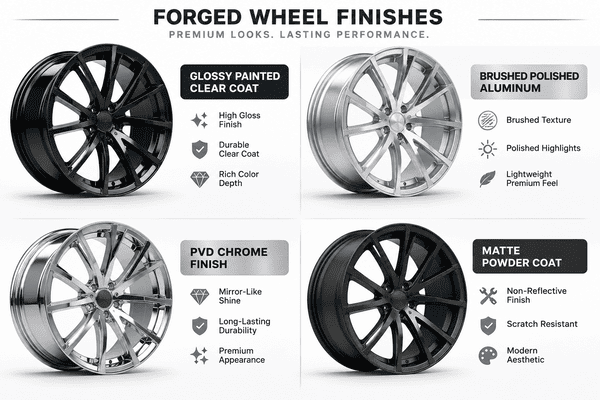
Here’s a practical breakdown of how the most common forged wheel finishes differ in care requirements:
| Finish Type | What It Looks Like | Key Vulnerability | Avoid |
|---|---|---|---|
| Glossy painted / clear coat | Mirror-like shine, often colored | Clear coat lift, micro-etching | Acidic cleaners, abrasive pads |
| Brushed / polished aluminum | Directional lines or mirror polish, metallic | Oxidation, water spotting | Alkaline cleaners, leaving wet |
| PVD (chrome-look) | High-gloss metallic, chrome appearance | Delamination from harsh chemicals | Any strong solvent-based cleaner |
| Matte powder coat | Flat, non-reflective, often black or dark | Wax/sealant fill-in (kills matte effect), staining | Conventional car wax, oil-based products |
Matching care to finish type
For glossy painted finishes: Use a pH-neutral wheel cleaner. Dry immediately after washing to prevent water spotting. Apply a dedicated wheel wax or ceramic sealant every 3–4 months to protect the clear coat.
For brushed or polished aluminum: These are the most maintenance-intensive. Polished surfaces oxidize without a protective layer.2 After cleaning with a pH-neutral product, apply a non-abrasive metal polish (following the brush direction on brushed finishes), then seal with a carnauba wax or spray sealant. Do not leave wet — water spots etch polished aluminum over time3.
For PVD finishes: PVD is chemically sensitive. Stick to mild soap and water or products explicitly rated safe for PVD. One modification shop we work with reported premature delamination on a set of PVD wheels after a customer used a spray-on fallout remover not labeled for that finish type. The damage was cosmetic but irreversible without refinishing.
For matte powder coat: Do not apply standard car wax — it fills the surface texture and creates unwanted gloss patches. Use a matte-specific detailer or leave unprotected beyond regular cleaning. Matte surfaces actually hide light dirt well but show oil and fingerprints prominently. Clean with a soft microfiber and pH-neutral soap only.
What cleaning products are actually safe for forged aluminum wheels?
Cleaning product choice is the single most avoidable source of coating damage. Yet general-purpose wheel cleaners are widely marketed without clear disclaimers about coating compatibility.
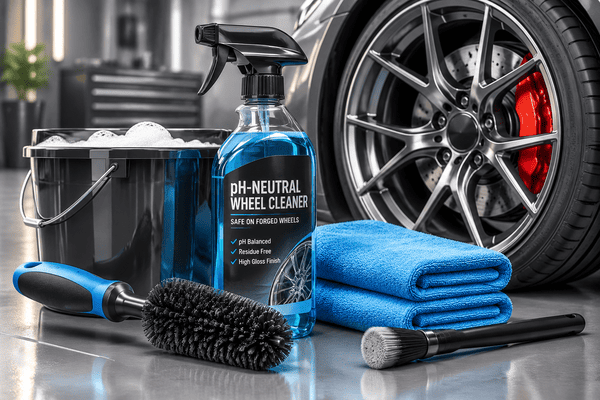
The safest baseline for any forged wheel finish is a pH-neutral, non-acidic, non-alkaline wheel cleaner paired with a soft microfiber cloth or soft-bristle brush. Anything outside that baseline requires you to verify compatibility with your specific finish type before use.
Why pH matters more than brand reputation
Acidic cleaners (pH below 7) are effective at dissolving brake dust and iron contamination — they work fast, which makes them popular. But they attack clear coats, anodizing, and polished surfaces chemically.4 The damage isn’t always immediate or dramatic; often it shows up as gradual loss of gloss, hazing, or increased susceptibility to water spotting over months of repeated use.
Alkaline cleaners (pH above 7) are common in general-purpose degreasers and some all-wheel spray products. These strip protective wax layers efficiently5 — which means they’re effective degreasers, but also that any wax or sealant protection you’ve applied comes off with each wash.
General guidance by cleaner type:
- pH-neutral soapy water or dedicated pH-neutral wheel cleaner → Safe baseline for all finish types
- Iron fallout removers (purple-bleeding sprays) → Generally safe for painted and powder-coated finishes; verify before using on PVD or polished surfaces
- Acid-based wheel cleaners → Use only on bare steel or standard alloy; avoid on any coated forged wheel surface
- Abrasive compounds or polishes → Appropriate only for bare polished aluminum or specific cutting-polish applications; not for painted or PVD finishes
- Solvent-based tire shine overspray → Avoid contact with wheel face — documented cause of clear coat hazing on glossy painted finishes
Note: We list these as general guidance, not engineering endorsements. Verify any product’s compatibility with your specific coating type before use. When in doubt, contact your wheel supplier or the coating applicator.
The physical cleaning process
Beyond chemistry, the physical process matters too. These practices apply across all finish types:
- Rinse first — remove loose brake dust and road grit before any contact with the wheel surface. Rubbing grit against a finish causes micro-scratches.6
- Use separate cloths for wheels and bodywork — wheels accumulate iron particles that will scratch painted surfaces on the rest of the car.
- Clean one wheel at a time — don’t let cleaner dry on the surface, especially in direct sunlight or hot climates (relevant for Middle East and Australian customers).
- Rinse thoroughly — residual cleaner left in spoke crevices continues reacting with the surface.
- Dry completely — use a clean microfiber drying towel. Don’t air-dry, especially on polished or brushed finishes.
How often should you clean and protect forged aluminum wheels?
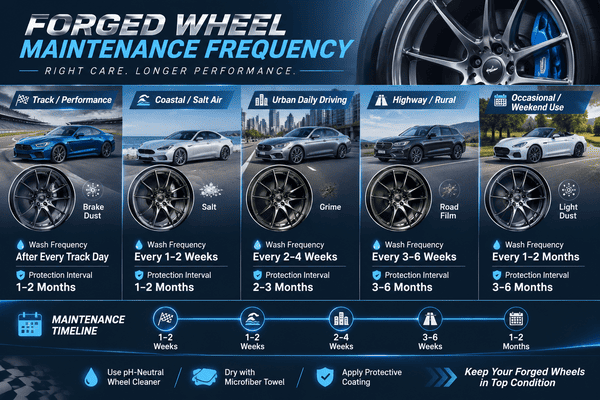
Maintenance frequency isn’t one-size-fits-all. It depends on how you use the vehicle and what your operating environment exposes the wheels to.
The highest-risk environments — track days, coastal roads, urban stop-and-go traffic — introduce different contaminants at different rates. A low-maintenance routine that works fine for a weekend driver in a dry inland city will be inadequate for a daily driver near the ocean.
Maintenance frequency by usage context
| Usage Type | Primary Contaminant | Recommended Clean Frequency | Protection Reapplication |
|---|---|---|---|
| Track / performance use | Brake dust, high heat residue | After every session | Monthly (heat degrades sealants faster7) |
| Coastal / salt air driving | Salt, moisture, airborne chloride8 | Weekly | Every 6–8 weeks |
| Urban daily driving | Road grime, industrial fallout, brake dust | Every 2 weeks | Every 2–3 months |
| Highway / rural | Light dust, road film | Monthly | Every 3–4 months |
| Occasional / weekend use | Minimal contamination | Monthly or as needed | Every 4–6 months |
The protection layer — why wax and sealant matter
Cleaning removes contaminants. Protection prevents them from bonding to the surface in the first place.
For glossy and polished finishes, a wax or ceramic sealant layer does two things: it creates a physical barrier between the coating and environmental contaminants, and it makes the next cleaning easier because fewer particles bond directly to the coating surface.
For matte finishes, skip conventional wax. Look for matte-specific spray detailers that don’t alter the surface texture.
For PVD, keep protection minimal — some PVD finishes don’t require or benefit from additional sealant layers. Check with your supplier.
Frequently Asked Questions
Can I use a pressure washer on forged aluminum wheels?
Yes, with caution. Keep the nozzle at least 30 cm (12 inches) from the wheel surface, and use a wide fan tip, not a concentrated jet. High-pressure direct contact can lift poorly adhered clear coat edges and force water into micro-cracks. Pre-rinse before applying any cleaner.
Will brake dust permanently damage the coating on forged wheels?
If left on the surface long enough, yes. Brake dust contains iron particles that oxidize and bond to the coating surface — a process accelerated by heat from the brake system.9 Regular cleaning prevents bonding. If iron contamination has already occurred, a pH-appropriate iron fallout remover can help, but verify compatibility with your specific finish before use.
Do forged wheels need different care than cast alloy wheels?
The metal responds differently to structural stress, but the coating types and care requirements are largely the same. The confusion arises because buyers expect forged = more durable in every way. The finish care protocol should be based on the coating type, not the manufacturing method of the wheel underneath.
Can I restore a forged wheel finish that has already oxidized or hazed?
It depends on how deep the damage goes. Surface oxidation on polished aluminum can sometimes be addressed with a non-abrasive metal polish. Clear coat that has already lifted or peeled typically requires professional refinishing or recoating. A modification shop with wheel refinishing experience can assess whether the finish is salvageable before refinishing costs are incurred.
How do I know what coating is on my Tree Wheels forged wheels?
The finish type is specified at order and documented in your order confirmation or product specification sheet. If you’re uncertain, contact Tree Wheels directly with your order reference. We can confirm the finish type and provide care guidance appropriate for that specific coating.
Conclusion
Keeping forged aluminum wheels shiny comes down to one principle: protect the coating, not just the metal. The forged aluminum underneath is structurally strong, but the surface finish — whatever type it is — requires regular, finish-appropriate care to stay intact. Using the wrong cleaner is the most common and most avoidable cause of peeling, oxidation, and loss of gloss that we see reported from customers.
Identify your finish type first. Match your cleaner and protection routine to that finish. Adjust your cleaning frequency based on your driving environment. And when in doubt, ask your wheel supplier before applying a product you’re not certain about.
If you have questions about the specific coating on your Tree Wheels forged wheels, or you’re evaluating a custom order and want to understand the maintenance requirements before committing to a finish type, contact the Tree Wheels team — we’re happy to walk you through your options.
-
"Review of the Effects of Micro structure on Fatigue in …", https://ntrs.nasa.gov/api/citations/19840014667/downloads/19840014667.pdf. The mechanical superiority of forged aluminum over cast aluminum is attributed to grain refinement and alignment during the forging process, which reduces porosity and improves fatigue life; see, e.g., ASM International or peer-reviewed metallurgy literature on wrought versus cast aluminum alloy properties. Evidence role: mechanism; source type: research. Supports: That the forging process aligns grain structure in aluminum alloys, resulting in improved density, strength, and fatigue resistance relative to cast aluminum.. Scope note: General metallurgical literature covers aluminum forging broadly; specific data for automotive wheel applications may vary by alloy grade and forging method. ↩
-
"What Makes Chrome Finishing Different from Polished Aluminum …", https://treewheels.com/what-makes-chrome-finishing-different-from-polished-aluminum-wheels/. Aluminum readily forms an aluminum oxide (Al₂O₃) layer upon exposure to atmospheric oxygen and moisture; while this native oxide provides some corrosion resistance, continued oxidation and surface contamination cause visible dulling of polished finishes, as described in standard materials science references. Evidence role: mechanism; source type: encyclopedia. Supports: That unprotected polished aluminum surfaces form an oxide layer upon atmospheric exposure, causing visible hazing or dulling of the finish.. Scope note: The rate of visible hazing depends on environmental conditions including humidity, temperature, and pollutant exposure; the article’s implication of rapid degradation without protection may not apply uniformly across all climates. ↩
-
"This is how I feel about polishing out water spots…", https://www.facebook.com/groups/226043429672219/posts/1097805639162656/. Hard water deposits containing calcium and magnesium carbonates, when concentrated by evaporation, can create localized alkaline or acidic microenvironments that etch polished aluminum; this mechanism is discussed in corrosion science and automotive detailing literature. Evidence role: mechanism; source type: research. Supports: That mineral deposits left by evaporating water can etch or pit polished aluminum surfaces through localized chemical attack.. Scope note: The severity of etching depends on water hardness, temperature, and dwell time; the claim as stated may overstate the risk in soft-water regions or with prompt drying. ↩
-
"The effects of carboxylic acids in aluminum anodizing", https://scholars.unh.edu/cgi/viewcontent.cgi?article=1329&context=honors. Acidic solutions are known to hydrolyze polyurethane and acrylic clear coat binders and dissolve the aluminum oxide layer formed during anodizing; relevant chemistry is documented in corrosion science literature and automotive coatings research. Evidence role: mechanism; source type: research. Supports: That acidic (low-pH) solutions chemically degrade clear coat polymers and anodized aluminum oxide layers through hydrolysis or acid etching.. Scope note: Direct studies on commercial wheel cleaners at specific pH values and their effect on automotive clear coat are limited; most evidence is extrapolated from broader coatings chemistry and corrosion literature. ↩
-
"High Alkaline V PH Neutral Car Wash Products Degrading Wax …", https://www.youtube.com/watch?v=pyiHW9bX9eg. Saponification of ester-based waxes such as carnauba under alkaline conditions is a well-documented chemical process; high-pH detergents exploit this mechanism in automotive cleaning, as discussed in surface chemistry and automotive detailing literature. Evidence role: mechanism; source type: research. Supports: That alkaline (high-pH) cleaning agents saponify or emulsify wax-based protective coatings, effectively removing them from automotive surfaces.. Scope note: The rate and completeness of wax removal depend on pH level, temperature, and contact time; the article’s implication of removal in a single wash may overstate the effect for mildly alkaline products. ↩
-
"Scratch Properties of Clear Coat for Automotive … – PMC", https://pmc.ncbi.nlm.nih.gov/articles/PMC8625055/. Abrasive wear of automotive clear coat by hard particles (e.g., silica, road grit) during washing has been documented in tribology and automotive coatings research; particle hardness relative to the coating and applied pressure determine scratch depth and visibility. Evidence role: mechanism; source type: research. Supports: That hard abrasive particles trapped between a cleaning cloth and a coated surface cause micro-scale scratches through abrasive wear mechanisms.. Scope note: Most published research focuses on car body paint rather than wheel coatings specifically; the mechanism is directly applicable but quantitative thresholds may differ. ↩
-
"Development of Car Coating Materials over the Past Decade …", https://pmc.ncbi.nlm.nih.gov/articles/PMC12694507/. Polymer-based sealants and carnauba wax coatings are subject to accelerated thermal degradation at elevated temperatures, as thermal energy increases oxidation rates and disrupts cross-linked polymer networks; this principle is established in polymer chemistry and is relevant to wheel sealants exposed to brake-generated heat. Evidence role: mechanism; source type: research. Supports: That elevated temperatures experienced during track driving accelerate the thermal degradation of wax and polymer sealant coatings on wheel surfaces, reducing their protective lifespan.. Scope note: Specific temperature thresholds and degradation rates for commercial wheel sealants under track conditions are not widely published; the claim is a reasonable inference from general polymer thermal stability principles. ↩
-
"CORROSION OF ALUMINUM ALLOY 2024 BELONGING TO …", http://oaktrust.library.tamu.edu/bitstream/handle/1969.1/ETD-TAMU-3002/GUJARATHI-THESIS.pdf. Chloride ions are well-documented initiators of pitting corrosion in aluminum alloys; in coastal environments, airborne sea salt deposits chloride on exposed surfaces, breaking down the passive aluminum oxide layer and accelerating localized corrosion, as described extensively in corrosion science literature. Evidence role: mechanism; source type: research. Supports: That coastal environments expose aluminum surfaces to chloride ions from salt air, which accelerate corrosion by disrupting the passive oxide layer on aluminum.. ↩
-
"How to Select Perfect Wheels for a Black Mercedes EQS?", https://treewheels.com/how-to-select-perfect-wheels-for-a-black-mercedes-eqs/. Studies on brake wear particle composition confirm the presence of iron-rich particles from cast iron rotors and metallic pad compounds; thermal cycling has been shown to promote oxidative bonding of these particles to adjacent surfaces (see environmental and tribology literature on brake emissions). Evidence role: mechanism; source type: research. Supports: That brake dust contains ferrous particles from rotor and pad wear that oxidize and adhere to wheel surfaces, with thermal cycling from braking accelerating the bonding process.. Scope note: Most brake dust composition research focuses on airborne particulate matter and health effects rather than wheel surface bonding specifically; the bonding mechanism described is a reasonable inference from this literature. ↩